


Uncategorized
Jewish New Yorkers fault Mamdani on antisemitism but back his police commissioner, poll finds
Nearly two-thirds of Jewish voters in New York City disapprove of Mayor Zohran Mamdani’s handling of antisemitism, according to a new poll released on the third anniversary of the Oct. 7, 2023, Hamas attack on Israel. Jewish voters also said Mamdani, a fierce critic of Israel, should not hold or attend an official city event marking the anniversary.
The Honan Strategy Group survey of 503 Jewish voters across the five boroughs, shared exclusively with the Forward, found that 65% disapprove of Mamdani’s handling of antisemitism, including 47% who strongly disapprove. Just 34% approve. Among 1,167 non-Jewish respondents, 46% approve of his handling of antisemitism and 43% disapprove.
The poll was conducted Oct. 2 through Oct. 6 via text-to-web and analyzed Jewish and non-Jewish respondents separately. The overall margin of error is plus or minus 2.8 percentage points, while the Jewish sample has a margin of error of plus or minus 4.3 points.
The survey offers a broader snapshot of Jewish opinion than previous polling on Mamdani. A Honan survey at the beginning of his term included only 131 Jewish respondents, while a poll published in July included a sample of 99 Jewish voters. The findings come a week after Mamdani rolled out a citywide strategy to combat hate and antisemitism, amid continued concerns about rising antisemitic incidents across the city and criticism that his rhetoric on Israel is causing harm.
Recent NYPD statistics showed that in the first nine months of 2026, hate crimes rose 13%, and 53% of those hate crimes involved Jewish victims. During the first nine months of this year, anti-Jewish hate crimes increased 1.2%.
Police Commissioner Jessica Tisch gets much higher marks
Jewish voters gave much higher marks to Jessica Tisch, the Jewish NYPD commissioner who was reappointed by Mamdani after serving a year under former Mayor Eric Adams. Tisch, who strongly supports Israel and is widely respected in the Jewish community, has frequently appeared alongside Mamdani to discuss the rise in hate crimes.
The survey showed that 75% of Jewish respondents approved of Tisch’s handling of antisemitism, while just 6% disapproved — the strongest rating of any official tested in the poll.
During a joint briefing on the latest crime statistics with Mamdani on Tuesday, Tisch remarked, “On the eve of the third anniversary of Oct. 7, we renew our pledge to Jewish institutions that they will not be left to protect themselves without a strong partner in the NYPD.”
City Council Speaker Julie Menin, the first Jewish speaker in history who many Jewish leaders see as a check on Mamdani and who has made combating antisemitism a focus of her tenure, received 57% approval and 13% disapproval. Gov. Kathy Hochul, who is running for reelection in November, received 54% approval.
Mamdani released his administration’s citywide strategy to combat antisemitism last week. The plan includes millions of dollars for security, education and hate-crime prevention, but does not adopt a definition of antisemitism — an issue that has divided the mayor and much of the Jewish community in the city with the largest Jewish population outside of Israel. Throughout his mayoral campaign and since, Mamdani has sought to draw a line between his opposition to Israel and Zionism and his commitment to protecting Jewish New Yorkers.
The new plan mentions the Oct. 7 Hamas attack and the war in Gaza that followed as part of the rise in antisemitism, but does not directly link them.
New York Jews don’t want Mamdani at an Oct. 7 event
Wednesday’s poll found that 64% of Jewish voters said Mamdani should not hold or attend an official city event marking the anniversary of the Oct. 7 attack. Twenty-four percent said he should. Mamdani is expected to attend a vigil in remembrance of Oct. 7 on Wednesday evening, according to his daily public schedule, followed by a meeting with Palestinian New Yorkers.
Meanwhile, City Council Speaker Menin and Jewish councilmembers Inna Vernikov and Eric Dinowitz, who lead the legislative body’s bipartisan task force to combat antisemitism, are expected to join other elected officials in Brooklyn to call for a permanent public memorial in Brooklyn to the victims of Oct. 7.
Mamdani has condemned violence and expressions of support for terrorist organizations, called the Hamas attack a “horrific war crime,” but also defended the constitutional right to protest.
Israel’s consul general in New York, Ofir Akunis, invited Mamdani on Monday to watch the 47-minute compilation of raw footage assembled by the Israeli military documenting the Oct. 7 attack. In a letter to the mayor, Akunis said he hoped seeing the footage would convey “the reality of what happened on October 7th in a way that words alone cannot.”
Members of New York City’s Young Democratic Socialists of America have promoted a demonstration at City Hall, accusing the mayor of capitulating to pro-Israel pressure since taking office. The chapter is the student offshoot of the DSA, in which Mamdani is a member. Mamdani’s spokesperson has said the group organizing the protest is separate from the local DSA chapter with which the mayor is affiliated, but declined to comment when asked by the Forward about the planned protest and whether Mamdani had a message for the protesters.
Worsening relations
The poll found an even broader sense of concern among Jewish New Yorkers about the city’s climate for Jews since Oct. 7.
Seventy-nine percent said antisemitism has increased since Oct. 7, including 55% who said it has increased “a lot.” And 86% said relations between Jewish and non-Jewish New Yorkers have gotten worse since the attack. Just 1% said they have improved, while 12% said they have stayed about the same. Among non-Jewish voters, 51% acknowledged that relations have gotten worse.
There was a larger divide when respondents were asked to compare antisemitism and Islamophobia. A majority of Jewish voters – 57% – said antisemitism is the bigger problem, while 10% said the two are equally serious. Among non-Jewish voters, 66% said antisemitism and Islamophobia are equal problems.
The post Jewish New Yorkers fault Mamdani on antisemitism but back his police commissioner, poll finds appeared first on The Forward.
Uncategorized
Chicago Jewish theater drops Naomi Ragen play, saying actors feared repercussions of working with the Israeli writer
(JTA) — Naomi Ragen, the New York-born Israeli novelist and playwright known for her portrayals of Orthodox Jewish women in crisis, says the cancellation of a planned Chicago revival of one of her plays represents a “return to McCarthyism” in the American cultural scene.
Ragen, 77, has revealed that plans by a Jewish arts company in Chicago to revive her 2001 play “Women’s Minyan” have been shelved. In a post shared with her thousands of followers on Facebook, Ragen included an email from the company’s artistic director saying that she had been inundated by messages from actors, directors and designers who feared that working with a “a pro-Zionist Jew/Israeli” like Ragen could damage their careers.
Ragen told the Jewish Telegraphic Agency that Chicago-based Arts Judaica first approached her in July with a request to stage her play about a haredi woman trying to flee her abusive marriage. Elayne LeTraunik, the company’s artistic director, told Ragen they intended to stage 13 performances next March.
Happy to collaborate, Ragen asked for a contract. She heard nothing until this week when she received a reply from LeTraunik, saying she “must sadly withdraw my intent to do the show.”
LeTraunik’s email continued: “People were seeing you were a pro Zionist Jew/Israeli and I was bombarded with actors, directors and designers who were actually afraid that doing a show with you as playwright would hurt their careers. I never have faced this before and I was stunned about all the accusations of ‘genocide’ flying around.”
The episode stands in contrast to Arts Judaica’s stated mission: Its website says that “American audiences need Jewish stories on stage more than ever.”
“In the past I have done plays about suicide bombers and never had a peep from anyone,” LeTraunik told Ragen. “This world is getting insane. Perhaps once all this dies down (if it ever does) I will try again. I am so sorry.”
Born in New York, Ragen emigrated to Israel in 1971, where she settled in Jerusalem. In addition to best-selling novels like “Sotah” and “The Sacrifice of Tamar,” she regularly writes opinion pieces sharing her hawkish views on Israel. On her website and on social media, she shares dispatches from her “Israel War Diary,” expressing strong support for Prime Minister Benjamin Netanyahu and IDF military action against Hamas. She has also spoken against what she describes as a worldwide “climate of hatred, fear, and intimidation.”
Some people, she said, have suggested the play was canceled because she is a right-wing Zionist. “Are we now back to McCarthyism, where you have to check the political credentials of an artist [before deciding] whether or not to promote their work?” she said.
“I thought all the progressives were against McCarthyism. Now we’re back there where I have to pass some kind of political test in order to have my work shown.”
LeTraunik told JTA she could never have predicted the pushback or the cancellation when she first approached Ragen. “This situation is one I have never faced before after a lifetime in theater,” she said.
“Since the play has nothing to do with politics I didn’t anticipate any problems,” she continued. “But unfortunately people had done research on Naomi and felt so triggered by her politics it appeared that there were concerns from would-be actors, etc. and even the person who had offered to put up some of the funding was not comfortable.
“As for me, I am almost 80 years old, [a] lifetime American and Jew and I have long decided not to get involved in the current political turmoil. I just want to do interesting theater.”
Ragen told JTA that while it is “strange to get such a response from a Jewish venue,” particularly one whose mission statement includes Holocaust education, she is not angry at LeTraunik.
“I have only sympathy for her,” she said. “I think all these Jewish cultural organizations are now under fire and what we need is not to criticize them because they’re not brave enough, but to understand the pressures they’re under.”
Earlier this month the Anti-Defamation League published a report alleging “the systemic exclusion and marginalization of Jewish and Israeli artists across American cultural life.” In its examination of museums, publishing and live entertainment, the ADL said it found that Jewish, Israeli and Zionist artists have “faced growing scrutiny, organized protest activity, online targeting, event disruptions, reputational campaigns and, in some cases, cancellations or institutional distancing.”
Ragen said her play, originally commissioned by Habima, Israel’s national theater, has previously been staged in the United States. She is not taking the cancellation personally, she said, but as a symptom of a far greater problem.
“You had a situation in Germany in 1938 where you couldn’t produce a Jewish play or any play which didn’t toe the Nazi line,” she said. “Are we going back to that?”
In her conversation with JTA, Ragen called on “American Jews and good people” to “be a little brave,” adding: “It’s not time to build another Holocaust museum — it’s time to wake up, smell the coffee, and put your money and your time and your effort where your mouth is.
“If you are a person who wants to promote Holocaust education, well, you’re living in the middle of it.”
This article originally appeared on JTA.org.
The post Chicago Jewish theater drops Naomi Ragen play, saying actors feared repercussions of working with the Israeli writer appeared first on The Forward.
Uncategorized
They survived Oct. 7. At Rock Camp, they found a way to feel alive again.
(JTA) — ”They tried to kill us. We survived. Let’s eat.”
Alan King’s joke about Jewish holidays gets to the essence of Jewish persistence in the face of horror. He might have added “Let’s sing.” Music has accompanied the Jewish people for millennia through periods of joy and sorrow. Moses and the Israelites praised God for His salvation from the Egyptians in the “Song of the Sea.” Weddings, the Shabbat table and kumsitzes all come with joyous soundtracks.
In times of overwhelming devastation, songs have served as expressions of survival, determination and memory. During the Holocaust, Jews continued to compose and perform it in ghettos and concentration camps, including Theresienstadt. ”The Partisan Hymn,” “Zog nit keyn mol” (“Never Say”), was composed in the Vilna Ghetto.
Three years ago this week, music and tragedy once again intertwined when Hamas-led terrorists attacked the Nova Music Festival as part of the Oct. 7 assault on Israel. Approximately 1,200 people, including 364 civilians at the Nova festival, were killed that day, and 251 were abducted to Gaza.
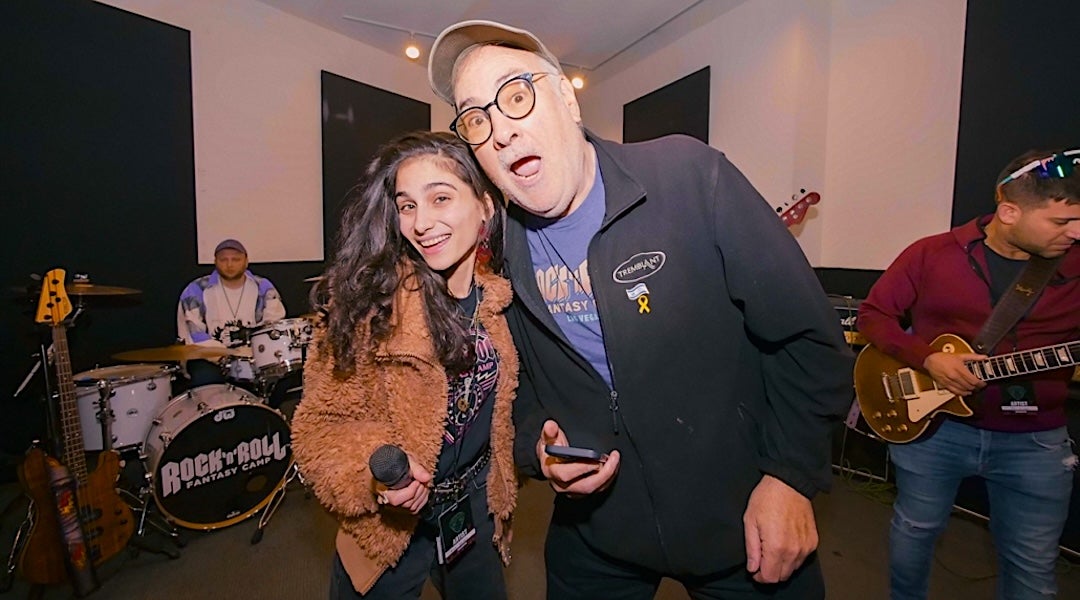
Two months later, David Fishof, who founded Rock ’n Roll Fantasy Camp, saw music and trauma bound together at the funeral for Yotam Haim, the red-headed hostage who escaped with two others but was killed by friendly fire.
“Yotam’s brother, Tuval, and father, Raviv, are drummers,” said Fishof, an L.A. sports agent and entertainment producer. “They performed a 20-minute drum solo in Yotam’s honor, after which Tuval threw the sticks in the grave. At that moment, it hit me: I wanted to bring Tuval and nine other Oct. 7 survivors to Rock Camp in L.A.”
With the help of Sam Grundwerg, former world chairman of Keren Hayesod – United Israel Appeal, the 10 survivors were flown to Los Angeles in March 2024 to participate in the sold-out camp.
Now, their experience is chronicled in “The Bridge,” a new documentary produced by “Friends” executive producer Kevin Bright that highlights how music can become a pathway from trauma to healing. Its message: “When tragedy strikes the Jewish people, we play louder.” Ahead of a wider theatrical release in November, the film is now playing at select North American venues.
Rock Camp, founded by Fishof in 1997, brings amateur rockers alongside music legends for four days of mentorship, rehearsals and performances at such iconic clubs as Whisky a Go Go and The Viper Room.
Music, memory and trauma informed Fishof’s upbringing. Music saved the life of his father, Mark, a survivor of Auschwitz and Buchenwald.
“My dad would sing to the Nazis, just to entertain them,” Fishof said. “They would say, ‘Sing this song,’ and he would. Music saved him. It was a way for him to take his mind off of what he was going through.”
His father served as a cantor in Hackensack, New Jersey, for 33 years.
Fishof said his memories of his father’s sufferings made Oct. 7 the worst day of his life.

By contrast, their four days at Rock Camp offered the Oct. 7 survivors a rare respite from their trauma and a chance to reconnect with the joy of making music. The Israelis jammed with rock legends Michael Anthony of Van Halen, Sebastian Bach of Skid Row, Warren DeMartini of Ratt and Tommy Aldridge of Whitesnake, and met Richard Fortus and Slash of Guns N’ Roses.
Among the Israeli rockers was 27-year-old vocalist and guitarist Raz Shifer of Ramat Gan, a Nova Festival survivor who was close friends with two hostages, including Inbar Hayman, who was murdered in captivity.
After that Black Saturday, Shifer says in the film, “I couldn’t sleep. I couldn’t eat. I just sat on my couch, literally in shock, trying to figure out what the f— had happened. I forgot who I was — the happy, smiley, energetic Raz. Rock Camp was my first time getting back on stage and letting it all out. For me, it was a really big step. I was able to remember myself again. Music is my victory. It’s the reason I get out of bed every day and the power that keeps me alive.”
Also among the group was 28-year-old vocalist and guitarist Bar Rudaeff of Tel Aviv, the son of Kibbutz Nir Yitzhak’s former deputy security coordinator Lior Rudaeff, who was murdered while defending the kibbutz on Oct. 7. His remains were returned to Israel in November 2025.
For Rudaeff, performing with Tommy Aldridge, the legendary hard rock and heavy metal drummer who played with Ozzy Osbourne and Whitesnake, was a way of reaching his father — through a joy they shared.
“My dad really liked ’80s rock, like Deep Purple, Bon Jovi, Foreigner and Ozzy Osbourne, so when we played with Tommy, it was really meaningful and emotional,” he says in “The Bridge.” “Rock Camp gave me the opportunity to stop thinking, for a little while, about my dad not being here. Music really helped me cope and pulled out a lot of feelings that I was repressing. It was a ray of hope in the middle of one of our darkest periods and gave me the strength to move on.”
At Rock Camp, Fishof said, “Each survivor played on behalf of loved ones — whether family members or friends who had been killed or were still being held in captivity. Every note meant something to them.”
Bright added, “Music enabled them to take a break from Oct. 7 for a week. I think it was a well-deserved respite from everything that was going on in Israel at the time. One of the survivors says in the film, ‘I’m still living Oct. 7. The trauma doesn’t go away.’ At the time that ‘The Bridge’ was made, their trauma was even stronger, and so their ability just to participate was really impressive.”
Three years after that devastating day in October, the survivors are continuing to do what their people have done in the face of adversity for millennia: sing and make music.
Tuval performs regularly and has released two albums, including “Ahim” (“Brothers”), a nod to Yotam. Bar now produces music, including a fellow camper’s upcoming album. And Raz is touring as a full-time vocalist.
“Music is what kept my father alive during the Holocaust,” said Fishof. “It’s what kept him going, and it’s what keeps me and many others going. Because no matter what happens, no one can ever take away our music. If we have that, we have life.”
They tried to kill us. We survived.
Let’s sing.
And eat.
To find local screenings, visit thebridgedoc.com
This article originally appeared on JTA.org.
The post They survived Oct. 7. At Rock Camp, they found a way to feel alive again. appeared first on The Forward.
Uncategorized
The battle for Sderot still rages in the minds of its survivors
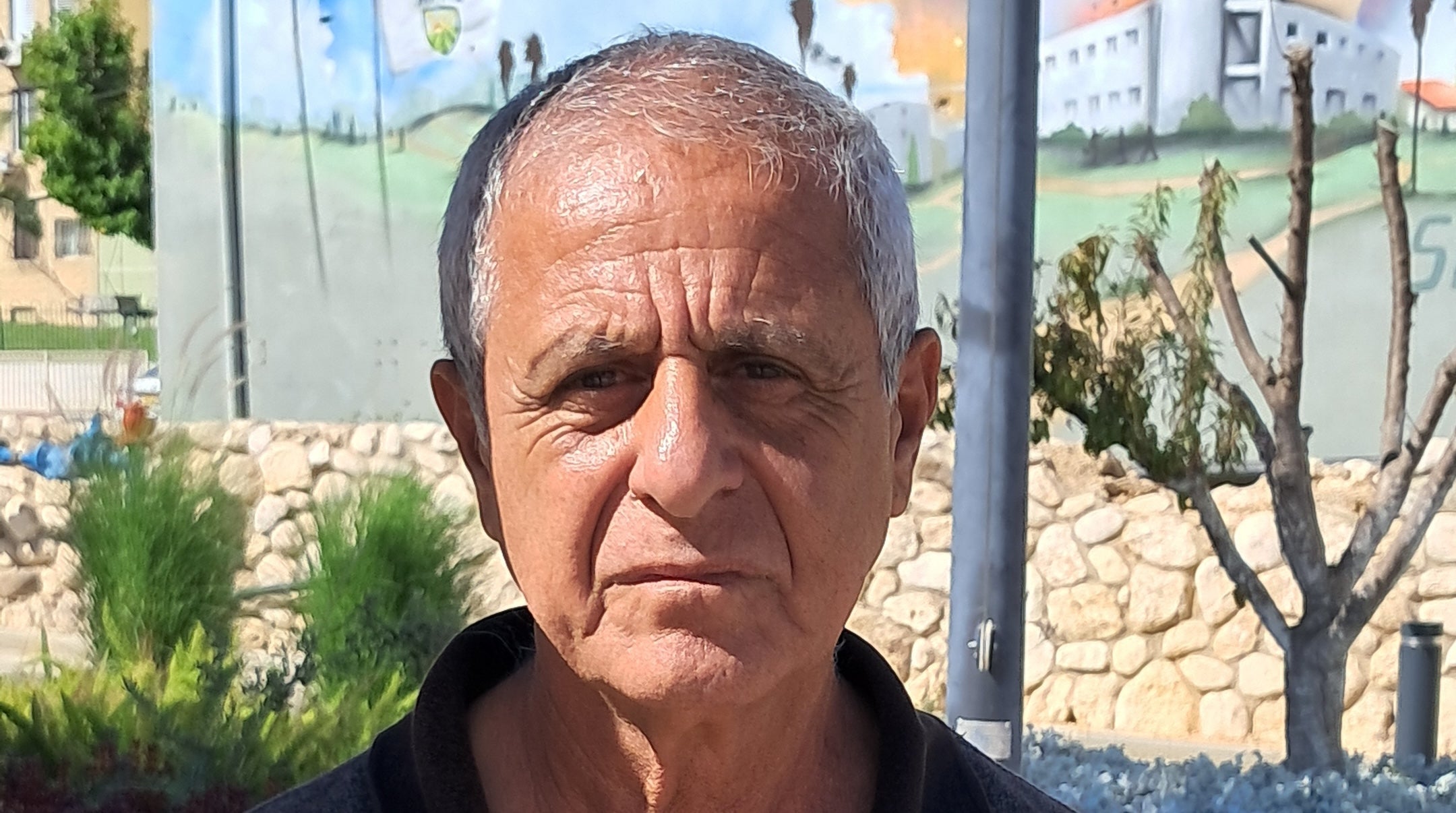
(JTA) — SDEROT, Israel – Shalom Aida was at home when the first air raid siren sounded at 6:29 a.m. on October 7, 2023, but he wasn’t initially fazed.
Rocket sirens were a common occurrence in his city of Sderot, which is less than a mile from Gaza at its closest point.
It wasn’t until he heard gunshots that Aida, a retired police officer, realized that dozens of heavily armed Hamas terrorists had infiltrated Sderot and were gunning down any civilian, soldier or police officer they came across.
By the time he arrived at the police station “it was a battlefield,” he said. The sight almost paralyzed him.
“The entire street in front of the station was full of bloodied people. Police, civilians, dead or dying. Hamas kept firing.”
One of the police officers killed that day was Aida’s cousin. Many others were his friends.
Three years later, he is still haunted by the memories.
“Sderot seems quiet now, but it’s not quiet or peaceful inside our heads,” he said as he watched groups of visitors walk around the Sderot Memorial and Heroes Park. It is situated at the site of the police station, which was destroyed on that day and built elsewhere.

Despite the ongoing trauma of Oct. 7 and its aftermath, Aida said he wouldn’t dream of moving elsewhere.
“I never once thought about leaving,” he said, shocked by the question. “The best people in the world live in Sderot.”
Not all residents of the “Gaza Envelope” who experienced the horrors of Oct. 7 returned home when the government gave the all-clear, after ordering them to evacuate for their own safety. But the vast majority of Sderot’s residents — set at over 37,000 by the Central Bureau of Statistics in 2024 — who had already lived through two decades of rocket barrages from Gaza, returned to the city within months.
Once it was a struggling development town where successive governments sent immigrants who had just arrived from the Middle East and the former Soviet Union.
It generated domestic and international headlines over the last two decades, as it became the first city hit by Hamas rockets as early as 2001, and remained one of the places the Gaza-based terror group has most frequently targeted.
International dignitaries including U.N. Secretary-General Ban Ki-moon in 2009 and then Sen. Barack Obama during his 2008 presidential campaign visited Sderot.
Initially a city without adequate protective shelter for its residents, it became the only place in Israel where every single apartment and bus stop has its own bomb shelter.
Despite it all, the city has prospered: gleaming new apartment buildings, parks and a sprawling mall greet visitors as they enter.

“If you were to input all the data about Sderot into OpenAI, the 25 years of rockets and Oct. 7 and the bomb shelters, it would say this must be a ghost town. But that’s not the reality here,” said Ilan Abecassis, a retired educator and now tour guide who has lived in the city all his life.
Rather than shrinking, he said, the city’s population has grown by about 5,000 people since the Oct. 7 attack.
“I know it’s counterintuitive, but the more they try to destroy us, the stronger we become,” Abecassis said. “In the Torah, a new pharaoh sees the Israelite population growing and enslaves them. But the Torah tells us ‘the more they afflicted them, the more they multiplied and grew.’ We are like those Israelites.”
Arie Yagudaev, 30, from Sderot, and his cousin Eitan Izayev, 28, who lives in nearby Kibbutz Nir Am, said they are also committed to staying, even after they encountered terrorists in the street on Oct. 7.
Drinking strong coffee outside his family’s grocery store in Sderot, Izayev recounted how he had begged his cousin to pick him up from the kibbutz, which terrorists were trying to infiltrate, so he could help defend loved ones in Sderot. Along the way, they picked up two teenage girls, survivors of the Nova music festival.
“As we approached the roundabout into Sderot, we saw some pickup trucks ahead of us,” Izayev recalled. “We thought the men in the bed of the truck were IDF soldiers. But when the terrorists saw us, they shot at us nonstop.”
“One of the bullets shattered my car’s back window. It’s a miracle we survived,” Yagudaev said. Even though he suffered from PTSD every night as an evacuee in an Eilat hotel room, he said, “I wanted to go home.”
“It wasn’t just because the hotel room was cramped,” he said “Leaving Sderot and Israel is exactly what the terrorists want. We’re not going anywhere.”

One Sderot restaurant owner, who was born and raised in Sderot but moved to Kibbutz Nir Am several years ago, feels the same way.
“Not to return would be rewarding Hamas for its terrorism,” said the restaurant owner who requested anonymity because of his ongoing stints in the IDF reserves.
As it was, he and his wife and baby spent almost a year in a small Tel Aviv hotel room before returning to their kibbutz two years ago. It wasn’t an easy homecoming, he said. For one thing, IDF soldiers had lived in their empty house, and it needed major repairs. Returning to the area also triggered traumatic memories from the Hamas attack.
“For 22 hours I stood outside our house to protect my wife and newborn baby,” he recalled, sitting at a table in his restaurant. “Eventually we decided to flee in our car with just the clothes we could throw into a trash bag. We placed the baby under the seat of the car, hoping to protect him.”
Once the owner of three restaurants, he now owns only one. He needed to sell the two popular restaurants he owned at another kibbutz because he couldn’t operate them from Tel Aviv, and, back then, the Gaza border was an active war zone.
Although the Gaza border is much more secure due to the buffer zone the IDF maintains in Gaza, “it’s not quiet on the border,” he said. “We live one kilometer from Gaza. Every day we hear the choppers and the shooting.”
Still, he and his wife have no plans to leave.
“My parents live here, my grandparents live here,” he said. “On Oct. 7 I saw an apocalypse, bodies on the ground. I knew 100 people who were killed or kidnapped. The ground beneath us is soaked with their blood. I can’t leave.”
This article originally appeared on JTA.org.
The post The battle for Sderot still rages in the minds of its survivors appeared first on The Forward.
