


Uncategorized
Jews in Iran and in the diaspora find respite in celebrating Nowruz amid war
Anna Hakakian, a resident of Great Neck, New York, grew up in Iran during the Iran-Iraq war. At that time, Nowruz, the secular Persian New Year, offered a rare moment of respite from a conflict that claimed hundreds of thousands of lives.
That war came in the aftermath of the 1979 Islamic Revolution, when Iran’s new leaders tried to ban Nowruz, seeing it as un-Islamic. But Iranians of all religions refused to let it go.
This week, Hakakian is celebrating Nowruz in the shadow of another war. For her, the holiday carries the legacy of Iranians fighting to preserve thousand-year-old traditions despite efforts to suppress them.
“They really tried to erase this from our culture these past 47 years, but it didn’t work,” she said. “It had nothing to do with religion, and all the religions celebrated it, and that’s why it really lasted, because they all fought to keep it.”
How Jews celebrate a Zoroastrian holiday
Nowruz is a 3,000-year-old celebration rooted in ancient Persian tradition, predating the religious divisions that later shaped the region. Its name, meaning “New Day,” marks the arrival of spring.
Though rooted in Zoroastrianism, one of the world’s oldest monotheistic religions, Nowruz is celebrated by Iranians of all faiths. Even observant Jews mark the holiday. “You don’t get the sense that Iranian Jews took Nowruz any less seriously than non-Jewish Iranians,” said Lior Sternfeld, an expert on Iranian Jews and author of Between Iran and Zion.
The holiday lasts 13 days and begins at the exact moment of the spring equinox. Every year, the start time varies, so Iranians often stay awake until the early hours of the morning to welcome the new year. This year, Iranians brought in the holiday on March 20, around 6 p.m. in Tehran. The celebrations will continue until April 2.
Iranians mark the event by setting up a haft-seen table — a vibrant display of symbolic objects that represent themes of spring and renewal. The table traditionally includes seven items beginning with the Persian letter “S,” like sprouts (sabze), the Iranian spice sumac, and hyacinth flowers (sombol). Iranians also visit one another’s homes, hold neighborhood parties and — during the final days of the holiday — gather for picnics.
According to an Iranian Jewish woman living in the U.S., who asked to remain anonymous because her family remains in Iran, some Jewish Iranians are going to great lengths to celebrate the holiday even amid the war. During her biweekly, one-minute phone calls with her parents — kept short to avoid state surveillance and the exorbitant cost of roughly $50 per minute — they told her they had celebrated Nowruz at home, the last thing they did before fleeing to a safer part of the country to avoid bombardment.
“We only talk for one or two minutes. Usually, they just call to tell me they’re alive. But this time because of Nowruz, the call was a little bit longer,” she said. “It was three minutes! Now three minutes is long.”
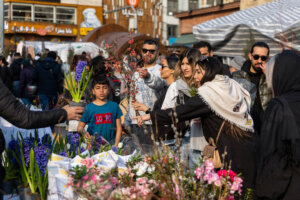
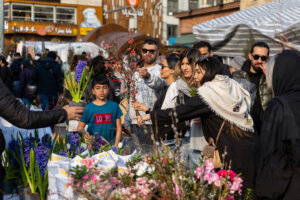
Videos and photos circulating on social media show the bazaar in Tehran, which had been closed since the war began, alive once more with patrons shopping for Nowruz essentials like fresh flowers and greens.
Most Nowruz traditions are shared across religions, but Jews have adapted certain customs to reflect their heritage.
Many Muslim families include a Quran on their haft-seen table, but “We Jews … put a little Torah in there,” Hakakian said. “We just adjust a little bit to include our history, but everything else is the same.” Some Jewish families elect instead to include a book of Hafez poetry, a secular symbol of Iranian culture and literary tradition.
The holiday typically falls a week or two before Passover, which shares similar themes of renewal and rebirth. While Nowruz is traditionally marked by spring cleaning, Sternfeld said many Jewish Iranians connect the two for practical reasons.
“If Pesach is a few days away, you want to use this occasion to get rid of chametz while you’re cleaning for Nowruz.”
The only holiday celebrated in public
In Iran, Jewish holidays are kept quiet, confined to private homes, and sometimes even basements or secret locations to maintain discretion. But Nowruz is the one holiday Jews are able to celebrate outwardly.
“Holidays were stressful. They were very stressful. I associate holidays with having to watch myself. I thought there was no such thing as a carefree holiday,” said the anonymous Iranian Jewish woman.
Cindy Chaouli, an Iranian Jew who left the country in 1978 and now lives in Los Angeles, recalled how “subdued” it felt celebrating holidays like Purim and Passover during her childhood. “It was celebratory, but it was still quiet from the outside world.”
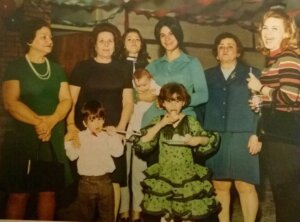
Nowruz, by contrast, spilled into the streets.
“It was totally different,” said Chaouli. “This was the one holiday that was universal. It had nothing to do with religion. You felt it as much outside as you did inside yourself.”
She recalled visiting the homes of non-Jewish neighbors during the holiday.
“I remember going to our neighbor’s house downstairs and having sweets … they’d make a drink called sharbat with cherries, sugar and water. You would just eat and play. It was just extremely celebratory.”
Nowruz in exile
After the 1979 Iranian Revolution, much of Iran’s Jewish community dispersed — many settling in Los Angeles and Long Island, New York, now home to two of the largest Iranian diasporas in the U.S., where Iranians continue to celebrate Nowruz with fervor.
“Here … everyone has parties, all the families get together, we have Nowruz billboards everywhere,” Chaouli said, referring to advertisements across the city publicizing Nowruz events, which this year, honor the plight of Iranians in Iran.
In the days leading up to the holiday, Persian grocery stores become scenes of near chaos. At Elat Market, a kosher Persian grocery store in Los Angeles, the crowds are notoriously intense when Nowruz and Passover coincide.
“There was a woman and her mother — one was standing at this container, filling bags and throwing them over people’s heads,” Chaouli recalled.
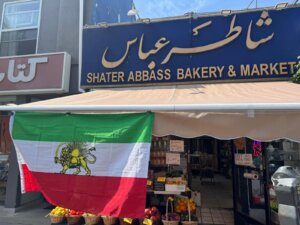
This year, many of the Persian stores are adorning their windows with the pre-revolutionary Iranian flag, a symbol of protest against the Islamic Regime.
Out on the streets, the celebratory mood is unmistakable. “Everyone I say hello to, it’s ‘Happy Nowruz,’” she said. “It’s a very celebratory time here.”
The sense of shared celebration has been tested in recent years. Chaouli said she has felt tensions between Jewish and Muslim Iranians in the diaspora grow in the wake of the Hamas attack on Israel and the Gaza war that followed.
“After October 7, there was definitely a rift and a lot of friendships were lost,” she said.
But with the new war dredging up shared feelings of grief and cautious hope for the country’s future, Chaouli feels Iranians of all religions are celebrating the holiday together more intensely than before.
“I’ve heard multiple people say that it doesn’t feel the same this year,” said Hakakian. “There’s a feeling of guilt to celebrate and to be happy when all this is going on. But at the same time, we say, Nowruz is here. It’s giving us hope.”
In Hakakian’s Persian calligraphy class, which she takes alongside Iranians of different faiths, the holiday became a moment of shared mourning.
“We sat together, and first we said, ‘Happy Nowruz,’ and then we all sat together in a moment of silence for the Iranian people,” she said. “It didn’t matter who’s Jewish, who’s not. We were all grieving for Iranians. And that, to me, was a moment — like, yes, we do need a moment of silence together.”
The post Jews in Iran and in the diaspora find respite in celebrating Nowruz amid war appeared first on The Forward.
Uncategorized
Man arrested over alleged firebomb plot targeting pro-Palestinian activist Nerdeen Kiswani
(JTA) — A New Jersey man was arrested on Thursday for allegedly plotting to firebomb the home of the prominent pro-Palestinian activist Nerdeen Kiswani.
Alexander Heifler, 26, was arrested by authorities in Hoboken after a weeks-long undercover operation led by the New York City Police Department revealed that he allegedly planned to throw a dozen Molotov cocktails at Kiswani’s residence.
The investigation into Heifler began in early February when Heifler discussed using Molotov cocktails on a group video call that included an undercover law enforcement officer, according to a criminal complaint filed in the U.S. District Court of New Jersey.
He later told the undercover officer that he had planned to flee the country following the attack. (The criminal complaint did not specify the name of the group or the country he planned to flee to.)
During a search of Heifler’s home Thursday night, detectives and FBI agents uncovered eight Molotov cocktails. He has been charged with unlawful possession of firearms and making of destructive devices.
In a statement Friday, New York City Mayor Zohran Mamdani said that Heifler was an alleged member of the Jewish Defense League, a far-right pro-Israel group that the has FBI labeled as a terrorist organization since 2001, and that the country he had planned to flee to was Israel.
“Last night, an alleged member of the Jewish Defense League — designated by the FBI as a ‘known violent extremist organization’ — attempted to blow up the home of Nerdeen Kiswani in a chilling act of political violence and an apparent assassination plot,” the statement read. “The defendant allegedly planned to flee to Israel following the attack. This comes amidst an alarming rise in threats and violence across the country targeting Palestinian human rights advocates.”
“Let me be clear: We will not tolerate violent extremism in our city. No one should face violence for their political beliefs or their advocacy. I am relieved that Nerdeen is safe,” the statement continued.
A police official confirmed that Heifler was a member of a branch of the Jewish Defense League on Friday, according to The New York Times.
Last month, Kiswani, who has long drawn accusations of antisemitism for her rhetoric on Zionists, sued Betar USA, a far-right militant pro-Israel group, accusing the group of violating her civil rights by putting out social media “bounties” on her and repeatedly harassing her. (In January, Betar USA agreed to dissolve its New York operations following a settlement with the state attorney general.)
The activist has also been singled out by far-right Florida Jewish Rep. Randy Fine, who reposted a tweet of Kiswani’s last month to make disparaging remarks about Muslims which sparked calls for his censure.
In a post on X, Kiswani, a Palestinian-American who co-founded the hardline pro-Palestinian group Within Our Lifetime, wrote that she had been informed by the FBI Joint Terrorism Task Force on Thursday night that “a plot against my life that was ‘about to’ take place.”
“For months, Zionist organizations like Betar and politicians like Randy Fine have encouraged violence against my family and me,” Kiswani continued. “I will have more to say as additional details come to light. I will not stop speaking up for the people of Palestine. Thank you for your support.”
In response to The New York Times’ post about the arrest, Betar USA wrote that it was “not surprising if other terrorists targeted her.”
“Violent terrorist Nerdeen Kiswani wants to globalize the intifada not surprising if other terrorists targeted her. Palestinians have always targeted one another,” the group posted on X alongside a video of Kiswani’s rhetoric. “Not surprising given the violent nature of these people who have globalized the intifada.”
The announcement of the arrest drew praise from the Jewish Community Relations Council of New York, which wrote in a post on X that there is “absolutely no place in our city for violence, threats, or attempts to take someone’s life—ever.”
“While we adamantly disagree with Nerdeen Kiswani’s inflammatory rhetoric and her organization’s tactics, we condemn in the strongest possible terms the reported plot against her,” the group said.
Brad Hoylman Sigal, the Jewish Manhattan borough president, also praised the NYPD for the arrest in a post on X.
“Grateful to @NYPDnews for their swift work in preventing this horrific plot against Nerdeen Kiswani,” Sigal wrote. “Political violence, against anyone, for any reason, has no place in our city.”
This article originally appeared on JTA.org.
The post Man arrested over alleged firebomb plot targeting pro-Palestinian activist Nerdeen Kiswani appeared first on The Forward.
Uncategorized
The moral degradation of Israel’s far-right is even worse than you think
This week, an Israeli Knesset member said something that should have been shocking, horrifying and unanimously condemned.
“I stand behind IDF soldiers in every situation,” said Yitzhak Kroizer, a member of the ultranationalist Otzmah Yehudit Party. Even if the “collateral damage is children or women — it does not matter to me.”
“In Jenin, there are no innocent civilians,” he added. “In Jenin, there are no innocent children.”
Kroizer was referring to a genuine tragedy: The killing of almost an entire Palestinian family by Israel undercover forces on March 15, near the village of Tammun. The forces opened fire on the family’s car as they returned from a shopping trip. Waed Bani Ohde, her husband Ali, and two of their young children Othman, 7, and Mohammed, 5, were killed. Two sons survived. The army says the car accelerated toward the forces; Palestinian witnesses say the IDF gave no warning before attacking.
It is tempting to dismiss statements like Kroizer’s as the rhetoric of the extreme. Indeed, I often find myself making that point when talking to people inclined to think the worst of Israel: They do not represent the majority, and not even the immoral government of Prime Minister Benjamin Netanyahu.
But that, while true, is becoming a little too pat.
For it is also true that as time goes, as the wars continue and hearts harden, what Kroizer articulated is a moral framework that is steadily taking hold in the Israeli right.
That’s why the statements were not condemned by anyone associated with the government. And, indeed, Israeli far-right activists responded to the deaths with social media posts rejoicing in the death of the unarmed “terrorists.”
No senior Israeli official apologized for the shooting. No one said publicly that even if the soldiers believed they were acting under threat, the killing of two children demands something more than a routine internal review.
No official has even conceded that this type of event might contribute to agitation and instability in the West Bank, and perhaps spark another uprising. Set empathy aside; even enlightened self-interest is beyond the current Israeli government.
Yes, an investigation has been opened. But military investigations almost never lead to concrete action against the troops. A Guardian report this week revealed that no Israeli citizen has been prosecuted for a killing in the West Bank since 2020, despite a radical uptick in violence; settlers and police have already killed 10 Palestinian civilians this month alone.
The undercover soldiers, especially, are something like the real life version of the international hit Fauda, widely admired for their counter-terrorism activity. There is little appetite for throwing the book at them.
So while it’s tempting to chalk this up as just another tragedy in a long list of tragedies on both sides, it is actually much more: a devastating manifestation of something fundamental — not just a personal tragedy but a national one.
That’s a tragedy I’ve seen unfolding slowly, since even before the Hamas attack of Oct. 7, 2023.
I’ve seen it in the rhetoric of far-right leaders like cabinet ministers Itamar Ben-Gvir and Bezalel Smotrich. But I’ve also seen it firsthand, as when I found myself on wartime television panels where I was besieged by right-wingers enraged at my assertion that innocents have been killed during the war in Gaza. I challenged one of them about whether this idea would include a two-week old baby.
“OK, maybe not the baby!” he conceded, unhappily.
The descent of part of Israeli society into this unforgivable lack of compassion is, some have argued, an inevitable outcome of indefinite control over the Palestinian territories. For years, warnings that rule over millions of disenfranchised Arabs would mutate Israel’s character were treated as excessive, even hysterical.
Israel was not a colonial power in the classic sense, its defenders argued; it was a democracy under siege, navigating impossible dilemmas. The West Bank may be “occupied” but that was justifiable because of the threat its near proximity posed. Israel’s actions might be harsh, but they were necessary, the argument went. It was said that the country’s moral core, despite pressures, would remain intact.
The initial signs after this latest tragedy are not exactly reassuring. Far from condemning Kroizer, as they rightly should have, the cabinet convened this week to offer his party a great gift: the legalization of 30 illegal settlement outposts, including some in “Area A,” which is supposed to be under full Palestinian control.
Israel did not begin this way. Its founding story was deeply bound up with an acute awareness of the need to maintain morality. The early Zionists envisioned a country that would be a “light unto the nations.”
As occupation has become an entrenched reality, most Israelis have wanted to look away; the problem is too complicated. This position may not be possible for much longer. The moral rot is too extreme. But the good news is that it has not infected everything and everyone. Israel’s public broadcaster devoted a segment to the Palestinian family’s tragedy, characterizing Kroizer’s statements as a disgrace.
The humanistic ideas through which Israel once judged itself have eroded. We must now hope that they won’t entirely vanish.
The post The moral degradation of Israel’s far-right is even worse than you think appeared first on The Forward.
Uncategorized
Rubio Says Iran War to Last ‘Weeks Not Months,’ No US Ground Troops Needed

A view of a residential building damaged by a strike, amid the US-Israeli conflict with Iran, in Tehran, Iran, March 23, 2026. Photo: Majid Asgaripour/WANA (West Asia News Agency) via REUTERS
The US expects its operation against Iran to conclude within weeks, not months, and Washington can meet all its objectives without using ground troops, US Secretary of State Marco Rubio said on Friday.
Rubio told reporters after meeting G7 counterparts in France that Washington was “on or ahead of schedule in that operation, and expect to conclude it at the appropriate time here – a matter of weeks, not months.”
While he said Washington could achieve its aims without ground troops, he acknowledged it was deploying some to the region “to give the president maximum optionality and maximum opportunity to adjust the contingencies, should they emerge.”
Washington has dispatched two contingents of thousands of Marines to the region, the first of which is due to arrive around the end of March aboard a huge amphibious assault ship. The Pentagon is also expected to deploy thousands of elite airborne soldiers.
The deployments have raised concerns that the war, which the US and Israel launched on Feb. 28 with airstrikes that killed Iran‘s supreme leader and other top officials, could turn into a prolonged ground battle. Iran‘s response, striking US and Israeli targets in the region as well as civilian targets in Gulf Arab nations and shipping, has severely disrupted global trade in energy and other commodities, raising fears of rising prices and recession.
US President Donald Trump has appeared anxious to wind down the unpopular war, and emphasized this week what he has described as productive negotiations aimed at a diplomatic solution to the war, despite repeated assertions from Tehran that no such talks have begun. On Thursday, Trump extended a deadline by 10 days for Iran to reopen the blockaded Strait of Hormuz or face attacks against its civilian energy grid.
Rubio discussed with G7 foreign ministers the possibility that Iran, even after the conflict ends, could try to impose shipping tolls through the Strait of Hormuz. Rubio said European and Asian countries that benefit from trade through the waterway should contribute to efforts to secure free passage through the strait, downplaying the US dependence on the trade.
NEW STRIKES ON IRAN
Iranian media reported strikes on Iran‘s decommissioned heavy-water nuclear research reactor and a factory producing yellowcake uranium late on Friday, and said there were no radiation leaks or danger arising from either attack. Iran informed the International Atomic Energy Agency there was no increase in off-site radiation levels at the yellowcake facility, the IAEA said on X, adding that it would look into the report.
Iranian Foreign Minister Abbas Araqchi said on X that Israel, in coordination with the US, had also hit two steel factories and a power plant. “Attack contradicts POTUS extended deadline for diplomacy. Iran will exact HEAVY price for Israeli crimes,” Araqchi said, using an acronym for the president.
A senior Iranian told Reuters that Tehran had not decided whether to respond to a 15-point proposal the US sent this week after attacks on industrial and nuclear infrastructure on Friday. The official said Iran had expected its response to be delivered on Friday or Saturday, but said the continuing strikes while the US was seeking talks was “intolerable.”
The US proposal, sent via Pakistan two days ago, is reported to include demands ranging from dismantling Iran‘s nuclear and missile programs to relinquishing control of the world’s most important trade route for energy supplies.
The war has spread across the Middle East, killing thousands of people and causing a major disruption to energy supplies, hitting the global economy with soaring oil, gas, and fertilizer prices that have fueled inflation fears.
In Iran, more than 1,900 people have been killed and at least 20,000 injured, said Maria Martinez of the International Federation of Red Cross and Red Crescent Societies.
Attacks on Israel by Iran‘s Lebanese ally Hezbollah have also prompted an Israeli campaign that has displaced a fifth of Lebanon’s population.
IRAN STILL POSSESSES MISSILES
The United States, which has set out to neutralize Iran‘s long-range strike capabilities, can only confirm that about a third of the country’s missile arsenal has been destroyed, five people familiar with the US intelligence told Reuters.
As the damage mounts, Gulf Arab states are telling the US that any deal must not merely end the war but also permanently curb Iran‘s missile and drone capabilities and ensure global energy supplies are never again weaponized, four Gulf sources said.
Far from being laid low, Iran‘s clerical rulers and the increasingly powerful Guards are still peppering the region with airstrikes, driving up energy prices and roiling financial markets.
While a third of Iran‘s missile stock may still be available for use, another third is likely to be damaged or buried in tunnels, some of which could be recovered once fighting stops, said four of the sources familiar with US intelligence, who asked to remain anonymous.
One source said the intelligence on Iran‘s drone capability was similar, with about a third most likely destroyed.
Stock markets continued their slide on Friday, while the Brent crude oil benchmark topped $112, having risen more than 50% since the war began.
In the US. where Trump is politically vulnerable to rising fuel prices, diesel in California hit an all-time high at an average $7.17 a gallon, the American Automobile Association said.