


Uncategorized
Minneapolis synagogue targeted with antisemitic, pro-Hamas graffiti on Oct. 7 anniversary
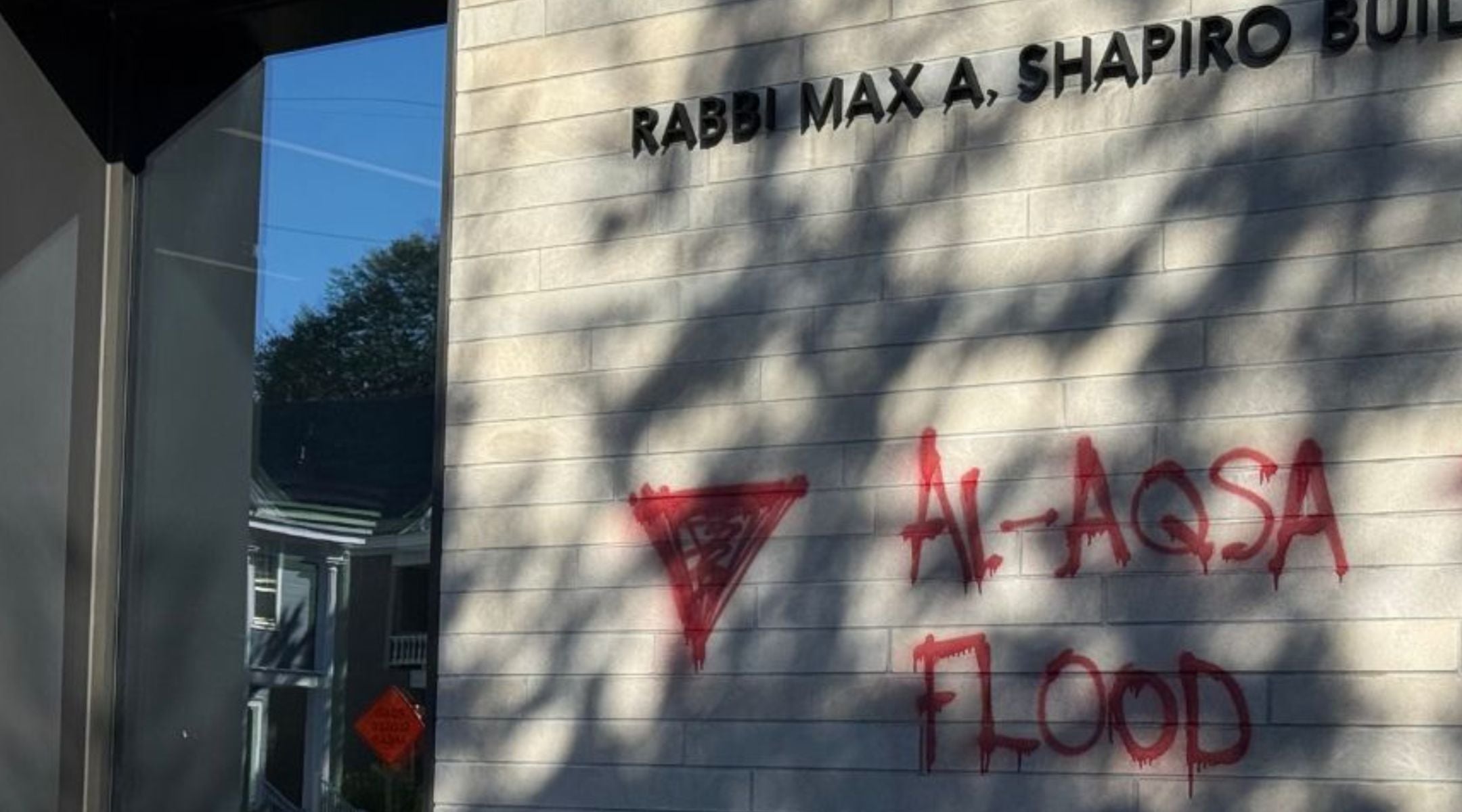
Graffiti targeting “zionists” and praising Hamas was spray-painted on the preschool wing of a Minneapolis synagogue on Tuesday night, the second anniversary of Hamas’ Oct. 7, 2023, attack on Israel.
Rabbi Marcia Zimmerman said she was notified by one of Temple Israel’s neighbors about the vandalism. She said her first reaction was outrage and pain.
“This does not solve any problem, and blaming American Jews in Minnesota for what’s happening globally is hate speech, it’s antisemitism. It’s nothing different than that,” she said. “It’s not about political differences. It’s about hate.”
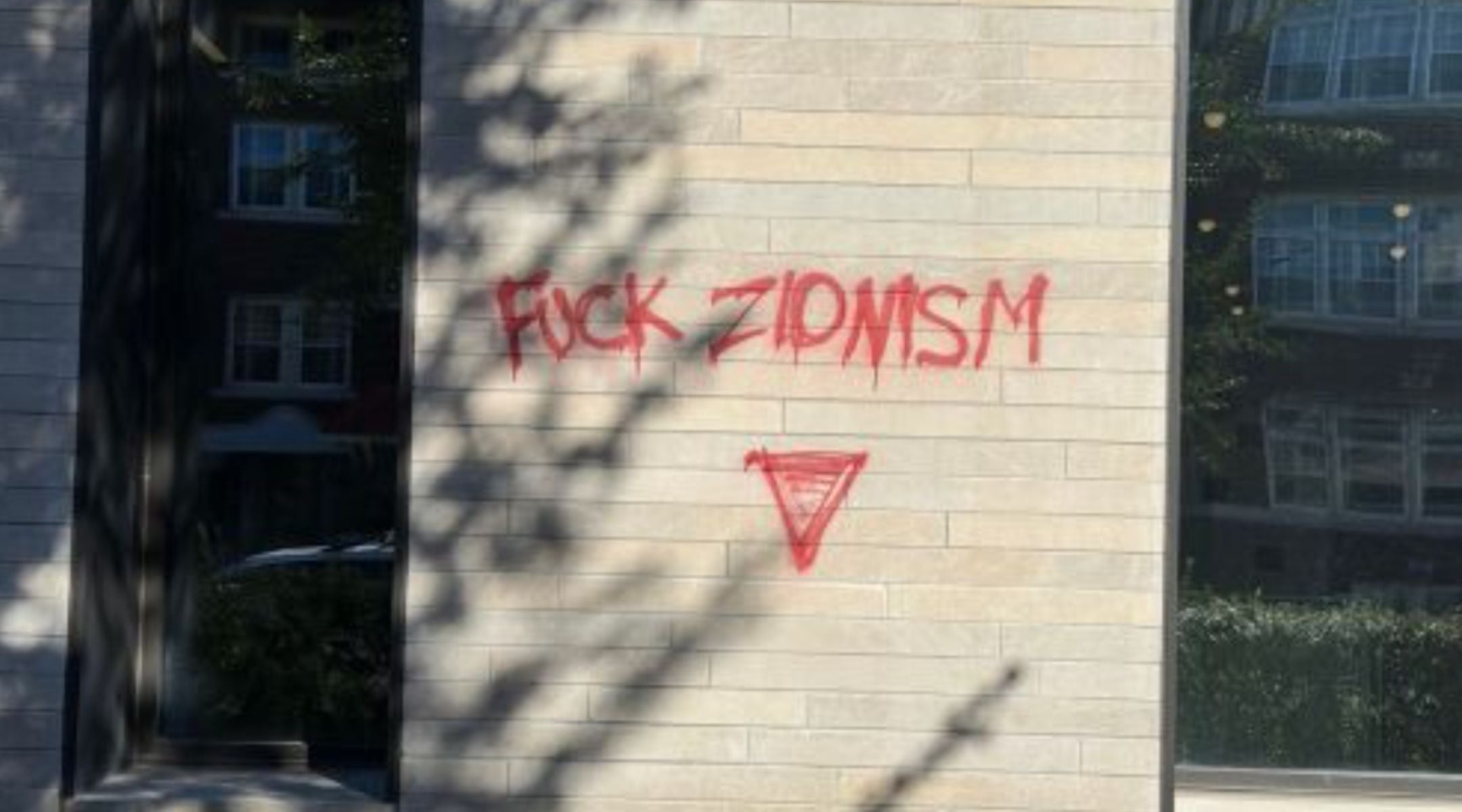
“Fuck Zionism” is spray-painted on the wall of Temple Israel. (Lonny Goldsmith/TC Jewfolk).
On the building was spray-painted “Watch out Zionists,” “Fuck Zionism,” and “Al-Aqsa Flood,” Hamas’ code name for the Oct. 7 attack. There were also 14 inverted red triangles spray-painted on the building — a symbol associated with Hamas, which has used it in videos produced by its military wing to signify Israeli targets. The symbol has appeared in other graffiti of Jewish institutions during theIsrael-Hamas war.
Zimmerman said a report has been filed with the Minneapolis Police Department and video footage has been turned over for the investigation. E-mails to the MPD seeking comment were not returned.
Steve Hunegs, the executive director of the Jewish Community Relations Council of Minnesota and the Dakotas, called the incident “harrowing.”
“It’s targeted and consciously imitating the mass terrorism of Oct. 7,” he said. “It doesn’t get much more antisemitic and violent than that, other than the actual perpetration of the horrific acts.”
Hunegs said the incident represents an escalation of anti-Israel rhetoric.
“We’re seeing that someone would take the time to, in the middle of the night on Oct. 7, to vandalize the synagogue with the most incendiary, venomous message you could possibly find,” he said. The perpetrators, Hunegs said, decided “terrorism against Jews is worthy of celebration, and [they’re] going to take that message to an iconic synagogue in the heart of Minneapolis.”
Zimmerman said that she heard from Gov. Tim Walz and Minneapolis Mayor Jacob Frey, who is Jewish and has attended services at Temple Israel. He said in a tweet that the vandalism was “a reminder that hate still tries to find a foothold” but that it would not find on in the city.
“People are reaching out and in that, you feel a connection and camaraderie and support,” Zimmerman said. “Which is very helpful, but it doesn’t take away the horror of the message. It does help to not feel so alone.”
Zimmerman said she is a proud Zionist who also wants to see an end to suffering in Gaza — something that she said whoever spray-painted the graffiti did not understand.
“If you do understand the nuance and the complicated realities of the world and see each other as human, then you don’t do this. It’s disregarding the humanity of others by promoting hate and promulgating hate,” she said. “But it’s not going to stop us from continuing to do our work and to do interfaith work and to move forward in being proud of being Jewish and teaching about Israel and making sure that we work towards peace and towards the mission of being in the city and supporting the city.”
This story originally appeared on TC Jewfolk, an independent publication covering Jewish life in Minneapolis.
—
The post Minneapolis synagogue targeted with antisemitic, pro-Hamas graffiti on Oct. 7 anniversary appeared first on Jewish Telegraphic Agency.
Uncategorized
Israeli-American soldier Moshe Katz, killed in Lebanon rocket strike, laid to rest on Mt. Herzl
(JTA) — Hundreds gathered on Sunday night at Israel’s military cemetery on Mt. Herzl for the funeral of Moshe Yitzchak Hacohen Katz, an American-born Israeli soldier who was killed by a rocket strike on Saturday in southern Lebanon.
Katz, 22, from New Haven, Connecticut, is the fifth Israeli soldier killed in Lebanon since Hezbollah, an Iranian proxy in Lebanon, resumed attacks on Israel following a 2024 ceasefire, after Israeli and U.S. strikes on Iran last month.
“With unspeakable tragedy I regret to inform you that my 22 year old son Moshe Yitzchak a*h a sergeant in the idf, fell in battle in Lebanon,” Katz’s father, Mendy, wrote in a post on Facebook on Saturday. “My oldest Son with a zest for life and jokes. Burial is tomorrow in israel. Maybe we only share good news. My heart is shattered and the wound is real.”
Mendy Katz had been in Israel when the war began and posted on March 7 about witnessing his son’s graduation from basic training with the Israel Defense Forces before returning to the United States via Egypt.
During the funeral on Sunday, Katz, who was posthumously promoted from corporal to sergeant and was affiliated with Chabad, was eulogized by a host of fellow soldiers who referred to him as a “true friend” who “always used to make sure that anyone around him was always taken care of.”
“Moshe was a brave soldier, we have proof of that, but more than that, he was a loyal friend, he was a hard-working son and a loving, caring brother,” Adina, Katz’s sister, said between tears during her eulogy. “Moshe’s body might be gone, but his legacy is not. He was a proud soldier and a proud Jew, and we are the proudest family.”
Israeli Prime Minister Benjamin Netanyahu offered condolences to Katz’s family in a post on X and wished a speedy recovery to three other soldiers moderately wounded in the attack.
“Moshe z”l immigrated to the land from the United States, enlisted in the Paratroopers Brigade, and fought bravely for the defense of our homeland,” Netanyahu wrote. “On behalf of all Israeli citizens, we embrace Moshe z”l’s family in this difficult hour and wish a swift and complete recovery to our fighters who were wounded in that incident.”
On Sunday, Netanyahu announced that he had instructed the Israeli military to further expand its operations in Lebanon in order to “finally thwart the threat of invasion and to push the anti-tank missile fire away from our border.”
Menachem Geisinsky, a photographer and friend of Katz’s, also eulogized him in a post on Facebook, writing that he “forever will be my hero” for “his bravery in coming all the way from New Haven, Connecticut to fight for what he believed was right and also for being a man who wouldn’t tolerate a frown.”
“So be like Moshe. Be a hero. Make someone’s day. Make someone giggle or smile,” wrote Geisinsky. “Step up, and be the man Moshe was, and forever will be remembered as.”
Katz is survived by his parents, Mendy and Devorah Katz; siblings Adina, Yehuda, Shua and Dubi; and grandparents.
The post Israeli-American soldier Moshe Katz, killed in Lebanon rocket strike, laid to rest on Mt. Herzl appeared first on The Forward.
Uncategorized
A second poll of US Jews finds the same result: Most oppose the war in Iran
(JTA) — For the second time in a day, a nonpartisan poll has found that most American Jews oppose the U.S. military campaign against Iran — even as 90% of them say they oppose the Iranian regime.
The new poll, conducted by GBAO Strategies on behalf of the liberal pro-Israel lobby J Street, found that 60% of U.S. Jews say they oppose “the US military action against Iran.”
About the same proportion, 63%, said they believed “the most effective way to address U.S. and Israeli concerns about Iran’s nuclear program and destabilizing regional actions is through diplomacy and sanctions,” not military action.
And the majority of American Jews said they believed the war will not improve Israel’s security, with a third saying they believe the war will weaken Israel’s security.
As with the previous poll released earlier on Monday, the poll found a sharp partisan and denominational split in the results, with Republicans and Orthodox Jews more likely to support the war, which the United States and Israel jointly launched on Feb. 28.
A press release from J Street touted the survey as “the first methodologically sound poll of Jewish American opinion since the conflict began,” positioning the results as an antidote to findings from the Jewish People Policy Institute, which surveys “connected” U.S. Jews and has found that a majority of them support the war, even though the proportion has fallen since the war’s start.
“This data is a wake-up call for anyone claiming to speak for the American Jewish community while beating the drums of war,” J Street President Jeremy Ben-Ami said in a statement. “Most American Jews see this war for what it is: A reckless, unforced error by a President who has no clear, achievable goals or an exit strategy. This poll proves that the ‘pro-Israel’ position is the pro-peace position – and that means stopping this war before more lives are lost.”
The survey of 800 Jewish registered voters was conducted March 24 to 26 and has a margin of error of 3.5 percentage points.
The J Street survey also asked respondents about other issues related to Israel. It found that 70% of U.S. Jewish voters said they are more sympathetic to the Israelis than the Palestinians in the Israeli-Palestinian conflict, compared to multiple polls finding an even split or slight edge for the Palestinians among Americans overall.
It also found that 70% of American Jews oppose unconditional military and financial assistance to Israel — reflecting a mounting political consensus that is at odds with the priorities of AIPAC, the traditional pro-Israel lobby.
The post A second poll of US Jews finds the same result: Most oppose the war in Iran appeared first on The Forward.
Uncategorized
Their sons survived the battlefield but not their wounds. Now these Israeli mothers mourn together.
(JTA) — TEL AVIV — On the morning she left Jerusalem for a health retreat for bereaved mothers, Taly Drori was surprised to recognize another woman in her rideshare. More than two years earlier, they had often crossed paths in the intensive care unit of the same hospital, where their sons were being treated in neighboring rooms.
The woman was Hazel Brief, the mother of Yona, an American-Israeli soldier who was seriously wounded at Kibbutz Kfar Aza in the opening hours of the Oct. 7 attack. Drori’s son, Chanan, also a soldier, was severely injured in Gaza in December of that year.
Both women spent long nights watching their sons fight to graduate from intensive care into rehabilitation, a milestone neither reached. Consumed by their sons’ care, they barely spoke. When they passed each other in the ICU hallway of Sheba Medical Center, Brief said, it was often just “a nod and a look in the eyes, to say, I got you. I get you.”
After two months, Chanan died from a fungal infection. A year later, Yona followed.
The retreat, held in the Gilboa region in northern Israel, offered a different kind of rehabilitation, Brief said, a “sacred space” where hallway nods gave way to a shared language of grief, as mothers try to rebuild themselves.
The gathering was part of a new initiative by OneFamily, an Israeli nonprofit that supports families of terror victims and fallen soldiers. Its impact is so significant that founder Chantal Belzberg was awarded the Israel Prize for Lifetime Achievement last week, the highest civilian honor awarded by the Israeli government — at a time when more Israelis are unfortunately joining its constituency.
“I am moved not because of myself, but because of the people for whom OneFamily was created: bereaved parents, widows, orphans, bereaved siblings, double orphans, and the wounded, with visible and invisible wounds,” Belzberg said in a statement. “This prize is, first and foremost, recognition of them. It is an embrace for the thousands of families who continue to carry this country, even when their hearts are broken.”
Belzberg’s daughter, Michal Belzberg-Slovin, is a yoga instructor who embraced Drori’s suggestion for a weekly health-and-wellness circle for bereaved mothers, centered on movement, mindfulness and nutrition. During the current war, meetings are taking place in a bomb shelter. But before it began, Belzberg-Slovin led 10 weeks of Wednesday sessions before the group traveled north together.
The program draws more than a dozen women, ranging from their early 40s to late 70s, all bereaved mothers of soldiers except one whose son was killed at the Nova music festival. It was originally intended for mothers bereaved in the current war, but the flyer OneFamily circulated omitted that detail. As a result, several mothers who had lost sons years earlier joined the circle as well. Belzberg-Slovin called it a happy accident, saying their presence was “very strengthening and healing,” and that it offered newer members a glimpse of how life can reshape itself around loss over time.
After Chanan’s death, Drori said she felt grief register physically before she could process it emotionally. “My life energy was draining away from me,” she said. She described chest spasms, sleeplessness and difficulty concentrating. At one point, she struggled even to stand upright. “I felt like I was made of lead.”
The next summer, she and her husband Roni spent several weeks at a health retreat on a kibbutz in northern Israel, a change of scenery that coincided with the war with Iran. The days were structured around nature walks, breathing exercises, yoga and simple, clean meals.
“The place slowly brought us back to life,” she said. That experience, she said, convinced her that bereavement requires deliberate physical care as well as emotional support, because “grief and trauma are stored in the body.”
Drori took the experience and pitched it to OneFamily as a half-day program to fit into the routines of women juggling work, family and mourning. Belzberg-Slovin bought into the idea immediately.
“This is my language,” she said, describing years of yoga, reflexology and aromatherapy.
Belzberg-Slovin had grown up around OneFamily, which her parents founded in 2001 after the Sbarro pizzeria bombing in Jerusalem, inspired by her decision as a bat mitzvah-age girl to forgo a party and redirect the money to victims and their families.
The Wednesday circles became even more of a family affair when her husband, Nadav, stepped in to cook the group’s vegan meal.
While not bereaved herself, Belzberg-Slovin said her own uneven path into adulthood has made her attuned to other people’s pain. She recalled a childhood in which terror victims and their families were always in her home, and a young adulthood marked by hurdles, including an eating disorder, cycling though career paths and remaining single long after most of her peers were married.
“I’m not one of them but something in my upbringing gave me the sensitivity to be fully with them in this process,” she said of the women in her circle.
Yoga and OneFamily, she said, were the two constants. “OneFamily has always been my identity. I always went back to it,” she said. Now, married with two children and a third on the way, she said she finally feels she is arriving on her own terms. “Now I’m bringing my new self into OneFamily which is special for me.”
The circle incorporates trauma-sensitive yoga, adapting an approach often used with survivors of sexual abuse and other trauma. The emphasis, Belzberg-Slovin said, is not on achieving a pose but on slowing down and respecting where the body is holding. A second yoga teacher, who is also a licensed therapist, facilitates the group discussion afterward.
She described one participant who shared that she found it hard to enter a supermarket because she saw reminders of her son everywhere. “How do you get from yoga poses to speaking about grocery shopping? But that’s what happens,” Belzberg-Slovin said. “We bring up everything the body raises.”
One of the veteran bereaved mothers on the retreat was Ruhama Davino, whose son was killed nearly 12 years ago during the 2014 conflict in Gaza. Davino said she kept her relationship with OneFamily at arm’s length, speaking by phone but repeatedly declining invitations to attend programs. “Every time they called, I said no,” she said. “I wanted to stay far from the bereavement and just continue my life.”
She doesn’t know what made her finally show up to the Wednesday health circle after so many years, but she left the first time without any doubt that she would be back, she said. “It’s powerful to be there, to be part of it, to draw strength.” Being in a room with mothers newly bereaved, alongside others who have lived with loss for years, changed her mind. “In the end, each of us needs this for the body and the soul,” she said.
Before the war, Chanan Drori had been studying biotechnology at Hadassah College and was preparing to begin his final research project in a medical research lab. After his death, the lab launched a research track in his name focused on infectious fungi, the complication that ultimately killed him.
“Chanan dreamed of helping people for whom no cure existed,” Drori said. “He dreamed of developing those medicines, so we felt like the best way to commemorate him was by realizing his dream.”
Chanan was treated at Sheba by Dafna Yahav, the head of its infectious diseases unit, who also treated Yona. Brief credited Yahav with pushing to bring in experimental drugs from overseas and said she never approached the family as a case first. “With all her accolades and running departments and being a world renowned expert, she’s an incredible human before being an incredible doctor,” Brief said. “She always responded first as a mom talking to another mom.”
Although the timelines were different — Yona was hospitalized for 417 days and Chanan for two months — Brief said the two mothers shared a form of loss that is hard to explain even to families of other soldiers who receive their news in an instant, with a knock at the door.
The similarities didn’t end there. Both men had volunteered to serve. Chanan did not meet criteria for a combat role, and Yona was exempt after he was wounded by an exploding pipe bomb months before Oct. 7. Both men loved music. OneFamily helped bring a piano for Yona, who played piano and guitar, into the hospital.
Both men and their families believed they would survive. Despite sustaining 13 bullet wounds and enduring repeated complications during his hospitalization, Brief said she expected Yona to “make it.”
Three weeks before Chanan died, doctors woke him from a medically induced coma and the family brought musicians to play at his bedside, including Yagel Harush, a singer he loved. The family invited Harush back to sing at the celebration they expected to hold after Chanan’s recovery, and at his wedding to his fiancée, Rivka.
“He was supposed to live,” Drori said.
Instead, this winter, two weeks after Drori returned from the north, Harush performed at a memorial event for the second anniversary of Chanan’s death.
When Drori met Brief again at the retreat, the two women posed for a photo to send to Yahav. Brief said she didn’t want to describe the retreat as “nice” or “comforting,” because nothing offers real consolation — “there’s no nechama,” she said, using the Hebrew word for solace. But OneFamily, she said, offered something she struggled to find elsewhere.
“You so often feel abnormal in society and here all of a sudden you feel normal,” she said. “Here’s another mom that knows what it’s like to see her son in intensive care for an extended period of time. I can’t share that with many people.”
The post Their sons survived the battlefield but not their wounds. Now these Israeli mothers mourn together. appeared first on The Forward.