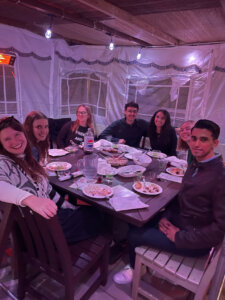
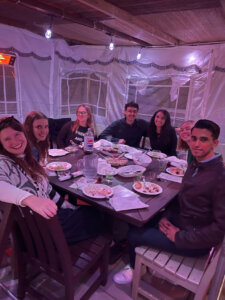
Muslim and Sephardic Jewish college students are connecting over shared heritage
Joseph Pool, a senior at Rollins College in Florida, grew up hearing his Moroccan-born grandparents describe Mimouna, a traditional Moroccan Jewish celebration marking the return to eating chametz after Passover. Because Jewish families had cleared their homes of chametz for the holiday, Muslim neighbors would bring over fresh flour, butter, and milk, and together they would enjoy a chametz-filled meal.
Amid rising campus tensions after October 7, Pool decided to host a Mimouna event of his own at Rollins College, and Muslim students showed up in droves.
“I spent years sleeping over at my grandparents’ house and hearing stories about the connection Muslims and Jews shared in Morocco,” Pool said. Seeing Muslim classmates embrace the celebration, he recalled thinking: “Wow, this is still the case today. There is still this connection ability here.”
At a moment when Jewish-Muslim tensions have intensified on campuses nationwide, some Sephardic and Muslim students say shared cultural heritage, rather than formal interfaith programming, is opening unexpected space for connection.
SAMi (Sephardic American Mizrahi Initiative) hosts Sephardic cultural programming on 16 college campuses across the country, including Persian music karaoke nights, hamsa painting events, and Mimouna celebrations. According to Manashe Khaimov, SAMi’s founder and CEO, roughly 10% of the 6,000 students the organization has engaged are Muslim.
The events are not intended to be spaces for interfaith dialogue, and that is a big part of their appeal. “Students don’t want to show up to an interfaith event unless [they’re] interested in political dialogue,” said Khaimov. Rather, students who are just looking for a place to engage with their culture show up to listen to the kind of music they grew up with, eat familiar foods, and hear Arabic or Farsi spoken.
For many Muslim students, SAMi events “smell the way it smells at home” as opposed to many Jewish spaces on college campuses that can feel “foreign” or “alienating,” said Khaimov. “For most of the Muslim students,” he said, “this is the first time even walking into Hillel spaces.”
Emily Nisimov, a Bukharian student from Queens College who organized Sephardic heritage events on her campus with SAMi, said, “The point of the events originally was to spread love and intimacy between Jewish students.” To her surprise, Muslim students started showing up. “Maybe they did just come for the food,” she said, “but the fact is that they stayed and they interacted with us and they tried to find a middle ground, which I was really impressed and shocked by.”
These connections are not limited to organized programming. Across campuses, Muslim students say friendships with Sephardic and Mizrahi peers have reshaped their understanding of Judaism, and Jewish students say the friendships have changed them, too.
Ali Mohsin Bozdar, a Muslim student at Springfield College who met Sephardic students through Interfaith America’s BRAID fellowship, said, “Jewish people from Middle Eastern backgrounds — most of the culture is similar. The food, the music, the language. I found that really fascinating,” he said. “It automatically binds you.”
Yishmael Columna, a Moroccan Jewish student and SAMi organizer at Florida International University, said the exchange has been mutual. “After Oct. 7”, he said, “it’s easy to give in to hate.” But getting to know Muslim peers complicated that instinct. “I wouldn’t be able to form opinions on many things as well as I do now if I didn’t have these conversations with them,” he said.
Sofia Houir, a Moroccan Muslim senior at Columbia University, said she had never met a Jewish person before attending college. Forming close friendships with Sephardic students on Columbia’s campus changed that. “Having friends who are Middle Eastern Jews definitely made Judaism more personal to me,” she said. “You can read about Judaism, you can study it, but talking to friends about how they grew up made me realize that, regardless of our religion, we’re all North African or Middle Eastern.”
Sofia Houir and Orpaz Zamir at a Shabbat dinner on Columbia’s campus. Courtesy of Sofia Houir
Sofia formed a particularly close bond with an Iraqi Israeli student, Orpaz Zamir, during her time at Columbia, which she says deeply influenced her decision to travel to Israel for the first time. “Orpaz played a huge role in me going to Israel, just because I’m super close to him. And I really, really wanted to discover his culture, and to discover his country,” she said.
But that decision came with consequences.
Sofia said that her friendships with Jewish and Israeli students as well as her decision to travel to Israel caused peers in the Muslim and Arab communities on campus to stop speaking to her.
“I had some heated arguments with people who basically argued with me as if I was representing the Israeli government,” she said. “The frustrating thing was that they never had a conversation with me about it. They just presumed that me going was me validating Netanyahu’s politics or betraying the Palestinians.”
Nisimov said campus tensions at Queens College, part of New York City’s public university system, have not disappeared simply because of a heightened awareness of shared culture.
After October 7, she said, “A lot of claims were made that we should go back to where we came from.” “We tried to explain to them — just like you, we came from the same spot — but they didn’t want to listen.”
Even so, she said, her personal friendships have endured outside the realm of discourse on the Israeli-Palestinian conflict. “My Muslim friend and I, we’re not really on the political level of conversation,” she said. “But we have plenty of conversations about our cultures and our religions and the differences and similarities.”
Rethinking Jewish Whiteness
For some students, these relationships have also challenged assumptions about Jewish identity and, thus, the tenor of political conversations.
Mian Muhammad Abdul Hamid, a Muslim student from Syracuse University, told the Forward that he “thinks the majority” of Muslim students on his college campus believe Jews only come from Europe. “When people think Jewish, the first thing that pops up is European.”
Bozdar agreed. “When I met these people, it confirmed for me that there are Jews from the Middle East,” he said. “Until you meet people, nothing is for sure.”
Columna recalled participating in a tabling event about Israel shortly after Oct. 7, when a Muslim student approached him to talk. The two later became friends. Weeks later, Columna asked why he had approached him rather than the other nearby Jewish students.
“He told me, ‘I decided to talk to you because, in contrast to the Ashkenazi Jews nearby, you were the only one who looked brown,” Columna said.
“I feel that sometimes the reason why these conversations do not work is because Muslim students don’t feel that Jews are even part of the Middle East,” said Columna. “Once you break that wall, and you find a common ground,” he said, “it becomes a more productive conversation.”
Zamir, an Iraqi Jewish student at Columbia University, described a similar experience. Though initially nervous about enrolling amid campus tensions, he said, “I never felt I was being attacked for my views.”
A Muslim friend later told him it was because he was seen as “from the region.”
“If you are Mizrahi,” Zamir said, “Muslim students respect what you say a bit more because if you’re from the region, you’re entitled to be there.”
But that dynamic also raises uncomfortable questions about which Jewish students are seen as having legitimate perspectives on campus.
“There’s this extreme position that Ashkenazi Jews shouldn’t be there or shouldn’t have this view because they’re ‘colonizers,’ but you’re okay because you’re part of the region,” he said.
“Unfortunately, this is the case, but it also makes my interactions with them easier,” he added.
While several students said their conversations about their shared background remain at the cultural level rather than getting political, Pool believes shared meals can create space for conversations that lean on these shared identities.
“If you share a meal with someone, you start with something in common,” he said. “You have the same food, maybe then you have the same family tradition of how to cook this food. And then suddenly, when you’re talking about politics, you can talk about just a political issue versus it being your entire identity.”
McGill University Law School Adviser Resigns Over Referendum Endorsing Academic Boycott of Israel
Dueling pro-Israel and anti-Israel demonstrations at McGill University in Montreal, Canada; May 2, 2024. Photo: ZUMA Press Wire via Reuters Connect
McGill University’s law school in Montreal, Canada lost the chair of its advisory board on Sunday, when he resigned from the position over what he described in a letter notifying the administration of his decision as an “escalating pattern of hostility toward Jewish students, faculty, and alumni.”
The immediate cause, wrote Jonathan Amiel, was the Law Students Association’s passing an academic boycott of Israel through a student referendum held on Saturday. If adopted as university policy, the measure would shutter partnerships with Israeli institutions, bar individual Israelis or known Zionists from holding teaching positions, and allow professors to refuse writing letters of recommendation for students applying to study abroad in Israel.
A majority, 57 percent, of students who participated in the referendum voted to approve it, with 67 percent of the student body casting ballots, indicating high turnout. It accused Israel of being an “apartheid” state and of perpetrating a “genocide” against the Palestinians, despite that the Palestinian Bureau of Statistics reports that the Palestinian population has “doubled about ten times since” Israel’s founding in 1948.
While a Jewish student is challenging the vote in court, as reported by the MontrealGazette, its approval by the student body has, according to activists, left an impression on the Jewish community there while achieving a reverberant political victory for the student anti-Zionist movement.
“We are deeply concerned by the ongoing developments within student governance at McGill University Faculty of Law,” the Center for Israel and Jewish Affairs (CIJA), a Canadian Jewish advocacy group, said in a statement.
According to Amiel, last week’s endorsement of a boycott of the world’s lone Jewish state was part of a broader, troubling trend.
“The referendum is not an isolated event,” Amiel wrote in his resignation letter, which he since made available for public viewing. “An institution once defined by intellectual rigor and principled debate has, in too many instances, become an environment where being Jewish, identifying as a Zionist, or maintaining any association with the State of Israel carries professional and personal risk.”
He added, “This includes the normalization and, at times, glorification, of events marking acts of mass violence, the obstruction of students’ access to classrooms and university facilities, and the use of academic platforms to legitimize or advance extremist ideologies.”
Amiel also charged that the institution failed to discipline “conduct involving harassment or intimidation.”
McGill University was one of hundreds of schools where anti-Zionists organized to celebrate Hamas’s Oct. 7, 2023, massacre, in which the terrorist group’s fighters slaughtered, kidnapped, and raped Israeli civilians during their invasion of the Jewish state.
Their activities culminated in an anti-Israel encampment which spanned across four months and did not disband until long after the end of the 2023-2024 academic year. While McGill officials took steps to limit the freedom of action of the group which staged the demonstration, such as bringing the issue before a court and denouncing the “obvious antisemitism” of its members, Amiel’s letter suggests that the university has not done nearly enough to combat anti-Jewish harassment and discrimination on campus.
“The defining feature of this period has been an absence of decisive leadership at moments when clarity and resolve were required,” Amiel continued. “In that absence, direction has effectively been ceded to actors whose objectives are fundamentally misaligned with the university’s core academic mission.”
McGill University has denounced the outcome of the referendum, with president Deep Saini saying, “The effects here are antisemitic, and that plain fact must guide McGill’s response.”
Amiel’s resignation comes amid an ongoing crisis of pervasive antisemitism on campuses across the Western world.
Earlier this month, the Union of Jewish Students (UJS) released survey results showing that Jewish campus life in Great Britain is rapidly deteriorating. The group found that 47 percent of Jewish students report having heard their classmates justify the Oct. 7 massacre in which Hamas slaughtered civilians and committed mass rape; 23 percent have witnessed Jewish students persecuted over their identity; as many as 36 percent have either lost friends in this new milieu or know someone who has; and a shocking 40 percent report “having changed their journey through campus” to avoid anti-Zionist protests occurring every week at some universities.
Some of the report’s most concerning findings focused on anti-Jewish sentiments expressed by non-Jewish students. Twenty percent said they prefer not be roommates with a Jewish person, while a quarter of students surveyed believe that arguing that “Zionists control the media/government” does not constitute antisemitism. Responding to a separate question, 16 percent expressed approval of saying outright that “Jews control the media/government.”
“This report demonstrates that antisemitism on campus is not isolated but normalized,” Union of Jewish Students president Louis Danker said in a statement. “No Jewish student should have to face social ostracism, abusive language, or physical violence — there is a right to protest but not harass. If we are serious about combating extremism in Britain, we have to start on campus, where half of students have seen glorification of Hamas or Hezbollah. Concerned sentiments and piecemeal progress are not enough.”
The issue is no less severe in the US.
In February, the American Jewish Committee (AJC) and Hillel International reported that a striking 42 percent of Jewish students reported experiencing antisemitism during their time on campus. Of that group, 55 percent said they felt that being Jewish at a campus event threatened their safety. Meanwhile, 34 percent of Jewish students avoid being detected as Jews, hiding their Jewish identity due to fear of antisemitism.
According to the data, 38 percent of Jewish students said they decline to utter pro-Israel viewpoints on campus, including in class, for fear of being targeted by anti-Zionists. The rate of self-censorship is significantly higher for Jewish students who have already been subjected to antisemitism, registering at 68 percent.
“No Jewish student should have to hide their identity out of fear of antisemitism, yet that’s the reality for too many students today,” Hillel International chief executive officer Adam Lehman said in a statement released with the survey results. “Our work on the ground every day is focused on changing that reality by creating environments where all Jewish students can find welcoming communities and can fully and proudly express their Jewish identities without fear or concern.”
Israel’s Former Eurovision Contestant Eden Golan Says She Still Has Anxiety, ‘Recurring Nightmares’ of Being Killed
Eden Golan, Israel’s representative at the Eurovision Song Contest, reacts during a press conference following the official unveiling of Israel’s song submission, in Tel Aviv, Israel, March 10, 2024. Photo: REUTERS/Carlos Garcia Rawlins
Eden Golan, who represented Israel in the 2024 Eurovision Song Contest, talked in a new interview about still experiencing anxiety, fear, and nightmares of threats against her life two years after the competition ended.
“I’m always afraid. I look in every direction like a security guard,” the 22-year-old Israeli singer said in an interview published on Friday in the “7 Nights” supplement of Yedioth Ahronoth. “I’ve had recurring anxiety since Eurovision: I walk into a place, a restaurant, or a show, and someone shoots me from behind. I have recurring nightmares of people chasing me and killing me. But I’m learning to live with it. No one will silence me anymore.”
Golan told Yedioth Ahronoth that she also still faces antisemitism almost everywhere she goes.
“Quite a few of my performances abroad had protests,” she explained. “In Switzerland they threw red paint at the entrance to the venue, supposedly to say the blood is on our hands. There was one protest with signs against [Israeli Prime Minister] Bibi [Netanyahu] and against me. After all the threats I received, there’s definitely fear for my life, but what could be worse than what I went through at Eurovision?”
Golan participated in the 2024 Eurovision in Malmo, Sweden, with the song “Hurricane” and finished in fifth place. The song was originally titled “October Rain,” but the name and its original lyrics were disqualified by the European Broadcasting Union (EBU), which organizes the Eurovision competition, for being too political since it referenced the deadly Oct. 7, 2023, Hamas terrorist attack in southern Israel.
Golan made it to the top five of the competition even after being booed on stage by anti-Israel audience members, facing death threats, and having a Eurovision jury member refuse to give her points because of his personal feelings against Israel’s military actions during its war against Hamas in Gaza.
Golan has also said she had to conceal her identity outside her hotel room in Malmo during the Eurovision contest because of the threats she received from anti-Israel activists, who were angry about the Jewish state’s participation in the international competition. At the time, the deputy director general of the EBU condemned the harassment that participating singers had experienced.
Noam Bettan is Israel’s representative in the 2026 Eurovision Song Contest, which will take place in Vienna, Austria, in May. He is competing with a trilingual song titled “Michelle.”
A map showing the Strait of Hormuz is seen in this illustration taken June 22, 2025. Photo: REUTERS/Dado Ruvic/Illustration
In the war between Iran and the joint force of the US and Israel, the Islamic Republic’s strongest tactic is to obstruct shipping in its coastal Strait of Hormuz.
The regime has strangled the world’s supply of oil and natural gas by attacking several commercial vessels as they transited the Persian Gulf channel. Some of Iran’s naval weapons have killed members of the ships’ crews.
As a political matter, Iran hopes that creating a global energy crisis will generate opposition to the US-Israeli military campaign. But as a legal matter, Iran’s targeting of civilian ships is a flagrant violation of international law.
The regime never “ratified” either treaty because it did not incorporate the international laws into its domestic law. That means Iran never became a formal party to the two pacts. However, the “innocent passage” framework of at least the 1958 convention is considered legally binding on Iran through customary international law, a consequence of widespread maritime practice.
The United Nations Security Council applied the principle of innocent passage during the Iran-Iraq War of the 1980s. The council rebuked both combatants for firing on commercial oil tankers in the Persian Gulf.
In the current war, the UN Security Council likewise chided Iran’s lethal interference with civilian shipping in the Strait of Hormuz. A coalition of 22 countries including two Arab Gulf states recently signed a joint statement that condemned Iran’s violent closure of the strait and warned of “appropriate efforts” to reopen it. A US military contingent is now headed to the strait, presumably to clear the key coastal terrain.
Iran attempts to evade its maritime obligations with two legal arguments.
First, it asserts self-styled “maritime claims,” in which every commercial ship’s right of innocent passage through the Strait of Hormuz is subject to the regime’s “prior approval.” Iran accordingly grants safe passage to vessels from “friendly” states like China and Pakistan but not ships that could “benefit the aggressors.”
Assuming an additional power of prior approval, Iran has threatened to impose toll charges on ships passing through the waterway. International maritime organizations such as the United Kingdom Maritime Operations Centerhave confirmed that Iran’s self-serving legal concoction is unfounded. In fact, most of the shipping lanes in the strait run through the territorial waters of Oman, which lie beyond Iran’s legal reach.
Iran alternately contends that its anti-shipping terrorism in the strait is a “tool of pressure” to combat the US and Israel, implying a right of military self-defense. But the laws of naval warfare do not permit attacks on ordinary civilian vessels as a means of self-defense.
Finding Iran in breach of maritime law is easy. Enforcing the law is another matter.
The International Court of Justice cannot assert jurisdiction over a state without that state’s consent. The International Criminal Court lacks authority over Iran because the state never signed the court’s enabling treaty. The Security Council could vote on Bahrain’s proposed March 23, 2026, resolution authorizing “all necessary means” to reopen the Strait of Hormuz. But the measure would probably be vetoed by Russia and/or China, states that oppose the use of force against Iran.
At stake is nothing less than freedom of navigation, which is vital to global trade and security. If Iran can paralyze the Strait of Hormuz, other nations may block similar chokepoints such as the Strait of Taiwan, the Turkish Straits, the Panama Canal, or the Suez Canal. The resulting chaos could render maritime law a dead letter.
It may be difficult for American-Israeli warfare to release Iran’s illegal grip on the Strait of Hormuz. Nevertheless, military action may be the only way to restore the rule of law in the waterway and deter future maritime aggressions.
Joel M. Margolis is the legal commentator of the American Association of Jewish Lawyers and Jurists, US Affiliate of the International Association of Jewish Lawyers and Jurists. He is the author of The Israeli-Palestinian Legal War.