



Uncategorized
Netanyahu Applauds Eurovision Runner-Up Noam Bettan: ‘Everyone Is Very Proud of You’

Noam Bettan, representing Israel, performs “Michelle” during the dress rehearsal 2 of the Grand Final of the 2026 Eurovision Song Contest, in Vienna, Austria, May 15, 2026. Photo: REUTERS/Lisa Leutner
Israeli Prime Minister Benjamin Netanyahu congratulated Israeli singer Noam Bettan on finishing in second place in this year’s Eurovision Song Contest on Saturday, despite boos and anti-Israel protests in the audience and boycotts from several countries due to Israel’s participation.
“Noam, what an amazing victory, what an achievement, and how much pride, strength, confidence, and artistry,” Netanyahu told the 28-year-old singer during a phone call. “You are on a path to greatness. In any case, you have the gratitude of the entire nation. Everyone is very, very proud of you.”
The prime minister also applauded the singer for standing “tall against those hollow verbal potshots.”
“You did it exactly as it should be done,” Netanyahu told Bettan. “You did a wonderful job. And I saw that the audience, as usual, was more supportive than the judges. Well done to you. Keep moving forward, rise and succeed, and many blessings.”
During their call, Bettan thanked Netanyahu for his kind words and said it was “a great privilege” to represent Israel in the Eurovision Song Contest, “to bring honor, to represent us in a positive light, and to bring some light and goodness into this world.”
“And I have a certain hope, because I felt there was a very great unity tonight, and I hope so much that it stays with us and continues in two days, in a year, and in 50 years,” Bettan noted. “I want unity so much, and I truly hope it continues.”
Prime Minister Benjamin Netanyahu spoke with singer Noam Bettan, who represented Israel in the Eurovision Song Contest and won an impressive second place in the competition > >https://t.co/dxTAe2NiRQ pic.twitter.com/lVMZYl2JlQ
— Prime Minister of Israel (@IsraeliPM) May 17, 2026
The 2026 Eurovision Song Contest took place at the Wiener Stadthalle in Vienna, Austria.
Bulgaria won with the upbeat dance track “Bangaranga,” performed by Dara. The victory marked the first ever Eurovision win for the Balkan nation, which will host next year’s competition. Bettan finished second with “Michelle,” a trilingual song in Hebrew, French, and English that is about putting oneself first when in a toxic relationship.
Anti-Israel protesters who disrupted Bettan’s performance during the semifinals last week were removed from the audience inside Vienna’s Wiener Stadthalle after chanting “stop, stop the genocide” and “Free, free Palestine.”
“One audience member, close to a microphone, loudly expressed their views as the Israeli artist began his performance, and during the song, which was heard on the live broadcast,” Austrian national broadcaster ORF and the European Broadcasting Union, which organizes the Eurovision, said in a joint statement about the incident. “They were later removed for continuing to disturb the audience. Three other people were also removed from the arena by security for disruptive behavior.”
Bettan told Reuters he also heard boos from a few pro-Palestinian protesters in the audience when he first went on stage for the semifinals.
Spain, Ireland, the Netherlands, Slovenia, and Iceland refused to participate in this year’s Eurovision because of Israel’s inclusion, in protest of the country’s military operation in the Gaza Strip targeting Hamas terrorists who orchestrated the deadly attack in southern Israel on Oct. 7, 2023.
Israel also finished second in the 2025 Eurovision Song Contest.
Uncategorized
Harry Styles Responds ‘Correct’ to Fan Shouting ‘Long Live Palestine’ at Amsterdam Concert

Harry Styles poses on the red carpet during for the BRIT Awards at the Co-op Live Arena, in Manchester, Britain, Feb. 28, 2026. Photo: REUTERS/Temilade Adelaja
British pop star Harry Styles on Saturday night interacted with a fan who shouted a slogan in support of Palestinians during the kickoff of his “Together, Together” world tour in Amsterdam.
The “Aperture” singer was performing in Amsterdam’s Johan Cruijff Arena on the opening night of his tour and stopped to adjust his earpiece on stage when an audience member shouted, “Viva, Viva Palestina!” which means “Long Live, Long Live Palestine” in Spanish. The former One Direction singer replied to the comment saying, “Correct.” A clip of the interaction was posted on social media.
One of the charity partners for the “Together, Together” tour is Choose Love, which provides humanitarian aid to Palestinians in the Gaza Strip and West Bank, including food and medical treatment.
The tour will include more than 60 performances around the world, including in The Netherlands, the United Kingdom, Australia, Mexico, and Brazil. Styles’ only shows in the United States will be 30 consecutive nights at New York City’s Madison Square Garden. The singer’s fourth solo album, “Kiss All the Time. Disco, Occasionally,” was released in March.
Uncategorized
Israel Warns of Escalating Terror Threat in West Bank as Iran, Turkey, Hamas Seek to Stoke Extremism

Israeli soldiers walk during an operation in Tubas, in the West Bank, Nov. 26, 2025. Photo: REUTERS/Mohamad Torokman
Israeli security officials have warned of a rapidly deteriorating security situation in the West Bank, citing deepening Iranian and Turkish involvement alongside Hamas efforts to expand terrorist infrastructure and orchestrate attacks across the territory.
According to the Israeli news outlet Walla, defense officials point to a growing role by Iran, Turkey, and Hamas in financing, directing, and sustaining terrorism, while also leveraging Gaza-linked networks to expand coordination, incitement, and operational activity across the West Bank.
With Israeli communities in the West Bank steadily expanding, the local military command is under significant strain, operating with 22 battalions while confronting a wide range of security challenges, including dismantling terrorist infrastructure, disrupting terrorist financing channels, locating weapons caches, protecting settlements, and stopping arms smuggling from Jordan.
Israeli officials have previously warned that large-scale terrorist attacks targeting local communities could serve as a destabilizing flashpoint amid the wars in Gaza and Iran.
Last year, Israeli forces uncovered documents suggesting Hamas is actively preparing plans for raids on settlements in the area.
Israel’s domestic intelligence agency, the Shin Bet, arrested six Arab Israeli citizens last month suspected of transferring millions of shekels from Hamas’s Turkish branch into the West Bank as part of an underground terrorist financing network believed to have smuggled more than three million shekels to fund attacks against Israel.
Experts also point to a growing threat from the Jenin Brigades in the northern West Bank — an alliance of Palestinian Islamic Jihad and Hamas operatives that has transformed refugee camps into bases for shootings, bombings, and ambushes.
The group’s operations are reportedly sustained by a complex financing system that moves Iranian funds through Palestinian banking channels, siphons off Israeli-collected tax revenues, and makes use of international facilitators.
“By sustaining this West Bank front through Hamas and Palestinian Islamic Jihad networks, Tehran forces Israel to fight simultaneously across multiple fronts, drains resources that could otherwise consolidate gains in Gaza, and keeps the Palestinian issue politically radioactive enough to sabotage broader Arab-Israeli alignment,” Jose Lev Alvarez, a writing fellow at the Middle East Forum think tank, explained in a recent article.
“Tehran [then] advances its axis-of-resistance doctrine at minimal cost — no Iranian boots, no direct missile exchanges, just calibrated chaos designed to obstruct any credible day-after plan for Gaza and derail normalization agreements with Saudi Arabia or Gulf states demanding Palestinian stability,” he continued.
Last year, the Israel Defense Forces (IDF) warned that Iran was driving a growing terrorist threat in the West Bank, with concerns that Iranian-backed arms smuggling could enable an Oct. 7-style attack.
Israeli intelligence and security forces have since intensified operations across the territory amid fears that Iranian-supplied weapons are increasingly reaching Palestinian terrorists and escalating the risk of a large-scale assault.
Israeli intelligence assessments have also warned that terrorists operating in the West Bank are believed to possess weapons capable of breaching Israeli defenses, including what officials described as “standard Iranian weapons.”
According to Joe Truzman, a senior research analyst at the Foundation for Defense of Democracies (FDD), a Washington, DC-based think tank, Israeli officials should be closely monitoring the West Bank as Hamas regroups and rearms in the Gaza Strip after more than two years of war.
“Hamas and its allied factions understand that igniting violence in the territory would divert Israel’s attention during a critical time of rebuilding the group’s infrastructure in Gaza,” Truzman told The Algemeiner last year.
“The release of convicted terrorists to the West Bank under the [Israel-Hamas] ceasefire agreement may be a factor in the resurgence of organized violence in the territory,” he continued.
As of last February, Israeli security forces foiled nearly 1,000 terrorist plots over the past year, with senior military officials increasingly worried that the volatile situation in the West Bank could lead to a large-scale attack similar to Hamas’s Oct. 7, 2023, onslaught against Israeli settlements and communities near the security barrier.
According to a survey released last year by the Jerusalem Center for Security and Foreign Affairs, 70 percent of all respondents — and 81 percent of Jewish respondents — expressed fear of an Oct. 7-style attack coming from the West Bank. In contrast, 53 percent of Arab respondents said they were not worried about such an attack.
In response to these concerns, the IDF has established a special command to address potential threats in the West Bank and launched a nearly unprecedented counterterror operation in the northern part of the territory.
Uncategorized
Romanians Stabbed Journalist in London at Behest of Iran, UK Court Told
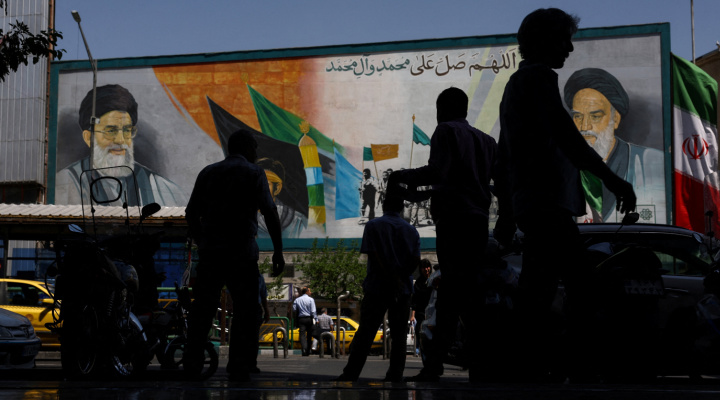
People walk past a mural depicting the late leader of the Islamic Revolution, Ayatollah Ruhollah Khomeini, and the late Iran’s Supreme Leader Ayatollah Ali Khamenei, in Tehran, Iran. Photo: Majid Asgaripour/WANA (West Asia News Agency) via REUTERS
A team of Romanian men, acting as proxies for the Iranian government, carried out a knife attack on a journalist working for a Persian-language media organization in London, prosecutors told a British court on Monday.
Pouria Zaratifoukolaei, known as Pouria Zeraati, a British journalist of Iranian origin who works for Iran International, was stabbed in the leg three times as he was attacked near his home in Wimbledon, southwest London, in March 2024.
At the start of the trial of two of the three men accused of carrying out the stabbing, prosecutor Duncan Atkinson said they had targeted Zeraati, whose Saudi-funded TV employer is critical of Iran‘s government and has been designated a terrorist organization by Tehran.
‘DELIBERATE, PLANNED VIOLENCE’
“This was no robbery, no fight that got out of control, it was deliberate, planned violence to achieve what it did, that is serious injury to its target,” Atkinson told London‘s Woolwich Crown Court.
They had “committed a planned attack preceded by reconnaissance, and which was ordered by a third party acting on behalf of the Iranian state,” the prosecutor said.
Iran has denied any involvement in the incident.
Nandito Badea, 21, and George Stana, 25, both deny charges of wounding with intent and unlawful wounding. The third man accused of involvement, David Andrei, was arrested in Romania but is not involved in the trial.
Atkinson said Zeraati was an “obvious and readily identifiable target for violence to be inflicted by proxies” acting for Iran. He said posters had been put up in Tehran in November 2022 featuring pictures of journalists including Zeraati, under the heading “Wanted: dead or alive.”
“In recent years, since 2005, the Islamic Republic has turned less to its own operatives and increasingly to use proxies such as criminal gangs to meet their threatened violence on their behalf,” Atkinson said.
“That has included attacks on persons in this country who have become targets of Iranian intimidation and, effectively, terror.”
Atkinson said Zeraati had been subject to “extensive reconnaissance,” and a year before Stana had been arrested in the garden of his apartment with another man, in possession of latex gloves, scissors, and a mask.
On the day of the attack, Badea and Andrei confronted Zeraati as he crossed the street from his home to his car, the prosecutor said. Andrei held him, while Badea stabbed him at the top of his thigh before they fled to a getaway car driven by Stana, the prosecutor added.
The men, who were motivated by money, dumped the car and some clothing, and then took a taxi to Heathrow Airport from where they flew to Geneva, Atkinson said.
The trial, which is expected to last more than two weeks, continues.