



Uncategorized
Non-Jews Must Stand Up to Indifference: Antisemitism in Modern Europe
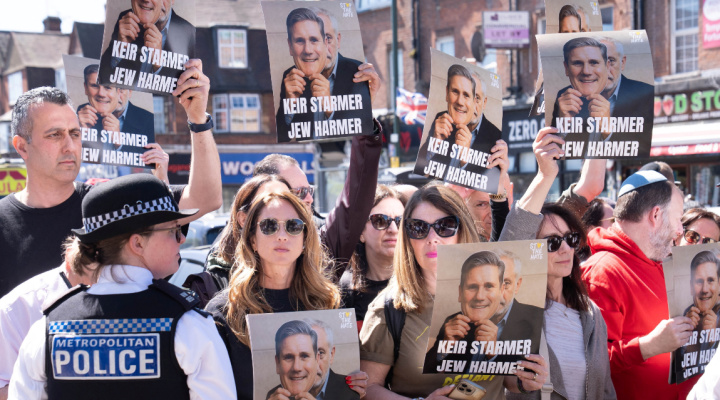
Protesters hold up placards against British Prime Minister Keir Starmer during his visit to Golders Green, northwest London, following a terror attack on April 29, 2026, in which two men were stabbed, in London, Britain, April 30, 2026. Photo: Stefan Rousseau/Pool via REUTERS
Fears and anxieties are running high among British Jews, and among Jews across Europe more broadly. There is only so long that a community can project strength and resilience while its members are being stabbed in broad daylight, and while vile antisemitic graffiti stains the walls of cities like Berlin.
At some point, the question must be asked: how much can a society tolerate before its silence becomes complicity?
This is not a theoretical concern — it is already visible in policies, media coverage, and public debate.
What is perhaps most disturbing is not only the rise in antisemitic incidents, now at record highs in many parts of Europe, but the muted response to them. Similar hatred towards other minorities would provoke outrage and sustained debate.
Yet when Jews are targeted, reactions are often subdued and short-lived. Coverage exists, but in everyday conversations and workplaces, the urgency is largely absent.
Living in Germany, I have found that antisemitism is rarely a topic of concern among non-Jews. It does not seem to stir deep emotional reactions or sustained attention. It exists, but almost in the background. This indifference is not neutral. It is part of the problem.
Many Europeans today do not personally know a single Jewish person. Their understanding of Jews is often filtered through biased media narratives.
There is a vague awareness of a connection between Jews and Israel, but little real understanding. Seen mainly through conflict and accusations, Israel often becomes a reason for disengagement. Even when Jewish co-workers may exist, their identity may remain hidden. I was reminded of this when my son told me about a Jewish boy on his football team who was mocked by teammates when they heard that one of his parents is Jewish. I encouraged my son, as captain, to confront such behavior immediately.
When I share such incidents with non-Jewish friends, they are often genuinely shocked and condemn it, unable to believe such things still happen in Germany today. For a moment, this is reassuring. Yet the concern rarely lasts as people move on with their lives.
But antisemitism is never just a “Jewish problem.” It is a societal one.
History has shown, time and again, that what begins with Jews does not end with them. Antisemitism is not an isolated prejudice; it is often a symptom of broader ideological movements that seek control and dominance. Whether in the forced religious expansions of the medieval period, the racial ideology of Nazi Germany, or modern Jihadist movements that weaponize religion, the pattern is clear: once a society tolerates the dehumanization of one group, it opens the door to the erosion of freedom for all.
This is why today’s indifference is so dangerous. It reflects not only a failure to protect Jews, but an unwillingness to confront the deeper threats.
There is yet another dimension to the issue of antisemitism that is often overlooked: the position of non-Jewish allies.
Across Europe and beyond, there are Christians, Hindus, Muslims, and other righteous individuals who stand up against antisemitism and support Israel, often at significant personal cost.
They lose friendships, face tensions within their families, and encounter hostility in their workplaces. Unlike Jewish communities, which are bound by a strong sense of shared identity and belonging in Am Israel, these allies often stand alone. They do not always have a community to turn to.
This raises an uncomfortable but necessary question: what happens to these individuals if antisemitic rhetoric continues to escalate into physical violence? Jews, despite the immense challenges, have Israel — a homeland that represents refuge and continuity. For Diaspora Jews, aliyah remains an option, however challenging it may be.
But what about those who stand with them, who have tied their moral convictions to the fight against antisemitism? Who protects them?
They may well be the next in line — not because of who they are, but because of what they represent: resistance to hatred, commitment to truth, and refusal to conform to dominant narratives.
This is the hallmark of an unhealthy society — not only the presence of hatred, but the isolation of those who oppose it.
There is a broader irony: many who champion progressive values like anti-oppression, anti-colonialism, and human rights, fail to see how their silence or selective outrage contributes to the problem. In overlooking antisemitism, they undermine the very principles they claim to uphold.
The solution is neither simple nor immediate. But it begins with something fundamental: speaking.
We must continue to talk about antisemitism. We must do it consistently and persistently. There is a lesson in the propaganda strategies of the past: repetition shapes perception. Just as the Nazi propagandist Joseph Goebbels demonstrated how repetition can amplify lies, it can also strengthen truth.
Silence allows distortion to take root. Speaking up on the other hand, creates the possibility of change. There is still hope that people will listen. Because the cost of silence is not only borne by Jews. It is borne by society as a whole.
Paushali Lass is an Indian-German intercultural and geopolitical consultant, who focuses on building bridges between Israel, India, and Germany.
Uncategorized
Trump Says Iran ‘Should Wave White Flag of Surrender’ as Shaky Ceasefire Holds Despite Exchange of Fire
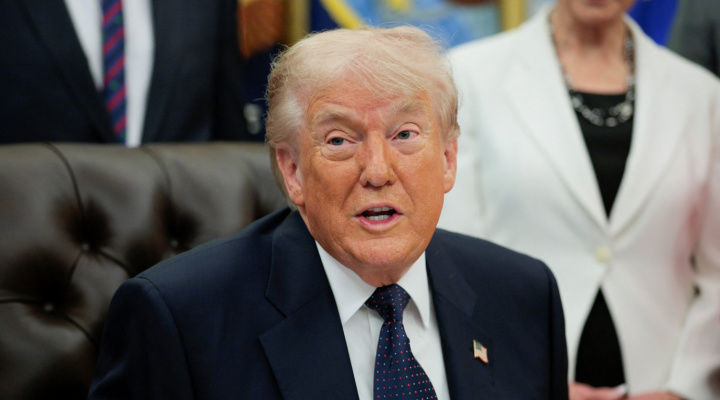
US President Donald Trump speaks during an event to sign a memorandum in the Oval Office at the White House in Washington, DC, US, May 5, 2026. Photo: REUTERS/Evan Vucci
US President Donald Trump on Tuesday dismissed Iran‘s military capability and said Tehran “should wave the white flag of surrender” but is too proud to do so.
Trump’s comments to reporters in the Oval Office came as the United Arab Emirates said it was under attack from Iranian missiles and drones, even as Washington said a shaky ceasefire was intact despite an exchange of fire the previous day as US forces attempted to force open the Strait of Hormuz.
Despite the escalation, Iran‘s military has been reduced to firing “peashooters,” Trump said, adding that Tehran privately wants to make a deal despite its public saber-rattling.
“They play games, but let me just tell you, they want to make a deal. And who wouldn’t, when your military is totally gone?” he said.
Trump heaped praise on the US blockade of Iranian ports in the region. “It’s like a piece of steel. Nobody’s going to challenge the blockade. And I think it’s working out very well,” he said.
When asked what Iran would need to do to violate the ceasefire, Trump said: “Well, you’ll find out, because I’ll let you know … They know what not to do.”
Trump argued that Iran “should save the white flag of surrender,” adding, “If this were a fight, they’d stop it.”
The US military said it had destroyed six Iranian small boats, as well as cruise missiles and drones, after Trump sent the navy to escort stranded tankers through the strait in a campaign he called “Project Freedom.”
US Defense Secretary Pete Hegseth said the operation to protect commercial ships was temporary and the four-week-old truce was not over. “We’re not looking for a fight,” he told a press conference. “Right now, the ceasefire certainly holds, but we’re going to be watching very, very closely.”
Iran fired missiles at US ships on Monday and attacked the UAE, a key regional ally of Washington, with missiles and drones. After issuing a new map of the Strait of Hormuz with an expanded Iranian area of control, Iran‘s Revolutionary Guards warned vessels on Tuesday to stick to the corridors it had set or face a “decisive response.”
Shortly after Hegseth spoke on Tuesday, the UAE’s defense ministry said its air defenses were again dealing with missile and drone attacks coming from Iran.
‘RIGHT TO RESPOND’
The Gulf Arab state’s foreign ministry said in a statement that the attacks were a serious escalation and posed a direct threat to the country’s security, adding that the UAE reserved its “full and legitimate right” to respond.
There was no immediate comment on that from Iran, though earlier its parliament speaker, Mohammad Baqer Qalibaf, had said breaches of the ceasefire by the US and its allies endangered shipping through the strait, which carries a large share of the world’s oil and fertilizer supplies.
“We know well that the continuation of the current situation is unbearable for the United States, while we have not even begun yet,” he said in a social media post.
The Strait of Hormuz has been virtually shut since the United States and Israel began attacks on Iran on Feb. 28, triggering disruptions that have pushed up commodity prices around the world.
Iran has effectively sealed off the strait by threatening to deploy mines, drones, missiles, and fast-attack craft. The United States has countered by blockading Iranian ports and mounting escorted transits for commercial vessels.
Hegseth said the US had successfully secured a path through the narrow waterway and that hundreds of commercial ships were lining up to pass through.
The US military said two US merchant ships made it through the strait, without saying when, with the support of Navy guided-missile destroyers.
Iran denied any crossings had taken place, though shipping company Maersk said the Alliance Fairfax, a US-flagged ship, exited the Gulf under US military escort on Monday.
Several merchant ships in the Gulf reported explosions or fires on Monday, and an oil port in the UAE, which hosts a large US military base, was set ablaze by Iranian missiles.
Iran also said it fired warning shots at a US warship approaching the strait, forcing it to turn back.
Reuters could not independently verify events in the strait as the two sides issued contradictory statements.
General Dan Caine, the chairman of the US Joint Chiefs of Staff, said Iranian attacks against US forces fell “below the threshold of restarting major combat operations at this point.”
PAKISTAN’S MEDIATION EFFORTS CONTINUE
The war has killed thousands as it spread beyond Iran to Lebanon and the Gulf, and has roiled the global economy. The head of the International Monetary Fund said on Tuesday that even if the conflict ended immediately, it would take three to four months to deal with the consequences.
US and Iranian officials have held one round of face-to-face peace talks, but attempts to set up further meetings have failed.
Iranian state media said on Sunday that the US had conveyed its response to a 14-point Iranian proposal via Pakistan, and Iran was reviewing it. Neither side gave details.
Iranian Foreign Minister Abbas Araqchi said peace talks were still progressing with Pakistan’s mediation and warned the US and the UAE against being drawn into a “quagmire.”
He was traveling to Beijing on Tuesday for talks with his Chinese counterpart, his ministry said. Trump is also due to visit China this month.
A senior Pakistani official involved in talks said: “We have put in a lot of efforts – actually both the sides have narrowed gaps on a majority of the issues.”
Trump has said the US-Israeli attacks aimed to eliminate what he called imminent threats from Iran, citing its nuclear and ballistic missile programs and its support for terrorist groups Hamas and Hezbollah.
Trump has insisted Iran must surrender its enriched uranium stockpiles to prevent it producing a nuclear weapon – an ambition Tehran denies.
Uncategorized
UK’s Starmer Convenes Community Leaders to Fight Antisemitism After Attacks
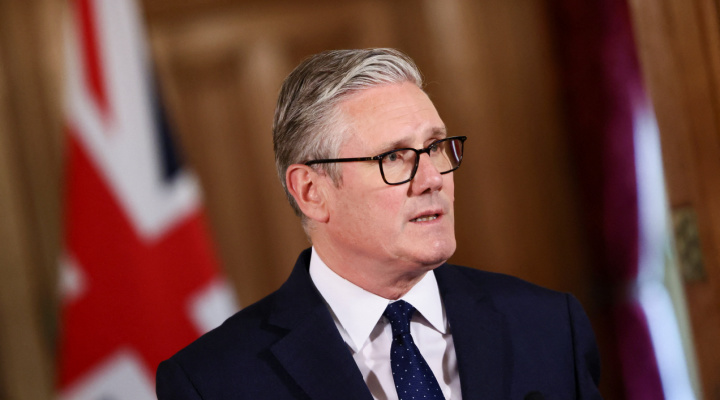
British Prime Minister Keir Starmer gives a media statement at Downing Street on the government’s response to a stabbing in which two Jewish men were wounded, which police said was a terrorism‑related attack, after a man was arrested in connection with the incident on Wednesday, in London, Britain, April 30, 2026. Photo: REUTERS/Jack Taylor
British Prime Minister Keir Starmer urged leaders from across society on Tuesday to work together to eradicate antisemitism “from every corner,” as he convened a meeting following the stabbing of two Jewish men and a string of other attacks.
The attacks have left Jewish communities fearing for their safety and piled pressure on Starmer to show he can tackle them. The opposition Conservative Party has called antisemitism a “national emergency.”
Moments after Starmer began speaking, counter-terrorism police confirmed they had launched an investigation into an arson attack at a former synagogue in east London. The incident was the latest in a series of arson attacks on Jewish targets since March, most of them in north London, some of which authorities are examining for possible Iranian links.
Starmer told the meeting – which brought together representatives from business, health, culture, higher education, and policing for talks with members of the Jewish community – that investigators were examining whether a foreign state could be behind some of the incidents.
“Our message to Iran or to any other country that might seek to foment violence, hatred, or division in society, is that it will not be tolerated,” Starmer said, adding that the government was fast-tracking legislation to tackle threats.
TERRORISM-RELATED DEATHS ON THE RISE
Starmer, whose wife is Jewish, said last week’s stabbings formed part of a broader pattern of rising antisemitism against Britain’s 290,000 Jews, leaving many feeling frightened and angry.
In response, the government has raised the national terrorism threat level to “severe” and announced an additional 25 million pounds ($34 million) in funding to bolster protection for Jewish communities.
A new 1-million-pound support package was announced to target antisemitism in high-risk areas, with a further 500,000 pounds allocated to the local authority covering the area where the stabbings took place.
Starmer also announced new requirements for universities to publish details of antisemitic incidents on their campuses and the steps being taken to address them.
“Only by working together, we eradicate antisemitism from every corner,” Starmer said.
The Global Terrorism Index has said terrorism-linked deaths fell globally in 2025, but surged 280% in Western countries, largely driven by antisemitism, Islamophobia, and political terrorism.
In Britain, government data published last year showed sharp rises in hate crimes against the Jewish community in the months following the 2023 Hamas attack on Israel that triggered the Gaza war.
Uncategorized
Jailed Iranian Peace Laureate at Risk of Dying After Heart Attack, Husband Says

A picture of Nobel Peace Prize winner Narges Mohammadi on the wall of the Grand Hotel in central Oslo before the Nobel banquet, in connection with the awarding of the Nobel Peace Prize 2023, in Oslo, Norway, Dec. 10, 2023. Photo: NTB/Javad Parsa via REUTERS
The husband of Iran’s imprisoned Nobel Peace Prize winner Narges Mohammadi described the family’s fears on Tuesday after her hospitalization for severe medical problems and the authorities’ refusal to transfer her to Tehran.
Mohammadi, 54, won the prize in 2023 while in prison for a campaign to advance women’s rights and abolish the death penalty, and she suffered a heart attack last week.
“We are very afraid because the illnesses that Narges has, such as high blood pressure or a pulmonary embolism, could lead to her death,” said her husband, Taghi Rahmani, who lives in Paris.
“We are maintaining contact through family, through acquaintances we have, and through her lawyer, and it is very difficult right now. The internet is down, and we are receiving information through phone calls and various other means,” he said in an interview with Reuters.
Mohammadi’s family want her to be transferred from Zanjan, where she was serving her sentence and where she is now in hospital, to the capital where she could receive better medical care.
The couple have 19-year-old twin children.
Rahmani spoke to Mohammadi on Tuesday morning, he said, adding that Iranian authorities had agreed to keep her in hospital for a week.
“Even if her condition improves a little, if she is sent back to prison her condition will worsen again and we are afraid of that,” he added.
Rahmani said he believed the Iran war, which began with a US-Israeli attack on the Islamic Republic on February 28, had made things worse for Mohammadi, by giving the military greater control.
Security authorities were reluctant for her to return to the main Evin prison in Tehran in case she was able to engage in activism there, he said.
“Narges is an activist who, wherever she goes, becomes active and for the repressive system this activity is considered a threat,” he said.
Iran shut down most of the internet in the country in January as authorities suppressed mass protests triggered by economic unease. Rights groups have reported ongoing executions of people involved in the unrest.
“Executions are happening under the shadow of war-related news; this war is not bringing democracy to Iran. It is worsening the situation in Iran,” he said.