



Uncategorized
Northwestern launches civil rights investigation into club that banned pro-Israel group from its food festival
Northwestern University’s Office of Civil Rights is investigating a club that said it canceled its annual “Cultural Food Fest” after students objected to its initial inclusion of a pro-Israel student group.
Spoon University Northwestern, a student-run food magazine, wrote in an email to students that it was calling off its Nov. 6 food festival because of concerns about the participation of Wildcats for Israel, a club housed within Hillel that describes itself as focused on Israeli culture and society.
“There’s been a lot of disappointment expressed in and around Hillel today,” Michael Simon, executive director of Northwestern Hillel, told the Forward on Friday. “What should be an opportunity for connecting across differences and having really positive engagement got turned into a sort of political catfight.”
Students involved with Wildcats for Israel were initially “really excited” to participate in the fest, Simon said.
But amid student backlash, Spoon reversed course and disinvited Wildcats for Israel, Simon said. In a statement posted to Instagram, Spoon cited “the ongoing genocide in Gaza” to explain the group’s removal.
Yet even that exclusion was not enough for some student organizations. Northwestern’s Asian Pacific American Coalition; Alianza, the Latinx student alliance; and the Middle Eastern North African Student Association, issued a joint statement saying that they were withdrawing from the fest because of the original inclusion of Wildcats for Israel.
“A ‘culture’ born from the active land theft and genocide of Palestinians should not be recognized,” the student groups wrote on Instagram.
Spoon then cancelled the event altogether.
Now, Spoon’s status as an officially registered student organization has been frozen while the investigation into allegations of discrimination is being conducted, a Northwestern spokesperson wrote in an email to the Forward.
The investigation comes as Northwestern faces additional obligations to address and report allegations of antisemitism as part of its $75 million settlement with the Trump administration in November 2025. As part of the agreement, the university pledged that its Office of Civil Rights would publish annual reports with data about complaints of antisemitism, including investigative and disciplinary actions taken.
Spoon did not respond to the Forward’s request for comment.
In its email to students, Spoon said Wildcats for Israel was removed because of its status as “a political action group, not a cultural organization.”
Simon pushed back on that characterization of the club. “They’re not engaged in political advocacy or political work, certainly not in their current iteration,” Simon said. “They’re really focused on doing cultural and educational programming, connecting with Israel and with the Israeli people.”
The idea that Wildcats for Israel is considered political, while other student organizations opposing Israel are not, “appears to be a real double standard,” Simon said.
Still, Simon said the cancellation did not prevent Wildcats for Israel from having its own cultural food event — inviting students to the Hillel building on Friday to talk about what had happened over slushies in two flavors popular in Israel, limonana and iced cafe.
“They’re really turning to a place of being in community and supporting one another,” Simon said.
The post Northwestern launches civil rights investigation into club that banned pro-Israel group from its food festival appeared first on The Forward.
Uncategorized
Israel’s love affair with Trump may be over – with no other suitor in sight
Israelis were among the few groups outside America who genuinely liked Donald Trump, and they had persuaded themselves that the feeling was mutual. Now, as the American president pledges to terminate military assistance and blames Israel’s unpopularity for the Republicans’ electoral humiliation, they are confronting the possibility that their greatest supposed friend may become one of their gravest strategic liabilities.
In a 2025 Pew Research Center survey of 24 countries, 69% of Israelis expressed confidence in Trump to do the right thing in world affairs. Israelis saw a champion where much of the democratic world saw a menace.
Israelis, who tend to be more direct and plainspoken than other Western societies, were less inclined to be scandalized by Trump’s personal shortcomings. But mainly it was policy that made him so popular: Trump moved the American embassy to Jerusalem, recognized Israeli sovereignty over the Golan Heights and cultivated a conspicuously warm relationship with Prime Minister Benjamin Netanyahu, despite his increasing toxicity around the world. Trump opposed Hamas and ultimately joined Israel in attacking the Iranian regime.
Still, warning signs were there – in the displays of U.S. dominance over decisions in the 2025 and 2026 Iran confrontations and in the Election Day announcement last week that Trump plans to terminate roughly $4 billion in annual military assistance to Israel this year.
The announcement threatened a cornerstone of Israeli security planning established under Barack Obama, whose administration negotiated a 10-year, $38 billion assistance agreement extending through 2028.
The precise legal and financial consequences remain uncertain, not least because Congress controls appropriations. But the political significance is unmistakable: The president whom Israelis regarded as their most dependable protector was proposing to dismantle an arrangement that even administrations regarded as unfriendly to Netanyahu had sustained.
Moreover, the aid is far more than a gift. Its greatest value is not financial but geopolitical: the unmistakable message to Israel’s enemies that Washington stands behind it.
As the dismal election results became clear, Vice President JD Vance highlighted a supposed demand among disaffected Republican voters to “change our relationship to Israel,” placing the alliance itself among the issues requiring political reassessment.
In Sunday’s 60 Minutes interview, Trump went further, identifying what he called a “great dislike” for Israel as one factor in the Republican electoral defeat.
Trump certainly has a point. A 2026 Pew survey found that 60% of Americans viewed Israel unfavorably, up from 42% in 2022, including 57% of Republicans under 50. Gallup found that, for the first time in its 25-year tracking, Americans were no longer more sympathetic to Israelis than Palestinians: 36% favored Israelis, compared with 41% for Palestinians. The longstanding bipartisan consensus is unraveling. Among younger Americans, the situation is even worse.
Whether the reason is a global propaganda campaign against Zionism, social media manipulation, Netanyahu and his noxious far-right allies, or Israel’s actions in Gaza and the West Bank are almost beside the point – the collapse in Western and U.S. opinion is undeniable.
Trump also asserted that “those countries that we’ve protected” from Iran – meaning Israel – “wouldn’t exist” without the U.S. and “are going to pay us back any and all costs that we’ve had for the war,” which was another major surprise and mystery that caught Israelis off-guard.
Whether this implies a demand that Israel reimburse the United States, and for precisely what, remains unclear. What is clear is that Trump has begun discussing a relationship Israelis considered existential in the language of electoral liabilities and financial transactions.
Writing in Maariv on Monday, veteran Washington correspondent Shlomo Shamir reported that senior Washington commentators described Netanyahu as having become effectively persona non grata in Trump’s inner circle – and that Trump’s seeming affinity for Netanyahu was “more a media relationship than a genuine friendship.”
The change in atmosphere in Israel has been extraordinary.
On Monday, Israeli television seemed preoccupied with little beyond the coalition negotiations following Israel’s election and the growing fear that the country might lose its most important international relationship.
Appearing on Channel 13, I argued that another Netanyahu government would have faced economic sanctions from Europe and even serious discussion of an American weapons embargo. This provoked very little disagreement.
“Netanyahu put all his chips on Trump, and it’s falling apart,” observed anchor Daniel Zilberstein. “It wasn’t only him, but the entire system,” replied Omri Rolls, an expert in monitoring and countering anti-Israel propaganda. “We put all our attention on the United States. Europe, we’ve completely given up on. All over the world, important elements are simply not on Israel’s agenda.”
The alarm was loud and clear this week across the Israeli political and diplomatic establishment.
Tovah Herzl, a former Israeli diplomat who served in Washington as liaison to Congress, captured the predicament in the title of her article in Maariv: “Netanyahu Bet on Trump — and Israel Could Lose Far More Than Money.”
“Israelis are unaware of the depth of the hole into which the country has fallen,” wrote Yedidia Stern, a leading expert on Israel-U.S. relations, in Ynet. “The hourglass has been turned over: we have two years to regain the legitimacy that has been lost” before a Democrat potentially wins the White House.
Ashley Perry, a former senior Israeli government adviser, wrote in The Jerusalem Post that Israel must urgently start arguing its case – “consistently demonstrating what Americans gain” in intelligence cooperation, joint defense development, investment, trade and Israeli contributions to scientific and technological progress.
Beyond all that, there is a general understanding that Israel will need some real policy changes – for example, cracking down on Jewish extremists in the West Bank. And it will need to court the U.S. Democrats and the Europeans once more – as it did decades ago.
There is a grim lesson at play, and it has more to do with morality than ethics.
Israelis are people badly traumatized by the conflicts that implacable enemies have forced on them. Over the decades, however, they took some pride nonetheless in what they believed was a moral high ground. It’s safe to say this has eroded, at least somewhat.
In a reflection of that erosion, one of Trump’s greatest attractions to Israelis – sadly enough – was his indifference to Palestinian human rights, an issue that had long complicated Israel’s relations with more conventional Western leaders. Trump was clearly untroubled by the West Bank occupation, the expansion of settlements or the absence of a credible political horizon for millions of Palestinians. In February 2025, he even proposed removing Gaza’s Palestinian population in its entirety and placing the territory under American control, a scheme whose breathtaking implications seemed scarcely to concern him.
Many Israelis overlooked the dark aspects of such absurdities, seeing only evidence of exceptional friendship. They overlooked the possibility that a president so utterly uninterested in Palestinian rights might also prove indifferent to Israeli interests whenever they ceased to coincide with his own.
They celebrated his willingness to discard diplomatic conventions – or even basic human decency – when it worked in their favor. They are discovering now that sometimes cliches are true: What goes around comes around.
The post Israel’s love affair with Trump may be over – with no other suitor in sight appeared first on The Forward.
Uncategorized
In the Golan Heights, her people have been marginalized, persecuted and brutalized. She just wants to play hockey.
The documentary On Thin Ice recounts the complicated lives and often contradictory experiences of the Syrian Druze community living in the Golan Heights, which was annexed by Israel in 1981.
An estimated 25,000 Druze live in a handful of hardscrabble villages flanked by mountains and long stretches of desert. They identify as Syrians, but they are not Muslims, and they have a long history of being marginalized, persecuted, if not brutalized by radical Jihadists.
Set in Majdal Shams, the film centers, at least initially, on Aya, a 19-year-old Druze ice hockey player who desperately wants to join Israel’s all-woman ice hockey team, its first. She is qualified and the coaches want her on board. However, to compete internationally she needs an Israeli passport, which means she’ll self-identify as Israeli and will be called to serve in the IDF, an idea she is more than open to.
When her father says, “A passport will prevent a normal life,” she responds, “A passport will give me a normal life.”
Her father and especially her beloved Uncle Ayoub, a farmer and journalist, are vehemently opposed, viewing her ambition as a betrayal of their Syrian roots. Uncle Ayoub argues that their reputations will be besmirched and, far worse, so will hers. She will be stigmatized and shunned within her own community and will end up without friends, an eligible husband, or children.
This is a familiar conundrum facing a protagonist: What takes precedence — social expectations or personal dreams? In the end, will the culture triumph or the individual, and at what cost? The implicit feminist elements here can’t be ignored either. The unspoken assumption, at least as intimated by the uncle, is that there is nothing more important to a woman than marrying the right man.
The patriarchy here is not villainous. Father and uncle are sympathetic figures. They understand how difficult a decision this is for Aya, while she, a shy and insecure young woman, whose self-worth is tied up with ice hockey, appreciates where they’re coming from. The film’s title works well on both a literal and metaphorical level.
Filmmakers Udi Kalinsky and Irit Hod do a nice job capturing the complex inter-relationships, the fluidity of identity and the inevitability of change.
Making the film took three years, and the filmmakers incorporated events into the narrative as they unfolded in real time. Among the most significant was the controversy surrounding Israel’s construction of wind turbines in the Golan Heights.
Though these are intended as a progressive alternative energy source, many angry inhabitants, including Uncle Ayoub, say the over-sized turbines will destroy agricultural lands belonging to the already exploited and vulnerable Druze. The Kibbutzim and other Israeli villages, he asserts, do not want the turbines either and, far more insidious, the turbines planned for the Golan Heights are much larger and more invasive than those sprouting up in other Israeli regions. Whether or not this is true remains unclear.
In one of the film’s more unnerving scenes, a raucous protest winds through the ancient cobblestone streets of Majdal Shams. Enraged residents, some in western-style clothes, others in traditional garb, some on foot, others riding horses, and still others balancing themselves atop moving cars are all shouting, many waving the four-striped Druze flag. Israeli police converge on all sides spraying the crowd with tear gas.
Towards the end, though, the story takes a 180-degree turn when ISIS perpetrates a massacre against the Druze. Uncle Ayoub and his wife watch on their cell phone as a victim is dismembered while still alive.
The film fails to provide context or details about the violence and the events are confusing. We suddenly learn that, for many years, the Druze have identified, at least on some level, with the Israelis especially in the post-Oct. 7 days. We witness hordes of Golan Heights Druze storming the Syrian border and planting an Israeli flag in its soil and hear Aya and a friend assert that the IDF would defend them if they were assaulted by ISIS.
In the closing scene, Ayoub, who is being interviewed by a reporter, is asked how he would feel if a child of his wanted to join the IDF. At one time, he would have been appalled, but now he admits his views have shifted. “At least Israel is a democracy,” he reluctantly concedes.
On Thin Ice successfully dramatizes how politics and self-interest have evolved over a 55-year span in a Mideast tinderbox. The cinematography throughout is impressive and the music by Alberto Schwartz is haunting. Still, the film is disjointed. By the film’s end, the story about Aya’s determination to join the Israeli ice hockey team has completely disappeared.
More serious, unless the moviegoer is conversant in Druze history, a lot of Googling is required.
On Thin Ice makes its US premiere at the Other Israel: New Perspectives Film Festival on Nov. 11.
The post In the Golan Heights, her people have been marginalized, persecuted and brutalized. She just wants to play hockey. appeared first on The Forward.
Uncategorized
In Israel’s mixed cities, the future of coexistence is already being tested
Human ingenuity has equipped us with technology to connect individuals in a way once unimaginable. But, in the past two decades, we have used that power to find ever more things that we hate about each other.
Since modern society has become remarkably proficient at manufacturing polarization, we need to learn from places where people already live alongside those they have been taught to regard as fundamentally different. Not because those places have solved the problem, but because they have no choice but to confront it.
Israel’s so-called mixed cities are among those places.
In Split: Life in the Israeli Mixed Cities, filmmakers Shady Srour and Dina Zvi Riklis examine the fragile arrangements through which Jewish and Arab Israelis inhabit the same urban spaces. The documentary focuses on five cities — Acre (Akko), Ramla, Haifa, Lod (Lydda) and Jaffa — that are defined as “mixed” by Israel’s Central Bureau of Statistics because “a significant majority of Jewish residents lives alongside a significant minority of Arab residents.” Each of these cities, though, has a distinct history, demographics and political reality which resists the reassuring simplicity of the official designation.
Mixed implies that ingredients combine to produce something new. These cities are, however, more accurately described as shared, contested or, as the film’s title suggests, “split.” (The full title is in Arabic and Hebrew — Fasl Mukhtalat: Chatzuyot.) Their residents live along the same streets but do not necessarily inhabit the same understanding of what those streets mean. According to Adam Raz, one of many experts and residents interviewed in the film, families living a mere 100 meters apart often have an entirely different worldview because they consume completely opposing narratives — with a Jewish home watching Israel’s Channel 12 while an Arab neighbor watches Qatar’s Al Jazeera.
Artistic collaborators, Samira Saraya and Neta Weiner make music together in Jaffa to try to bridge the gap. Saraya sings a fragment of Hayim Nahman Bialik poem “To the Bird” about the beauty of Israel while on a car trip with Weiner. It lands poignantly and defamiliarized, given her Arab identity. She says “the word ‘mixed’ is taking two things and putting them together, but ‘blended’ means people live together and speak the language of both groups.” She describes Jaffa as “truly a mixed city.”
“It’s the only place,” she says, “where I can breathe and just be.”
In a country whose population is roughly four-fifths Jewish and one-fifth Arab, the question of how these communities live together is not incidental to Israeli democracy; it is fundamental to its survival. Srour and Riklis ask experts, including politicians, professors and theater directors, about the history of the conflict and the challenges facing the cities. Mostly they cut between historical footage of events and interviews they have shot with Arab and Jewish experts as well as locals of all genders and ages on their streets and homes. This constant weave of testimony across lived, cultural and political experience leads to a rich density of overlapping concern and anxieties, though it does mean that the cities blur into each other.

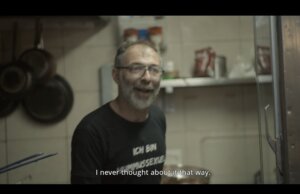
One interview takes place in a Ramla kitchen where Jalal Habit discusses the situation and his life with energy and passion all while sporting an “Ich bin hummussexuelle” t-shirt and preparing the food for his restaurant. He seems angry at the Jews, but in a chef’s businesslike way. He recounts how he was complaining to his friend that the Jews have taken everything from the Arabs, land, hummus, falafel, and how his friend demurred, no they haven’t taken anything, they are “building everything for us and soon they’ll leave and they’ll leave everything to us.”
The Hebrew word du-kiyum, coexistence, is invoked throughout the film. Beyond the Kulna Yachad school in Jaffa where children learn together, however, it mostly describes a hope or a transient memory rather than a concrete way of being. What makes Split compelling is its attention also to the conversations that coexistence often requires people not to have. Jewish and Arab neighbors may work together, maintain friendships and cooperate on municipal initiatives. They can agree about schools, garbage collection, traffic and the everyday business of keeping a city functioning. Yet the larger questions — of history, dispossession, national belonging and competing loyalties — remain unspoken. Split gives those questions a tentative voice.
The alternative to such imperfect arrangements has sometimes been catastrophic. Split does not draw the comparison, but when British India was partitioned in 1947, over 15 million people were displaced, and massacres killed hundreds of thousands. Neither in India nor the Middle East did partition eliminate competing identities. It converted them into borders, refugees and inherited grievances. Despite accepting the partition plan and taking billions of dollars in aid from America and the West, the Islamic Republic of Pakistan has lurched from military coup to corrupt civilian governance without ever safeguarding the rights of women, LGBTQ individuals, or religious minorities.
The relative economic success, and demographic tolerance of Israel’s mixed cities has led to their own challenges. They contain communities with their own histories of war, displacement, and social transformation, particularly from the aftermath of World War II. The filmmakers catch a Jewish resident of Acre as she’s inspecting an abandoned bomb shelter. In a perfect distillation of traumatized Israeli Jewish identity she explains how she sees herself descended from the Shoah and from Ottoman Jews:
My personal story contains the story of my grandmother from Germany and that of my grandfather from the Jewish Quarter in ’48 and it’s a story that passes down, and it’s in my DNA. The experience of the surviving Jew, it’s an existential experience of a people and the desire to annihilate us. And we’re facing it again all over the world.
Meanwhile, different Arab families explain in affecting terms how their families were dispossessed by the State of Israel during the Nakba, from Haifa which became a battlefield, from Acre, and from Jaffa. Ghassan Mounir from Lod gives an extended account of the ongoing challenges placed in his way by the Jewish state: from the attacks on his family in 1948, to the refusal to give him the same building rights as the army veterans and Haredim who surround him. This is the historical context of a state that was nominally set up establishing rights “without distinction of religion or race” and “without domination or subjugation”
We have been in Lod since the 12th century. I grew up on this street, this is my home. [In 1948] the Jews … gathered [the whole village] in the square of the church and the mosque and expelled them to Abdullah. That march — thousands, thousands of people [were forced to make it] in the middle of July while fasting for Ramadan. They walked to Ramallah, some survived and some died.
Nothing of the present situation can be understood without those histories, however differently their residents describe them.
Edited down from a three-episode docuseries that premiered in Haifa, to a 90-minute documentary, Split is unhurried but urgent. It traces family histories as exemplars of different communities’ experiences and also the history of eruptions of urban violence throughout the history of the state. It calmly shows what it’s like to be in a minority where the majority is blasé about its ignorance of your culture.
At times, the movie veers close to despair — the heartfelt testimony of Ilham and Omar Siksik in Jaffa leaves it teetering on the edge. But their hope along with the testimony of Danny Rabinowitz (a Jewish anthropologist) and Mustafa Abbasi (an Arab-Israeli historian of Palestine) holds out the possibility that somehow rival national narratives might coexist in the same physical space. Rabinowitz says he still longs for hope, but without knowing exactly where to look for it. He is waiting for “leaders of vision and courage” from both sides. In the words of Abbasi:
There are those on both sides who believe that there is no shared future. I tell them, the future belongs to coexistence, and there is no solution other than mutual understanding.
When Hanna Safran and Nabila Espanioly — two veterans of the feminist struggle, one Jewish, one Arab — argue about political agency, Espanioly points out how obvious it is in the feminist context that freedom to be yourself is a sine qua non of being free politically. It’s a clear point and one given further depth and richness later by the testimony of Ayat Abu Shamis who is a mother, a resident of Jaffa, and an Arab who writes poetry in Hebrew. She reads her poem in Hebrew about coexistence as part of her interview.
Watching Split and some of the ways Arab-Israelis were treated — specifically how former soccer commentator and MK Zuheir Bahloul talked of his constituents’ rights — reminded me of Count Stanislas de Clermont-Tonnerre’s famous statement of emancipatory racism. The identity prescribed by the State of Israel for Arab-Israelis carries a philosophical contradiction as old as modern Jewish citizenship. In December 1789, during the French Revolution, Clermont-Tonnerre articulated the bargain at the heart of Jewish emancipation: Jews should receive full rights as individuals but no separate political rights as a nation. The promise was equality. The price was the surrender of collective difference in the public sphere.
Israel reverses that historical equation in fascinating and uncomfortable ways. It was established to make Jewish collective identity politically sovereign. Yet within that Jewish state live Arab citizens who — until the passage of the 2018 Israeli Nation-State Law downgraded Arab identity in Israel from “equal” to “special” — had full rights as individuals, but whose own collective identity, history and national aspirations were, by and large, proscribed. The challenge is not merely to grant equal rights to individuals, essential though that is. It is to imagine a democracy capable of accommodating communities whose understandings of the state itself may be irreconcilable with each other.
In last month’s elections, Arab representation in the Knesset reached a record high, approximately one-sixth of its membership. Finally, Arab MKs are at a level approaching the proportion of Arab citizens in the electorate. That political presence matters. But parliamentary representation cannot by itself resolve the contradictions visible on a street in Lod or Jaffa. The novelist Amos Oz famously described the Israeli-Palestinian conflict not as a struggle between good and evil but as a tragedy of “right against right.” In that formulation he recognized that competing claims can possess equal moral force, even when they cannot both be satisfied completely.
Split brings that abstract proposition down to the municipal level, where coexistence is less a philosophical ideal than a daily negotiation. The film’s deeper question is not whether Jews and Arabs can learn to like one another. Some already do. Nor is it whether they can avoid discussing everything that divides them. Evidently, they sometimes must. It is whether a shared civic life can eventually become robust enough to accommodate the disagreements it currently suppresses.
The chef Habit is given the last word: “But I don’t want the Jews to leave. If the Jews leave, it won’t be the same place. Jews and Arabs have to live together, they can live together. If I weren’t optimistic, I would’ve stayed in Ramla.”
As the world perfects the technology and politics of polarization, Israel’s mixed cities offer neither an easy inspiration nor a comforting warning but something more useful: evidence that people can remain profoundly divided while still sharing responsibility for the places they call home. The future depends on learning how to live with our differences — especially when the people across the street have every intention of staying.
“Split: Life in the Israeli Mixed Cities” has its U.S. premiere as part of the Other Israel: New Perspectives Film Festival. It will show on Mon, Nov. 9 at 7:30 PM at the Marlene Meyerson JCC Manhattan and again on Wed, Nov 11, 7:30 PM at the Brooklyn Heights Synagogue.
The post In Israel’s mixed cities, the future of coexistence is already being tested appeared first on The Forward.
