


Uncategorized
Propaganda for Tyrants: The Danger in Tucker Carlson’s ‘Pacifism’

Fox personality Tucker Carlson speaks at the 2017 Business Insider Ignition: Future of Media conference in New York, U.S., November 30, 2017. Photo: REUTERS/Lucas Jackson
When Tucker Carlson sat across from comedian-turned-podcaster Dave Smith last week and declared that the “dividing line” between him and Ben Shapiro was that Shapiro “feels a thrill when killing the enemy,” he wasn’t making a point about morality. He was performing one.
With his trademark half-smirk of false humility, Carlson intoned, “We do not have a right to kill people… we do not have a right to kill the innocent.” Then, as he so often does, he cast himself as a noble voice of moral conscience surrounded by bloodthirsty warmongers. “That’s the dividing line between me and Ben Shapiro,” he said.
But that line doesn’t divide pacifism from bloodlust. It divides moral clarity from moral theater.
The Convenient Conversion
Carlson’s newfound pacifism would be more convincing if it weren’t so exquisitely convenient. He wasn’t always allergic to the use of force. In the early 2000s, he defended the Iraq War, mocked anti-war protesters, and called for “resolute American leadership.”
He praised US strikes in Syria as “necessary shows of strength.” Only after those wars became unpopular — and after populism replaced conservatism — did Carlson decide that any military action involving civilian casualties was inherently immoral.
Since then, he has transformed “anti-war” sentiment into performance art. He interviews strongmen like Vladimir Putin and Iran’s Ayatollah Khamenei with deference bordering on reverence. He portrays their regimes as victims of Western arrogance, scolds the United States for aiding Ukraine’s defense, mocks NATO as an “empire,” and treats every aggressor — from Hamas to the Kremlin — as a misunderstood nationalist simply protecting his homeland.
This is not pacifism. It is appeasement for tyrants, rebranded as empathy.
There’s a clear pattern to Carlson’s moral inversions. When Israel defends itself against fascist terrorist regimes, he insists that “killing civilians” can never be justified. When Russia invades a democracy, he claims the US “provoked” it. When Iran bankrolls terror proxies across the region, he shrugs and asks whether it’s “really our problem.”
He calls this “asking hard questions.” In reality, it’s moral inversion disguised as introspection. His sympathies reliably tilt toward those who wield cruelty as policy and away from the democracies that agonize over conscience even as they fight for survival.
That pattern reached its nadir when Carlson hosted white nationalist Nick Fuentes — a Hitler- and Stalin-admiring Holocaust denier whom he treated not with revulsion but with indulgent curiosity. Fuentes spewed bile about “Zionist media control.” Carlson nodded, called him “talented,” and moved on. In that same interview, Carlson calmly declared that he “hates Christian Zionists more than anyone.” When public outrage followed, he feigned contrition, claiming he’d merely been “mad.” It was the same pattern as always: provoke, deny, and reframe the provocation as misunderstood virtue.
Ben Shapiro and the Real Moral Divide
Carlson’s supposed “dividing line” with Shapiro reveals the delusion he’s selling. Shapiro’s worldview — rooted in Jewish ethics, classical liberalism, and just-war theory — recognizes the tragic necessity of force in confronting evil. The question is not whether killing may ever occur, but whether moral societies can survive without defending themselves.
Carlson now confuses moral restraint with moral paralysis. He accuses others of bloodlust because he has lost the vocabulary to distinguish between aggression and defense. He sees all war as equally corrupt, while Shapiro understands that refusing to confront evil ensures its victory.
Carlson’s selective pacifism collapses under the weight of reality — especially in the war Hamas started and sustained by cynical design. Hamas doesn’t merely fight Israel; it fights the very concept of moral civilization. It builds command centers beneath hospitals and schools, fires rockets from residential towers, and blocks civilians from reaching Israeli-designated humanitarian corridors.
Its 700 kilometers of tunnels, which could have sheltered ordinary Gazans, were reserved for its terrorists — not its children.
When ordinary Gazans protest, Hamas executes them. In October 2025 alone, it murdered hundreds accused — without trial — of “collaboration.”
This is not a movement that protects innocents. It is a fascist regime that feeds on civilian death. Every corpse is a press release. Every tragedy, a weapon. Hamas’s strategy is not merely to harm Israel — but to corrupt the world’s conscience by making morality itself seem impossible.
Israel, by contrast, spends billions on pure defense: Iron Dome interceptors, bomb shelters, warning systems, and evacuation zones — designed to protect civilians, both Israeli and Palestinian. Its moral imperative is the same as every democracy’s: to safeguard life even amid war. That effort often fails — not from malice, but from the impossible calculus of fighting an enemy that hides behind its own people.
Carlson’s moral arithmetic ignores that calculus entirely. If, as he claims, “no innocent death” is ever acceptable, then every democracy facing fascist regimes like Hamas is doomed. For if one side obeys the laws of war while the other hides behind them, only barbarism will prevail.
The Anti-War Pose as Anti-Moralism
Carlson’s evolution — from conventional conservative commentator to sanctimonious defender of authoritarians — mirrors a deeper sickness that is growing the West: the belief that moral complexity is hypocrisy, that self-defense is indistinguishable from aggression, and that survival itself is suspect.
It’s the same mindset that brands Israel an “occupier” for refusing to surrender its ability to defend itself, calls NATO “imperial,” and derides Churchill as a “warmonger.” At its core, this is not compassion, but cowardice marketed as virtue.
Carlson’s moral theater now serves those who thrive on Western self-doubt. Russian state television airs his commentaries. Iranian media echoes his talking points. Hamas officials cite his words when denouncing Israel.
He plays the role once filled by the isolationists of the 1930s — the celebrity preachers, pilot, and industrialists who mocked Churchill as a warmonger and thought peace could be purchased with silence. Those voices, too, claimed to be true moral realists. History judged them otherwise.
The Real Dividing Line
Carlson says the dividing line between himself, and Ben Shapiro is the “thrill of killing.” The real line is between moral seriousness and moral vanity — between those who know that defending life and free societies sometimes requires force and those who posture as saints while others bear the cost of courage.
Under very limited circumstances, pacifism can be noble. But Carlson’s brand of pacifism isn’t noble — it’s narcissistic: the comforting illusion that moral purity can be preserved by staying on the sidelines.
Slavery didn’t end through persuasion. Nazism wasn’t defeated by restraint. Evil stops only when it’s resisted — sometimes by force, always by moral clarity.
Carlson wants his audience to mistake cowardice for compassion and indulgence for conscience. If that illusion continues to spread, he won’t just distort history — he’ll help repeat its darkest chapters.
Micha Danzig is an attorney, former IDF soldier, and former NYPD officer. He writes widely on Israel, antisemitism, and Jewish history and serves on the board of Herut North America.
Uncategorized
Israel is the one thing both Pennsylvania gubernatorial candidates agree on
(JTA) — Democratic Pennsylvania Gov. Josh Shapiro and GOP opponent Stacy Garrity faced off on Wednesday in a heated gubernatorial debate, clashing over most policy issues — with the notable exception of Israel.
“I want to recognize the anniversary of the Hamas attacks, where 1,200 innocent people were killed, including 49 Americans,” said Garrity, referring to the third anniversary of Hamas’ Oct. 7, 2023, attack on Israel.
“I want to remember the lives that were stolen, the families that were changed forever, and the Americans that didn’t make it home,” she added.
While Garrity, Pennsylvania’s state treasurer, has the endorsement of President Donald Trump, Shapiro has a 25 percentage point lead in a poll released Wednesday. Both candidates won their primaries uncontested in May, and both have been outspoken against antisemitism.
Shapiro, who himself is Jewish, likewise recognized “the third anniversary of the October 7 massacre” at the debate. He recalled how “Hamas, a terrorist organization, broke into Israel and murdered 1,200 innocents, took over 250 hostage, including many Americans.”
“This is a moment where my heart stands with the people of Israel,” he said. “My heart stands with the Jewish community, who I know are grieving as a result of this.”
“This is a moment where we need to stand together against terrorism, against hate and against antisemitism,” the governor added.
Although the candidates shared similar perspectives on Israel during Wednesday’s debate, they clashed on numerous other topics, including the death penalty, voter identification, taxes and tariffs.
Asked by the debate moderator about the plunging support for Israel in the Democratic Party, Shapiro replied that he has “been very, very consistent” in both his “love of Israel” and his disagreements with Prime Minister Benjamin Netanyahu.
Shapiro then noted that Israelis will head to the polls in just a few weeks to choose their next leader. He expressed hope that they would not elect Netanyahu, whom he said “has led Israel down a very dangerous and isolated path.”
“I want America to have a strong relationship with Israel and with the Israeli government,” Shapiro added. “That’s not possible right now with the Netanyahu government in charge.”
Shapiro, one of the most prominent Jewish Democrats nationwide, was among the final candidates considered by Kamala Harris in her vice-presidential search in the 2024 election. He is also seen as a possible 2028 presidential hopeful.
But Shapiro has also faced the challenges posed by increasing antisemitism in America. During Harris’s search, for example, a website and social media feed labeled him “No Genocide Josh” over his support for Israel.
In April 2025, an arsonist set fire to Shapiro’s house just hours after his family had conducted a Passover seder. In 2018, while Shapiro was serving as Pennsylvania’s attorney general, a terrorist killed 11 people and injured six others at the Tree of Life synagogue in Pittsburgh..
Garrity, meanwhile, has more than tripled Pennsylvania’s investment in Israel bonds in her current role. She invested $20 million after the Oct. 7 attack and another $35 million in July 2025.
The post Israel is the one thing both Pennsylvania gubernatorial candidates agree on appeared first on The Forward.
Uncategorized
Protesters overrun Oct. 7 Israeli peace vigil attended by Mamdani
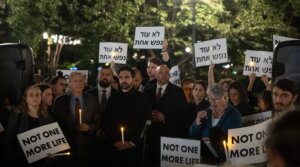
(New York Jewish Week) — Hundreds of pro-Palestinian protesters on Wednesday night overran a vigil marking Oct. 7 attended by New York City Mayor Zohran Mamdani.
The demonstrators swamped the area of Union Square Park that was supposed to host the event held by Israelis for Peace, a left-wing peace group. The organizers moved the vigil to a nearby spot in the park surrounded by police barricades as speakers struggled to be heard above the protesters. Attendees held electrically lit candles and signs reading, “Not one more life.”
Upon learning Mamdani was present, the pro-Palestinian protesters booed and broke into a chant of “Traitor!” and “Zohran, what do you say? How many boots did you lick today?”
The mayor stood solemnly throughout the event and did not speak at the vigil or address the protesters.
One protester yelled at Israelis for Peace organizers: “We don’t want peace with Israelis, bro! We sent your people to hell on October 7.” Other protesters wielded megaphones and drums while chanting anti-Israel slogans, including “Gaza will be liberated!” and “Israel is a terrorist state!”
Earlier in the evening, protesters were seen grabbing the electric candles intended for the vigil and mockingly singing the Jewish folk song “Hava Nagila.”
Another protester in the vigil area shouted out his disapproval of Mamdani: “He’s 100% Muslim but as of now, he stands as an ambassador of Zionism and U.S. imperialism.”

And someone else carried a poster depicting Yahya Sinwar, the Hamas leader who helped mastermind the attacks on southern Israel that killed 1,200 people three years ago Wednesday.
Amid the cacophony, Brad Lander, the Jewish Democratic nominee running to represent parts of Lower Manhattan and Brooklyn in Congress, took the microphone during the vigil to recite the words of the mother of a 20-year-old man who was murdered at the Nova music festival three years ago. He looked visibly shaken as the evening progressed, watching the protesters while speakers shared testimonies of people killed on Oct. 7.
Speakers also shared testimonies of Palestinians killed by the Israel Defense Forces, and the event included the group being led in a Muslim prayer. Many speakers referred to Israel’s campaign in Gaza as a “genocide.”
The vigil ended with the participants raising their candles and reciting the Mourner’s Kaddish, the traditional Jewish prayer honoring the dead. As they filed out of the event, the protesters shouted “Death to the IDF!”
Lander told the Jewish Telegraphic Agency that throughout the ceremony he felt “a deep and profound sadness for the testimony” of those lost, recalling that he’s met family members of some of the victims, both Jewish and Palestinian, whose stories were read.
“That level of heartbreak is a lot more than the level of having some people shouting,” he said. “The flattening of empathy is another sadness. And the fact that this is one of the few places where people even try to say Kaddish together and to mourn both Israeli lives lost on Oct. 7 and 75,000 Palestinian lives lost in Israel’s war since, is also sad. And that’s why it was important to do.”
Amichai Lau-Lavie, who leads New York’s Lab Shul and led the Mourner’s Kaddish, told JTA that “In the heat of these protest battles, there’s no room for nuance. It’s the slurs and the slogans. And what we saw here tonight was hatred that is coming from a good place of justice and freedom, but is not attuned to what we’re doing here.” He described that goal as one that acknowledges that both peoples’ futures are intertwined.
Lau-Lavie also praised the mayor for coming. “I can say I’m glad about the fact that the mayor was here and witnessed this animosity, and stood with us,” he noted. “For all his flaws, and there are many, I hope he got something.”
Despite the war of words, both gatherings disbanded peacefully. No arrests were made.
Amid the rival gatherings, Ross Glick, a New York pro-Israel activist and former executive director of Betar US, a far-right staunchly Zionist group, arrived with a group of counter-protesters holding Israeli flags. They were swiftly confronted by anti-Israel protesters, and the two sides got into a shouting match as they stood separated by a barrier.
The pro-Palestinian protesters had held a rally at City Hall, organized by Pal-Awda and various student groups, before heading to the location of the vigil. They condemned Israel and the United States for the war in Gaza, but also criticized Mamdani for capitulating “to Zionist pressure.” Some carried anti-Mamdani signs, including one that depicted Mamdani rolling out a red carpet for Israeli Prime Minister Benjamin Netanyahu.
The throng of protesters outside City Hall chanted “Free Palestine,” “Globalize the intifada,” “Resistance is justified when people are occupied,” and “Israel is a terrorist state.”
One protester held a sign reading “Operation Epstein Fury,” a play on Operation Epic Fury. Another held a sign that read “Liberation in action Oct. 7.” Nearby, an Israeli flag was held up with the text “Death cult” and an inverted red triangle — a Hamas symbol — atop the Star of David.

Earlier in the day, Jews in the city who marked Oct. 7 expressed fear about the political environment three years on from the attacks.
Toni Rabin, an 83-year-old Upper West Sider who lived in Israel in the 1970s, told JTA that she calls herself a progressive and has attended protests against President Donald Trump. But like many New York Jews, she gets unnerved by Mamdani.
“I’m burying my head in the sand a bit, because it’s a little too much for me to handle,” she admitted. She timed her arrival for her swim at the Marlene Meyerson JCC Manhattan to coincide with the commemoration of the third anniversary of the Oct. 7 attacks by Hamas in southern Israel.
“We should never forget,” she said. “We already have forgotten so much about the Holocaust, and there are very few people left who can speak about it anymore. They’re dying out. … So, we have to remember the horrific event that took place, the shock.”
She spoke over the sound of a cellist who performed for a small crowd in a lobby that was otherwise packed with small children having lunch with grownups. There was art on display by the Israeli artist Zeev Engelmayer from his “Strokes of Hope” exhibition.
Throughout the city on Wednesday, New Yorkers found themselves coping with the intense memories of learning about the 1,200 people, mostly Israelis but also foreign nationals, slain in Hamas-led attacks on southern Israel on Oct. 7, 2023, the majority of them civilians. Meanwhile, Palestinian residents and their supporters mourned the more than 74,000 Palestinians killed in the ensuing Gaza war, according to Gaza’s Ministry of Health. The ministry doesn’t distinguish between civilian and combatant deaths.
Hours before arriving at the vigil, Mamdani posted a statement on X in which he paid tribute both to Israelis killed by Hamas attackers in southern Israel on Oct. 7, 2023, and to Palestinians killed in the Gaza war that followed.
His statement infuriated leaders in the mainstream Jewish community, who read his post as yet another vehicle for accusing the Israeli government of genocide and apartheid.
Wednesday “marks three years since the horrific war crimes of October 7. On that day, Hamas killed more than 1,100 Israelis and abducted 251 others,” the mayor said in his X post. “We grieve alongside our many friends and neighbors who still carry that unthinkable loss.”
He went on, however, to say that the Israeli government led by Prime Minister Benjamin Netanyahu presided over an “ongoing genocide in Gaza,” saying that Israel “has killed more than 74,000 Palestinians — including more than 21,000 children.”
Mamdani continued, “Three years later, we must refuse to accept a world in which occupation and apartheid continue, where war crimes are met with impunity, and our federal government continues its complicity with every arms shipment.”
The city’s Jewish Community Relations Council was scathing in its response, saying that Mamdani “continues to fall short” of bringing New Yorkers together.
“It does not honor the dead to pit them against each other,” it said in its statement. “It is shameful. Today, Jewish New Yorkers across the five boroughs walked through metal detectors to drop off our children at preschool, thanked the police officers posted outside our synagogues for keeping us safe, tucked in our Jewish stars on the subway, and felt the gut punch of grief remembering the 1,200 innocent people who were slaughtered in their homes, in front of their families, and dancing at a music festival just because they were Jewish.”
Lander, favored to win his race for Congress next month, said on X ahead of the vigil that there was room to mourn the dead on all sides. “On this third anniversary of October 7th, a good start is to try to resist the flattening of empathy, to let ourselves weep for all the lives lost, the children killed, the families torn apart, the homes destroyed.”
The post Protesters overrun Oct. 7 Israeli peace vigil attended by Mamdani appeared first on The Forward.
Uncategorized
Newly aired recordings of paramedic Amit Mann’s final hours renew push to let families access Oct. 7 records
(JTA) — Three years after paramedic Amit Mann, 22, was killed by Hamas while treating the wounded in Kibbutz Be’eri on Oct. 7, newly aired recordings of her final calls revealed fresh and harrowing details about her last hours.
The recordings, aired by Channel 12 on Tuesday, prompted her sister, Haviva Mann Izikson, to renew an appeal for a centralized system to ensure other families are not left searching for similar records years later.
The calls capture Amit repeatedly calling emergency services as Hamas terrorists overran Be’eri, seeking assistance while continuing to treat wounded residents.
The previously unknown calls came to light by chance, when, earlier this year, Mann Izikson contacted the Magen David Adom emergency service seeking the precise times of calls Amit had made on Oct. 7 as she updated a presentation she planned to give about her sister. MDA provided information on seven calls. Until then, the family had known of only four.
Mann Izikson said hearing them revealed both that what Amit endured was “even worse than we had thought” and the extent to which Amit continued caring for others even as the situation around her deteriorated.
“It showed me even more both the hell that she went through and, on the other hand, who she was. What she was dealing with, what she went through there, which was even worse than we had thought, and how despite all of that she keeps treating the wounded in every way she can,” Mann Izikson told the Jewish Telegraphic Agency Wednesday as she prepared to return to Be’eri for a memorial event at the dental clinic where Amit was killed.
The recordings trace Amit’s increasingly desperate attempts to summon help as terrorists closed in around the dental clinic. Hours later, she sent her sisters a chilling last message: “They’re here, in the clinic. I don’t think I’ll make it out of here. I love you.”
In one call, Amit is heard struggling to convey the scale of what was happening to a police dispatcher.
“I don’t understand what’s going on,” she told the dispatcher, describing wounded and dead people around her and continued gunfire. She asked whether the army or police had reached the kibbutz. When the dispatcher told her help was coming and urged her to stay inside, Amit began to cry. “Just tell me you’re here.”
Hours later, at 10:41 a.m., after seven calls to Magen David Adom, Israel’s national emergency medical service, Amit made her final recorded call to police. “Listen, terrorists have infiltrated Be’eri! We urgently need an ambulance or police here. Come urgently to the dental clinic.”
Hearing the latest recordings was heartbreaking, Mann Izikson said. She was struck by Amit’s ability to pull herself together after desperate calls for help and return to caring for the wounded, comforting them, asking about their families, bringing them water and improvising with what little there was. Amit placed helmets beneath their heads and covered those who were cold from blood loss.
“She keeps them alive until her final moments, and she stays true to herself until her last breaths,” Mann Izikson said. “It just amazed us.”
Mann Izikson is urging the state to establish a central body that would collect all existing documentation from Oct. 7, including recordings held by emergency services and police as well as security-camera footage and other material, catalogue it by victim, and contact each family. Such a body, she said, should tell relatives: “We have documentation of your loved one. Would you like to receive it?”
“If the family wants it, then all of it should be provided to them proactively,” she added.
She pointed to the family of Gil Buyum, 55, a member of Be’eri’s security squad whom Amit treated after he was shot. In one call, Amit reported him wounded; in a later call, she reported that he had died.
The two recordings allowed Buyum’s widow, Ayelet, to narrow down the time of her husband’s death, Mann Izikson said. Buyum’s 22-year-old son, Inbar “Buri” Buyum, was also killed while trying to defend the kibbutz that morning.
“Only because of Amit’s recordings was she able to identify the 20-minute window in which he died,” Mann Izikson said. “That’s just one example of how someone can get some kind of closure from something like this.”
She said families should be able to decide for themselves whether they want such material. “It belongs to the families. It is the families’ material, and the families should decide what, if anything, to do with it.”
A law passed in July established an Oct. 7 Memory Authority slated to include an archive and centralize documentation of the attack. The law is due to take effect in January, but it is unclear whether the authority will match material to individual victims and notify their families.
JTA was unable to reach the Prime Minister’s Office and the Israel State Archives, the government body responsible for preserving state records, in time for publication.
Merav Israeli-Amarant, CEO and co-founder of the Civil Commission on Oct. 7 Crimes by Hamas, which released a major report in May documenting sexual violence during the attack and its aftermath, said Mann Izikson’s proposal was “profoundly important.”
“Families should not have to discover, years later and by chance, that recordings, footage, or other documentation connected to their loved ones exist,” Israeli-Amarant told JTA. She said there should be a mechanism that “approaches families with sensitivity,” while giving them the choice of whether to “receive it, view it, preserve it, or not engage with it at all.”
But Israeli-Amarant also said there was “unique importance” in preserving such material through civilian institutions, noting that many Oct. 7 families feel abandoned by the state and that some prefer documentation to be handled independently and “outside political considerations.”
Maya Gan-Zvi, manager of the National Library of Israel’s Bearing Witness: October 7 Archive, which has collected hundreds of thousands of files from the attack, cautioned that proactively approaching families, as Mann Izikson proposes, also raised ethical questions because families differ widely in how, and whether, they want to encounter such material.
“Some want to receive everything, and some do not want to know, or not yet,” Gan-Zvi told JTA, adding that even members of the same family may disagree. Contacting a family without first knowing its wishes could “reopen wounds,” she said, particularly in cases involving graphic material or footage filmed by the terrorists themselves.
Gan-Zvi said she favored a system in which bereaved families themselves would take the initiative, registering that they wanted to be contacted, specifying the types of material they wanted and receiving a description of what had been found before deciding whether to obtain it.
According to Israeli-Amarant, any system would face “significant” practical and legal hurdles because Oct. 7 material is scattered among government bodies, emergency services, police, the military, media outlets and private individuals, raising questions of ownership, privacy, consent and the rights of victims’ families.
Some recordings or footage may also be evidence in ongoing investigations or criminal proceedings against Hamas terrorists, she said, making chain of custody, publication restrictions and the integrity of those proceedings additional considerations.
Mann Izikson said providing documentation would help answer fundamental questions that remained unresolved.
“Three years later, we still don’t know the full truth and don’t understand how this happened,” she said. “Every piece of material like this can shed another bit of light and help us understand a little bit more.”
She has listened to the newly aired recordings repeatedly, echoing a pattern she described to JTA on the first anniversary of the attack, when she said she reread Amit’s messages from Oct. 7 every day, in part to piece together what happened during her sister’s final hours and try to come to terms with it.
It took two and a half days for Amit’s body to be identified. Mann Izikson told JTA at the time that when her sister was lowered into the grave, “I felt like they were burying half of my own child. I wanted to go in instead of her.”
Even amid the war, the hostage crisis and the wider grief in Israel on the first anniversary of Oct. 7, Mann Izikson said Amit’s loss eclipsed everything else. “There is all the rest — and the rest is painful and scary,” she said. “And then there is Amit and nothing else at all.”
This article originally appeared on JTA.org.
The post Newly aired recordings of paramedic Amit Mann’s final hours renew push to let families access Oct. 7 records appeared first on The Forward.
