


Uncategorized
Protesters overrun Oct. 7 Israeli peace vigil attended by Mamdani
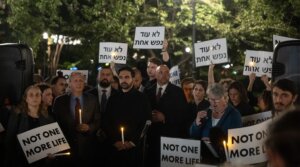
(New York Jewish Week) — Hundreds of pro-Palestinian protesters on Wednesday night overran a vigil marking Oct. 7 attended by New York City Mayor Zohran Mamdani.
The demonstrators swamped the area of Union Square Park that was supposed to host the event held by Israelis for Peace, a left-wing peace group. The organizers moved the vigil to a nearby spot in the park surrounded by police barricades as speakers struggled to be heard above the protesters. Attendees held electrically lit candles and signs reading, “Not one more life.”
Upon learning Mamdani was present, the pro-Palestinian protesters booed and broke into a chant of “Traitor!” and “Zohran, what do you say? How many boots did you lick today?”
The mayor stood solemnly throughout the event and did not speak at the vigil or address the protesters.
One protester yelled at Israelis for Peace organizers: “We don’t want peace with Israelis, bro! We sent your people to hell on October 7.” Other protesters wielded megaphones and drums while chanting anti-Israel slogans, including “Gaza will be liberated!” and “Israel is a terrorist state!”
Earlier in the evening, protesters were seen grabbing the electric candles intended for the vigil and mockingly singing the Jewish folk song “Hava Nagila.”
Another protester in the vigil area shouted out his disapproval of Mamdani: “He’s 100% Muslim but as of now, he stands as an ambassador of Zionism and U.S. imperialism.”

And someone else carried a poster depicting Yahya Sinwar, the Hamas leader who helped mastermind the attacks on southern Israel that killed 1,200 people three years ago Wednesday.
Amid the cacophony, Brad Lander, the Jewish Democratic nominee running to represent parts of Lower Manhattan and Brooklyn in Congress, took the microphone during the vigil to recite the words of the mother of a 20-year-old man who was murdered at the Nova music festival three years ago. He looked visibly shaken as the evening progressed, watching the protesters while speakers shared testimonies of people killed on Oct. 7.
Speakers also shared testimonies of Palestinians killed by the Israel Defense Forces, and the event included the group being led in a Muslim prayer. Many speakers referred to Israel’s campaign in Gaza as a “genocide.”
The vigil ended with the participants raising their candles and reciting the Mourner’s Kaddish, the traditional Jewish prayer honoring the dead. As they filed out of the event, the protesters shouted “Death to the IDF!”
Lander told the Jewish Telegraphic Agency that throughout the ceremony he felt “a deep and profound sadness for the testimony” of those lost, recalling that he’s met family members of some of the victims, both Jewish and Palestinian, whose stories were read.
“That level of heartbreak is a lot more than the level of having some people shouting,” he said. “The flattening of empathy is another sadness. And the fact that this is one of the few places where people even try to say Kaddish together and to mourn both Israeli lives lost on Oct. 7 and 75,000 Palestinian lives lost in Israel’s war since, is also sad. And that’s why it was important to do.”
Amichai Lau-Lavie, who leads New York’s Lab Shul and led the Mourner’s Kaddish, told JTA that “In the heat of these protest battles, there’s no room for nuance. It’s the slurs and the slogans. And what we saw here tonight was hatred that is coming from a good place of justice and freedom, but is not attuned to what we’re doing here.” He described that goal as one that acknowledges that both peoples’ futures are intertwined.
Lau-Lavie also praised the mayor for coming. “I can say I’m glad about the fact that the mayor was here and witnessed this animosity, and stood with us,” he noted. “For all his flaws, and there are many, I hope he got something.”
Despite the war of words, both gatherings disbanded peacefully. No arrests were made.
Amid the rival gatherings, Ross Glick, a New York pro-Israel activist and former executive director of Betar US, a far-right staunchly Zionist group, arrived with a group of counter-protesters holding Israeli flags. They were swiftly confronted by anti-Israel protesters, and the two sides got into a shouting match as they stood separated by a barrier.
The pro-Palestinian protesters had held a rally at City Hall, organized by Pal-Awda and various student groups, before heading to the location of the vigil. They condemned Israel and the United States for the war in Gaza, but also criticized Mamdani for capitulating “to Zionist pressure.” Some carried anti-Mamdani signs, including one that depicted Mamdani rolling out a red carpet for Israeli Prime Minister Benjamin Netanyahu.
The throng of protesters outside City Hall chanted “Free Palestine,” “Globalize the intifada,” “Resistance is justified when people are occupied,” and “Israel is a terrorist state.”
One protester held a sign reading “Operation Epstein Fury,” a play on Operation Epic Fury. Another held a sign that read “Liberation in action Oct. 7.” Nearby, an Israeli flag was held up with the text “Death cult” and an inverted red triangle — a Hamas symbol — atop the Star of David.

Earlier in the day, Jews in the city who marked Oct. 7 expressed fear about the political environment three years on from the attacks.
Toni Rabin, an 83-year-old Upper West Sider who lived in Israel in the 1970s, told JTA that she calls herself a progressive and has attended protests against President Donald Trump. But like many New York Jews, she gets unnerved by Mamdani.
“I’m burying my head in the sand a bit, because it’s a little too much for me to handle,” she admitted. She timed her arrival for her swim at the Marlene Meyerson JCC Manhattan to coincide with the commemoration of the third anniversary of the Oct. 7 attacks by Hamas in southern Israel.
“We should never forget,” she said. “We already have forgotten so much about the Holocaust, and there are very few people left who can speak about it anymore. They’re dying out. … So, we have to remember the horrific event that took place, the shock.”
She spoke over the sound of a cellist who performed for a small crowd in a lobby that was otherwise packed with small children having lunch with grownups. There was art on display by the Israeli artist Zeev Engelmayer from his “Strokes of Hope” exhibition.
Throughout the city on Wednesday, New Yorkers found themselves coping with the intense memories of learning about the 1,200 people, mostly Israelis but also foreign nationals, slain in Hamas-led attacks on southern Israel on Oct. 7, 2023, the majority of them civilians. Meanwhile, Palestinian residents and their supporters mourned the more than 74,000 Palestinians killed in the ensuing Gaza war, according to Gaza’s Ministry of Health. The ministry doesn’t distinguish between civilian and combatant deaths.
Hours before arriving at the vigil, Mamdani posted a statement on X in which he paid tribute both to Israelis killed by Hamas attackers in southern Israel on Oct. 7, 2023, and to Palestinians killed in the Gaza war that followed.
His statement infuriated leaders in the mainstream Jewish community, who read his post as yet another vehicle for accusing the Israeli government of genocide and apartheid.
Wednesday “marks three years since the horrific war crimes of October 7. On that day, Hamas killed more than 1,100 Israelis and abducted 251 others,” the mayor said in his X post. “We grieve alongside our many friends and neighbors who still carry that unthinkable loss.”
He went on, however, to say that the Israeli government led by Prime Minister Benjamin Netanyahu presided over an “ongoing genocide in Gaza,” saying that Israel “has killed more than 74,000 Palestinians — including more than 21,000 children.”
Mamdani continued, “Three years later, we must refuse to accept a world in which occupation and apartheid continue, where war crimes are met with impunity, and our federal government continues its complicity with every arms shipment.”
The city’s Jewish Community Relations Council was scathing in its response, saying that Mamdani “continues to fall short” of bringing New Yorkers together.
“It does not honor the dead to pit them against each other,” it said in its statement. “It is shameful. Today, Jewish New Yorkers across the five boroughs walked through metal detectors to drop off our children at preschool, thanked the police officers posted outside our synagogues for keeping us safe, tucked in our Jewish stars on the subway, and felt the gut punch of grief remembering the 1,200 innocent people who were slaughtered in their homes, in front of their families, and dancing at a music festival just because they were Jewish.”
Lander, favored to win his race for Congress next month, said on X ahead of the vigil that there was room to mourn the dead on all sides. “On this third anniversary of October 7th, a good start is to try to resist the flattening of empathy, to let ourselves weep for all the lives lost, the children killed, the families torn apart, the homes destroyed.”
The post Protesters overrun Oct. 7 Israeli peace vigil attended by Mamdani appeared first on The Forward.
Uncategorized
Ossoff vs. Collins: The choices facing Jewish voters in the Georgia Senate race
(JTA) — Georgia Jews will choose between a Democratic politician who wants to limit arms sales to Israel and a Republican with ties to white nationalists when they head to vote Tuesday in a Senate race that will help determine which party controls the chamber.
The race pits incumbent Jewish Sen. Jon Ossoff – widely expected to be a 2028 presidential contender – against GOP Rep. Mike Collins. The Republican challenger has received a good deal of media attention, as well as attacks by his opponent, over family members’ and former employees’ far-right political views. Ossoff, meanwhile, sparked outrage among some in the Jewish community when he became one of the earliest Senate Democrats to vote to halt certain arms sales to Israel.
Collins’ son-in-law, David Alan Scheer II, has invoked the Jewish Bolsheviks conspiracy theory propagated by Nazi Germany that blamed Jews for atrocities committed by the Soviet Union. He has also complained about Holocaust education and media on the subject.
“They don’t tell us the history of Germany before World War II,” Scheer said in a YouTube video last year, titled “I’m NOT a Judeo Christian.”
He continued, “All we’re told is Germany bad, Hitler evil, don’t ask questions. Holocaust, Holocaust, Holocaust. Here’s 50 movies every year about the Holocaust and why it’s so bad.”
In the same video, Scheer also said that “Jewish executives run the entire mainstream media complex” as well as “homosexual propaganda, they run all of the fraudulent banking systems and insurance scams. They are behind this orchestrated downfall of what was once the most prosperous nation in the world.” Israeli newspaper Haaretz has reported that Scheer apparently lives in a house built on property owned by Collins.
The Collins campaign did not return the Jewish Telegraphic Agency’s request for comment. But elsewhere Collins has addressed Scheer’s statements by saying, “I don’t believe or support those views.”
Scheer did not respond to a request for comment.
Meanwhile, a former Collins staffer had posted Nazi imagery and an image of what appeared to be himself in KKK robes, The Washington Post reported in August. Collins replaced another staffer — his chief of staff Kip Talley — in 2024 after Slate reported that he was in a group chat with streamer Nick Fuentes, widely accused of being one of the internet’s foremost antisemites, and white supremacist Richard Spencer. Slate reported that the chat was dedicated to trying to help Charles Johnson, who has been accused of promoting Holocaust denial and was in jail at the time.
In a statement, Talley told Slate that he acted “solely in my personal capacity after hearing concerns that an acquaintance I have known for years was being mistreated in custody and denied basic medical care.”
The Georgia congressman also appeared at last year’s New York Young Republican Club gala, which drew controversy as it hosted white nationalists and a number of officials from Germany’s far-right AfD party. Fuentes said that he received an invitation that was later rescinded, and Jewish New York City Council member Inna Vernikov backed out of the event and suggested the decision was connected to antisemitism on the right.
Collins has responded to questions about his connections to these white nationalist elements by saying he condemns “all forms of antisemitism” and hate, and citing his support for Israel.
J Street, the liberal Jewish Middle East advocacy group, homed in on Collins’ far-right connections in a 15-second ad released last week that ended with the message, “Mike Collins: Dangerously extreme for Georgia.”
The attack ad was the first released in J Street’s $3 million campaign this year to take down six Republican candidates who are backed by the pro-Israel lobbying group AIPAC. In a piece for the Atlanta Jewish Times, Collins wrote earlier this month that he supports Israel “because my faith tells me to and because it is the right policy for America.”
Ossoff, meanwhile, has long targeted Collins over his white nationalist ties, calling him a “notorious bigot, antisemite and extremist” in June. Ossoff told Collins during a debate that he “hired half the Third Reich to staff your congressional office.”
The quip drew some pushback. “Jon Ossoff, my advice to him is, if you start calling your political opponents Nazis, maybe it’s time to shut up,” said The Atlantic’s center-right staff writer David Brooks, during a PBS NewsHour conversation about personal attacks in this year’s U.S. Senate races. “That’s just not what we do here in this country.”
Meanwhile, Collins’ Jewish supporters have said that Ossoff’s status as a Democrat — a party that increasingly includes strident anti-Zionist voices — is more damning than the headlines around Collins.
“At a time of rising antisemitism, at a time when Jewish Americans need friends, Mike Collins has been a friend to the Jewish community,” Sam Markstein, spokesperson for the Republican Jewish Coalition, told JTA. He said that Collins was “a friend to the Jewish community in the aftermath of Oct. 7” and pointed to his voting record on Israel.
Eric Levine, an RJC board member, said he has not been involved in this particular race but that extremes “must be condemned” on both sides.
“It is never a good thing to have ties to antisemitic/far-right figures,” he told JTA in a text. “I will also say, it is never a good thing to have ties to antisemitic/far left figures like Hasan Piker, [New York Mayor] Zohran Mamdani, [Michigan Senate candidate] Abdul el-Sayed and much of the DSA/Democratic caucus.”
Piker, an anti-Israel streamer who has campaigned with some left-wing Democratic candidates, has drawn heat for remarks about American Jews’ connection to Israel. Earlier this year, he named Ossoff positively as a “dark horse” contender for the 2028 Democratic presidential nomination. Ossoff later distanced himself from Piker and has said he will not run for president in 2028. Ossoff endorsed El-Sayed after he won the Democratic nomination in Michigan.
Ossoff has also come under fire for his decision to vote to block certain arms sales to Israel during the height of the Gaza war in November 2024, a position that he has generally stuck to since then.
In July 2025 he voted to block a sale of rifles to Israel, citing mass starvation in Gaza caused by “the policies of Prime Minister Benjamin Netanyahu’s government,” but voted against a resolution that would block an air-to-ground munitions sale.
Ossoff wrote at that time that the U.S. “must continue to support the Israeli people, who face the persistent threat of rocket and missile attack and have been subjected to intense aerial bombardment from Iran, Lebanon, and Yemen.”
Though Ossoff called his commitment to Israel’s security “ironclad” in a Senate floor speech ahead of the arm sales vote, some Jewish voters and organizations said it rang hollow.
Michael Morris, publisher of the Atlanta Jewish Times, penned an open letter this August blasting Ossoff for “lying to me and your constituents” about his support for Israel.
Ossoff’s first vote against weapons in November 2024 spurred another critical letter from several Georgia Jewish organizations including synagogues, Jewish schools, the local Anti-Defamation League chapter and other groups. His vote also drew the attention of AIPAC, which released 30-second ads attacking U.S. senators — including Ossoff — who had voted to block weapons sales.
Asked about Collins’ far-right ties, Morris told JTA he did not believe they were disqualifying.
“Most of the complaints about him are about his son-in-law who is a virulent antisemite,” Morris said in a text. “But his son-in-law does not get to vote, and as a father of 4 girls I can tell you that we do not get ANY say in who our girls marry, so from that standpoint, I am not concerned.”
Morris also said that neither President Donald Trump nor President Joe Biden condemned the most extreme among their voters, and opined that when it comes to Collins’ own extreme backers, he “can maintain their support without taking in their position.”
A number of readers disagreed with Morris’ sharp criticism of Ossoff, however, and wrote letters to the editor expressing their disapproval, as well as their concern about Collins.
“Mike Collins has peddled antisemitism. He has surrounded himself with bigotry while refusing to denounce white supremacy,” wrote a reader named Richard Mitchell, who said he is from Atlanta. “These values do not represent Georgians and are fundamental to why I will not be supporting Collins this election.”
Halier Soifer, CEO of the Jewish Democratic Council of America, which has endorsed Ossoff, wrote in a statement to JTA that her organization recognizes Ossoff’s “steadfast support for Israel’s security and future as a Jewish and democratic state.”
“Georgia voters should remember that a vote for Mike Collins is a vote for Donald Trump, and Collins is one of the most extreme candidates on the ballot,” she wrote.
This article originally appeared on JTA.org.
The post Ossoff vs. Collins: The choices facing Jewish voters in the Georgia Senate race appeared first on The Forward.
Uncategorized
Arab parties have rarely been full partners in governing Israel. It’s time to let them into the tent of Abraham.
Like a goal-line pileup in football, with half the players signaling a touchdown and the other half celebrating a defensive stop, everyone is claiming victory in Israel’s election. Prime Minister Benjamin Netanyahu points to Likud’s status as Israel’s largest party. His opponents point to the loss of his governing majority. Did Netanyahu win? Did the opposition win? Those of us watching from the stands are waiting for the referee’s signal, unsure of what exactly is going on in the field.
The arithmetic is straightforward. In Israel’s 120-seat Knesset, a governing coalition needs 61 seats. Netanyahu’s bloc won 53. The principal Jewish-led opposition parties won 48. Israel’s Arab parties won an unprecedented 19 seats, nearly doubling their previous representation. Neither major bloc can govern alone. The election is over, but the overtime game of coalition politicking has just begun.
There are several paths forward. Netanyahu and his opponents could form a national unity government. Alternatively, either bloc could seek cooperation with Arab parties. The difficulty is that political leaders have drawn red lines against both possibilities.
Herein lies one of the most uncomfortable paradoxes of Israeli democracy: Arab citizens have exercised their democratic rights in extraordinary numbers, yet the very parties whose votes could break the political deadlock are those whom much of Israel’s political establishment refuses to consider as governing partners.
Arab parties have rarely been full partners in Israeli governing coalitions. During Israel’s early decades, Arab lists affiliated with the ruling party participated but enjoyed little autonomy. In the 1990s, Yitzhak Rabin relied on Arab parties from outside his coalition. In 2021, Mansour Abbas and his Islamist Ra’am party became the first independent Arab party to join an Israeli government. Ironically, Netanyahu himself had explored cooperation with Abbas earlier that year.
Since Oct. 7, political boundaries have hardened. The attack, the hostages, the war, the continuing grief and fear have shattered trust. Many Israeli Jews now regard cooperation with non-Zionist parties with profound suspicion. These anxieties cannot be dismissed; there remains a trauma through which much of Israeli society sees its present and future.
The predicament has been called a “dilemma from hell.” Either politicians find a way to cross red lines or Israel risks another election, another round of recriminations, another deepening of its internal divisions.
At the heart of this political dilemma lies a question as old as the Jewish people itself: Can the Jewish family make room for those who do not share its Jewish identity? Can we affirm our own destiny without excluding another?
The biblical precedent
This is not the first time the Jewish people have confronted the question of whether there is room in the Jewish family for those who do not share its identity. The question goes back to the very first Jewish family. In the biblical account, Abraham and Sarah are blessed with Isaac, their long-awaited son. But Isaac is not Abraham’s firstborn. Years earlier, Sarah had given her Egyptian maidservant Hagar to Abraham, and Hagar had borne Ishmael. When Isaac arrives, Sarah perceives Ishmael as a threat. Biblical commentators debate her motivations: Was Ishmael behaving dangerously? Was Sarah concerned about inheritance? Whatever her concerns may have been, Sarah’s demand is unequivocal: “Cast out that woman and her son.” Despite Abraham’s distress, Hagar and Ishmael are sent into the wilderness.
The first Jewish family could not find a way to live together.
Jewish, Christian and Islamic traditions have long associated Ishmael with the ancestry of Arab peoples. It raises the question. What if Isaac’s covenantal destiny had not required Ishmael’s expulsion? What if Abraham’s tent had been large enough for Isaac to remain Isaac, Ishmael to remain Ishmael, and both to know they belonged?
We cannot rewrite Genesis. But given the crossroads Israel faces today, we can ask whether its tragedy must remain ours.
Three considerations make this moment worthy of serious political imagination.
First, consider Israel’s internal political health. Imagine what cooperation across entrenched political divisions might communicate to Israeli society. Coalition politics have always required compromise: Religious parties negotiate military-service exemptions and yeshiva funding. Why should negotiations with Arab parties be categorically unthinkable?
Not all Arab parties are alike, and their differences matter. Mansour Abbas condemned the atrocities of Oct. 7 and has acknowledged Israel’s Jewish character. Surely the “Start-Up Nation” can devise an agreement that safeguards Israel’s security and Jewish character while giving Arab representatives substantive governance over the issues affecting their communities.
Second, consider Israel’s international standing. Israel faces mounting criticism and accusations of discrimination and apartheid. Arab participation in government would not resolve the Palestinian question or erase existing inequalities. But imagine the Jewish state’s democratic promise expressed not only through Arab citizens voting, or the oft-cited presence of Arab pharmacists, but through Arab representatives sharing responsibility at the highest levels of government. What happens in Israel does not stay in Israel. Those of us who defend Israel in the public square understand the significance such an arrangement could carry.
Third, and perhaps most importantly, consider Israel’s Arab citizens. Their communities face violent crime, inadequate policing, infrastructure deficiencies, housing shortages and educational disparities. Effective representation matters. As the saying goes, nobody brings a rental car to the car wash. People invest in institutions in which they have a stake. Giving Arab representatives governing responsibility would strengthen the sense that Israel belongs to all its citizens.
An Israeli friend offered a simple observation this week: “If everyone keeps their pre-election promises, we’re going to have another election.” His comment reminded me of hatarat nedarim, the Jewish legal institution for annulling certain vows. Judaism takes promises seriously. Yet Jewish law also recognizes, as reflected in the tradition of hatarat nedarim and the familiar words of Kol Nidre, that commitments made without full knowledge of future circumstances may, under prescribed conditions and for the greater good, be reconsidered. What good could be greater than the future welfare of the Jewish state?
Jews love invoking Abba Eban’s famous observation that the Arabs never miss an opportunity to miss an opportunity. I can’t help but wonder if this is a moment that future generations will turn that observation back on us.
Perhaps what appears to be a dilemma could become an opportunity to break political deadlock and reconsider entrenched patterns of exclusion – a moment calling for political imagination across the spectrum.
It is the great “what if” of our people, from the first Jewish family to the present day. What if Abraham had found a way to keep Ishmael in the fold? Israel’s leaders now have a chance to recognize possibilities that have longed seemed out of reach; its citizens have a chance to give those leaders the political room to act, and together the opportunity to summon the courage and collective imagination to build a Jewish and democratic state capacious enough for all who seek a place within the tent of Abraham.
The post Arab parties have rarely been full partners in governing Israel. It’s time to let them into the tent of Abraham. appeared first on The Forward.
Uncategorized
American Jews have fought BDS for 20 years. Israel’s election just handed them the winning move.
For decades, the American Jewish community has battled the Boycott, Divestment, and Sanctions movement against Israel. Now, in the aftermath of the election there, it has the opportunity to deal it the biggest blow yet. All it has to do is send one clear message to the Israeli opposition leaders: Join with the Arab parties.
Many Israelis, such as The Democrats party leader Yair Golan, are making the same argument. Arab Israelis voted in historic numbers in this week’s national election, winning a total of 19 seats with all votes counted. Together Zionist and Arab parties would, with 67 seats, become the country’s ruling coalition and bring an end to the government of Prime Minister Benjamin Netanyahu.
Opposition leader Gadi Eisenkot pledged not to bring Arab parties into his coalition, and doing so would be no easy task. But if pressure builds at home and abroad — and if he gets cover and encouragement from Jewish leaders around the world — he might find a way. It’s a big ask of Eisenkot and more conservative opposition members, but it’s the right ask.
Breaking that one promise would enable Eisenkot to keep many more. He could pass his top legislative priorities, including an independent inquiry into Oct. 7, a crackdown on Jewish terrorism in the West Bank and a restoration of democratic norms.
Those are the immediate — and sufficient — Israeli reasons. There is a more basic one: a democracy shouldn’t treat the votes of 20% of its citizens as treyf. And from abroad, there’s an added benefit, one that could have a long-term impact on Israel’s well-being: Undermining the BDS movement.
For a generation, the movement to boycott, divest and sanction the Jewish state has called on governments, businesses and institutions to pull their investments from Israel, cancel Israeli academics and performers, and ban the import of Israeli goods.
It hasn’t succeeded — yet. Israeli international exports surged to $169 billion in 2025, the highest ever, and more than 35 states have passed anti-BDS laws. But BDS has been notching some major wins: In June, United Auto Workers delegates voted — barely — to divest from Israel bonds, the first major union to do so. Internationally, at least 50 universities, institutions and academic groups ended cooperative programs with Israeli universities, and there have been more than 1,000 cases of academic boycotts, cancellation of student exchange programs and research grants.
Some of that is in direct response to the Gaza War, but the BDS movement has built the infrastructure that turned outrage over the war into concrete actions.
The BDS movement has also normalized, or tried to normalize, the idea that entities that do business with Israel are complicit in apartheid, that Israel is a sham democracy and that Zionism is racism. BDS supplies the vocabulary of anti-Israel diatribes on social media.
Now Israel’s election provides a historic opportunity to prove BDS wrong, to take the steam out of a movement that shows no sign of slowing. Bringing together Jews and Arabs in a ruling coalition would be the single greatest blow to BDS.
For decades, American Jewish leaders and organizations have lobbied government officials, organized counter-petitions and worked to stem the BDS tide.
That job can now either get much easier, or immeasurably more difficult. A Jewish-Arab ruling coalition that acts on the issues of crime and under-investment plaguing Israel’s Arab communities would belie BDS advocates’ claim that a Jewish state and democracy are mutually exclusive.
That same Jewish-Arab partnership would have to work toward resolving Israel’s occupation of the West Bank and the Gaza disaster — but those enormous tasks will be much easier with a strong majority and in a country not facing constant international pressure.
And if those 19 Arab seats amount to nothing? If the Jewish parties do all within their power to disempower Arab citizens who turned out in historic numbers?
Try arguing against the BDSers then. Try defending Israel as “the only democracy in the Middle East” when 20% of its citizens were just shut out of national representation.
Of course, there are other good reasons to bring the Arab parties into the government. One of them is written into Israel’s Declaration of Independence, which promises Arab inhabitants of the State of Israel, “full and equal citizenship and due representation in all its provisional and permanent institutions.”
For decades many Arab Israelis didn’t believe that sentence because they didn’t experience it. They stayed home, many because they refused to participate in a system that they believed would never truly serve them. This time, enraged by the Gaza War, fearful of violence in their own community and disgusted by the overt racism of Netanyahu’s Kahanist cabinet ministers, they chose to vote.
“I also wanted to show that Palestinians can participate when we choose to, and that our exclusion cannot be blamed on our refusal to enter the political arena,” wrote the journalist Nagham Zbeedat in Haaretz.
Seeing Arab Israelis dance in celebration when the election results were announced is a testament to the power of democracy and the hope it brings.
I know that what gives hope to American Jews like me instills fear in many Israelis. Palestinians from Gaza came over a border and slaughtered their loved ones.
But Palestinian citizens of Israel did not join the terror — something Hamas leader Yahya Sinwar counted on them doing. Arab Israelis were killed alongside their Israeli Jewish neighbors. And in many cases, they rescued Jews under attack.
American Jewish institutions need to step up and fight as hard for including Israeli Arabs in a new government as they do against boycotting Israel. Because fighting for democracy and fighting against BDS — it’s the same fight.
The post American Jews have fought BDS for 20 years. Israel’s election just handed them the winning move. appeared first on The Forward.
