


Uncategorized
Rabbi Alvin Kass, longest-serving NYPD chaplain famed for 9/11 response, dies at 89
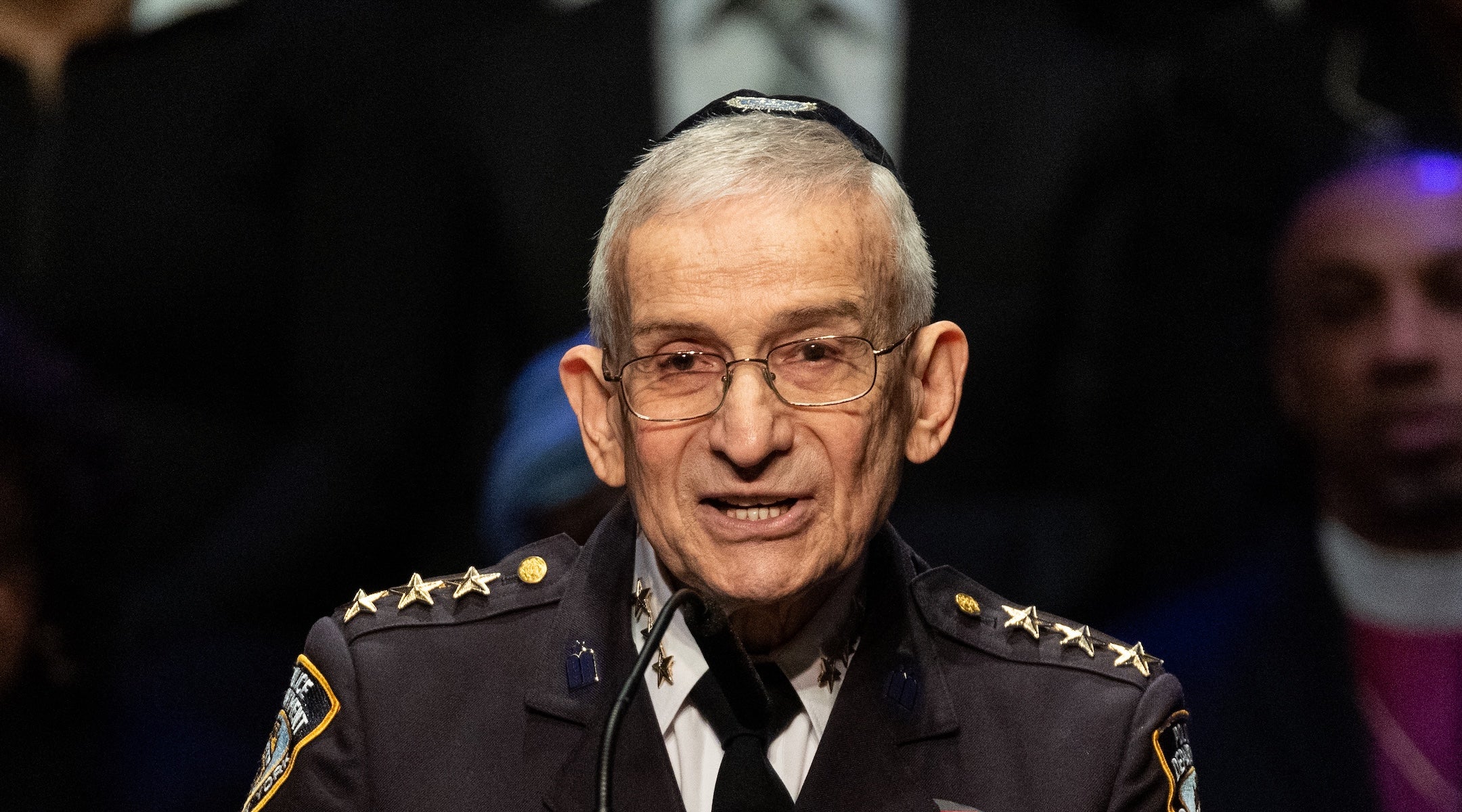
(JTA) — Less than a week after rushing to Ground Zero as a police chaplain on 9/11, Rabbi Alvin Kass led Rosh Hashanah services — not only for his Brooklyn congregation but at a makeshift synagogue at LaGuardia Airport for emergency responders who had flooded into New York City after the terrorist attacks.
“It was,” he would later say, “the most meaningful religious service in my career.”
Kass died Tuesday at 89 as the longest-serving chaplain in the New York Police Department, with a career that included responses to global terrorism, local violence and the intimate needs of police officers — as well as a hostage crisis that he famously resolved with a non-kosher pastrami sandwich.
Born and raised in New Jersey, Kass attended Camp Ramah before enrolling at Columbia University in 1953. His freshman-year roommates there were Robert Alter, who would become a preeminent translator of the Bible, and Shalom Schwartz, later a leading psychologist in Israel.
After graduating from college, he earned both a doctorate from New York University and ordination as a Conservative rabbi from the Jewish Theological Seminary of America before joining the U.S. Air Force as a chaplain. Returning stateside, he took a pulpit in Queens before being urged to join the city’s police department as a chaplain.
At the time, he was only the third Jewish chaplain to work for the NYPD. He would become its longest-serving and the first three-star chaplain, working under eight mayors and 21 police chiefs, while also helming the East Midwood Jewish Center, a Conservative synagogue in Brooklyn, for 36 years until 2014.
The NYC Benevolent Association called Kass “a true pillar of the NYPD” in a Facebook post mourning him. “Every time we bowed our heads for one of his prayers, we appreciated his deep faith, his old-school wit and his unshakable devotion to the men and women who protect NYC,” the group said. “He was a champion of all that is good and noble about our profession. May his memory be a blessing.”
NYPD Police Commissioner Jessica Tisch, who is Jewish, mourned Kass in a statement following his death. She noted that he was the youngest chaplain in the department’s history when he came on at age 30.
“Nearly six decades later, he remained its spiritual heart — a source of strength, guidance, and faith for generations of police officers and their families,” Tisch said, adding, “His loss is immeasurable. His example is everlasting.”
Within the NYPD, Kass was responsible for the spiritual care of all officers but especially the thousands who are Jewish. Kass successfully advocated for the right of Jewish police officers not to work on Shabbat and major Jewish holidays while also serving as the primary Jewish figure for Jewish officers who were otherwise unaffiliated with Jewish communities. He also served as spiritual director of the Shomrim Society, a fraternal organization for Jewish police officers.
“The main responsibility for a spiritual leader is to bring all people closer together, including those of your own faith,” he told the New York Jewish Week when he was honored as one of “36 to Watch” in 2024. “I feel particularly proud that the Shomrim Society embraces Jews of all backgrounds and points of view. The organization is a paragon of the unity that ought to bind all Jews together.”
After the terrorist attacks in Lower Manhattan on Sept. 11, 2001, Kass reported to Ground Zero, where he encountered a police officer he described as “crying like a baby” as well as the families of officers who were unaccounted for. Later, he attended the funerals of ever police officer who was killed that day, including two who were Jewish.
“I told their families that you’re supposed to say ‘Baruch atah Adonai, eloheinu melech ha’olam, dayan ha emet’: Blessed is the Lord our God, ruler of the universe, who is a judge of truth, or truthful judge. This means, essentially, that He knows what He’s doing. We don’t,” Kass wrote in an essay for The Forward on the 20th anniversary of the attack.
“We can’t comprehend what He’s doing very often, but presumably He knows what he is doing, and we submit. We bow our head to what is often inscrutable and incomprehensible, and we accept it with a measure of faith and hope,” he continued. “That really is the essential message of Judaism, in the face of evil.”
Kass would later say that 9/11 marked a transition in the role of the chaplain within the NYPD, peeling back some of the stigma that had been associated with seeking spiritual care in a department where machismo was long the currency.
Kass’ own encounters on the job ranged from lofty to the low-brow. He was pulled away from his son’s bar mitzvah celebration to tend to an officer who had been shot, according to a 2006 profile in the Columbia alumni magazine. On another occasion he flew upstate between Friday night services and Shabbat morning services to inform a family that their officer son had been murdered.
One of Kass’s more famous escapades came in 1981 when he was called in to negotiate with a Jewish man who had taken a woman hostage.
“I talked to him all night to give up his gun,” Kass recalled in a 2012 interview with the Wall Street Journal, neither the first nor last time he would recount the incident. “I was an utter failure. But by morning he was hungry.”
The hostage team ordered pastrami sandwiches from the (nonkosher) Carnegie Deli for the hostage-taker and for Kass. Kass traded one overstuffed sandwich for the man’s gun — but it turned out he had another. Kass, who ate only kosher meat, had not touched his sandwich and persuaded the man to accept it in exchange for the other gun. The police swooped in and ended the crisis.
The NYPD commissioner noted the incident when promoting Kass to three-star chief in 2016, saying, “In a feat that has become legendary, you were able to trade two pastrami sandwiches for the man’s two guns.”
But for Kass, whose small stature added to a widespread impression of modesty, the real feat came not in his ability to disarm the hostage-taker but in the man’s appetite. “Have you seen the sandwiches from the Carnegie Deli?” he recalled. “They’re huge.”
Kass is survived by his three children and three grandchildren. He was married for 54 years to Miryom Kass, an educator, until her death in 2017. Speaking at the 2016 ceremony marking 50 years with the NYPD, Kass said about Miryom, “She has been by confidant, my partner, my co-worker, she’s been my inspiration, she’s been my chaplain.”
The post Rabbi Alvin Kass, longest-serving NYPD chaplain famed for 9/11 response, dies at 89 appeared first on The Forward.
Uncategorized
Katz: ‘Israel’s Goal in Lebanon is to Disarm Hezbollah’

Then-Israeli transportation minister Israel Katz attends the cabinet meeting at the Prime Minister’s office in Jerusalem, Feb. 17, 2019. Katz currently serves as the foreign minister. Photo: Sebastian Scheiner/Pool via REUTERS
i24 News – Israel’s Defense Minister Israel Katz held a situation assessment Friday with senior military and defense officials, reiterating that the country’s policy in Lebanon remains focused on disarming Hezbollah by military and political means. Katz emphasized that the goal applies “regardless of the Iran issue” and pledged continued protection for Israeli northern communities.
Katz said the Israel Defense Forces are completing ground maneuvers up to the anti-tank line to prevent direct threats to border towns. He outlined plans to demolish houses in villages near the border that serve as Hezbollah outposts, citing previous operations in Rafah and Khan Yunis in Gaza as models.
The Defense Minister added that the IDF will maintain security control over the Litani area and that the return of 600,000 residents of southern Lebanon who had evacuated north will not be permitted until northern communities’ safety is ensured. Katz also reaffirmed that the IDF will continue targeting Hezbollah leaders and operatives across Lebanon, noting that 1,000 terrorists have already been eliminated since the start of the current campaign.
“We promised security to the northern towns, and that is exactly what we will do,” Katz said. He further warned that the IDF will act decisively against rocket fire from Lebanon, stating that Hezbollah “will pay heavy prices.”
Uncategorized
Pope Leo Urges Israel’s Herzog to End Iran War in Phone Call, Vatican Says

Pope Leo XIV delivers a homily during the Palm Sunday Mass in Saint Peter’s Square at the Vatican, March 29, 2026. Photo: REUTERS/Remo Casilli
Pope Leo spoke on the phone with Israeli President Isaac Herzog on Friday and urged him to “reopen all paths of dialogue” to end the Iran war, the Vatican said.
The pope, who has emerged as a sharp critic of the regional conflict, also urged Herzog to protect civilians and promote respect for international and humanitarian law, the Vatican added.
Uncategorized
Iran Leaders Join Crowds on Tehran’s Streets to Project Control in Wartime

Iranians gather at a park on Nature Day, amid the U.S.-Israeli conflict with Iran, in Tehran, Iran, April 2, 2026. Photo: Majid Asgaripour/WANA (West Asia News Agency) via REUTERS
After more than a month of being stalked by targeted assassinations, Iran’s leadership has adopted a new tactic to show it is still in control – with senior officials walking openly in the streets among small crowds who have gathered in support of the Islamic Republic.
In recent days, Iran’s president and foreign minister have separately mixed with groups of several hundred people in central Tehran. On Tuesday, state television aired footage of the two posing for selfies, talking to members of the public and shaking hands with supporters who had gathered in public areas.
According to insiders and analysts, the appearances are part of a calculated effort by Iran’s theocratic leadership to project resilience and authority — not only over the vital Strait of Hormuz but also over the population — despite a sustained US-Israeli campaign aimed at “obliterating” it.
One insider close to the hardline establishment said such public outings are intended to show that the Islamic Republic is “unshaken by strikes and that it remains in control and vigilant” as the war grinds on.
The US-Israeli war on Iran began on February 28 with the killing of veteran Supreme Leader Ayatollah Ali Khamenei and several senior military commanders in waves of strikes that have since continued to target top officials.
Iran’s new Supreme Leader, Mojtaba Khamenei, has not been seen in public since taking over on March 8 from his father. Foreign Minister Abbas Araqchi, meanwhile, was removed from Israel’s hit list amid mediation efforts last month, including by Pakistan, to bring Tehran and Washington together for talks to end the war.
Talks aimed at ending the war have since appeared to have petered out, as Tehran brands US peace proposals “unrealistic.” Against that backdrop, recent public appearances by President Masoud Pezeshkian and Araqchi appear designed to project defiance, if not a convincing display of public support.
A senior Iranian source said officials’ public presence demonstrates that “the establishment is not intimidated by Israel’s targeted killing of top Iranian figures.”
Asked whether Iran’s foreign minister or president were on any sort of kill list, an Israeli military spokesperson, Nadav Shoshani, said on Friday he would not “speak about specific personnel.”
NIGHTLY RALLIES TO SHOW RESILIENCE
Despite widespread destruction, Tehran appears emboldened by surviving weeks of intense US-Israeli attacks, firing on Gulf countries hosting US troops and demonstrating its ability to effectively block the Strait of Hormuz.
On Wednesday, US President Donald Trump vowed more aggressive strikes on Iran, without offering a timeline for ending hostilities. Tehran responded by warning the United States and Israel that “more crushing, broader and more destructive” attacks were in store.
Encouraged by clerical rulers, supporters of the Islamic Republic take to the streets each night, filling public squares to show loyalty even as bombs rain down across the country.
Analysts say the establishment is also seeking to raise the “political and reputational” cost of the strikes at a time when civilian casualties are deeply disturbing for Iranians.
Omid Memarian, a senior Iran analyst at DAWN, a Washington-based think tank, said the decision to send officials into gatherings reflects a layered strategy, including an effort to sustain the morale of core supporters at a moment of acute pressure.
“The system relies heavily on this base; if its supporters withdraw from public space, its ability to project control and authority weakens significantly,” Memarian said.
Speaking to state television, some in the crowds voice unwavering loyalty to Iran’s leadership; others oppose the bombing of their country regardless of politics; and some have a stake in the system, including government employees, students and others whose livelihoods are tied to it.
Hadi Ghaemi, head of the New York-based Center for Human Rights in Iran, said the establishment is using such loyal crowds as human shields to raise the cost of any assassination attempts.
“By being in the middle of large crowds they have protections that would make Israeli-American attacks against them very bloody and generate sympathy worldwide,” he said.
POTENTIAL PROTESTERS STAY OFF STREETS AT NIGHT
The Islamic Republic emerged from a 1979 revolution backed by millions of Iranians. But decades of rule marked by corruption, repression and mismanagement have thinned that support, alienating many ordinary people.
While there has been little sign so far of anti-government protests that erupted in January and abated after a deadly crackdown, the establishment has adopted harsh measures – such as arrests, executions and large-scale deployment of security forces – to prevent any sparks of dissent.
Rights groups have warned about “rushed executions” during wartime after Iran hanged at least seven political prisoners during the war.
“Many potential protesters are frightened by the continuing presence of armed men and violent crowds in the streets and largely stay at home once darkness falls,” Ghaemi said.