


Uncategorized
Sally Rooney to issue novel in Hebrew with Israeli publisher who complies with BDS
(JTA) — Irish novelist Sally Rooney, who drew headlines in 2021 for refusing a Hebrew translation of one of her books, is now publishing her latest novel in Hebrew through an Israeli publisher approved by boycott activists.
The Hebrew translation of “Intermezzo,” due out next month, will be published by November Books in collaboration with the left-wing Israeli news sites +972 Magazine and Local Call. The arrangement was announced this week alongside an interview Rooney conducted with Palestinian Irish activist Samir Eskanda in The Guardian.
Rooney’s decision marks an unusual but not unprecedented attempt to work within the framework of the Boycott, Divestment and Sanctions movement, or BDS, which has long called on artists and cultural figures to avoid working with Israeli institutions it considers complicit in Israeli government policies toward Palestinians.
In 2021, Rooney declined to sell Hebrew translation rights for her novel “Beautiful World, Where Are You?” to the Israeli publisher that had previously released her books in Hebrew. At the time, she said she supported the BDS movement and would not work with an Israeli publisher unless it is willing to “publicly distance itself from apartheid and support the UN-stipulated rights of the Palestinian people.”
That move prompted backlash in Israel and beyond, including calls to boycott Rooney’s work. Israeli bookstore chains reportedly removed some of her books from shelves.
Now, Rooney, 35, says she believes publishing “Intermezzo” in Hebrew through November Books is compatible with the boycott campaign because the publisher does not operate in West Bank settlements, does not receive Israeli government funding and has endorsed Palestinian rights.
“Though my refusal to work with complicit Israeli publishing houses made the contractual side of things more complex, I was, of course, never boycotting the Hebrew language or any language,” Rooney told The Guardian. “I’m very pleased that ‘Intermezzo’ will soon be available in Hebrew with November Books.”
Rooney added that she had stayed in contact with PACBI, a founding arm of the BDS movement that advises artists on cultural boycott issues, “to try to ensure that I was upholding both the letter and the spirit of the institutional boycott.”
Haggai Matar, the executive director of +972, said BDS is willing to work with Israeli publishers if they express that they are not “complicit” with the Israeli state, do not accept government funding nor operate within the settlements.
BDS also demands that its targets recognize the rights of Palestinians under international law, including the right of return of Palestinians seeking to reclaim their former homes in modern-day Israel. While Israel and many of its supporters consider such claims an existential threat, Matar said it “can be implemented in all sorts of ways.”
Asked why +972 was eager to help publish Rooney’s book, Mattar told the Jewish Telegraphic Agency that it was an opportunity to “dispel myths that BDS is antisemitic or aimed at all Israelis.”
“To take someone as famous as Sally and as outspoken on the Palestinian issue was a great opportunity to say, ‘Look, Israelis aren’t outcasts. This is not about our identity.’ It is an attempt by Sally and the BDS movement to not be involved with organizations that are complicit with apartheid or war crimes. Once you [act and say that you aren’t] you are not subject to boycott at all.”
Since Oct. 28, 2024, more than 7,000 writers have signed onto a boycott of “complicit” Israeli literary institutions. The boycott said it had evaluated 98 Israeli publishers and found that only November Books met its conditions for exemption.
November Books is a small Israeli nonprofit that distributes its books mostly through independent bookstores. It has previously published Hebrew translations of works by Ta-Nehisi Coates and Naomi Klein, both of whom support the boycott.
“Our task as a movement is to channel anger at Israel’s genocide in Gaza into the most meaningful initiatives,” said Rooney. Israel denies that the war in Gaza is a genocide, and supporters have called the war in Gaza a proportionate response to the Hamas attacks of Oct. 7, 2023, in which 1,200 people were killed in Israel and 251 were taken hostage.
Rooney also acknowledged what she described as inconsistencies in her earlier decisions. Rooney said that while she had supported BDS as a consumer, she had initially sold Hebrew translation rights for her first two novels to an Israeli publisher before concluding that mainstream Israeli cultural institutions were implicated in state policies she opposed.
“By the time it came to selling the rights for my third book in 2021, things had changed,” Rooney said. “I had come to a better understanding of the complicity of the Israeli culture sector in that apartheid system.”
Rooney’s novels, nearly all global bestsellers, have been translated into more than 40 languages and adapted for television by the BBC and Hulu.
The literary world has become a nasty if bloodless battleground since Oct. 7. Jewish writers say they have been targeted as “Zionists” even when their views on Israel aren’t public, bookstores have cancelled publicity events for Jewish authors, and that it has become more difficult to publish works with Jewish themes.
Meanwhile, Rooney asserted that “people” had warned that her decision to boycott Israel would harm her career, suggesting to her that she “had no idea what I was up against.”
“In reality, I have gone on writing and publishing happily since 2021,” she said.
Matar rejects the criticism that the cultural boycott, by targeting the literary and artistic community, only harms politically liberal voices and their ability to shape public opinion.
BDS, he told JTA, is a “nonviolent tool asking a publisher ‘to stand by us and not participate in our oppression.’ These are very minimal demands, not silencing or too heavy a burden.”
This article originally appeared on JTA.org.
The post Sally Rooney to issue novel in Hebrew with Israeli publisher who complies with BDS appeared first on The Forward.
Uncategorized
Mamdani faces growing pressure over Jewish NYPD Commissioner Tisch and over Israel from left flank
(JTA) — New York City Mayor Zohran Mamdani is facing increasing pressure from some on the leftmost flank of his voting coalition, and an ICE shooting Thursday led democratic socialist allies to add their voices to a major demand: dump police commissioner Jessica Tisch.
“The NYPD’s Strategic Response Group must be disbanded as quickly as possible, and Commissioner Tisch must step down,” said Darializa Avila Chevalier, who won her Democratic primary with Mamdani’s endorsement. The democratic socialist, who is expected to join Congress next year representing Upper Manhattan and parts of the Bronx, was referring to the heavily armed police department unit that often responds to protests.
The calls for Tisch’s removal follow strident criticism of the mayor from pro-Palestinian activists on Wednesday night who called him names, including “traitor” and “Ziohran,” when he showed up at an Oct. 7 Israeli peace vigil mourning the loss of both Jewish and Palestinian lives. The demonstrators assailed him for not doing more to advance the pro-Palestinian agenda that has long been central to his political beliefs, raising questions over whether he could lose parts of his base as he pledges to be a mayor for all New Yorkers.
The demand for Tisch’s removal came after an ICE agent shot and wounded a Dominican man in his car on Thursday afternoon while his 5-year-old son was in the back seat. Avila Chevalier, who joined protests against ICE on Thursday, wrote on X that the NYPD “spent more time protecting a militia that just shot someone than protecting New Yorkers.”
Mamdani’s decision last year to retain Tisch — a self-described “proud Zionist” who comes from a prominent Jewish family — was seen as a reassuring move by moderates and establishment Jewish organizations including UJA-Federation of New York and the Jewish Community Relations Council. (70 Faces Media, the parent company of the Jewish Telegraphic Agency and New York Jewish Week, receives UJA funding.)
A number of progressives were skeptical of the decision at the time, citing her background as an appointee of Mamdani’s predecessor, Eric Adams, and her past criticism of campus pro-Palestinian protests. Some viewed her as an impediment to criminal justice reform.
Meanwhile, some on the left have dinged him for not yet following through on campaign promises 10 months into his term, including dissolving the Strategic Response Group, or backing down from his vow to arrest Israeli Prime Minister Benjamin Netanyahu, a plan which he later said he did not have the power to execute.
Anti-Zionist groups including Pal-Awda, Within Our Lifetime and a number of student organizations who rallied against Mamdani at the Oct. 7 vigil accused him of succumbing “to Zionist pressure.” Protesters called him a “traitor” and a number of chants rang out including, “Mayor Mamdani you can’t hide, we charge you with genocide,” drowning out speakers at the vigil and forcing the organizers to move it behind police barricades to keep the protesters from overrunning the event.
Among those protesters’ many gripes with the mayor was his decision to retain Tisch. One sign at the demonstration depicted Mamdani with the text, “Chief Executive of the NYPD SRG” with a Star of David in the middle, and a name tag on the mayor’s chest reading, “Ziohran.”
Criticism was also directed at Mamdani for not stopping Israeli real estate events at synagogues, and for his strategy to combat antisemitism, released last week, which allocates funds to a number of community-based organizations aimed at preventing hate crimes. Some critics have charged that some of the funding will aid Zionist organizations.
“The Jewish community is a large part of New York and it should be cherished. But you cannot fund these Anti-Defamation Leagues that prioritize Zionism over Judaism,” a John Jay College student protester, who declined to be named, told JTA during the demonstration.
On Thursday, the Democratic Socialists of America’s New York City chapter — which Mamdani has called his “political home” — wrote that Tisch “must end NYPD complicity with ICE” and that if she “cannot put a stop to these injustices, she must be fired.”
“Abolish ICE. Disband the SRG. Fire Tisch,” wrote Illapa Sairitupac, a fellow democratic socialist who won the Democratic nomination for a Lower Manhattan State Assembly district. Mamdani endorsed both Sairitupac and Avila Chevalier this past year.
While some protesters at the vigil said they were Mamdani voters — and one speaker even identified herself as a former intern for the now-mayor — some of the mayor’s allies have stressed that the crowd protesting him was not representative of his base.
“If I had to gamble, I would gamble that the vast majority of them were people who never supported him,” activist Abby Stein told JTA on Thursday night, during the Mazals gala held by left-wing group Jews for Racial & Economic Justice. Mamdani was due to attend the JFREJ event, but because of the ICE shooting was instead in the Bronx, where he denounced the federal agency and demanded that it cease its operations in New York City.
Many of the signs excoriating Mamdani at Wednesday’s protest outside of City Hall were signed with the name of the Maoist Communist Union, an organization that opposed Mamdani before he took office. Some protesters were handing out copies of Spartacist, the Trotskyist International Communist League’s journal.
“We certainly didn’t support Mamdani or vote for him,” said Erica Jones, among the Trotskyist protesters. “We knew he was running as a Democrat and he would be as big of a sellout as AOC and Bernie Sanders and all the rest of those who claim to have, at one time, stood for socialism but in reality, stand for the capitalist masters who are oppressing us all.”
Stein, a member of the DSA in addition to JFREJ, called out some of the protesters’ rhetoric and the choice to crash the Israelis for Peace Oct. 7 vigil. But she also acknowledged that there was overlap between their demands and her views, including over the police commissioner.
“There are things that people are upset over that I think are legit — like keeping Jessica Tisch on, for example,” Stein said. “A lot of us were not very happy about it.”
Ultimately, Stein said there is “always going to be something to protest” with any politician, and pointed to a quote from New York’s mayor in the 1970s and ‘80s, Ed Koch: “If you agree with me on 9 out of 12 issues, vote for me. If you agree with me on 12 out of 12 issues, see a psychiatrist.”
This article originally appeared on JTA.org.
The post Mamdani faces growing pressure over Jewish NYPD Commissioner Tisch and over Israel from left flank appeared first on The Forward.
Uncategorized
A planned non-Zionist Jewish school in Boston hopes to ride the momentum of the left
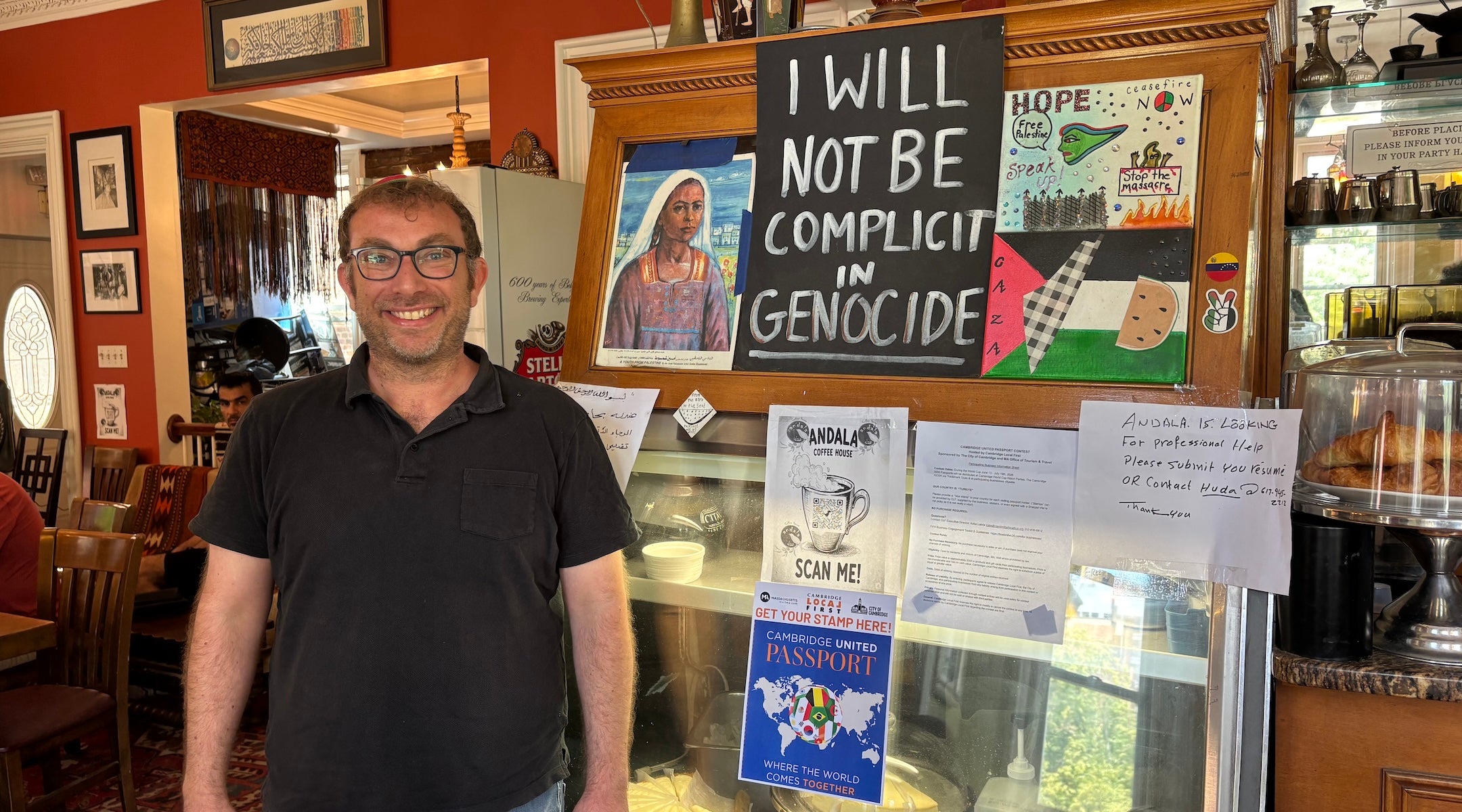
(JTA) — BOSTON — In the middle of a conversation about her future children, it dawned on Leah Robbins that the school she imagined for them did not exist.
Robbins envisioned a Jewish school where children studied Jewish texts, history and observance, as she did at the school run out of her Conservative synagogue in northern Florida. But having long ago rejected the allegiance to Israel that was entwined with her education, she could not fathom sending her children to a school that promoted Zionism — which ruled out all the Jewish day schools she knew.
“I was just overwhelmed with a sense of grief that my kids could be less Jewishly educated than I was,” Robbins, who has lived in Boston for 10 years, told the Jewish Telegraphic Agency. “I would never ever consider sending my kids to any of the local day schools because of total values misalignment.”
Four years after that conversation, Robbins is building her own institution for the children she hopes to have. She plans to open Achvat Olam, a “diasporist” day school whose name translates to “global solidarity” in Hebrew, in the Boston area in fall 2029. The school aims to launch with eight to 10 families, starting with a kindergarten and adding grade levels until ultimately becoming a K-8 school.
Achvat Olam is fiscally sponsored by Beloved Builders, a Massachusetts-based nonprofit that supports progressive Jewish projects. Robbins, who has a background in fundraising for Jewish nonprofits, hopes to raise $625,000 for the launch. She said she has met about 20 local families who expressed interest, and will start formal recruitment efforts, including focus groups and open houses, next year.
Achvat Olam will teach about Jewish history, cultures and languages outside of Israel, while engaging with Hebrew and Israel’s history from a non-Zionist perspective. The school’s website includes a page on “Israel/Palestine,” saying its community will share a belief that “the pursuit of justice, dignity, and thriving for all people is a Jewish moral imperative.”
“This includes an age-appropriate, honest confrontation with Zionism and the ongoing Nakba against the Palestinian people,” the website says, using the Arabic word for the displacement of over 700,000 Palestinians at the time of the State of Israel’s founding. The school also says that students will consider “the complicity and support of the US government and Diaspora Jews.”
Micah-Shalom Kesselman is the parent of a 4-year-old in Medford, Massachusetts, and participates in local left-wing Jewish groups such as the Boston Workers Circle. He’s disappointed that his son Oren will age out of Achvat Olam by the time it is scheduled to open as a kindergarten. “I would super want Oren to attend something like what Achvat Olam is shaping up to be,” he said.
Kesselman, who studies Yiddish with his son, explained that he would like Oren to be steeped in Jewish traditions and culture. But as a parent who is “not a supporter of Zionism,” he said he has found few Jewish educational opportunities that match his beliefs.
Diverse day school histories
Jewish day schools have historically encompassed a range of orientations toward Israel, according to Jonathan Krasner, a historian of American Jewish education at Brandeis University. The modern day school movement was born in the 1920s and initially dominated by orthodox schools, some of which did not emphasize Zionism. In the 1950s, secular Yiddishist schools taught varied attitudes toward Israel. Some yeshivas in the orthodox Haredi movement still today oppose Zionism on religious grounds, believing that Jewish sovereignty should only be established through the coming of the Messiah.
But Krasner could not name another day school that has Achvat Olam’s goal: education for Jewish families who disavow the current-day political realities of Israel and Zionism. In the aftermath of the Hamas attacks on Israel on Oct. 7, 2023, many day schools went the opposite direction, adding curricula to strengthen solidarity between Diaspora Jews and Israel.
“The initial response of the organized Jewish community was, understandably, to circle the wagons and to reinforce their connections to Israel and to the Israeli people,” Krasner said.
Jack Wertheimer, a professor of American Jewish history at the Conservative movement’s Jewish Theological Seminary, isn’t convinced that Achvat Olam will change that trend. He said he was “highly skeptical” that Robbins could attract enough families to sustain a school. According to historical data, he said, Jews who lean more politically left tend to be less engaged in Jewish life.
“From what I know, the overwhelming majority of parents who are interested in sending their children to Jewish day schools are pro-Israel,” said Wertheimer.
Nonetheless, Robbins believes that the market for her school is growing. Survey after survey has captured a drop in Americans’ support for Israel since the Gaza war, and Jews are not an exception to the trend. After decades of being treated as fringe in many of their communities, left-wing Jews who are anti-Zionist — or simply do not see Israel as part of their identity — say that instead of adapting to their congregations and Jewish schools, the institutions should adapt to them.
There are signs that this group makes up a substantial portion of Jews in the United States. About 30% of Jewish adults believe that Israel has committed genocide in Gaza, according to a June poll of 1,022 Jews from the Associated Press-NORC Center for Public Affairs Research, which had a 5% error margin. Less than 40% said that “supporting Israel” was crucial to their Jewish identity.
Younger Jews emphasize traditions
At the same time, among adults who identified as religiously Jewish, younger people said they emphasized Jewish traditions more than their older counterparts. Younger Jews were more likely than older ones to say that “celebrating Jewish holidays” and “celebrating or marking Shabbat” were important to them, while Jews over 45 placed more emphasis on “remembering the Holocaust” and “supporting Israel” than younger ones.
This finding could reflect the growing share of younger Jews who are Orthodox. It also comes amid a boom in Jewish leftist organizations that explicitly ground their activism in religious tradition. IfNotNow, an anti-occupation group that has grown from 1,000 dues-paying members in 2023 to 7,000 this year, says it is “growing a community rooted in Jewish values and ritual.” The anti-Zionist Jewish Voice for Peace, which has amassed 32,000 dues-paying members, often frames its protests through Jewish holidays, texts and prayer.
Robbins is betting that a significant pool of younger Jews, many of them now parents to young children, are seeking avenues to both protect their Jewish traditions and reset their community’s relationship with Israel for the next generation. Instead of supporting Israel, Achvat Olam says that its students will learn a curriculum of “collective liberation at home, globally, and in Israel/Palestine.”
“This is a very experimental moment in Jewish history. The Jewish left is growing by leaps and bounds,” said Robbins, referencing estimates of dozens of anti-Zionist congregations and prayer groups sprouting across the country. “There is hunger for this.”
Boston is a hub for such new organizations. Since 2024, the city has hosted the Conference on the Jewish Left at Boston University, a gathering of left-wing Jewish scholars, students, activists and faith leaders. The first annual meeting drew 300 people, the second 700, and the third in February saw more than 900 participants. A poll of Greater Boston by Combined Jewish Philanthropies, the central fundraising arm of Boston’s Jewish community, found earlier this year that 38% of Jews aged 18 to 29 identified as “anti-Zionist,” and another 30% said they were “uncommitted” to Zionism or anti-Zionism.
Rabbi Greg Hersh left his congregation at Temple Emmanuel in Wakefield, north of Boston, in 2024. He said he became increasingly alienated from his congregants after Oct. 7. Hersh felt that the congregation, focused on supporting Israel and fighting antisemitism locally, did not share his anguish about the deaths of Palestinians.

Last year, Hersh founded V’ahavtah, a mostly Cambridge-based congregation devoted to “practicing Judaism beyond Zionism.” V’ahavtah joined Jews, like him, who felt uncomfortable with the norm of Israeli flags flying inside synagogues. Their Shabbat services regularly draw 30 to 40 people, numbers he said he never saw in Wakefield. He believes that is proof of growing demand for non-Zionist Jewish institutions.
“You take Israel out of the equation and the Jews will show up, and that’s what happened with V’ahavtah,” said Hersh. “My expectation is Achvat Olam is going to be very well poised to fill that void.”
On the ground, Robbins faces formidable obstacles to funding Achvat Olam. Jewish day schools struggle across the country to attract enrollment in the face of tuition that many families can’t afford, along with budgets strained by economic uncertainty and heightened spending to ward off security threats. Earlier this year, MetroWest Jewish Day School in Framingham, a suburb of Boston, shuttered and said that its “model of highly individualized Jewish day school education is no longer sustainable.”
Heavy investments from local philanthropies have helped day schools offset high costs. Prizmah, a national network of 305 day schools, recently reported that it saw enrollment rise across denominations for the first time last year, thanks in large part to philanthropy.
But many groups that fund Jewish education hold values that are antithetical to Robbins’ — including CJP, which calls itself a “pro-Israel, Zionist organization.” Prizmah and CJP declined requests for comment from JTA.
The individual donors who fund Jewish schools also tend to be older, more conservative than Robbins and more motivated by support for Israel, according to Krasner.
“The people who are most likely to be in a financial position to support day schools with generous philanthropic gifts are demographically very different from the population that Leah is trying to attract,” he said.
Robbins admitted that funding challenges meant the success of Achvat Olam was not “any sort of inevitability.” But she believes there is inevitability to the political momentum that could drive families toward such a school. “Something I want to convey to people is that the train has already left the station,” she said. “There is no stemming the tide of the growth of the Jewish left.”
Robbins has turned to funding from left-wing organizations, which already siphon much of their resources to grassroots activism, legal defense and awareness campaigns.
“It can be hard to get in the face of people to make the case for something that requires long-game thinking,” she said. “I’m trying to make the case, when the last fire has been put out, what’s going to be left if we’re not building it right now?”
This article originally appeared on JTA.org.
The post A planned non-Zionist Jewish school in Boston hopes to ride the momentum of the left appeared first on The Forward.
Uncategorized
Protesters in Toronto: ‘We will honor all our martyrs’ after 3 years of Gaza war
(JTA) — TORONTO – Hundreds of protesters marched through Toronto’s downtown core via Yonge Street Saturday afternoon, chanting more loudly as additional people joined the demonstration. “We will honor all our martyrs, all our children, sons and daughters!” and “In my lifetime I will see Palestinians living free!” the crowd yelled in unison.
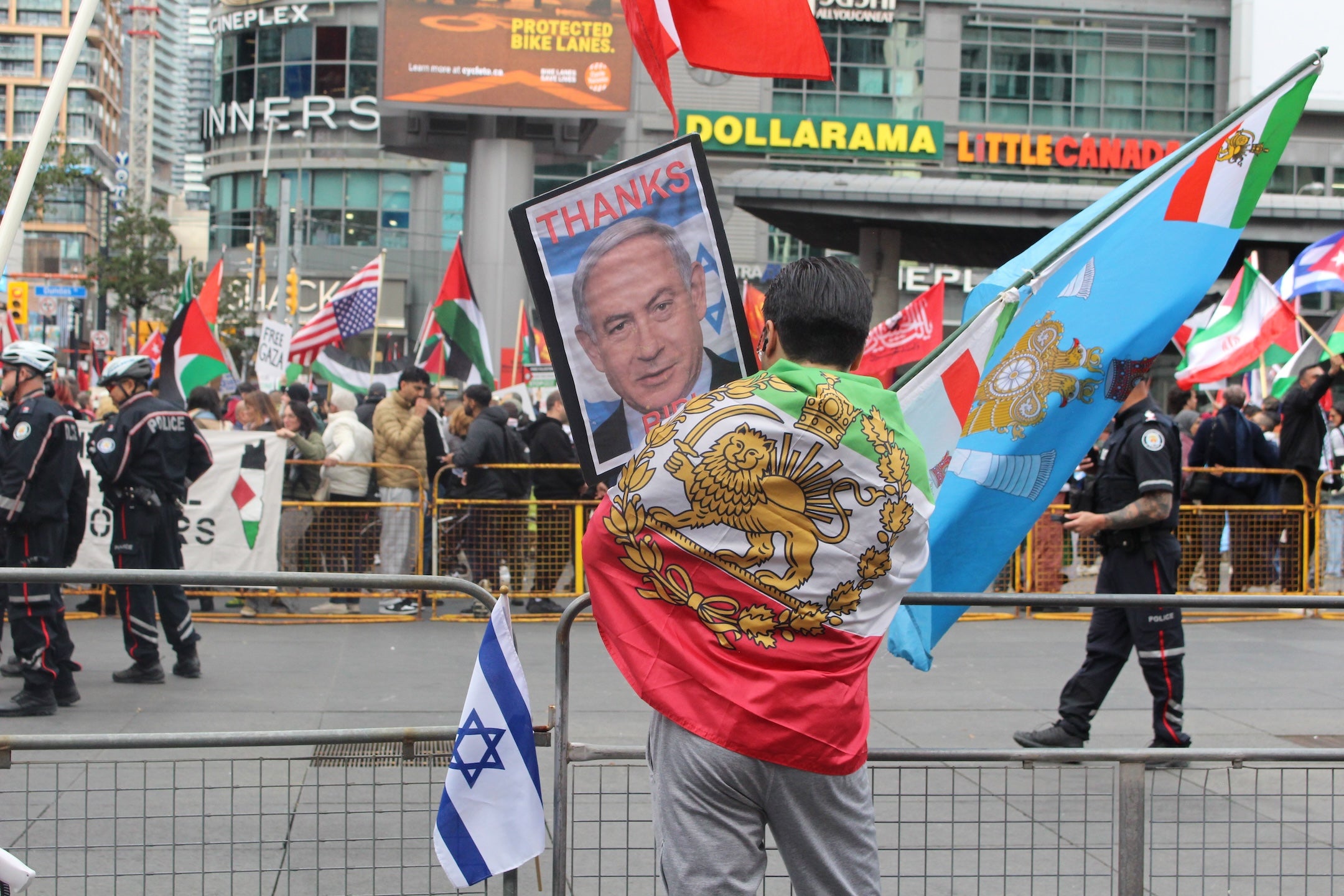
Separated by metal barricades and police officers, a much smaller group of counterprotesters waving Israeli and Iranian flags stood at the southern end of Sankofa Square, where the demonstrators gathered before the march to mark the third anniversary of the war in Gaza.
Trailing behind a white Ford F-150 equipped with speakers, protesters at one point shouted, “Overthrow the Epstein class,” a slogan referring to disgraced Jewish financier Jeffrey Epstein to decry the global elite and call for the ultra-wealthy to be stripped of power. Tensions briefly flared when a man wearing a Turning Point Canada sweatshirt confronted a group of pro-Palestinian demonstrators.
Otherwise, the protest was largely peaceful. Toronto police said that one individual was arrested at the demonstration after being recognized by officers as someone wanted in connection with an unrelated incident.
The protest was part of a broader international wave of demonstrations, with the Israeli Ministry for Diaspora Affairs counting 17 protests in Canada planned for Saturday through Wednesday, including in Montreal and Ottawa.
The demonstrators included Jews and Israelis who are highly critical of the prosecution of the war in Gaza and Zionism as a whole. “I went to school in Haifa, and I saw how Palestinians are treated,” said pro-Palestinian protester Shlomit, 65, who didn’t provide a last name due to concerns for her safety. “I grew up in a very Zionist family, but being in Israel actually changed my mind about things.”
Shlomit said she had mutual friends with Vivian Silver, a Canadian-Israeli peace activist who was murdered on Oct. 7, 2023, when Hamas attacked Israel, launching the Gaza war. She said she was emotionally impacted by Silver’s death, and believes the kind of work like Silver’s was critical to building peace between Israelis and Palestinians.
“I knew all these people who were connected to [Vivian]. She was a peace activist, and what happened to her was distressing to me,” said Shlomit, who wore a pin labeled “Jews Against Occupation.”
Prime Minister Mark Carney mentioned Silver in a statement on Wednesday, the three-year anniversary of Oct. 7 itself. “Canada unequivocally condemns Hamas, which must play no role in the future governance of a demilitarised Palestinian state,” read Carney’s statement. “We stand steadfastly with the Israeli people in their pursuit of a safe and secure Israel as part of a two-state solution.”
The statement continued by commemorating the Canadian lives lost to the Hamas attack, mentioning Silver and eight others. “We remember them for the lives they lived and the people they loved – and we honour the families and friends who continue to mourn their loss. May their memory be a blessing,” he said.
Other demonstrators expressed solidarity with issues beyond the Middle East. Caelen Leizer-Romalis, 24, was attending the protest as part of the Revolutionary Communist Party. “We have an obligation as Canadians to stand up to imperialism,” said Leizer-Romalis, who is Jewish. “In order to liberate the people of Palestine, we need to liberate the workers here as well.”

Despite being outnumbered, pro-Israel demonstrators — all of whom carried either an Iranian flag or a picture of the last shah of Iran before his ouster in the Iranian Revolution of 1979 — waved their flags as “Tel Aviv” by Omer Adam blasted from a boombox.
Mahya Tayabi, 38, decided to come to the protest to demonstrate unity between Israel and Iran. “I’m Persian, but I love Israel. I love Jewish people. Bibi and the IDF helped my country,” said Tayabi, referring to Israeli Prime Minister Benjamin Netanyahu by his nickname. As Tayabi spoke, the boombox switched to playing an EDM beat featuring the lyrics “Ayatollah Khamenei is dead!” Israel and the United States killed the ayatollah at the beginning of the war on Iran that they launched in late February.
The Centre for Israel and Jewish Affairs expressed concern regarding the weekend’s protests.
“Canada’s Integrated Threat Assessment Centre has warned about the consequences of turning a blind eye: when targeting of the Jewish community becomes frequent and normalized, it can push susceptible individuals toward violence. Events praising the ‘resistance’ responsible for the October 7 atrocities as communities gather to mourn the murdered demands moral clarity from civic leaders about what is acceptable in our society.”
This article originally appeared on JTA.org.
The post Protesters in Toronto: ‘We will honor all our martyrs’ after 3 years of Gaza war appeared first on The Forward.
