


Uncategorized
San Diego Group Apologizes for Disinviting Rabbi From MLK Jr. Event Over ‘Safety Concerns,’ Pro-Israel Stance
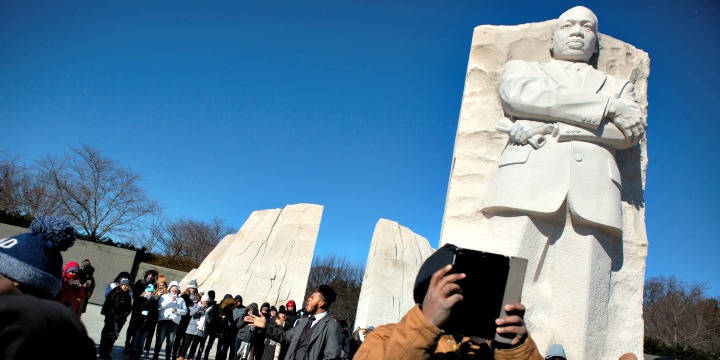
The Martin Luther King Jr. Memorial in Washington, DC. Photo: Reuters / Allison Shelley.
Organizers of a Martin Luther King Jr. Day event in San Diego, California, have apologized for disinviting a rabbi from speaking due to his stance on the Israel-Hamas war and “safety concerns.”
Alliance San Diego made the apology in a released statement after receiving widespread criticism for its treatment of Rabbi Hanan Leberman, the leader of Tifereth Israel Synagogue in San Diego. He was originally scheduled to lead the closing prayer at the city’s 38th annual All Peoples Celebration at the Balboa Park Activity Center on Jan. 19.
In a description for the event, Alliance San Diego invited the public to “choose Courage; to decide, with intention, to do what is right even when the fear and opposition are loud. Now more than ever, our voices must rise above hesitation. We must claim our dignity and echo the notion that any attack on one, is an attack on us all.”
A day before the event, Leberman wrote in a Facebook post he was “deeply upset” to learn he had been disinvited from presenting at the ceremony because of his “connection to Israel.” Alliance San Diego claimed Leberman was instead invited to attend the program as a guest, but the rabbi said he ultimately decided not to attend the event at all.
The decision to disinvite Leberman from presenting at the event was condemned by a coalition of nearly four dozen community-based organizations, social service providers, and synagogues in a joint statement published on Jan. 18.
While apologizing for the move in a statement shared on Instagram, Alliance San Diego also explained its decision, saying that event organizers faced “major disruption over two speakers’ public stances on the conflict in Israel-Palestine.”
“We hear the community’s concern that this decision felt to some like an exclusion of Jewish identity echoing historical traumas and antisemitic patterns present in many public spaces today. This was not our intention, and we apologize for reinforcing this pattern,” the group said. “To protect the attendees at the celebration and keep the focus on Dr. King, we asked both speakers to attend as our guests instead of present on the program. Our decision was based solely on safety concerns and was communicated in person conversations with the speakers. We recognize, however, that intent does not erase impact, and we take responsibility for the hurt caused … A deep source of regret is that our missteps have distracted us from our core work of creating a San Diego that is safe for all people.”
Leberman was born in Chicago, raised in Philadelphia, and ordained as a rabbi in Israel, where he lived and worked before moving to San Diego, according to the website for Tifereth Israel Synagogue. He moved to Israel at the age of 20 and served three years in the undercover counter-terrorist unit Duvduvan of the Israel Defense Forces, often serving as the unit’s cantor. Leberman studied at the Jerusalem Academy of Music, and aside from being a cantor, he is also a professional opera singer. He served as a rabbi and cantor for the Masorti movement in Israel and led congregations as a guest cantor in Israel, England, and the United States.
Alliance San Diego said in an earlier statement that it asked two speakers to give up their speaking roles at the event “in response to concerns about potential disruption related to Zionism and anti-Zionism,” but noted they had not been disinvited. The other speaker was not publicly identified but also ultimately decided not to attend the event.
“At the time, we believed we were acting in the best interest of protecting attendees and preserving the spirit of the event,” the group said in its statement. “Our intention was never to exclude Jewish faith leaders or Jewish voices from this space. As an organization working across many communities under immense strain and confronting assaults on immigrant communities, including Jewish and Israeli immigrants at a time of rising antisemitism and fear, we acknowledge that our decision contributed to that pain rather than alleviating it.”
Leberman said in his Facebook post on Jan. 18 that disinviting him from speaking at the event “runs counter to Dr. King’s message — particularly at this moment in history, when Jews are experiencing the most significant rise in hate crimes of any group.”
“The decision to disinvite me is, in my view, a disservice to the legacy of Dr. Martin Luther King Jr,” he added. “I believe the organization would benefit from deeper education about what Zionism truly is and about what the Jewish community is facing today — from both the left and the right.”
Uncategorized
9 Israeli Soldiers Injured in Lebanon Fighting, 2 in Serious Condition

Two IDF soldiers. Photo: IDF.
i24 News – Two Israeli officers were seriously wounded and seven additional soldiers injured in two separate incidents in southern Lebanon, the Israel Defense Forces (IDF) said.
According to the military, the first incident occurred during the morning hours amid an encounter between Israeli forces and armed militants operating in the area.
During the engagement, an anti-tank missile was launched toward deployed troops, which the IDF said was fired by Hezbollah operatives. Two officers were struck in the attack, with one sustaining serious injuries and the second moderately wounded.
A second incident took place overnight in a separate sector of southern Lebanon, when Israeli forces operating in the area came under rocket fire. In that strike, one officer was seriously wounded and six soldiers were moderately injured, the IDF said.
The incidents come amid ongoing cross-border hostilities between Israel and Hezbollah, marked by repeated exchanges of fire and periodic ground confrontations in southern Lebanon.
Uncategorized
Report: Some 30 US Troops Injured in Iranian Attacks on Prince Sultan Air Base in Saudi

Screenshot of video of Saudi Arabia’s Air Force intercepts Iranian drones over Saudi airspace. Photo: Saudi Defense Ministry / Screenshot
i24 News – Over 12 US troops have been injured in Iranian attacks on a Saudi air base in the past week, the Associated Press reported on Saturday citing two people who have been briefed on the matter.
On Friday, the Islamic Republic launched six ballistic missiles and 29 drones at Saudi Arabia’s Prince Sultan air base, wounding at least 15 troops, including five seriously, according to the sources who spoke to AP on the condition of anonymity.
US officials initially reported that at least 10 US troops were injured, including two seriously wounded.
The base had come under attack twice earlier this week, including an incident that injured 14 US troops, according to the people who had been briefed on the matter.
Located some 100 kilometers from the Saudi capital of Riyadh, the base is run by the Royal Saudi Air Force, but is also used by US troops.
Uncategorized
At CPAC, a Generational Divide Over Republican Support for Israel

Gabriel Khuly, 19, and Joshua-Caleb Barton, 31, pose for a picture outside Generation Zion’s booth at the Conservative Political Action Conference (CPAC) USA 2026 at the Gaylord Texan Resort and Convention Center, in Grapevine, Texas, U.S., March 27, 2026. Picture taken with a mobile phone. REUTERS/Nathan Layne
When former Congressman Matt Gaetz opened his speech by aligning with a Republican faction “loyal to only one nation,” his message to the Conservative Political Action Conference was clear: It was a veiled swipe at perceived Israeli influence over US politicians, even without naming Israel outright.
A month into the US-Israeli war with Iran, Gaetz’s comments struck a discordant note at the annual CPAC event. They cut against calls for unity and exposed a growing Republican rift largely along generational lines, as younger conservatives increasingly question support for Israel.
That skepticism reflects a broader distrust of military intervention among younger Republicans, fueled in part by conservative figures such as Tucker Carlson, whose allegations of excessive Israeli influence on US policy have drawn accusations that he is stoking antisemitism. Carlson has repeatedly denied accusations of antisemitism.
The Iran war, including Israel’s role in it, emerged as one of the main flashpoints at CPAC, which for decades has served as a central gathering for Republican politicians and activists.
Jack Posobiec, a conservative commentator and online influencer, said age 45 is a dividing line, with the younger cohort more likely to question the party’s steadfast support of Israel.
“People want to paint it off as if it’s antisemitism, but I don’t think that’s what it is,” Posobiec told Reuters. “It’s just a question of: Why? What is the purpose of this relationship? And I hear that a lot from young voters.”
The issue has roiled the Democratic Party in recent weeks, with some lawmakers and primary candidates distancing themselves from the pro-Israel lobbying group AIPAC amid growing unease over Israel’s military actions.
It is now exposing fault lines among Republicans as well, turning off young voters who helped propel Trump to victory in 2024 and potentially complicating the party’s efforts to defend slim majorities in the Senate and House of Representatives heading into November’s midterm elections.
Noah Bundy, 17, and Ryder Gerrald, 18, conservative friends from Georgia attending their first CPAC, said they opposed the war with Iran and questioned whether the military operation put Israel’s interests ahead of America’s.
“I think they totally pushed us into a war with Iran,” Bundy said. “My whole family is military and none of us is really for it.”
“Our younger generation, we don’t like Israel as much compared to the older generation,” said Gerrald. He said he would prefer redirecting US taxpayer dollars toward domestic priorities, rather than spending to bolster Israel’s military.
EVANGELICAL SUPPORT FOR ISRAEL
The party’s pro-Israel stance, however, resonates strongly with evangelicals – a pillar of Trump’s political base – and with older voters like Harry Strine III, an 83-year-old CPAC attendee who was wearing a red “Make America Great Again” hat.
“Israel is God’s people,” Strine said. “The US was founded on the Judeo-Christian belief. I guess I’m a traditionalist.”
On the conference’s opening day, Rev. Franklin Graham said that, by striking Iran to protect Israel, President Donald Trump was like the biblical figure of Esther, a Jewish queen who, according to scripture, was elevated by God to save her people from annihilation in ancient Persia.
“I believe God has raised him up for a time such as this, like Queen Esther,” said Graham, a prominent Christian evangelist, invoking a core evangelical belief that the modern state of Israel represents the fulfillment of biblical prophecy.
But unease over the Iran war and rising gasoline prices has pushed Trump’s approval rating down to 36% – its lowest since his return to the White House – a Reuters/Ipsos poll completed on Monday found. Support among his core base remains strong, however, with 74% of Republicans backing the strikes on Iran.
The debate over Israel coincides with a broader Republican fight over the future of the MAGA movement and who belongs in it. Allegations of antisemitism flared at a December event organized by Turning Point USA, a nonprofit focused on promoting conservative politics. At its first national event since founder Charlie Kirk’s death, commentator Ben Shapiro criticized fellow conservatives for associating with figures like white nationalist streamer Nick Fuentes, who has praised Hitler.
In his CPAC speech on Thursday, Gaetz said he did not agree with Shapiro and other conservative commentators “that we have some sort of near slavish loyalty to a country in a faraway land,” an apparent reference to Israel.
He argued that conservatives needed to allow for disagreements and that “antisemitism isn’t hiding around every corner and in every bush.”
Visitors to the CPAC booth of Generation Zion, a nonprofit group that trains young Christians and Jews to advocate for Israel and to combat antisemitism, could pick up a sticker reading “Tucker Carlson Hates Me,” a rebuke of the commentator’s recent criticism of Christian Zionism and Israel’s alleged sway over U.S. politics.
Gabriel Khuly, a 19-year-old volunteer for the group, said that while the Republican Party has an antisemitism problem, it is driven by a small minority with an outsized voice online.
“The actual anti-Israel, antisemitic wing of the Republican Party, I think, makes itself seem a lot bigger than it really is.”