



Uncategorized
Smith College to Hold Talks With Students for Justice in Palestine Following Unauthorized Encampment
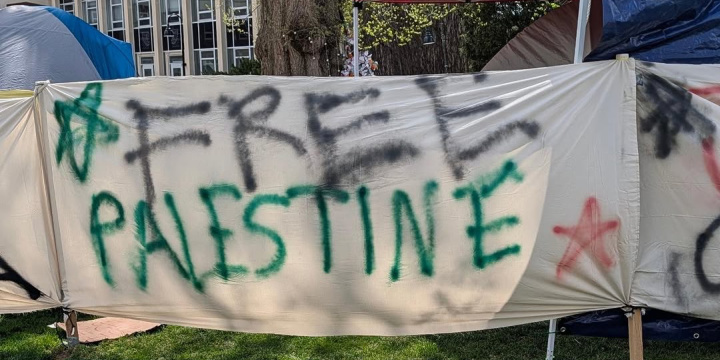
The “People’s University” encampment, established by Students for Justice in Palestine, on the campus of Smith College in April 2024. Photo: Screenshot
Smith College in Northampton, Massachusetts has granted Students for Justice in Palestine (SJP) a meeting with high-level officials in exchange for the group’s ending an unauthorized encampment established on campus to protest the board of trustees’ decision to reject a proposal inspired by the boycott, divestment, and sanctions (BDS) movement against Israel.
On April 18, SJP commandeered the Chapin Lawn and renamed it “The People’s University.” Armed with a litany of demands calling for “restructuring” Smith’s governance of its endowment, transferring power over the institution from administrators to faculty and students, and a “required course on race” informed by the divisive critical race theory discipline, the students initially vowed to dwell in the encampment indefinitely.
Over seven days, SJP hosted a series of anti-Israel themed events on “Palestinian resistance,” “Indigenous resistance,” and “organizing.” On other days, the group filled time with “listening sessions” and even provided dinner, suggesting that the encampment received financial support sufficient to feed dozens of college students. However, the mounting presence of public safety officers around the encampment site and little indication that the demonstration held the drawing power of encampments of previous academic years prompted SJP to consider settling for less than it wanted.
Additionally, the college had notified the group of being in violation of campus policies on peaceful assembly and threatened SJP with disciplinary sanctions, which the group described as “fear tactics.” Tamra Bates, director of student engagement, personally told the students they would be punished as “individuals” and, the group added, public safety officers addressed “at least one student” by their “full name.” After three days, paranoia took hold of the organizers, and they issued a prohibition on photography “at any time … especially of people’s faces.”
SJP ultimately agreed to enter negotiations with the college over email, a process which concluded with Smith College agreeing to hold a meeting with the group and college trustees “before the end of the semester.” The students decamped on Saturday.
Smith College has not responded to The Algemeiner‘s inquiry regarding the substance of the deal.
As previously reported, Smith College became one of the latest higher education institutions to see a class between anti-Zionists and administrators over institutional ties to Israel as college trustees neared a vote on what SJP titled the “ethical investment” proposal. Brimming with falsehoods, the document accused Israel of the crime of “femi-genocide,” which SJP described as “sexual and reproductive violence” and mass murder perpetrated against Palestinian women and girls. The enterprise continues a pattern of depicting Israel, the most progressive country in the Middle East, as a foe of left-wing causes and an enemy of liberalism.
Additionally, the proposal called on Smith to withdraw investments in armaments manufacturers while arguing that divestment from Israel is a prelude to divesting from fossil fuels, a subtle but common tactic in which far-left groups place Jews and Zionists at the center of an array of alleged conflicts and social maladies.
“Militarism and the use of explosive weaponry has a devastating impact on our climate: military carbon emissions from the ongoing occupation and genocide of Palestinians exceeds that of several countries combined,” the proposal said. “We face interconnected human rights crises at home and abroad that jeopardize our immigrant and international students, faculty, staff, and community members. Broader patterns of forced displacement are inseparable from climate change, and are fueled by a longer history of neoliberalization, securitization, and colonization.”
Citing fiduciary concerns, virtually all colleges asked to adopt BDS have rejected it.
In March 2025, Bowdoin College in Brunswick, Maine did so when its Board of Trustees voted to accept the counsel of a committee that recommended maintaining investment practices which safeguard the institution’s financial health and educational mission. In a report authored by the college’s Ad Hoc Committee on Investments and Responsibility, it said, “Interventions in the management of the endowment that are rooted in moral or political considerations should be exceedingly rare and restricted to those cases where there is near-universal consensus among Bowdoin’s community of stakeholders.”
Boston University rejected divestment the previous month, with its president, Melissa Gilliam, saying, “The endowment is no longer the vehicle for political debate; nevertheless, I will continue to seek ways that members of our community can engage with each other on political issues of our day including the conflict in the Middle East.”
Adopting divestment proposals dictated by anti-Zionist groups is a recipe for squandering tens of billions of dollars in endowment returns, according to a report published in September 2024 by the JLens investment network, an arm of the Anti-Defamation League (ADL).
Titled “The Impact of Israel Divestment on Equity Portfolios: Forecasting BDS’s Financial Toll on University Endowments,” the report said BDS would incinerate $33.21 billion of future returns for the 100 largest university endowments over the next 10 years, with Harvard University losing $2.5 billion and the University of Texas losing $2.2 billion. Other schools would forfeit over $1 billion in growth, including the University of Pennsylvania, Stanford University, and Princeton University. For others, such as the University of Michigan and Dartmouth College, the damages would total in the hundreds of millions.
Follow Dion J. Pierre @DionJPierre.
Uncategorized
Molly Crabapple’s book is well researched but ideologically biased
Molly Crabapple’s Here Where We Live Is Our Country is a captivating read. Drawing on the biographies of both major and lesser-known activists, Crabapple tells the history of almost 130 years of the Jewish Labor Bund. Her crackling, imaginative prose brings dry, documentary materials to life, and makes long-ago personalities feel contemporary.
Crabapple chooses Sam Rothbord , her great-grandfather, as a guide to the vanished world of Jewish Eastern Europe. Though Crabapple was born many years after his death, her family saved his photos and papers. Crabapple turns to these items to reconstruct a detailed picture of his life.
Born in the town of Volkovysk (now in Belarus), Sam joined the Bund as a young man. He soon immigrated to America, where he became an artist. His first exhibit was held at the former headquarters of the Forward on East Broadway.
Many well-known Bundists make an appearance in the book: Vladimir Medem, Arkady Kremer, Raphael Abramovitch, Mark Lieber, Sophie Dubnova-Erlich , Henryk Erlich, Viktor Alter and others.
Crabapple takes her readers through the cataclysmic events in which the Bund took part: the Russian revolutions of 1905 and 1917, World War I, the establishment of the Polish republic and, finally, the Holocaust. Despite her great reverence for the Bundists’ heroism and sacrifice, Crabapple acknowledges that these heroic figures could also have difficult personalities. She often compares her own experiences as an activist on the left with the struggle of radicals around the world today.
The Bundists left behind a rich legacy of memoirs and documents. Crabapple synthesizes these sources into a lively narrative full of color and emotion.
Crabapple makes liberal use of graphic cliches, and she doesn’t hold back when it comes to representing the ‘bad guys.’ Describing the 1905 pogrom in Odessa, she writes: “Blood-smearedRussian mothers loaded their pushcarts with the spoils from looted Jewish houses, then had their kids torch their homes behind them as they left.” ”
Crabapple is well-versed in Marxist theory, having learned it from her father who, she writes, is a professor of political economy. She clearly explains the ideological differences between the Bund and other leftist parties. Unfortunately, her relationship to historical facts is occasionally a bit loose.
Czar Nicholas I, for example, did not limit the number of Jewish students in Russian universities; at the time there were simply nearly no Russian Jews who would have liked to study there. The so-called “percent norm” (quota) was first introduced by his grandson, Alexander III in 1887, over 30 years after Nicholas’ passing in 1855.
Crabapple also writes that “Tsar Nicholas I wrote his policies with the declared aim of forcing a third of Jews to die, a third to emigrate, and a third to convert to Christianity.” But Nicholas I never declared this; in fact, he strictly prohibited emigration from Russia. Many popular books on Russian Jewish history attribute this statement to Alexander III’s official, Konstantin Pobedonostsev, although no documentary source exists for this.
On the whole, Crabapple paints a historical landscape of the time in black and white. The good guys are the Bundists. The bad ones are various governments, the Bolsheviks and, of course, the Zionists. At fault for all the world’s ills is the West, with its capitalist, imperialist regimes.
The book is prominently anti-Zionist in its politics. This ideological direction must have been a motivating factor for Crabapple as she undertook this project — and she’s successfully conveyed it to her readers, reviving the old fighting spirit of Bundist polemics.
For all this, Crabapple isn’t blind to the political weakness of the Bund. “The Bund had accomplished many things in the areas of mutual aid, cultural production, and armed self-defense. But there was one thing that the Bund had neglected: the necessity of taking power.” A question lingers, however: did the Bund ever have that option, besides a handful of times in 1905, in Russian or Polish cities?
Here Where We Live Is Our Country offers a major intellectual resource for today’s generation of radical activists protesting Zionism and the State of Israel. There’s ample historical and theoretical ammo here for their arguments. At the same time, Crabapple’s book shows that far from every critic of Zionism is an anti-Semite (although many of them are).
Historically, it was Zionism that won out over the Bund, and the State of Israel is an undeniable fact. Indeed, Israel became a new home for many Bundists who survived the Holocaust. For Crabapple, however, that was their bad luck: “The lucky ones got visas for refugee communities in Melbourne and Johannesburg, Paris and Montevideo. Others were not so lucky. In the years after the Holocaust, hundreds of Bundist survivors left for Palestine.” Their party, she adds, meaning the Bund, “had given them fairy tales. Zionists offered a place where they could rebuild their lives.”
There’s a sense of mixed feelings here: disdain for the Zionists, coupled with the acknowledgement that the Bundist project had come to nothing and Zionism did a better job for the Jews. In keeping with Crabapple’s anti-Zionist attitude, she makes no mention of the Bund’s vibrant afterlife in Israel, which included figures such as Isaac Luden and Mordechai Tsanin, and the Israeli magazine Lebns-Fragen, which was highly critical of the Israeli government.
But perhaps the book’s greatest weakness is its deeply caricatured portrayal of Zionism. Not a single word is said about the major role of the Zionist program in Europe and America to support Jewish life in the diaspora. Compared to the Bundists, the Zionist activists were often less dogmatic in their perspective on Jewish culture.
Crabapple clearly demonstrates the ideological divide between the Bund and Zionism. However, she doesn’t seem to acknowledge what these two movements shared: a commitment to the future of the Jewish people. Both emerged from the political environment of late 19th-century Eastern and Central Europe, where various ethnic communities were seeking to reinvent themselves as nations.
The Bund and the Zionists offered two different responses to this challenge. One centered on diasporic nationhood, the other on the creation of a nation state. For both, however, Jewish peoplehood remained the primary concern.
Crabapple concludes her book on the Bund by thanking “the people of Palestine.” It’s a provocative and predictable call in today’s radicalized climate. What remains unclear, however, is who exactly these people are: do they include Israeli Jews? A Bundist answer, I suspect, would be “yes.”
The post Molly Crabapple’s book is well researched but ideologically biased appeared first on The Forward.
Uncategorized
At Trump’s Christian revival on the National Mall, one rabbi made a Jewish case for America
On the National Mall Sunday, Christian worship music boomed from giant speakers as “Adonai” and other names of God flashed across jumbo screens behind a praise band. Pastors invoked America’s biblical destiny. Sadie Robertson, the Christian social media personality and granddaughter of Duck Dynasty patriarch Phil Robertson, preached from both the Old and New Testaments.
And then Rabbi Meir Soloveichik — the lone Jewish speaker at the planned nine-hour “Rededicate 250” rally called by President Donald Trump, billed as a national “jubilee of prayer, praise and thanksgiving” — stepped to the podium and began talking about Irving Berlin.
Soloveichik, 48, a scion of one of modern Orthodoxy’s most revered rabbinic families and a member of Trump’s Religious Liberty Commission, used his remarks to offer a Jewish case for American exceptionalism, a contrast to the explicitly Christian vision of the nation’s founding that defined the day.
Recalling how Berlin wrote “God Bless America” as fascism spread across Europe and antisemitism consumed the continent, Soloveichik described the song as both a patriotic anthem and a prayer of gratitude from a Jewish immigrant who found refuge in the United States. The hymn, he said, represented “a plaintive prayer to God that America continue to be blessed.”
The four-minute speech fit squarely within Soloveichik’s broader worldview. A senior scholar at the conservative Tikvah Fund and rabbi of Congregation Shearith Israel in Manhattan, the oldest Jewish congregation in the United States, he has long argued that America’s civic ideals are aligned with traditional Judaism and biblical morality. His 2024 book, Providence and Power: Ten Portraits in Jewish Statesmanship, examines Jewish political leadership through the lens of faith and moral responsibility.
For Soloveichik, the connection between Judaism and American identity culminated in the Second World War. He noted that “God Bless America” was first broadcast publicly the day after Kristallnacht, when Nazis destroyed Jewish homes and synagogues across Germany. “At the very moment when darkness deepened,” Soloveichik said, “America raised its voice united in the song that Irving Berlin wrote.”
He added that “in the years that followed 1938, the prayer that is ‘God Bless America’ was carried by American soldiers who defeated evil, liberating Europe and the world.”
Then came the line that drew some of the loudest applause of his remarks: “It is a reminder, as hatred of Jews makes itself manifest again, that antisemitism is utterly un-American.”
Separation of church and state
The moment captured the complicated role Jews increasingly occupy within the Trump-era religious right: embraced as part of America’s Judeo-Christian heritage, even as critics warn that the broader movement surrounding events like Rededicate 250 blurs the line between religious pluralism and Christian nationalism.
Rachel Laser, the Jewish CEO of Americans United for the Separation of Church and State, denounced the rally before the event. “If President Trump and his allies truly cared about America’s legacy of religious freedom, they would be celebrating church-state separation as the unique American invention that has allowed religious diversity to flourish in our country,” she said in a statement. “Instead, they continue to threaten this foundational principle by advancing a Christian Nationalist crusade to impose one narrow version of Christianity on all Americans.”
Sunday’s event — part revival meeting, part patriotic pageant — was the centerpiece of the Trump administration’s religious programming tied to this year’s 250th anniversary of the founding of the United States. Secretary of Defense Pete Hegseth and House Speaker Mike Johnson were slated to appear alongside evangelical pastors, worship leaders and conservative Christian influencers. President Trump and Vice President JD Vance were scheduled to address the crowd by video, while Trump himself spent the weekend golfing after returning from an overseas trip to China.
“This is a recognition of the deeply embedded history and religious and moral tradition of the country,” Johnson said Sunday on Fox News, dismissing criticism that the rally blurred the separation of church and state. Those objecting to the event, he added, “want to erase the history of America.”
No Muslim speakers appeared on the lineup. Organizers promoted Trump’s declaration of a national “Shabbat 250” observance the day prior as evidence of interfaith inclusion.
One of the Sunday event’s chief promoters, Trump spiritual adviser Pastor Paula White-Cain, had reassured supporters beforehand that the gathering would celebrate America’s Christian foundations without “praying to all these different Gods.”
Soloveichik did not address those tensions. Instead, he closed by returning to the image of America as a nation uniquely capable, in his telling, of transforming a Jewish refugee into the composer of one of the country’s most enduring patriotic hymns.
“To sing this song,” he said, “is to be reminded that America’s story is unique.”
“GOD BLESS AMERICA IS NOT JUST A SONG. IT’S A PRAYER.” 🇺🇸🙏
Rabbi Meir Soloveichik delivers a powerful reminder that America’s love of liberty has always been tied to faith — tracing its story and why anti-Semitism is fundamentally un-American. pic.twitter.com/aKMg42nS2I
— Real America’s Voice (RAV) (@RealAmVoice) May 17, 2026
The post At Trump’s Christian revival on the National Mall, one rabbi made a Jewish case for America appeared first on The Forward.
Uncategorized
Israel to Establish Defense Offices in Former UNRWA Compound

A man handles fallen cables at the Jerusalem headquarters of the United Nations Relief and Works Agency for Palestine Refugees (UNRWA) as the headquarters is dismantled by Israeli forces, in East Jerusalem, January 20, 2026. Photo: REUTERS/Ammar Awad/File Photo
Israel’s cabinet on Sunday approved a plan to build a defense compound on the site of the recently demolished premises of the United Nations Relief and Works Agency in East Jerusalem.
Israel in January demolished structures inside the UN Palestinian refugee agency’s East Jerusalem compound after seizing the site last year, in an act condemned by the agency as a violation of international law.
In a joint statement, the Defense Ministry and Jerusalem Municipality said the new compound would include the establishment of a military museum, a recruitment office and a defense minister’s office.
Defense Minister Israel Katz called the decision one of “sovereignty, Zionism, and security.”
UNRWA, which Israeli authorities accuse of bias, had not used the building since the start of last year after Israel ordered it to vacate all its premises and cease its operations.
A UNRWA spokesperson declined to comment on the Israeli plan.
The agency operates in East Jerusalem, which the U.N. and most countries consider territory occupied by Israel as it was captured from Jordan in the 1967 Middle East war. Israel considers all Jerusalem to be its indivisible capital.
UNRWA also operates in Gaza, the West Bank and elsewhere in the Middle East, providing schooling, healthcare, social services and shelter to millions of Palestinians.
“There is nothing more symbolic or justified than establishing the new IDF recruitment office and defense establishment institutions precisely on the ruins of the former UNRWA compound — an organization whose employees took part in the massacres, murders, and atrocities committed by Hamas terrorists on October 7,” Katz said.
Israel has alleged that some UNRWA staff were members of the Palestinian terrorist group Hamas and took part in the attack on Israel on October 7, 2023, that killed about 1,200 Israelis and led to Israel’s war against Hamas.