


Uncategorized
Ted Cruz to Jewish Republicans: Antisemitism is ‘an existential crisis in our party’
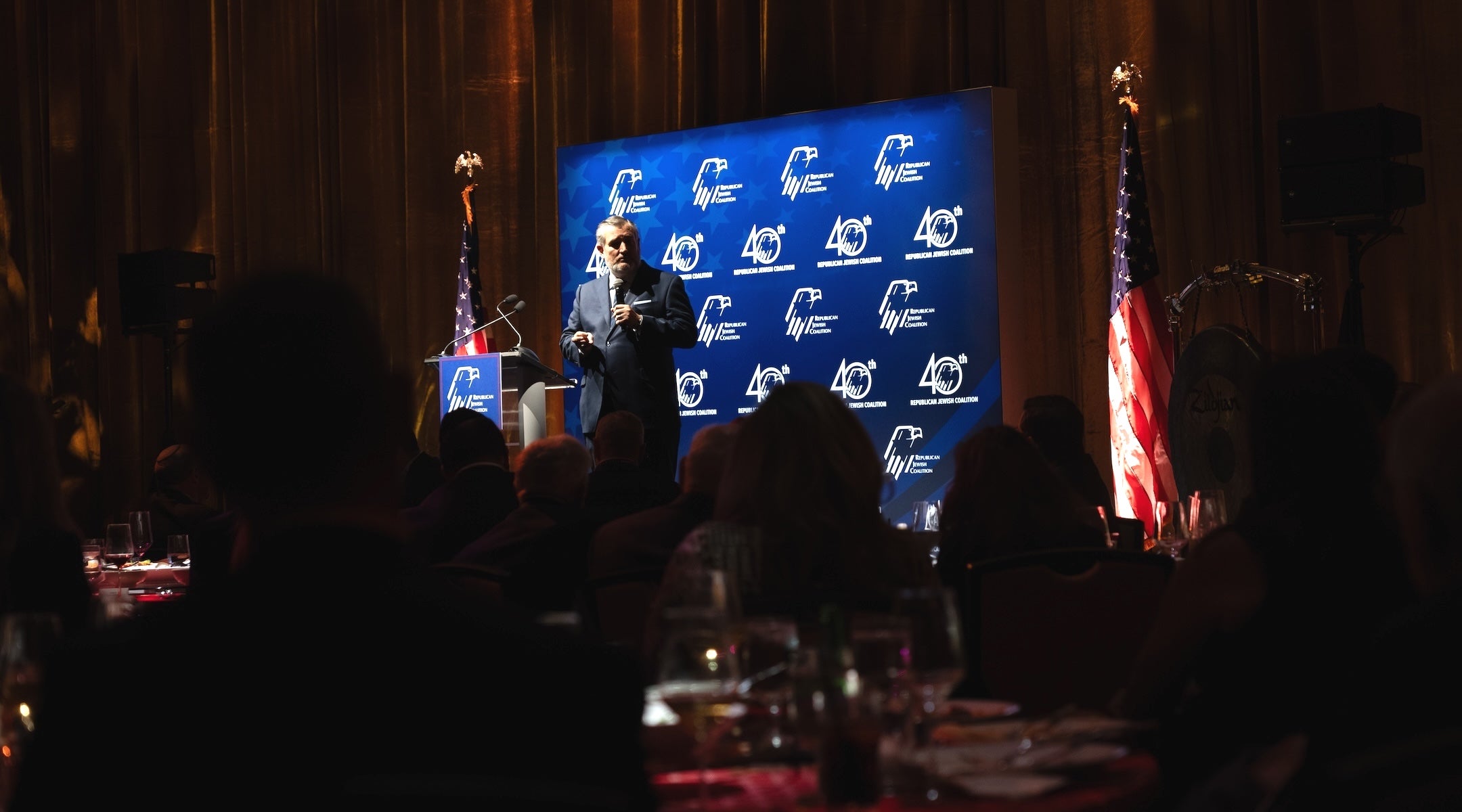
(JTA) — LAS VEGAS — Ted Cruz warned of rising antisemitism on the right — and a lack of Republican voices calling it out — as he kicked off the Republican Jewish Coalition’s annual summit Thursday night.
The speech reiterated comments he made at a San Antonio megachurch last week, including the core message that he’s recently seen more right-wing antisemitism than ever before.
“In the last six months, I’ve seen more antisemitism on the right than I had in my entire life,” Cruz said.
“This is a poison,” he continued. “And I believe we are facing an existential crisis in our party and our country.”
The RJC’s annual gathering, being held this weekend at the Venetian Resort Las Vegas, comes as a growing number of conservatives are turning against Israel, while right-wing voices who are spreading antisemitic conspiracies are finding mainstream audiences.
Cruz, a longtime supporter of Israel, presented the moment of division on the right as “a time for choosing.”
“And as for me, I choose to stand with you,” Cruz said to the room of about 100 Jewish Republican donors. “I choose to stand with Israel, and I choose to stand with America.”
As at the megachurch, Cruz, who is Christian, did not name names in his criticism of the “anti-Israel right.” But on Thursday he hinted strongly that he was speaking about Tucker Carlson, the former Fox News personality who recently hosted a friendly conversation with the white nationalist livestreamer Nick Fuentes. Carlson said during the interview that GOP supporters of Israel — including Cruz — are infected by a “brain virus.”
“If you sit there and nod adoringly while someone tells you that Winston Churchill was the villain of World War II, if you sit there and nod while someone says, ‘There’s a very good argument America should’ve intervened on behalf of Nazi Germany in World War II,’ if you sit there with someone who says ‘Adolf Hitler was very, very cool,’ and that their mission is to combat and defeat global Jewry, and you say nothing?” Cruz said. “Then you are a coward and you are complicit in that evil.”
His comments came just hours after Kevin Roberts, the president of leading conservative think tank the Heritage Foundation, answered mounting questions about whether he would continue to associate with Carlson after the Fuentes interview — with a resounding defense of Carlson.
RJC CEO Matt Brooks told Jewish Insider that, after working with Heritage over the years, there would be “a reassessment of our relationship with Heritage in light of this.”
Cruz called out the silence of Republican elected officials who’ve not spoken out against increasing right-wing antisemitism.
“I have to say, too many people are scared to confront them,” he said, referring to the “grotesque bigots” who do not plainly see Hitler as “the embodiment of evil.”
“How many elected Republicans do you see standing up and calling this out?” Cruz said. “How many do you see willing to take on the voices on the anti-Israel right?”
One name invoked by Cruz in a positive light was President Donald Trump, whom the Texas senator called “the most pro-Israel president in the history of the United States,” to loud applause.
Cruz affirmed to the RJC’s membership that with Trump in the White House, their interest in assisting Israel in its conflicts would be upheld, and kept away from the skepticism of a growing isolationist faction that would rather the United States not get involved.
(Trump has not publicly weighed in on Carlson hosting Fuentes; Trump once dined with Fuentes and rapper Ye between presidential terms in 2022, later saying that he had not known who Fuentes was.)
But Cruz then pointed to the post-Trump future as a fork in the road moment for the Republican Party.
“When Trump is not in the White House, what then?” Cruz said.
One man called out, “Ted Cruz!”
One potential candidate for Republican leadership in 2028 was not named in Cruz’s speech: JD Vance.
Cruz lauded Trump’s efforts in taking on Hamas and cracking down on campus protests, but did not name Vance as a friend of Jewish Americans.
Vance faced criticism this week after failing to push back on skeptical questions about Israel, including one laced with an antisemitic conspiracy theory, at a Turning Point USA event at Ole Miss. Vance also downplayed the messages sent in the recent Young Republicans leak, saying the text messages sent by early-career GOP activists — which included jokes about gas chambers, racist slurs and praise of Hitler — were simply immature “jokes” and that critics should “grow up.”
Cruz emphasized the need to “engage in college campuses” and “engage in the facts” in order to overcome the “handful of voices that are spreading this garbage,” whom he said were “giving every one of us a time for choosing.”
He thanked the crowd for being “patriots.”
“You love America — although the fact that you are Jewish means that there are idiots who would accuse you of not loving America simply because of it,” he said, invoking the dual loyalties trope to which Fuentes subscribes.
Cruz’s 25-minute speech included celebratory jokes about Israel’s pager operation that killed some and wounded hundreds of members of Hezbollah, condemnations of what he called a growing “pro-Hamas wing” of the Democratic Party, and a reflection on the horrors of Hamas’ Oct. 7, 2023, attack on Israel.
But its main thrust was that the Republican Party has reached a point where its Jewish and pro-Israel membership must think about how to stave off a growing anti-Israel movement, and quell the proliferation of antisemitic conspiracy theories.
Cruz began his speech by remarking that this was the RJC’s 40th-anniversary summit — a fact that he said poignantly reinforced the weight of this moment.
“Thinking back over the last 40 years, I don’t know that there has been a year in those 40 that the Republican Jewish Coalition was more needed than right now,” Cruz said.
The post Ted Cruz to Jewish Republicans: Antisemitism is ‘an existential crisis in our party’ appeared first on The Forward.
Uncategorized
Iran Leaders Join Crowds on Tehran’s Streets to Project Control in Wartime

Iranians gather at a park on Nature Day, amid the U.S.-Israeli conflict with Iran, in Tehran, Iran, April 2, 2026. Photo: Majid Asgaripour/WANA (West Asia News Agency) via REUTERS
After more than a month of being stalked by targeted assassinations, Iran’s leadership has adopted a new tactic to show it is still in control – with senior officials walking openly in the streets among small crowds who have gathered in support of the Islamic Republic.
In recent days, Iran’s president and foreign minister have separately mixed with groups of several hundred people in central Tehran. On Tuesday, state television aired footage of the two posing for selfies, talking to members of the public and shaking hands with supporters who had gathered in public areas.
According to insiders and analysts, the appearances are part of a calculated effort by Iran’s theocratic leadership to project resilience and authority — not only over the vital Strait of Hormuz but also over the population — despite a sustained US-Israeli campaign aimed at “obliterating” it.
One insider close to the hardline establishment said such public outings are intended to show that the Islamic Republic is “unshaken by strikes and that it remains in control and vigilant” as the war grinds on.
The US-Israeli war on Iran began on February 28 with the killing of veteran Supreme Leader Ayatollah Ali Khamenei and several senior military commanders in waves of strikes that have since continued to target top officials.
Iran’s new Supreme Leader, Mojtaba Khamenei, has not been seen in public since taking over on March 8 from his father. Foreign Minister Abbas Araqchi, meanwhile, was removed from Israel’s hit list amid mediation efforts last month, including by Pakistan, to bring Tehran and Washington together for talks to end the war.
Talks aimed at ending the war have since appeared to have petered out, as Tehran brands US peace proposals “unrealistic.” Against that backdrop, recent public appearances by President Masoud Pezeshkian and Araqchi appear designed to project defiance, if not a convincing display of public support.
A senior Iranian source said officials’ public presence demonstrates that “the establishment is not intimidated by Israel’s targeted killing of top Iranian figures.”
Asked whether Iran’s foreign minister or president were on any sort of kill list, an Israeli military spokesperson, Nadav Shoshani, said on Friday he would not “speak about specific personnel.”
NIGHTLY RALLIES TO SHOW RESILIENCE
Despite widespread destruction, Tehran appears emboldened by surviving weeks of intense US-Israeli attacks, firing on Gulf countries hosting US troops and demonstrating its ability to effectively block the Strait of Hormuz.
On Wednesday, US President Donald Trump vowed more aggressive strikes on Iran, without offering a timeline for ending hostilities. Tehran responded by warning the United States and Israel that “more crushing, broader and more destructive” attacks were in store.
Encouraged by clerical rulers, supporters of the Islamic Republic take to the streets each night, filling public squares to show loyalty even as bombs rain down across the country.
Analysts say the establishment is also seeking to raise the “political and reputational” cost of the strikes at a time when civilian casualties are deeply disturbing for Iranians.
Omid Memarian, a senior Iran analyst at DAWN, a Washington-based think tank, said the decision to send officials into gatherings reflects a layered strategy, including an effort to sustain the morale of core supporters at a moment of acute pressure.
“The system relies heavily on this base; if its supporters withdraw from public space, its ability to project control and authority weakens significantly,” Memarian said.
Speaking to state television, some in the crowds voice unwavering loyalty to Iran’s leadership; others oppose the bombing of their country regardless of politics; and some have a stake in the system, including government employees, students and others whose livelihoods are tied to it.
Hadi Ghaemi, head of the New York-based Center for Human Rights in Iran, said the establishment is using such loyal crowds as human shields to raise the cost of any assassination attempts.
“By being in the middle of large crowds they have protections that would make Israeli-American attacks against them very bloody and generate sympathy worldwide,” he said.
POTENTIAL PROTESTERS STAY OFF STREETS AT NIGHT
The Islamic Republic emerged from a 1979 revolution backed by millions of Iranians. But decades of rule marked by corruption, repression and mismanagement have thinned that support, alienating many ordinary people.
While there has been little sign so far of anti-government protests that erupted in January and abated after a deadly crackdown, the establishment has adopted harsh measures – such as arrests, executions and large-scale deployment of security forces – to prevent any sparks of dissent.
Rights groups have warned about “rushed executions” during wartime after Iran hanged at least seven political prisoners during the war.
“Many potential protesters are frightened by the continuing presence of armed men and violent crowds in the streets and largely stay at home once darkness falls,” Ghaemi said.
Uncategorized
US Fighter Jet Shot Down Over Iran, Search Underway for Crew, US Officials Say

FILE PHOTO: A U.S. Air Force F-16 jet fighter takes off from an airbase during CRUZEX, a multinational air exercise hosted by the Brazilian Air Force, in Natal, Brazil November 21, 2018. REUTERS/Paulo Whitaker/File Photo
A US fighter jet has been shot down over Iran and a search-and-rescue operation is underway for any survivors, two US officials told Reuters on Friday, in the first such known incident since the war began nearly five weeks ago.
The Pentagon and US Central Command did not respond to requests for comment.
The prospect of US pilots being alive and on the run inside Iran raises the stakes for the United States in a conflict that has struggled to win popular support among Americans, according to opinion polls.
It also presents a challenge to the US military, which faces the twin goals of trying to save the lives of any surviving U.S. crew and safeguard whoever is involved in perilous rescue missions.
Iranian officials called on civilians to be on the lookout for survivors and have flooded social media with images that purport to show wreckage from the aircraft.
The governor of Kohgiluyeh and Boyer-Ahmad province said anyone who captured or killed the crew “would be specially commended,” Iran’s semi-official news agency ISNA reported.
The incident follows threats by US President Donald Trump to bomb the country back to the “Stone Age,” including to attack Iran’s energy infrastructure and desalination plants, as he presses Tehran to end the war on US terms.
So far, 13 US military service members have been killed in the conflict and more than 300 have been wounded, according to the US Central Command. No US troops have been taken prisoner by Iran.
While Trump has repeatedly sought to portray the Iranian military as defeated, Reuters has reported on US intelligence showing Iran retains large amounts of missile and drone capability.
As of last week, the United States could only determine with certainty that it has destroyed about a third of Iran’s missile arsenal. The status of around another third was less clear but bombings likely damaged, destroyed or buried those missiles in underground tunnels and bunkers, Reuters’ sources said.
Uncategorized
Trump: US ‘Hasn’t Even Started Destroying What’s Left in Iran’

US President Donald Trump speaks on the day he honors reigning Major League Soccer (MLS) champion Inter Miami CF players and team officials with an event in the East Room of the White House in Washington, DC, US, March 5, 2026. Photo: REUTERS/Jonathan Ernst
i24 News – US President Donald Trump said Israel will halt its military campaign against Iran when he decides to end the war, while also signaling in recent conflicting statements that US strikes on Iranian targets could intensify.
Trump emphasized coordination with Israel, stating, “They’ll do what I tell them… They’ve been a good team player. They’ll stop when I stop. They’ll stop unless they’re provoked.”
At the same time, Trump indicated that the US has not yet fully escalated its military campaign. In a statement on Truth Social on Friday, he said, “Our military… hasn’t even started destroying what’s left in Iran. Bridges next, then electric power plants!” He added that Iran’s new leadership “knows what has to be done and has to be done FAST.”
According to a TIME report, Trump is weighing how to balance further military action with growing domestic pressure. Advisers warned him that public support for the war is declining as fuel prices rise and economic concerns mount in the United States.
The conflict has had global implications, particularly through disruptions in the Strait of Hormuz, a key route for oil shipments. The report notes that prolonged instability in the waterway could deepen economic strain and impact global markets.
At the same time, the administration has highlighted military achievements while acknowledging uncertainty over how to achieve broader goals such as limiting Iran’s long-term capabilities. Trump has expressed interest in ending the war but also in ensuring what he views as a decisive outcome.
The report indicates that the US is pursuing multiple options, with Trump seeking a way to conclude the conflict while maintaining pressure on Iran through continued or expanded strikes.