


Uncategorized
Teens, seniors explore Ashkenazi traditions at Yiddish New York festival
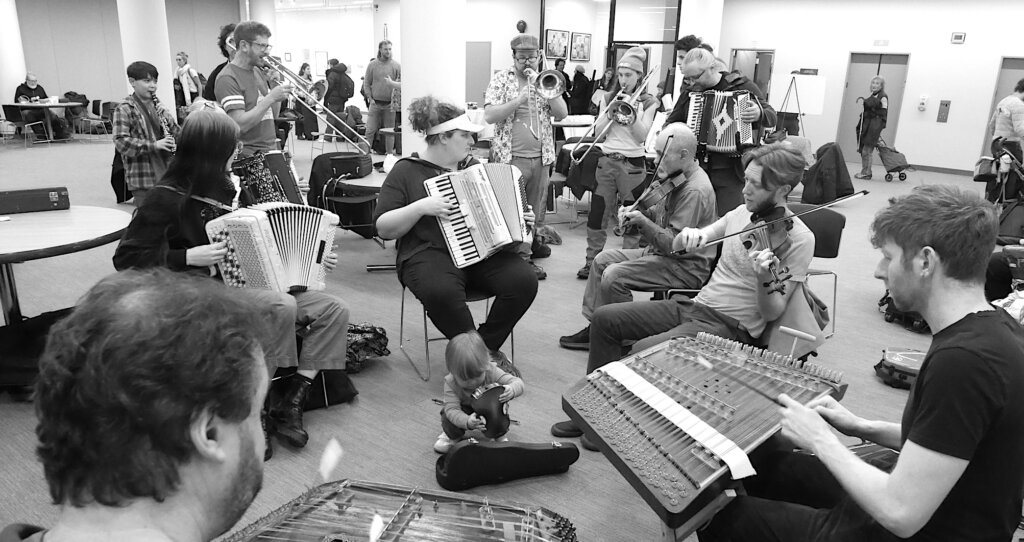
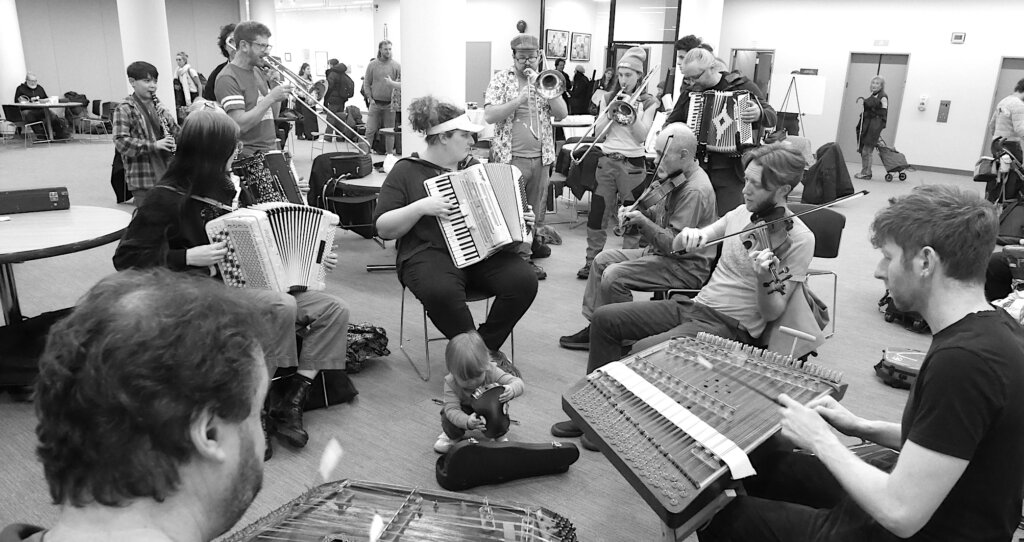
A group of klezmer musicians was jamming in Lower Manhattan, when its fiddler suddenly stopped and encouraged a preteen clarinetist to lead a tune. After a moment, the young musician began playing a traditional Yiddish dance melody known as “der shtiler bulgar,” and the other musicians joined in.
This was one of many scenes at the 11th annual Yiddish New York festival that took place last month at the New York City campus of Hebrew Union College.
The size of the festival was impressive: Over 100 speakers, 700 participants and 200 workshops and sessions on various aspects of Yiddish culture.
Yiddish New York began after KlezKamp, a storied Yiddish cultural festival that had been held in the Catskills for three decades, made its decision to shut down. “It was 2014 and KlezKamp had announced its last festival,” said Pete Rushefsky, executive director of the Center for Traditional Music and Dance and one of the lead organizers of Yiddish New York. “A bunch of us got together and said ‘we can’t bear to face the world without our Yiddish festival.’”
Now that the college has announced the sale of its Manhattan campus to nearby New York University, the five-day festival will be searching for a new home for 2026. “We’re going to have to find a new venue,” said Rushefsky. “It will be a challenge we will have to overcome. I’d love to see a residential component moving forward — I think there’s an interest.”
When he wasn’t helping out with administrative tasks, Rushefsky spent much of the day behind a tsimbl (an Eastern European hammered string instrument with a long history in the klezmer tradition), leading informal klezmer jams.
The festival’s offerings were wide-ranging within the scope of Yiddish culture: practical workshops, lectures, concerts, film screenings and informal music jams. And, of course, plenty of schmoozing.
Concerts included an evening of music by the versatile Yiddish playwright and performer Mikhl Yashinsky whose setlist included original Yiddish tradaptations (adapting a text from one language to another to make it culturally relevant for a new audience) of Tom Lehrer’s “Hanukkah in Santa Monica” and Bob Dylan’s “With God on Our Side.” Yashinsky also performed, together with a group of collaborators, several original songs and scenes from his Yiddish stage works Feast of the Seven Sinners and The Gospel According to Chaim.
Cantor Sarah Myerson and Dr. Avia Moore led a Yiddish Dance Fellows program featuring four fellows from around the country: Hannah Mira Friedland (Chicago), Sarah Horowitz (Albuquerque), Yael Horowitz (NYC), and Rachel Linsky (Boston). All were already leading, teaching and in some cases even choreographing Yiddish dance in their communities.
But the training that Myerson and Moore gave them wasn’t just about learning dance steps. They also role-played typical scenes where dance sessions might not go so smoothly. “Avia and I offered the most common ‘disruptions’ we experience on the dance floor: ignoring the leader, talking loudly, doing the wrong steps, etc. The fellows adjusted with generous grace!” Myerson said.
There were also programs for younger audiences. Teens learned about a 1950s music group, the Jewish Young Folksingers, affiliated with the International Workers Order, a mutual aid organization targeted during the Second Red Scare. Yiddish folk singer Ethel Raim, who was a part of the Jewish Young Folksingers herself, taught songs from the group’s history and shared her experiences in it. On the last day of the festival, the teens presented a skit based on all they had learned.
“It was really exciting to have that many generations in one room; we were spanning almost eight decades,” said Ozzy Gold-Shapiro, one of the teen program’s organizers. The youngest was 10; the oldest — in her eighties. “I was especially moved watching the Teen Program kids express and perform their version of cultural exploration and participation,” said Raim, who is herself in her 80s.
On the last evening of the festival, people gathered for the awarding of the 14th “Adrienne Cooper Dreaming in Yiddish Award” to musician and researcher Michael Alpert, known affectionately by his Yiddish name, Meyshke. Cooper, a singer and Yiddish cultural activist who passed away in 2011, played a leading role in the contemporary revival of Yiddish music.
“I was inspired and touched by Adrienne’s ability to make the Yiddish tradition accessible,” Alpert said. “There was a time when I thought I’d be the last person in the world who knew how to sing old Yiddish ballads and obviously that’s not the case. The younger cohort of this remarkable intergenerational community is one of the great joys of my life.”
The post Teens, seniors explore Ashkenazi traditions at Yiddish New York festival appeared first on The Forward.
Uncategorized
US Formally Reopens Caracas Embassy as Ties With Venezuela Warm

Venezuela’s interim president Delcy Rodriguez speaks during a press conference, more than a week after the US launched a strike on the country and captured President Nicolas Maduro and his wife Cilia Flores, at Miraflores Palace in Caracas, Venezuela, Jan. 14, 2026. Photo: REUTERS/Leonardo Fernandez Viloria
The United States on Monday formally reopened its embassy in Caracas, the State Department said, citing “a new chapter” in diplomatic relations with Venezuela less than three months after US forces seized the country’s then-President Nicolas Maduro in a raid on the capital.
President Donald Trump’s administration has engaged with an interim government led by former Maduro ally Delcy Rodriguez, including on an agreement for the US to sell Venezuelan oil, and has issued sanctions waivers to encourage US investment.
The two countries agreed in early March to re-establish diplomatic relations that were severed in 2019 after the first Trump administration refused to recognize Maduro as the country’s legitimate leader, following a disputed election, and instead recognized an opposition lawmaker as the country’s president.
“Today, we are formally resuming operations at the S. Embassy in Caracas, marking a new chapter in our diplomatic presence in Venezuela,” the State Department said on Monday.
US forces captured Maduro on Jan. 3 after months of heightened tensions between the two countries, setting off a chain of changes in Venezuela. Maduro and his wife, Cilia Flores, are on trial in New York on drug trafficking charges.
The raid came after the Trump administration said it would reassert US dominance in the Western Hemisphere, but Trump has also cited the success of deposing Maduro as a model for the war with Iran that began last month. The move against Venezuela cut off a major source of oil to Cuba, where the president has also hinted at US military action.
Secretary of State Marco Rubio said days after the Caracas raid that Washington would first seek to stabilize Venezuela, then begin a recovery phase where US companies would have access to the country’s energy resources, before finally beginning a political transition.
The Trump administration appointed Ambassador Laura Dogu, a career diplomat with experience in Latin America, to lead engagement with the interim government.
The State Department on March 19 removed a “do not travel” advisory for Venezuela and said Americans were no longer at risk of wrongful detention by authorities there, although it still warns US citizens to reconsider travel due to the risk of crime, kidnapping, terrorism and poor health infrastructure in the country.
The State Department said on Monday that Dogu’s team was restoring the Caracas embassy‘s chancery building “to prepare for the full return of personnel as soon as possible and the eventual resumption of consular services.”
“The resumption of operations at US Embassy Caracas is a key milestone in implementing the President’s three‑phase plan for Venezuela and will strengthen our ability to engage directly with Venezuela’s interim government, civil society, and the private sector,” the State Department said.
Uncategorized
Lessons From the Classroom: By the Time We Try to Teach Democracy, It’s Already Too Late

Harvard University campus on May 24, 2025, in Cambridge, Massachusetts. Photo: Zhu Ziyu/VCG via Reuters Connect
Ronald Reagan warned that freedom is fragile — that it must be taught, protected, and deliberately passed from one generation to the next. For years, that warning could be heard as rhetoric. As the United States approaches its 250th anniversary, it reads as diagnosis.
Ruth Wisse makes a similar point in her recent Jefferson Lecture, and she does so with characteristic clarity. Democracy, she reminds us, does not reproduce itself. “Democracy is not transmitted biologically.” It must be taught, reinforced, and defended.
That line should be engraved above the entrance to every school in America.
But even Wisse stops one step short of the deeper problem.
By the time we try to teach democracy in college, it is often already too late.
Her lecture is about endurance — how a people survives, how a civilization persists, how freedom is carried forward across generations. Drawing on Jewish history, she shows that continuity is never accidental. It is built through teaching, repetition, and expectation. The Shema is not just a prayer; it is a civilizational blueprint: teach your children, speak these truths constantly, bind them into daily life.
This is how a people endures.
But in the United States today, we have largely abandoned this model — and nowhere is that abandonment more visible than in education.
For years, colleges and universities have imagined themselves as the primary sites of civic formation. When students arrive with weak civic knowledge or thin historical grounding, institutions respond with programming — substituting initiatives for formation and statements for substance — designed to shape values in real time.
But anyone who teaches knows the truth: students do not arrive as blank slates.
They arrive formed.
And what is formed early tends to endure.
They have already learned whether disagreement is something to engage or something to silence. They have already absorbed whether institutions deserve trust or suspicion. They have already internalized whether their country is something to inherit or something to dismantle.
These habits are not formed in college. They are formed much earlier — especially in high school. Political scientists Richard Niemi and Jane Junn showed decades ago that high school is the decisive window for civic formation — that the knowledge, attitudes, and habits students carry into adulthood are largely shaped before they reach college.
I see this every day in the classroom. Present students with a controversial text and ask them to engage it — really engage it — and a familiar pattern emerges. Some move immediately to moral judgment before they can articulate the argument. Others retreat, wary of saying anything contestable. Very few instinctively attempt persuasion – laying out a case, anticipating objections, and revising their views in response.
This is not a failure of intelligence. It is a failure of formation.
And higher education, rather than correcting this, often deepens it.
Wisse watched this transformation up close during her two decades at Harvard, where she saw what Lionel Trilling called the adversarial culture — the ascent of grievance over gratitude — displace the serious transmission of civic inheritance. She wanted to remind her colleagues that democracy requires active reinforcement, not passive assumption. What she witnessed instead was the substitution of critique for formation, of grievance for gratitude.
In place of formation, we have substituted expression. Students are encouraged to “share their truth” but are rarely required to defend it. In place of shared civic frameworks, we offer individualized narratives. In place of intellectual discipline, we reward performance — moral, emotional, and increasingly ideological.
The result is a generation that is often articulate but not persuasive, engaged but not grounded, confident but not resilient.
These are not small distinctions. They are the difference between citizens and spectators — between a democracy that endures and one that frays.
Wisse is right to warn that civilizations must be defended — not only militarily, but culturally. Here, the Jewish experience offers a lesson that has become newly urgent after October 7.
For many, especially in the Diaspora, there was a quiet assumption that security could be taken for granted — that integration was sufficient, that strength could remain in the background.
October 7 shattered that illusion.
It was a brutal reminder that survival requires not only memory and meaning, but power and preparedness. The same is true, in a different register, for democratic societies. Freedom depends not only on ideals, but on the willingness to defend them — culturally, intellectually, and, when necessary, physically.
But defense begins with formation.
And here is where Wisse’s warning should land most forcefully: we are no longer reliably forming the citizens we need to sustain the system we have.
In K-12 education, the shift has been profound. History is too often taught as indictment rather than inheritance. Authority is treated with suspicion rather than seriousness. Students are encouraged to critique before they are asked to understand. The result is not critical thinking — it is premature certainty.
By the time these students arrive on campus, the patterns are already established.
Colleges are not building civic habits. They are attempting — often unsuccessfully — to remediate their absence.
This helps explain why so many institutional responses feel hollow. Statements are issued. Committees are formed. New programs are announced. But none of this addresses the deeper issue: the habits required for democratic life were never built in the first place.
And habits, once unformed, are extraordinarily difficult to create under pressure.
If we are serious about sustaining a free society, we must shift our attention earlier — restoring serious civic and historical formation in K-12 education, where these habits are actually built. That means requiring students to read founding documents and debate their meaning — not merely critique their authors. It means teaching argument before self-expression, and inheritance before indictment.
Wisse closes with a call for renewed patriotism — a reminder that Americans benefit from an extraordinary inheritance but “do not sing of it enough.” That is true. But patriotism is not a slogan. It is a disposition, formed over time through exposure, expectation, and practice.
It cannot be summoned at the moment of crisis. It must be cultivated long before.
Reagan understood that. Wisse reminds us of it.
But here is the harder truth:
Democracy is formed early — or it is not formed at all. And when we wait until college to build it, we are no longer forming citizens — we are trying, too late, to repair the habits we failed to build.
Samuel J. Abrams is a professor of politics at Sarah Lawrence College and a senior fellow at the American Enterprise Institute.
Uncategorized
Israel and the Impossible Standard of Moral Perfection

Jewish visitors gesture as Israeli security forces secure the area at the compound that houses Al-Aqsa Mosque, known to Muslims as Noble Sanctuary and to Jews as Temple Mount, in Jerusalem’s Old City, Photo: May 5, 2022. REUTERS/Ammar Awad
There is a standard applied to Israel that no other nation is expected to meet. It is not a standard of law, nor of morality as commonly understood. It is something far more rigid and far less honest. It demands perfection in the face of existential threats, and even then, it delivers condemnation.
As the conflict with Iran intensifies, Israel finds itself navigating a reality few countries have ever faced.
Iran has made its intentions unmistakably clear for decades. The destruction of Israel is not rhetoric for domestic consumption. It is official Iranian policy. It is repeated openly, consistently, and without apology.
When Iran strikes, it does not distinguish between civilian and military targets. In fact, it purposefully targets civilians. And it doesn’t only target Jews. Rockets do not ask who is religious or secular, Jewish or Muslim, Israeli or Arab. They fall where they are aimed, and often where they are not, with one purpose in mind: to kill, to terrorize, and to destabilize.
Israel, in contrast, is forced to think not only about survival, but about responsibility. This includes responsibility toward all of its citizens: Jewish, Muslim, Christian, Druze. The diversity of Israeli society is often overlooked, but in moments of crisis, it becomes impossible to ignore. Protection must extend to everyone, without exception.
That is why restrictions on public gatherings were imposed. Not as a political statement, but as a practical necessity. In wartime, large crowds are not just gatherings. They are potential mass casualty events waiting for a single missile.
Yet when Israel extended these restrictions during Ramadan, including closing access to major religious sites, the response was immediate outrage. The accusation was predictable: Religious discrimination. Oppression. A supposed targeting of Muslim worshippers.
The reality was different. The restrictions applied across the board. Muslims were not permitted at the Al-Aqsa Mosque. Christians were not permitted at the Church of the Holy Sepulchre. Jews were not permitted at the Western Wall or the Mount of Olives. This was not selective enforcement. It was a universal policy driven by security concerns.
But nuance rarely survives in the modern information environment.
Within hours, a simplified narrative took hold. Israel was once again cast as the aggressor, the oppressor, the state that denies religious freedom. The broader context disappeared. The ongoing threat, the indiscriminate nature of incoming attacks, the responsibility to prevent mass casualties, all of it was pushed aside.
Then, almost as if to underline the point, a rocket landed near Jerusalem’s Old City that very same day. It was a stark reminder of what was at stake. Had thousands gathered as they normally would, the consequences could have been devastating.
And yet, even that reality does not shift the narrative.
This is the dilemma Israel faces repeatedly. If it acts to prevent harm, it is accused of repression. If it refrains and harm occurs, it is blamed for negligence. There is no decision that escapes criticism, because the criticism is not rooted in the decision itself. It is rooted in a predetermined judgment against a state run by Jews.
Another example illustrates this pattern with uncomfortable clarity. A toddler was found approaching the Israeli border alone. In any other context, this would be seen for what it is. A child placed in danger, likely as part of a calculated attempt to provoke a reaction.
Israeli soldiers responded not with force, but with care. They ensured the child’s safety, provided food and water, and transferred him to the Red Cross. Evidence showed the child was unharmed at the time of transfer.
Yet the story that followed claimed abuse. Allegations of injuries surfaced, contradicting the available evidence. The facts did not matter. The narrative had already taken shape.
This is not simply misinformation. It is a pattern of interpretation that assumes guilt regardless of evidence.
As Easter approaches, restrictions on religious gatherings once again draw criticism. Clergy voice frustration. Observers condemn the limitations. But the fundamental question remains unanswered: What is the acceptable level of risk? How many lives can be gambled in the name of normalcy?
Israel does not have the luxury of abstract debates. Its decisions carry immediate consequences measured in human lives. That reality forces choices that are imperfect, often unpopular, and always scrutinized.
The tragedy is not only in the conflict itself, but in the inability of much of the world to acknowledge its complexity. Until that changes, Israel will continue to face an impossible standard, one where even its efforts to prevent tragedy are reframed as acts of injustice.
Sabine Sterk is the CEO of Time To Stand Up For Israel.