



Uncategorized
The Art of the Heart: A Message From Israel for Valentine’s Day

As Valentine’s Day, celebrated on Feb. 14, approaches, preparations are seen underway in the markets in ghodbander road, Thane, on Feb. 12, 2026, in Mumbai, India. Photo: Praful Gangurde/Hindustan Times/Sipa USA via Reuters Connect
In the weeks before Valentine’s Day, hearts appear on everything: cards, shop windows, menus, and messages. It’s sweet and familiar. We use the heart as a symbol for love because it’s the body’s center for the emotion of love.
The heart is not just a Valentine’s Day symbol, however. It’s an organ that works without stopping, and it responds, quietly and powerfully, to the way we live — how and what we eat, how much stress we carry, how well we sleep, how often we move, and whether we feel connected or alone.
I came to Israel from Los Angeles in 1983 with a mission that has guided me ever since: “Healing Ourselves; Healing the Planet.” A few years later I founded what became Reidman College, beginning with a small school for holistic massage. Back then, my belief was simple: When you touch someone, you touch their soul. Done with care and respect, touch can ease pain in the body, and it can also soften something deeper: the constant bracing that so many people carry without even noticing.
What I’ve seen through the clinical training our students provide across Israel is that people don’t arrive with only a physical complaint. They arrive with a full life behind the symptom. The body is not separate from the person. The heart is not separate from the story.
That is why Valentine’s Day can be more than a commercial holiday. It can be a useful mirror. Not because everyone needs romance, but because everyone needs and wants love in the wider sense: connection, belonging, steadiness, and the feeling that I am not carrying everything alone.
Heartbreak is not just the aching heart in a Country Western song. The emotions of prolonged stress, grief, anxiety, and loneliness often show up physically in the heart. A tight chest. Shallow breathing. Poor sleep. A nervous system that never truly calms down.
When stress becomes chronic, the body behaves as if danger is always close. That affects how we breathe, how we digest, how we rest, and how we make decisions. We reach for quick comfort because the system is asking for relief. Over time, those patterns shape the habits that can protect or damage heart health: movement, sleep, food choices, emotional regulation, and the ability to recover after difficult days.
In integrative medicine, we know that changing only one habit doesn’t solve everything. We also don’t separate a person into compartments — heart here, mind there, life somewhere else. At Reidman, we teach that real care is both responsible and grounded, and that integrative approaches work best; that is, conventional medicine alongside Natural Medicine, and not instead of it. If someone has symptoms that worry them, whether that be chest pain, shortness of breath, dizziness, unusual fatigue, or unusual palpitations, they should get checked. Only with a clear diagnosis can one then begin to take the right path toward better health.
For many people, the most meaningful change for better heart health begins with a question: What does my heart need from my daily life right now?
Usually, the answer is not dramatic. It starts with the nervous system. Many adults live in a state of constant tension — shoulders lifted, jaw tight, breath held, like we are bracing for impact. You don’t have to change your whole life to change that message. Even a small daily practice of slowing the breath, especially lengthening the exhale, can help the body come down from alert mode. I’ve seen again and again in our teaching clinics: When the breath settles, the person settles. And when the person settles, the heart doesn’t have to work as hard just to keep them emotionally afloat.
Then there is movement. A short walk most days is one of the simplest ways to support circulation, mood, and sleep. It also gives stress a place to go. So many people are trying to “think” their way out of tension. But the body often needs a physical release. A 10-minute walk after a meal, a few minutes in fresh air, small things, repeated, can shift the baseline.
Sleep matters more than people like to admit. When sleep is poor, everything becomes louder: worry, cravings, irritability, sensitivity. A tired nervous system is fragile. A rested one is resilient. The heart is part of that story. If Valentine’s Day is a time for gifts, then let this message be a gift to you: Protect your evenings from constant stimulation. Create a softer landing. Less screen. Lower light. A warm shower. A few quiet minutes before bed because your body repairs itself at night and your heart benefits when you respect that repair.
And then there is the most overlooked “heart health” factor of all: connection.
Love is not only romance. Love is the person who checks in. The friend who answers. The community that makes space for you and perhaps having a pet. It is known that people with pets to care for and receive love from live longer and happier than most others. Dogs, in particular, are renowned for giving unconditional love.
Valentine’s Day can unintentionally reflect to single people, widows and widowers, the divorced, the grieving, and the lonely that they are “outside” the story. But the heart doesn’t only respond to couple-hood. The heart responds to belonging. To the feeling that you matter to someone, and someone matters to you.
If you want a simple Valentine’s practice that is actually meaningful, it’s this: Reach out in a real way. Not a reaction emoji. Not a forwarded video. A sentence that carries warmth. “How are you, really?” “I’m thinking of you.” “Do you want to take a walk together?” It sounds small, but small acts of connection are often what keep people steady.
Judaism understands something essential here: We are not meant to live as isolated individuals. We are built for community. Even the rhythm of Shabbat — pausing, disconnecting from constant doing, returning to family and to presence, is, in its own way, a heart practice. It reminds the body that life is not only pressure. There is also rest. There is also meaning. There is also relationship.
And there is touch, appropriate, respectful touch, which is increasingly missing in modern life. We live in a world that is both touch-starved and touch-confused. But the body still needs safe contact: a hug that is asked for, not taken; a hand held; a massage given with dignity. This is one reason I began in massage all those years ago. Because when touch is done properly, it can communicate something words often can’t: “You are safe, you are seen, you are not alone, and I am here with you.”
At Reidman, we speak a lot about dignity. And that includes the way we treat ourselves. Many people live at emergency speed. The heart doesn’t respond well to constant stress. It responds to steadiness. To daily care. To a life that is livable.
So yes, enjoy Valentine’s Day. Enjoy the sweetness. Send the heart emoji, send the flowers, book that romantic dinner.
But if you want the holiday to mean something deeper, let it be a reminder that your real heart is listening to your life. This month, give it more than a symbol. Give it calmer breathing, steadier sleep, gentle movement, and real connection — because love is not only what we celebrate. Love is also what we practice. Love is the most powerful healer of all. Loving ourselves; and loving others. Perhaps the Beatles were right: “All we need is love, love. Love is all we need.”
Sally Reidman, who immigrated to Israel in 1983 from Los Angeles, is the founder of Reidman College, Israel’s largest institute for complementary and integrative medicine.
Uncategorized
US, Israel Said to Plan New Iran Strikes as Tehran Pounds UAE
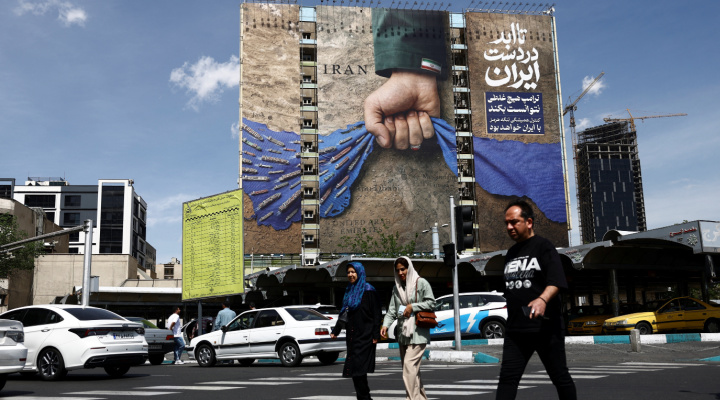
People walk past a billboard with a graphic design about the Strait of Hormuz on a building, amid a ceasefire between US and Iran, in Tehran, Iran, April 27, 2026. Photo: Majid Asgaripour/WANA (West Asia News Agency) via REUTERS
Israel and the US are coordinating plans for another round of strikes on Iranian targets, CNN reported Tuesday, as Iran kept up its attacks on the United Arab Emirates for a second straight day and amid reports that the Gulf state’s defense increasingly appeared to be drawing on Israeli support.
CNN cited an Israeli source as saying that the plans, largely drawn up before the ceasefire with Iran began in April, include strikes on Iran’s energy infrastructure and targeted killings of senior officials.
“The intention would be to carry out a short campaign aimed at pressuring Iran into further concessions in negotiations,” the source said, adding that any decision to resume the war would be made by US President Donald Trump.
CNN also reported that an Israeli-operated Iron Dome battery intercepted an Iranian missile over the UAE on Monday, the first known use of the system to defend a Gulf state. The system had been secretly deployed there at the start of the war, according to the report, along with Israel Defense Forces (IDF) soldiers sent to operate the system.
The system has so far intercepted dozens of Iranian missiles in the UAE, according to Israeli officials cited in a separate report by Axios.
The UAE said Iran fired 12 ballistic missiles, three cruise missiles, and four drones at the country on Monday. And then, according to Emirati officials, Iran launched additional missiles and drones on Tuesday. The UAE’s Foreign Ministry called the attacks a “serious escalation” and a “direct threat” to national security, adding that the UAE reserves its “full and legitimate right” to respond.
Another report by the London-based Iran International said that Iranian President Masoud Pezeshkian was furious over the escalation and warned military commanders of the regime’s Islamic Revolutionary Guard Corps (IRGC) that the “completely irresponsible” attacks risked dragging Iran back into full-scale war.
He also described the IRGC’s handling of tensions with regional states as “madness,” the report said, citing sources close to the matter, and warned that the consequences could be irreversible.
The New York Times reported last week that senior IRGC commanders were increasingly driving decision-making in Tehran, with Iran’s new supreme leader, Ayatollah Mojtaba Khamenei, unable to command the system with the authority once wielded by his father. The report added to mounting rumors over Khamenei’s health and capacity, and to growing confusion over who is ultimately directing Iran’s military and political response.
Iranian state media, citing an unnamed military official, said that the strikes on the UAE were unintentional and “the result of the US military’s adventurism to create passage for illegal ship transit” through the Strait of Hormuz, a narrow waterway between the Persian Gulf and the Gulf of Oman through which about one-fifth of the world’s trade in oil and liquefied natural gas flows.
Adm. Brad Cooper, the head of US Central Command, on Monday said American forces had cleared a mine-free route through the strait, which Iran shut in response to the US-Israeli strikes, and were escorting civilian vessels when Tehran launched cruise missiles, drones, and small boats at ships under US protection.
US military helicopters destroyed six of the boats, Cooper told reporters, saying “each and every” threat had been defeated.
Beyond mounting escorted transits for commercial vessels, the US has countered Iran’s shutdown of the waterway by blockading Iranian ports, a move that has further crippled the country’s already ailing economy and pushed it to the brink of collapse.
Iran’s Revolutionary Guards issued a new warning Tuesday, saying any vessel that does not use the route approved by Tehran through the Strait of Hormuz would face retaliation.
“We warn all vessels planning to transit the Strait of Hormuz that the only safe passage is the corridor previously announced by Iran. Any diversion of ships to other routes is dangerous and will result in a firm response from the Iranian Revolutionary Guards navy,” the Guards said in a statement carried by state television.
IDF Chief of Staff Lt. Gen. Eyal Zamir on Tuesday said the military was “closely monitoring developments in the Gulf” and is “prepared to respond with force against any attempt to harm Israel.”
Uncategorized
Brooklyn Nets Forward Michael Porter Jr. Defends Deni Avdija Against Hate for Representing Israel

Mar 2, 2025; Cleveland, Ohio, USA; Portland Trail Blazers forward Deni Avdija (8) drives to the basket against Cleveland Cavaliers guard Ty Jerome (2) and forward Dean Wade (32) during the second half at Rocket Arena. Photot: Ken Blaze-Imagn Images via Reuters Connect
Brooklyn Nets forward Michael Porter Jr. defended fellow NBA player and Trail Blazers forward Deni Avdija against the hate he receives for representing his home country of Israel.
Porter Jr. recently made an appearance on a live stream with YouTuber N3on and mentioned that Avdija is a player who gets to the free-throw line often. N3on then commented that Avdija “gets a lot of hate,” referring to hate messages on social media, even though “he’s a good player.” When Porter asked the streamer if Avdija is criticized because he is Jewish, N3on replied yes.
“Really? What are people mad about?” Porter asked.
“Because he wore a flag or something,” N3on replied, referring to Avdija’s public display of pride for Israel, such as wearing a jersey featuring an Israeli flag or draping himself in an Israeli flag on the court.
“It’s so weird,” Porter said in response. “Do people not want others to represent their country? What do they expect from him?”
Michael Porter Jr. tells N3on people are weird for hating on Deni Avdija just because he proudly represents Israel
“Why hate someone for repping their country?”
pic.twitter.com/C945Xr0dhB
— luci. (@inmaxera) May 2, 2026


Avdija, who is set to become a free agent in 2028, is the first Israeli to be named an NBA All-Star and last month became the first Israeli to reach and win an NBA Playoff game. Unfortunately, the Portland Trail Blazers ended their 2025-26 season last week with a 114-95 loss to the San Antonio Spurs in the first round of the 2026 playoffs.
Earlier the year, Avdija spoke to The Athletic about the hate that he receives as an NBA player from Israel.
“I obviously stand for my country, because that’s where I’m from. It’s frustrating to see all the hate,” he said. “Like, I have a good game or get All-Star votes, and all the comments [on social media] are people connecting me to politics. Like, why can’t I just be a good basketball player? Why does it matter if I’m from Israel, or wherever in the world, or what my race is? Just respect me as a basketball player.”
“You don’t have to love what I stand for or how I look, but if I’m a good player, give props,” Avdija added. “All this hate … for no reason, like I’m deciding things in the world … I’m from there, and I respect my country, and I stand behind it. I’m a proud Israeli because that’s where I grew up. I wouldn’t be where I am today if it weren’t for Israel and the support the people and fans gave me. But all the extra stuff around it? It’s just unnecessary.”
Uncategorized
Mike Stoller and Iris Rainer Dart talk ‘Beaches’ and reviving their Yiddish musical
A Peanuts poster in the background of our video call reminds Iris Rainer Dart of her brief time starring in a musical.
“I was the understudy for Judy Kaye in the L.A. company of You’re A Good Man, Charlie Brown,” recalled Dart, 82, the author of the bestselling novel Beaches and the book and lyrics for the new Broadway musical based on it. “She wanted to go home for Thanksgiving, and so they let me go on one time to see if I could do it. And then for Thanksgiving, I had a peanut butter and jelly sandwich and then went on as Lucy!”
After that, it was curtains. “That’s my distinguished acting career,” Dart said. “Boy, am I glad it gave me up!”
But Dart never gave up on musicals, which she started writing as an undergrad at Carnegie Mellon with an up-and-coming composer named Stephen Schwartz. She worked as a writer for Sonny and Cher’s variety show, and used Cher as a partial model for the character of Cee Cee Bloom, the brassy diva whose friendship with the more refined Bertie White is the center of Beaches. (There’s a bit of Dart in Bloom, too — namely the Jewishness.) Years later, after Garry Marshall directed the 1988 film version of Beaches, Bette Midler, who gave life to Cee Cee on screen, asked Dart to write a new vehicle for her.
Searching for subject matter, Dart remembered her stint as a replacement teacher at her daughter’s Jewish school in her largely Judenrein neck of California. She felt unprepared to take over — “The understudy doesn’t know the lines” — but she got mailers from Jewish institutions to develop her lesson plans. One was a catalog of Yiddish films.
Growing up in Pittsburgh with Yiddish-speaking immigrant parents, she didn’t need subtitles to watch them. Inspired, she wrote what would become The People in the Picture, a memory play of Yiddish theater and the Holocaust.
Midler wouldn’t go on to star in the show, which debuted on Broadway in 2011 with Donna Murphy, but she made the shidduch between Dart and Mike Stoller, the legendary songsmith who, with lyricist Jerry Leiber, penned “Hound Dog,” “Jailhouse Rock,” “Yakety Yak” and, yes, a tune called “Charlie Brown” for the Coasters.
When it came time to adapt Beaches, a story built in part around backstage drama, and an enduring friendship that grows out of it, Dart reconnected with Stoller after working with a different composer on a previous run of the show.
Stoller, 93, has had his music feature in many Broadway musicals — mostly of the jukebox variety, long after they had already been hit records. He says he approaches crafting an original score differently, writing for characters rather than an artist like Elvis. With Beaches he set out to write a “musical-musical,” that was traditional and book-driven. In the case of both Beaches and People in the Picture, there’s a heaping helping of Yiddishkeit.
One line that has audiences rolling in the aisles comes when Cee Cee (played by Jessica Vosk) pays a visit to her friend Bertie (Kelli Barrett), whose mother is dying at a Catholic hospital. She tells the nuns “my mother used to point you out to me on the street and say, ‘At least they married a Jewish guy.’”
Stoller spent some of his early years living in the converted basement of his grandparents’ house in Bell End, Queens. His grandmother spoke Yiddish, Russian, Polish and English with a Cockney accent.
“She left Bialystok and moved to Whitechapel in London on her way to America,” Stoller explained.
Stoller never had a bar mitzvah, and learned his father didn’t either. It was only when the family moved to California that Stoller learned his dad, A.L. Stoller’s, full name.
“I was thrilled to find out that his name was really ‘Abraham Lincoln Stoler,’” Stoller recalled. “In a way, it sounded Black, and I was working primarily with African American people when I started writing along with Jerry, and those were the singers that inspired us, and so I felt additional pride in his name.”
The People in the Picture brought Stoller to tears. Beaches, which (spoilers for a 41-year-old story) ends with Bertie’s untimely death, has audiences cracking up before they reach for a Kleenex.
The one song Stoller didn’t compose for the show is “The Wind Beneath My Wings,” which became a standard from the film. But beyond that, the story stays truer to Dart’s novel than the movie did.
“I always knew, because I wasn’t writing it, that it would not be the story that I wanted to tell,” said Dart of the film version. “The story I wanted to tell was in the book and in this musical.”
In the meantime, Stoller and Dart want to bring back People in the Picture. Dart said she has a new draft ready to go.
“I’m hoping that maybe we can get Jeff Goldblum, who says he loves Yiddish,” Dart said. “He’s from Pittsburgh also, and I think his father, Dr. Goldblum, may have been the doctor to my family, to my mother. Because there were two Dr Goldblums, and one of them was an eye doctor, and my mother was always trying to fix him up with my cousin.”
“Need I say more?” Dart asked.
The post Mike Stoller and Iris Rainer Dart talk ‘Beaches’ and reviving their Yiddish musical appeared first on The Forward.