



Uncategorized
The civil war in the far-right is coming down to Jews
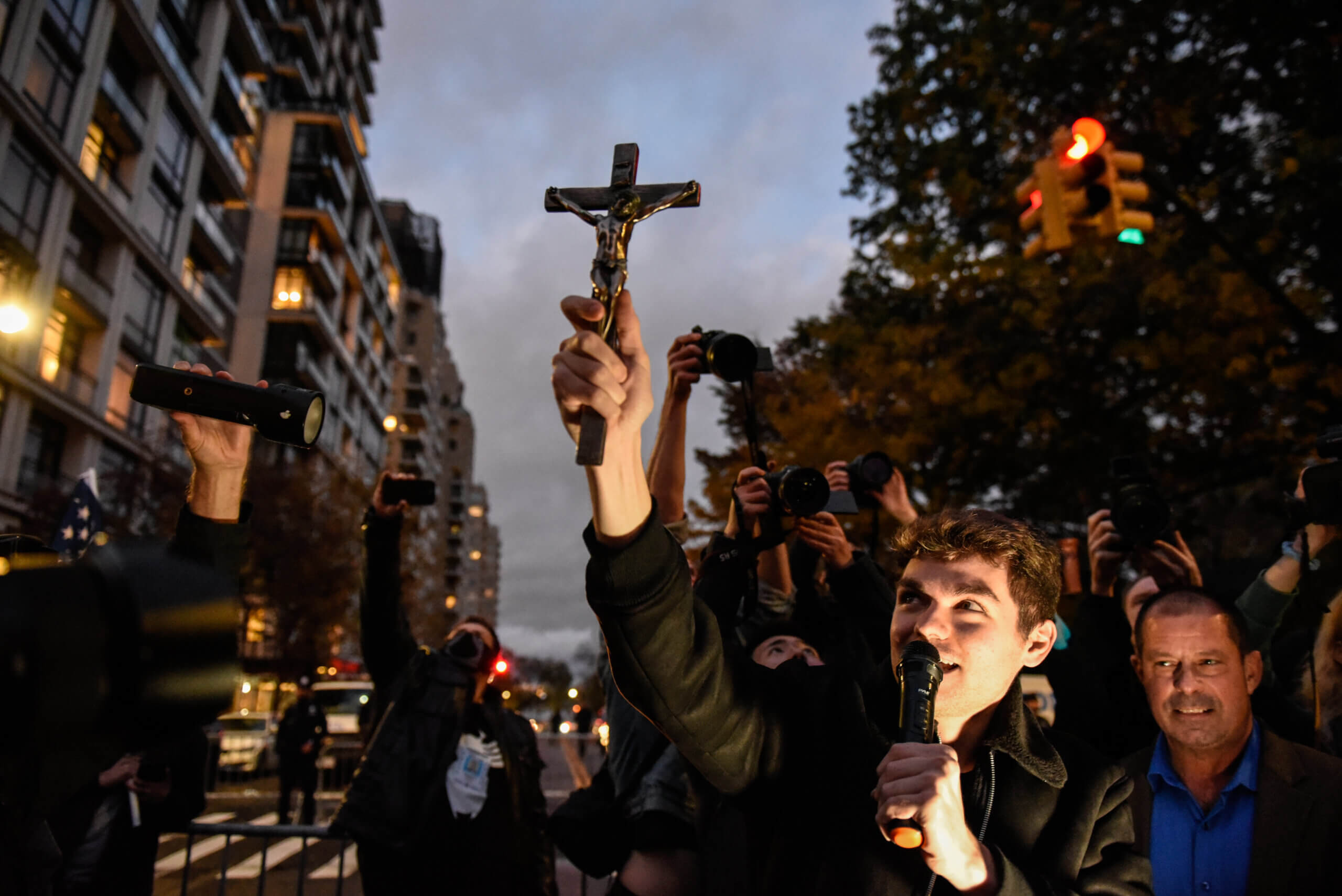
On 9/11 of this year, far-right extremist and Jan. 6 agitator Jake Lang led a protest against New York Mayor Zohran Mamdani’s attendance at the memorial service. Lang referred to his protest as a “crusade” and brandished a wooden cross at Ground Zero.
Among the many counter-protesters who showed up to oppose Lang was a group of neo-Nazis carrying a banner reading “Jake Lang is a Jew” and screaming that Lang is leading a “psyop” — an attempt to sway public opinion secretly backed by a government, presumably Israel’s.
Just as confusingly, in between shouts of “We are the real Nazis! We are the real racists!” and rants about removing Jews from the American government, the small group of Nazis chanted “Free, free Palestine” and “Heil Hitler, free Palestine!” Perhaps most bafflingly of all, alongside the seven men in swastika armbands stood someone in a full Elmo suit wearing a Palestinian flag as a cape.
Lang has a Jewish mother and was bar mitzvahed. But he has decisively renounced Judaism to embrace an extreme form of Christian nationalism. He has burned a Koran and a Talmud, performed a Heil Hitler salute outside of AIPAC headquarters and regularly screams “Christ is King” at his protests, which are usually directed against Muslims — he protested Mamdani on 9/11 as well as in March outside Gracie Mansion, and targeted the large Arab population in Dearborn, Mich. with another “crusade” protest in August.
The Nazis protesting Lang epitomize an issue increasingly splitting the far-right: Jews.
From the outside, the far-right appears relatively united in its support for extremist ideas about Christian and white nationalism, as well as its openly expressed racism. They are virulently anti-immigration and anti-women, suspicious of science and education and in favor of building an ethnically and theologically homogenous society. They are almost always antisemitic, spreading false conspiracy theories about Jewish control. Yet internal battles on the right are breaking out with increasing regularity over just what form of antisemitism they endorse.
Take Lang. He is, by his statements and actions, a staunch Christian nationalist. Though he focuses his ire mostly on Muslims — Lang advertised the Dearborn protest with videos captioned “Americans against Islamiphication” [sic], and his protests against Mamdani have focused on the New York City mayor’s Muslim identity — he is far from friendly to Jews.
He regularly proclaims that “America is a Christian country.” And he has endorsed antisemitic conspiracy theories, stating, on erstwhile Trump ally and conspiracy theorist Laura Loomer’s podcast, “I will be the first one to call out this liberal, woke Jewish mafia that controls Hollywood and is brainwashing the white women to all fall in love with Black men and they’re poisoning and they’re not real Jews.” That’s a real litany of antisemitic conspiracy theories all rolled efficiently, if somewhat incoherently, into a single sentence — the Great Replacement Theory and Jewish cabals with a dash of some Medieval-era well-poisoning.
Still, he hedged his antisemitism a little bit: “We have been psyoped into blaming everything on the Jews, that’s ridiculous,” he said in the same podcast with Loomer.
That statement, along with his Jewish ancestry marks him as an outsider to the other wing of the far-right — including the Nazis opposing him. “We’re pro the white race,” said one at the protest last week. “Whites and everyone in this world who opposes Jewish power, in one struggle against the Jews.”
It’s not just the handful of Nazis. Other far-right influencers have also called out Lang.
Dan Bilzerian, another rightwing influencer who spread antisemitism during his run for Congress, pointed out Lang’s Jewish background in a tweet saying “This is what jews do, they pretend to be white to spread white, black and Muslim hate.”
Antisemitic streamer Nick Fuentes, who has also led a crucifix-brandishing march in New York, said the same of Lang in another tweet: “This guy is a Jewish operative and his entire campaign is a psyop to instigate conflict between Whites and Muslims.”
The rift on the right

Lang is not the only face of his almost-but-not-quite-antisemitic side of the far-right aisle, nor the only target of neo-Nazi ire. It was perhaps best embodied in Charlie Kirk, who espoused open anti-Black racism, anti-LGBTQ hate, Islamophobia and anti-immigrant sentiments — but also on a few occasions attended Shabbat dinners with Jews.
Opposing them are those for whom antisemitism isn’t one of many extremist or bigoted beliefs, but the guiding ideology. This side is characterized by the “groypers,” or followers of Nick Fuentes, though it’s certainly not limited to them.
It’s not that Lang and Kirk’s side of the schism doesn’t still spread antisemitic ideas; Kirk talked about the “great replacement strategy” and Jewish media control. Yet he also, in his book about keeping the Sabbath, expressed respect for some Jewish thinkers, even as he denigrated Judaism’s lack of belief in Jesus.
These political views are common in MAGA circles; Vice President JD Vance and Secretary of Defense Pete Hegseth regularly reference Christian nationalism in their conception of what makes the U.S. great, and aggressively oppose immigration. Hegseth brought the leader of his church movement, Doug Wilson, to lead prayers at the Pentagon; Wilson has stated that women should not have the right to vote and that the U.S. should be a Christian country governed by the Bible.
But most of these figures also support Israel, even if it is often out of a desire for Christian control over the Holy Land. And they try — with somewhat limited success — to sidestep open antisemitism.
Yet open antisemitism is no longer just limited to the far fringe of the right and self-identified groypers. Today, politicians like former congresswoman Marjorie Taylor Greene and once-mainstream media figures like Tucker Carlson have openly embraced the ideology, as well as groypers themselves, even interviewing and “mm-hmming” along with Fuentes.
In this political framework, hating Jews is a core part of being a true Christian and a true American. This is justified by theological ideas including but not limited to supersessionism, but those religious concepts are mixed inextricably with conspiracy theories about Jewish devil-worship and outsize Jewish influence over world events. For those believers, there is no good country with Jews in it. And they reject anyone who is friendly toward Jews or Israel, or even remotely associated; Fuentes claimed Wilson was “in bed with the Jews” despite his Christian nationalism.
This was obvious immediately in the wake of Kirk’s death; groypers had been warring with Kirk, showing up to events put on by his conservative youth organization Turning Point USA to disrupt and push Kirk even further to the right. After Kirk’s murder, they celebrated and some even referred to his death as a “shitpost,” or form of trolling.
The cultural power and inspiring heroic image that the mainstream right attempted to construct from Kirk’s death never quite came to be; a statue of Kirk arrived in Times Square this month, but the Turning Point USA founder has been turned into a mocking meme by the far-right young men he once courted. Kirk’s politics, which managed to toe the line of acceptable rhetoric on the mainstream right, have been abandoned for open neo-Nazism and antisemitic conspiracy theories.
This hate for Jews has grown so strong that it can even override Islamophobia, despite the movement’s foundational white, Christian nationalism; the groypers’ and neo-Nazis’ antisemitism is so virulent that it sometimes turns, incongruously, into pro-Palestine activism, particularly when combined with suspicion of the government’s alliance with Israel.
Carlson interviewed a Palestinian archbishop, using the conversation more as a way to emphasize the idea that Israel was bombing Christians. The Nazis opposing Lang chanted “Free Palestine” on several occasions. Marjorie Taylor Greene regularly posts about children in Gaza. Even Fuentes seems warmer to Muslims than he is to Jews. “My enemy’s enemy is my friend,” appears to be the guiding principle.
In many ways, both sides of the rift in the far-right share a vision of America as a white, Christian nation. They even share some antisemitism — but one side at least still keeps it somewhat veiled. The other will abandon its commitment to white Christian nationalism if it means ridding the country of Jews.
That rift could fracture the extremist right entirely and leave it weakened or even destroyed. Or we could be seeing more than a handful of neo-Nazis out on the street next time.
The post The civil war in the far-right is coming down to Jews appeared first on The Forward.
Uncategorized
Eisenkot outlines 3 paths to Israeli government, signaling urgency and openness to Arab-party backing
(JTA) — Gadi Eisenkot outlined three tracks he is pursuing to build a coalition, including a minority government that would need the outside support of Arab-led parties, saying that Prime Minister Benjamin Netanyahu was putting Israel “in a very dangerous place” with his anti-Arab rhetoric.
Each option Eisenkot presented Friday in a lengthy post on X could involve breaking a promise that at least one of the parties in the “change” bloc Eisenkot leads had made: not to rely on the Arab parties; not to join with Netanyahu; or not to work with the haredi Orthodox parties as long as they refuse to compromise on military service.
One of his partners, Avigdor Liberman, who leads the Yisrael Beytenu party, said the option of joining with the haredim was the likeliest.
Eisenkot, who leads the Yashar party, described an urgency to form a coalition spurred in part by Netanyahu’s relentless rhetoric targeting the Arab parties, which Eisenkot said was placing the Arab Israeli population at risk of attack. Forming a coalition under the conditions Eisenkot lays out would remove Netanyahu from his role as prime minister, depriving him of a powerful pulpit.
“We are in a very dangerous place. A place where the outgoing prime minister is acting in ways we have never seen before,” he said.
“Israeli society, our democracy, and our standing and position on the international stage are all approaching a point of no return,” he said. “The path from a violent campaign of delegitimization against 21% of the population and labeling them ‘supporters of terrorism’ to actual violence could also be short. The writing is on the wall.”
President Isaac Herzog last week gave Eisenkot the mandate to form a government within 28 days, after 67 members of the parliament, or Knesset – including the “change” bloc and the 19 Knesset members belonging to Arab-led parties – gave their nod to the former Israel Defense Forces. Netanyahu got the approval of 46 lawmakers, and seven abstained. If Eisenkot does not get a government together by Dec. 6, he can ask Herzog for a 14-day extension.
The first option Eisenkot raised was forming a government with the support of the ultra-Orthodox, or haredi, parties. Such a move would have been almost unthinkable until recently, given the longstanding and close alliance between Netanyahu and the haredi parties, as well as the central campaign promises of the anti-Netanyahu bloc to bring about fundamental changes to the state’s relationship with the ultra-Orthodox community, including mandatory military service – a position the haredi parties strongly oppose.
“Serious discussions are underway with the ultra-Orthodox parties, aimed at finding solutions and formulas that will strengthen the IDF, address security needs and preserve the status of those who study Torah, as we promised during the election campaign,” Eisenkot wrote in his post.
He stressed that the negotiations did not amount to “backing down on the issue of military service,” but rather involved formulating an arrangement based on the principles of his party’s “Service for All” framework, which would codify non-military service as an option for some sectors. All four parties in the change bloc ran on a platform of ending the vast exemptions from military service haredi Jews have enjoyed for decades.
The negotiations appear to have led one of the two ultra-Orthodox parties, United Torah Judaism, to refrain from recommending Netanyahu to the president as the candidate to form the next government. The other haredi party, Shas, which is considered more right-wing and closer to Netanyahu, has so far given no indication that it intends to cross political lines and join the anti-Netanyahu bloc. Without Shas, the bloc would have to settle for a minority government.
Liberman said in an interview with Channel 12 News on Friday evening, hours after Eisenkot’s post, that forming a government with the support of the ultra-Orthodox parties was “the only practical option.” He said he was convinced that a government supported by both haredi parties could be formed. According to Liberman, the bloc should be willing to “sacrifice” its pledge not to cooperate with the ultra-Orthodox and to fundamentally change the state’s relationship with their community in pursuit of its primary goal: “an end to Bibi’s rule.”
The second path outlined by Eisenkot was a unity government with Likud. Negotiating teams from the two parties met earlier this week. “As for the contacts with Likud, we are making sincere and genuine efforts on our part. Unfortunately, however, there is a wide gap between the Likud’s rhetoric and their action and actual willingness to move forward,” Eisenkot said. He nevertheless made clear that “I intend to give this track another chance.”
Eisenkot did not name the “gap,” but reports have said talks have foundered on Netanyahu’s role in a unity government. Netanyahu reportedly is insisting on serving as prime minister in the first part of a “rotation” agreement that would see the premiership rotated among bloc leaders.
Liberman ruled out sitting in a government with Netanyahu under any circumstances, including a rotation agreement in which Netanyahu would serve as prime minister second after Eisenkot. Another leader of the opposition bloc, Naftali Bennett of the B’Yachad party, held lengthy talks with Netanyahu in the Knesset this week, triggering a wave of speculation that he was advancing the possibility of a unity government. But Bennett would still need to convince the other parties in his bloc to join him in doing so, as his party isn’t large enough to secure a parliamentary majority with Netanyahu on his own.
The third option Eisenkot raised at the end of his post was the formation of a “national emergency government.” He clarified that he would pursue this track only if “the necessary conditions for the formation of a broad government through the channels I am leading do not materialize.”
Although he did not explicitly say so in his post, Eisenkot appears to be referring to the possibility of a minority government that would rely on the votes of the Arab-led parties to secure the parliamentary majority needed to form a government without actually including Arab ministers in the government itself.
But the proposal faces significant opposition within Eisenkot’s own bloc, potentially jeopardizing the entire initiative. Liberman stressed that he would “categorically” vote against a narrow government relying on the support of the Arab-led parties. Channel 12 News also reported that Bennett had told leaders of the opposition bloc that he opposed forming a government dependent on Arab-led parties.
One of the two parties, Ra’am, led by Mansour Abbas, served in a coalition under Bennett from 2021-2022. Bennett has praised Abbas as a worthy partner but has also argued that including Arab-led parties in the government after the deadly Hamas-led attacks of Oct. 7, 2023 is untenable. Netanyahu has seized on the radical statements of some members of the other Arab-led party, the Joint List, to depict both parties as supporting terrorism.
Liberman and Bennett both argued that relying on the Arab-led parties would give Netanyahu a massive boost ahead of future elections.
Eisenkot, however, signaled that he was prepared to put that opposition to the test. In his post, he stressed that “all members of Knesset will have to follow their conscience and decide whether a new government will be formed, or whether they are willing to drag the State of Israel into another election while Netanyahu remains prime minister of a transitional government.
“It would be foolish to think that we have the luxury of delaying and losing the window of opportunity that has opened up, a window that may never open again. What is at stake is Israel’s future,” Eisenkot said.
This article originally appeared on JTA.org.
The post Eisenkot outlines 3 paths to Israeli government, signaling urgency and openness to Arab-party backing appeared first on The Forward.
Uncategorized
After devastating midterms, Jewish right-wingers lick wounds – and plan for 2028
(JTA) — NEW YORK – Anti-Israel rhetoric, “radical Islam” and the voting habits of young Jews were among the many concerns voiced this week at two of the first major events for Jewish conservatives held since Democrats’ sweeping victories in the midterm elections.
Speakers and attendees at both the Tikvah Fund’s Jewish Leadership Conference and the Zionist Organization of America’s annual gala, each held on Sunday in Manhattan, railed against the growing contingent of Democratic Socialists of America members entering Congress.
As they reeled from that “difficult Tuesday night,” as ZOA emcee Shabbos Kestenbaum referred to it, some advocated for a boost in Jewish education in hopes that young Jews would prioritize pro-Israel candidates. Others said the pendulum could swing back to a GOP victory in 2028 — but also expressed antipathy toward Vice President JD Vance, seen as the favorite to lead the party’s ticket.
ZOA president Mort Klein urged attendees at the Ziegfeld Ballroom in midtown Manhattan to fight against the “dangerous policies” of the DSA, the group that has endorsed a contingent of left-wing, Israel-critical candidates in Congress, bringing their number in the Democratic caucus to eight when the next session starts in January. He denounced growing accusations of Israeli apartheid and genocide, likening them to antisemitic propaganda used in Nazi Germany and other historical periods.
In an interview after the event, Klein said the ZOA is urging President Donald Trump “to make a major address on antisemitism — an address purely on Jew hatred and Israel hatred, not general hatred.” The ZOA, he said, is also “urging, even demanding” members of Congress to make similar speeches, noting that he could only recall Florida Rep. Randy Fine and Texas Sen. Ted Cruz as having done so to his satisfaction. He added that he is pushing for Jewish leaders and rabbis to do the same and to speak about “the dangers of radical Islam.”
It is not a new strategy for the ZOA, but Klein said the group is doubling down because “whatever strategy is in place, it’s not being fulfilled in any way, shape or form.”
A number of speakers at the ZOA event denounced young Jewish voters and the efforts of the liberal Jewish Middle East advocacy group J Street. J Street bills itself as pro-Israel and pro-peace; speakers at the ZOA gala accused it of turning young Jews against Israel.
Alan Dershowitz, the prominent pro-Israel attorney whose clients have included Trump, O.J. Simpson and Jeffrey Epstein, called J Street “the most dangerous organization to Zionism, to Israel and I believe to the Jewish future in the United States.”
“It has fraudulently convinced many young people that they are pro-Israel and has given cover, has given a hechsher [kosher certification], to anti-Israel, anti-Zionist and, in more and more respects, anti-Jewish attitudes than any other organization,” Dershowitz said.
The problem, Dershowitz continued, is exemplified by the number of Jews who “tragically voted for [New York City Mayor Zohran] Mamdani, how many Jews voted for [Michigan Sen.-elect Abdul] El-Sayed.”
J Street did not endorse either candidate. The group did not return a request for comment.
Josh Katzen, publisher of the Jerusalem News Syndicate, blasted the “new generation” as he received an award from the ZOA for Middle East journalism.
“Not only do they not have an emotional attachment to Israel, they don’t have an emotional attachment to the United States. They don’t have any idea who are the good guys, and who are the bad guys,” Katzen said. “They don’t understand that Israel is America’s front-line defense in supporting Western civilization against the attack of Islam.”
Attendees at the ZOA event had misgivings about Jews who voted for left-wing Democratic candidates, and about Muslim candidates.
Hy Drusin, a board member of the West Side Republican Club, told the Jewish Telegraphic Agency that he’d coined the term “JINOs” — “Jews in Name Only” — for Jews who voted for “these Muslim socialists.”
According to Upper East Side resident Nathaniel Gravonsky, “The problem in New York City is too many Jews read The New York Times as their Torah.”
Rabbi Yehuda Kaploun, Trump’s special envoy to monitor and combat antisemitism, said in a speech that expanded Jewish education and stronger encouragement of young Jews to embrace their Jewish identity would set them on the right path, as opposed to voting for candidates like El-Sayed.
“For years, the Jewish community has followed the same playbook: more conferences, more photo ops and more nongovernmental organizations. It is a proven recipe, now, for failure,” Kaploun said.
Drusin opined to JTA that Jewish education would indeed “better the chances that [students] will remain Jewish or Jewish identified.” But, he added, “What Rabbi Kaploun urged has been urged for decades, centuries. Is it happening? Is it working? Spreading? Or is it declining? There are arguments and statistical evidence on both sides.”
Drusin said it was “disturbing” to see exit polls that had half of Jewish Michigan voters voting for El-Sayed, and that it would be tough to buck Jews’ “long tradition of knee-jerk affiliation with the Democrat Party.”
Earlier on Sunday, at the Jewish Leadership Conference, Cruz offered hope that the pendulum could very well swing back to the Republicans in 2028. He pointed to the election of then-Vice President George H.W. Bush in 1988, which came two years after Democrats — similar to this year’s results — won the midterms in commanding fashion and took control of the House and Senate.
But hopes of a 2028 Republican victory were accompanied by doubts about the current vice president, who is seen as Trump’s likeliest successor to lead the GOP. Vance has drawn the ire of Jewish conservatives over his reprimanding of Israeli officials, indulgence of anti-Israel conspiracy theories and his silence on his friend Tucker Carlson, a prominent media personality who promotes such narratives.
Most recently, Vance outraged a number of pro-Israel Republicans when he blamed the party’s midterm losses in part on the current U.S.-Israel relationship, and listed “change our relationship to Israel” among four strategies to bring back voters.
“I’m disgusted with it,” Drusin said about Vance’s post. “That’s why I support [Secretary of State Marco] Rubio.”
Gravonsky, too, said he is “always going to pick Marco Rubio over JD Vance” in a hypothetical primary battle between the two, echoing a number of Jewish Republican voters and donors who say Rubio is their preferred 2028 candidate.
Cruz, speaking at the Tikvah Fund’s event, said he disagreed with Vance’s assessment that Israel was a major factor in the recent GOP losses.
Mike Huckabee, Trump’s ambassador to Israel, spoke at both events about the need for a strong U.S.-Israel relationship, though he did not address Vance’s comments head on. He did so in a subsequent interview with The Press Service of Israel, however, saying that “Israel was not the reason the midterm elections yielded disappointing results for the Republicans.”
Neil Cooper, a Republican Jewish Coalition member who attended the Jewish Leadership Conference on Sunday, called the vice president’s post a “political suicide note” that would alienate voters.
Should Vance emerge as the nominee, however, Cooper said he believes Jewish conservatives would “likely hold our noses and vote for Vance on the theory that, despite his flaws, he would nevertheless be preferable to a Democrat from a policy standpoint.”
But Cooper also predicted that any rightward realignment of American Jews — a demographic whose typical allegiance to the Democratic Party has been under a microscope amid shifting sentiment on Israel — would be dampened by Vance becoming the nominee.
If Jewish voters find Vance “repugnant,” Cooper said, it becomes “that much easier to revert to their default position and vote for the Democratic candidate.”
This article originally appeared on JTA.org.
The post After devastating midterms, Jewish right-wingers lick wounds – and plan for 2028 appeared first on The Forward.
Uncategorized
Can Palestinian Christians undermine Christian Zionism?
Americans tend to associate Palestinians with Islam. And studies show that most Americans view Islam in a negative light; a Pew study found that this has actually gotten worse since 9/11 — more than 50% of Americans surveyed in 2026 agreed with the statement that Islam encouraged violence, double the 25% who agreed with that statement in 2002.
Since Oct. 7, some Christian groups and influencers in the U.S. have been trying to change this association, drawing the attention of their fellow American Christians to the plight of — and the existence of — Palestinian Christians in the hopes of activating their empathy toward Palestinians.
American Christians have historically advocated strongly for their fellow Christians abroad. In 1998, Congress passed the International Religious Freedom Act in response to the civil war in Sudan that saw an Islamist government oppressing Christian citizens. Earlier this year, Congress passed a resolution expressing concern for Coptic Christians in Egypt. And another Pew study found that the vast majority of groups advocating for religious freedoms abroad are Christian.
In short, the U.S. is a Christian country, and many of its citizens feel connected to Christians in trouble abroad.
But this has been somewhat less true when it comes to Israel where American Christian views over the past several decades have been shaped by Christian Zionism. Evangelicals hold immense political sway through lobbying groups and voting power, and most adhere to a theology that demands support for Israel, and for Jews to return to the biblical land, in order to bring about the End Times and the return of Jesus. There is such a strong moral alignment between Israel and God — their Christian God — that some American evangelicals seem to be shocked when they learn that Israel did not distinguish between Palestinian Christians and Palestinian Muslims in Gaza. Instead, they associated Palestinians with the violence they connect to Islam — a narrative that gels easily with Israel’s justifications for its crackdown in Gaza to eliminate Hamas.
Church collapse shifts the church
However, in 2025, Israel struck the only Catholic church in Gaza, killing three people and injuring nine others, in addition to destroying an ancient Christian historical site. The IDF claimed it was accidental, but the Latin Patriarch of Jerusalem, Pierbattista Pizzaballa, harshly criticized the destruction, and claimed that Israel had been “targeting innocent civilians.”
With this strike, American evangelicals began to take note of the plight of Palestinian Christians. Mike Huckabee, the U.S. ambassador, wrote a harsh letter to Israel’s minister of the interior about its hostility to Christians, threatening visa restrictions. Trump called Prime Minister Benjamin Netanyahu to complain. Congresswoman Marjorie Taylor Greene, a staunch Republican but also a devout Christian, voted with Democrats to deny funding to Israel.
“Israel bombed the Catholic Church in Gaza, and that entire population is being wiped out as they continue their aggressive war in Gaza,” Greene said, to explain why she crossed party lines.
Since then, Christian influencers have drawn attention to Palestinian Christians’ treatment in Israel. Sometimes, these efforts are humanitarian and informational, such as those of the Palestinian Christian Alliance for Peace, an organization that grew out of the progressive mainline Protestant United Methodist Church’s movement to divest from Israel.
Other influencers, like Tucker Carlson, have taken more of a shockjock approach. Carlson has regularly interviewed Palestinian clergy, including Bethlehem-based Lutheran priest Munther Isaac; Mother Agapia, an American Greek Orthodox nun who immigrated to the Holy Land; and Hosan Naoum, an Anglican archbishop in Jerusalem. All of them emphasize a direct throughline from Jesus to Palestinian Christians, depicting them as upholding the most original form of Christianity.
When Carlson speaks on the subject, he often omits that the people in question are Palestinian, referring to them simply as Christians in astonished tones, playing the audience he imagines, then trying to walk his viewers step by step away from their prior assumptions
“So Christian churches in the United States send more money to Jewish settlements in the West Bank than they do to Christians in Jesus’ own town of Nazareth?” Carlson asked Naoum, in tones of total befuddlement. “When people in the American media say Palestinian, it means someone who is an Islamist, basically — but you’re saying a lot of those Palestinian refugees were Christians!”
Palestinians, both Christian and Muslim, are being attacked and oppressed by Israeli settlers and soldiers; this much has been established, including by many Jewish groups. But many of these Christian influencers, including Carlson, who are now advocating for Palestinians, have a history of antisemitism, which frames their exposés on Israeli violence — Jews, they believe, killed Jesus. Now, they highlight Jews destroying the Christian-owned olive groves in Taybeh or Bethlehem, bombing a church in Gaza, or spitting on a priest. The implication is clear.
An increasing number of viral videos featuring Israelis opposing Christianity in some way are now being shared virally: Orthodox Jews in Jerusalem’s Old City spitting on Christians, an IDF soldier taking an axe to a statue of Jesus in southern Lebanon. Even the Christian Broadcasting Network, an evangelical channel that has historically been extremely Zionist, aired a number of clips about Jewish attacks on Christians and Christian holy sites.
But the sympathy only holds among the Christian influencers if the victims are Christian; though they may criticize violence against Palestinians at large, the argument is clearly weaker. As Candace Owens, a devout Catholic and outspoken antisemite put it, “The biggest issue that I have, by the way, with Israel, and talking about them being above reproach, is the fact that they are supplying the arms to murder Christians.”
Yet many of these videos rely on separating Palestinian Christians from Palestinians more generally for greater emotional impact in the U.S. And the reality is that Palestinian Christians are still Palestinians, first and foremost, a tougher sell to the American Christian populace, which is still largely rooted in Zionism.
To address this, two Christian conferences —Not In Christ’s Name last week in D.C. and the Crossroads Conference in Atlanta earlier this month — invited Palestinian priests Issa Thaljieh and Munther Isaac, both from Bethlehem, to speak. Their testimony was meant to describe the experience of Palestinian Christians, to address Christian Zionism and to be “an invitation to American evangelicals to meet Palestinian Christians, and to reckon with the ways their theology harms Palestinians on the ground.”
But because of Trump’s blanket ban on Palestinian Authority passport holders, neither of them could get a visa — even though they’re priests.
The post Can Palestinian Christians undermine Christian Zionism? appeared first on The Forward.
