



Uncategorized
‘The Girl in the Red Jacket’: A Testimony From Inside Iran

Cars burn in a street during a protest over the collapse of the currency’s value, in Tehran, Iran, Jan. 8, 2026. Photo: Stringer/WANA (West Asia News Agency) via REUTERS
I am Maddie, a millennial woman from Iran and an eyewitness to a bitter reality impossible to unsee.
I woke up on the morning of January 7, 2026, and checked my phone, scrolling through clips of my favorite shows. I walked into the living room with my phone still in my hand, when I realized that protests had broken out in the capital, Tehran.
At first, I ignored it. I had seen this before. In the 2019 “Bloody November” protests (Aban-i-Khoonin), the streets did not just protest; they bled. What started as fury over oil prices became a desperate fight for survival and freedom. The only thing more deafening than the gunfire was the chilling realization that this regime would rather rule a graveyard than lose its throne.
In 2022, the death of Mahsa Jina Amini in police custody sparked a new wave of demonstrations, and headscarves were burned. Streets filled again. Bullets tore through the chants; the shadow of the gallows grew longer every passing day. For every burned scarf, a life was taken.
Every time the streets stir, that old terror returns. The memory of what happens to empty hands never really fades. Our only weapon is our voices, but voices don’t stop bullets. You can’t save your loved one with chants; the memory of the consequences of rising against a totalitarian regime is etched in the pavements of this land in the form of stains.
This time, I knew the protests would be suppressed as they always are, and people would be forced back into silence. I put on my hoodie and left to buy eggs and dog food. I hadn’t been to the market for over a week. At the counter, I handed my card to the shopkeeper. The card machine beeped and showed an insufficient funds error. I knew I had money; I was certain of it. I asked the shopkeeper why the payment was being declined. He looked at me and said I didn’t have enough.
That was when I realized what had happened. Prices had tripled in less than two weeks. The US dollar had surged past 150,000 toman. At that moment, something broke inside me. I was not just shocked. I was angry, frustrated, and humiliated. Standing there, unable to pay for basic necessities, I understood that the crisis was no longer something happening on screens in Tehran. It had reached my hands, my wallet, and my life.
I spent the day reading, watching videos, and playing with my dogs. By the afternoon, I had to go to work. I went, finished my shift, and came back home. When I returned, I asked my uncle whether there had been any protests where we live. He said there were none.
“This is a small city,” he said. “Everyone knows everyone, you can’t just disappear in a crowd, so even if there are protests, you are not going anywhere.”
I nodded and went out to see my friends. We talked about ordinary things while the news played in the background, the way people do when fear has become a routine. Injustice lingered in the air like a toxin, impossible to escape. Near the main street, I noticed two men and a few young boys and girls standing together in silence. A police van parked in front of them, close enough to silence them without a word. Chanting wasn’t allowed. No banners, no organization — this alone was dangerous.
I went home with a pounding heart. I took off my shoes, then put on a black mask and wrapped a black shawl around my head and neck. In my rush, I forgot to change my red jacket. I found myself already moving before I had fully decided.
Uncle called out, “Where are you going?”
“I am just going to see, not going to do anything!”
“It is dangerous, they will find out, this is a small town,” he warned me about the consequences.
“Ten minutes? I will keep my distance,” I pleaded.
“Only ten minutes! Don’t do anything stupid.”
This is how we negotiate with fear, through time limits and promises that no one believes.
I put my shoes on in a hurry and stepped outside, overwhelmed by adrenaline, moving fast, almost without thinking.
Every step felt like calculating a potential death sentence. Every corner felt like a risk that couldn’t be undone. Here, opposition is not met with dialogue; it is met with batons, bullets, prison, and execution without trial. We grow up knowing the names of the dead even when their stories are erased. We know that a protest is never just a protest; it is a gamble with your future, your freedom, and your life.
As I turned the corner, I saw a few protesters standing apart from one another, careful not to form a crowd. I stopped at a distance. My legs were shaking. My hands would not stay still. I leaned against a wall, trying to steady my breathing. It was my first time standing this close to a protest. I noticed that everyone was wearing black jackets and black masks, as if color itself could be used against us.
I glanced down at my own red jacket and thought of the girl in the red coat in Schindler’s List, a symbol of how innocence and visibility offer no safety when violence is systematic. I stood there for less than a minute, fully aware that in this country, a minute is more than enough to change everything.
Before I could think any further, one of the girls stepped out from the group and walked towards me. I didn’t recognize her at first.
“Maddie, come,” she said.
I didn’t answer. I didn’t have to. My feet moved even as my mind resisted. When I reached the group, I recognized a few of my friends not by their faces, but by their eyes. That was visible.
One of them whispered. “Why are you wearing red? Are you crazy?”
“I didn’t think about it,” I said. I’ll wear black tomorrow.”
We stood there without speaking. One by one, others joined us. Ten people in total. No chants. No movement. Only bodies assembling quietly under constant watch in a small town crowded with the Revolutionary Guard and Basij.
I came home.
Uncle asked. “How did it go?”
“It was fine, I won’t wear a red jacket tomorrow,”
“Tomorrow?” He was quiet. He didn’t say another word.
All night, I kept turning from side to side, consumed by the consequences of having joined a protest. In my family, repression is not an abstract idea. Many of our relatives were killed in the 1970s. We never supported what was called a revolution; what actually took place was a coup d’état. The memories came back uninvited.
During the “Bloody November 2019-2020,” one of my family members was arrested and tortured in a detention center. He spent months as a political prisoner before being released on bail. Those months were filled with a familiar terror: not knowing where your loved ones had been taken, waiting weeks and months without answers, imagining every possible outcome just to survive the silence.
To quiet my thoughts, I downloaded an audiobook from YouTube, The Song of Achilles, my favorite book of all time. In the middle of fear, it offered a strange kind of warmth.
The next evening, at 8 PM, I put on a black jacket and a black mask and returned to the protest with two of my friends, Zahra and Melena. This time it was larger. The ground itself seemed to tremble under the weight of so many feet. Men, women, and children stood together, all dressed in black. The children I was used to seeing run freely through the streets now looked serious, alert.
“Why didn’t you bring your dogs?” one of them asked. They recognized me.
“They might bite you,” I said, and they laughed.
I noticed Snow — a white stray dog — near the sidewalk, looking for me. He finds me wherever I go. I ran home, brought him food, and returned. Dogs are considered filthy and forbidden under Islamic Sharia rules. I have faced constant opposition and mockery simply for feeding and caring for them. That story alone could fill pages.
Snow ate his food and stayed close. When we began walking towards the avenue, he followed along the sidewalk, frightened by the crowd. As we moved, more people joined us.
Then the chants began.
“Death to Khamenei!”
“Death to the dictator!”
“This land will not be free until the clerics are dead.”
The silence was gone, replaced by the brave people who enveloped the town whole.
Those who could not walk with us showed up with their cars, driving slowly in front of and behind the crowd. Their continuous honking, clapping through open windows, and making their presence known gave me the courage to keep walking and chanting even as my heart pounded and I felt certain I could be shot at any moment.
At that moment, Zahra grabbed my arm and shouted at the top of her lungs, “You know what I feel, Maddie?”
“What?” I shouted back.
“I feel free, I feel free to scream, for once in my life I am feeling that my voice is liberated, I have the right to shout.”
I looked at her — the only thing I found was the glistening eyes behind that mask, which was supposed to be a barrier between us and death itself. I nodded, and we held each other’s hands firmly.
That night, I returned home to find the Internet completely cut off. The blackout had begun. I didn’t care; I threw my phone onto the bed, and slept. In the morning, I realized it wasn’t just the Internet. Phone calls didn’t go through. Messages wouldn’t send. I couldn’t reach friends in other cities. Desperate for information, I watched television, scanning for any mention of what was happening elsewhere.
Reports emerged that a hospital in Ilam had been attacked and besieged by police. In Marvdasht, in Fars province, residents had taken up weapons against security forces. The situation was escalating. Authorities brought in forces from other provinces to regain control.
On the third night, again at 8 PM, we went out again; this time the crowd was even larger. Soon after, security forces opened fire on protesters in a nearby town. The crackdown intensified. Families were harassed. Homes were raided. Tear gas, metal pellets, and live ammunition were used. People were shot in the head and in the back, killed or permanently paralyzed.
A 16-year-old boy I knew was murdered. His name was Mehdi. The IRGC and Basij abducted him and his friend from the protest, beat them with rifle butts, sexually assaulted them, and then shot them. One died on the spot, the other remains in a coma.
This is not an exception; this is the life we have been living for decades. The following day, Iranian Intelligence began calling families of the protesters one by one, threatening them, ordering them to turn themselves in, and to stop protesting. Homes were raided. My friends and family were targeted.
Families were told their lives would be destroyed. In some cases, relatives of those killed were forced to sign documents falsely stating their loved ones had been killed by the “Mossad agents and terrorists.”
My uncle received a call. “Tell your family to stay home, or there will be consequences.”
We did not stop, but I began to lose strength when I could no longer reach my friends in other cities.
Eleven days after the massacre began, I briefly regained Internet access. The first thing I did was message friends in larger cities. One of them, from eastern Tehran, I won’t mention his name, told me that the regime had shot everyone who came out; the streets were flooded with blood. Security forces executed wounded protesters by shooting them in the head while they were receiving medical care. Families were forced to pay a ransom to retrieve the bodies of their children.
There is credible evidence that Iraqi, Afghan, and Pakistani militia, many of whom fought in Syria for Bashar al-Assad, were deployed to suppress protesters.
Another friend from Tehran sent me videos he recorded himself. In it, bodies were tagged and placed into bags. These were not anonymous images pulled from social media; they were scenes witnessed firsthand by people I know. The dead were not statistics; they were protesters who had stepped into the streets just like me, and never returned. Every name was a story. A dream.
What Iranians are suffering is not unrest. It is a calculated campaign of terror. The Islamic regime has turned public spaces into a killing ground, medical centers into execution sites, and mourning families into targets of extortion and intimidation. Violence is applied methodically, meant not only to crush protests, but to teach an entire nation what dissent costs.
This is not a momentary crisis. It is the continuation of a system that has perfected repression over decades, one that survives by bloodshed, silence, and the deliberate erasure of human dignity.
Many Islamic countries remain silent. Their narrative is a lie painted over a massacre. While our streets ran red, the leaders of the Muslim countries looked the other way. Seeing them shake hands with the very men who ordered our slaughter is a sickening sight.
My request is direct and urgent.
World leaders, the UN, and international human rights organizations! The Islamic Republic does not recognize international law. It violates it openly and repeatedly. Human rights abuses are central to its survival. Repression is not a policy failure. It is the policy.
The regime promised it would not execute protesters. From early January up till now, it carried out multiple executions. These were acts of intimidation, intended to terrorize a population into submission. Many political prisoners are at risk of execution.
The world must stop treating this regime as a legitimate governing authority and begin treating it as what it is: a system sustained by violence, fear, and the systematic destruction of human life. Silence, neutrality, and delay are not neutral positions. They are choices with consequences measured in blood.
This is not a warning.
It is a record.
It is an appeal to action, before more victims are added to the documented toll of the Islamic regime’s state violence.
Long live Iran.
پاینده باد ایران
Maddie Ali is a teacher and philosophy student based in Iran. In addition to her academic work, she has been involved in civic activity in her hometown, including participating in and helping organize local protests alongside friends and family. Her name has been changed to protect her identity.
Uncategorized
At Trump’s Christian revival on the National Mall, one rabbi made a Jewish case for America
On the National Mall Sunday, Christian worship music boomed from giant speakers as “Adonai” and other names of God flashed across jumbo screens behind a praise band. Pastors invoked America’s biblical destiny. Sadie Robertson, the Christian social media personality and granddaughter of Duck Dynasty patriarch Phil Robertson, preached from both the Old and New Testaments.
And then Rabbi Meir Soloveichik — the lone Jewish speaker at the planned nine-hour “Rededicate 250” rally called by President Donald Trump, billed as a national “jubilee of prayer, praise and thanksgiving” — stepped to the podium and began talking about Irving Berlin.
Soloveichik, 48, a scion of one of modern Orthodoxy’s most revered rabbinic families and a member of Trump’s Religious Liberty Commission, used his remarks to offer a Jewish case for American exceptionalism, a contrast to the explicitly Christian vision of the nation’s founding that defined the day.
Recalling how Berlin wrote “God Bless America” as fascism spread across Europe and antisemitism consumed the continent, Soloveichik described the song as both a patriotic anthem and a prayer of gratitude from a Jewish immigrant who found refuge in the United States. The hymn, he said, represented “a plaintive prayer to God that America continue to be blessed.”
The four-minute speech fit squarely within Soloveichik’s broader worldview. A senior scholar at the conservative Tikvah Fund and rabbi of Congregation Shearith Israel in Manhattan, the oldest Jewish congregation in the United States, he has long argued that America’s civic ideals are aligned with traditional Judaism and biblical morality. His 2024 book, Providence and Power: Ten Portraits in Jewish Statesmanship, examines Jewish political leadership through the lens of faith and moral responsibility.
For Soloveichik, the connection between Judaism and American identity culminated in the Second World War. He noted that “God Bless America” was first broadcast publicly the day after Kristallnacht, when Nazis destroyed Jewish homes and synagogues across Germany. “At the very moment when darkness deepened,” Soloveichik said, “America raised its voice united in the song that Irving Berlin wrote.”
He added that “in the years that followed 1938, the prayer that is ‘God Bless America’ was carried by American soldiers who defeated evil, liberating Europe and the world.”
Then came the line that drew some of the loudest applause of his remarks: “It is a reminder, as hatred of Jews makes itself manifest again, that antisemitism is utterly un-American.”
Separation of church and state
The moment captured the complicated role Jews increasingly occupy within the Trump-era religious right: embraced as part of America’s Judeo-Christian heritage, even as critics warn that the broader movement surrounding events like Rededicate 250 blurs the line between religious pluralism and Christian nationalism.
Rachel Laser, the Jewish CEO of Americans United for the Separation of Church and State, denounced the rally before the event. “If President Trump and his allies truly cared about America’s legacy of religious freedom, they would be celebrating church-state separation as the unique American invention that has allowed religious diversity to flourish in our country,” she said in a statement. “Instead, they continue to threaten this foundational principle by advancing a Christian Nationalist crusade to impose one narrow version of Christianity on all Americans.”
Sunday’s event — part revival meeting, part patriotic pageant — was the centerpiece of the Trump administration’s religious programming tied to this year’s 250th anniversary of the founding of the United States. Secretary of Defense Pete Hegseth and House Speaker Mike Johnson were slated to appear alongside evangelical pastors, worship leaders and conservative Christian influencers. President Trump and Vice President JD Vance were scheduled to address the crowd by video, while Trump himself spent the weekend golfing after returning from an overseas trip to China.
“This is a recognition of the deeply embedded history and religious and moral tradition of the country,” Johnson said Sunday on Fox News, dismissing criticism that the rally blurred the separation of church and state. Those objecting to the event, he added, “want to erase the history of America.”
No Muslim speakers appeared on the lineup. Organizers promoted Trump’s declaration of a national “Shabbat 250” observance the day prior as evidence of interfaith inclusion.
One of the Sunday event’s chief promoters, Trump spiritual adviser Pastor Paula White-Cain, had reassured supporters beforehand that the gathering would celebrate America’s Christian foundations without “praying to all these different Gods.”
Soloveichik did not address those tensions. Instead, he closed by returning to the image of America as a nation uniquely capable, in his telling, of transforming a Jewish refugee into the composer of one of the country’s most enduring patriotic hymns.
“To sing this song,” he said, “is to be reminded that America’s story is unique.”
“GOD BLESS AMERICA IS NOT JUST A SONG. IT’S A PRAYER.” 🇺🇸🙏
Rabbi Meir Soloveichik delivers a powerful reminder that America’s love of liberty has always been tied to faith — tracing its story and why anti-Semitism is fundamentally un-American. pic.twitter.com/aKMg42nS2I
— Real America’s Voice (RAV) (@RealAmVoice) May 17, 2026
The post At Trump’s Christian revival on the National Mall, one rabbi made a Jewish case for America appeared first on The Forward.
Uncategorized
Israel to Establish Defense Offices in Former UNRWA Compound

A man handles fallen cables at the Jerusalem headquarters of the United Nations Relief and Works Agency for Palestine Refugees (UNRWA) as the headquarters is dismantled by Israeli forces, in East Jerusalem, January 20, 2026. Photo: REUTERS/Ammar Awad/File Photo
Israel’s cabinet on Sunday approved a plan to build a defense compound on the site of the recently demolished premises of the United Nations Relief and Works Agency in East Jerusalem.
Israel in January demolished structures inside the UN Palestinian refugee agency’s East Jerusalem compound after seizing the site last year, in an act condemned by the agency as a violation of international law.
In a joint statement, the Defense Ministry and Jerusalem Municipality said the new compound would include the establishment of a military museum, a recruitment office and a defense minister’s office.
Defense Minister Israel Katz called the decision one of “sovereignty, Zionism, and security.”
UNRWA, which Israeli authorities accuse of bias, had not used the building since the start of last year after Israel ordered it to vacate all its premises and cease its operations.
A UNRWA spokesperson declined to comment on the Israeli plan.
The agency operates in East Jerusalem, which the U.N. and most countries consider territory occupied by Israel as it was captured from Jordan in the 1967 Middle East war. Israel considers all Jerusalem to be its indivisible capital.
UNRWA also operates in Gaza, the West Bank and elsewhere in the Middle East, providing schooling, healthcare, social services and shelter to millions of Palestinians.
“There is nothing more symbolic or justified than establishing the new IDF recruitment office and defense establishment institutions precisely on the ruins of the former UNRWA compound — an organization whose employees took part in the massacres, murders, and atrocities committed by Hamas terrorists on October 7,” Katz said.
Israel has alleged that some UNRWA staff were members of the Palestinian terrorist group Hamas and took part in the attack on Israel on October 7, 2023, that killed about 1,200 Israelis and led to Israel’s war against Hamas.
Uncategorized
Palestinian Leader’s Son Wins Role in Abbas’ Party, Official Says
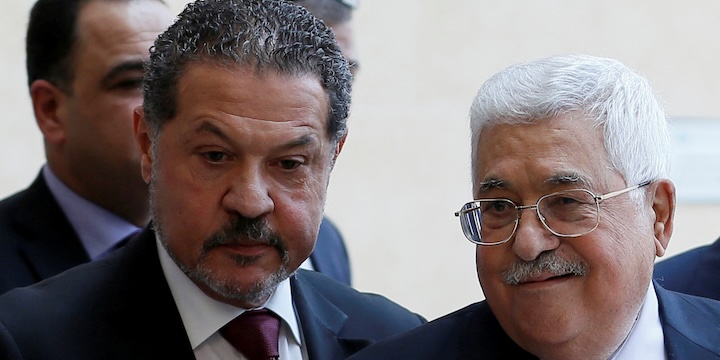
Palestinian President Mahmoud Abbas, accompanied by his son Yasser, leaves a hospital in Ramallah in the Israeli-occupied West Bank, May 28, 2018. REUTERS/Mohamad Torokman
The millionaire businessman son of Palestinian President Mahmoud Abbas has won a steering role in his father’s political party Fatah, a party official said on Sunday, as a succession fight looms for control of the embattled Palestinian Authority (PA).
Yasser Abbas won a seat in elections for the Fatah Central Committee, the party’s highest decision-making body, at its first general conference in almost a decade. Mahmoud Abbas, 90, will remain chairman, it decided.
The PA was set up as an interim administration under the 1990s Oslo accords between Israel and the Palestine Liberation Organization, an umbrella group still internationally recognized as the representative of the Palestinian people. The powerful Fatah party dominates both the PA and the PLO.
Abbas’ son’s foray into politics has fueled speculation that the president may be seeking to position Yasser, 64, to succeed him as head of Fatah.
That has drawn criticism from some Fatah officials, who say Yasser would be unable to unify Palestinians or help them chart a new political future after years without national elections or tangible steps toward statehood.
In the more than two decades since Mahmoud Abbas was elected to succeed Fatah founder Yasser Arafat, Palestinians have come to view the PA as ineffective and corrupt, something denied by Abbas, who has ruled by decree since his mandate expired in 2009.
In 2007, Abbas’ Fatah forces in the Gaza Strip were overpowered by Hamas militants who seized control of the enclave, a year after Hamas swept the Palestinian parliamentary elections.
Peace talks with Israel meant to lead to the creation of a Palestinian state in the West Bank, Gaza and East Jerusalem collapsed in 2014, with expanding Israeli settlements since carving up areas slated for Palestinian statehood. The PA is also grappling with a financial crisis.
Yasser Abbas, who has never held an official role within Fatah or the PA, runs tobacco and contracting firms in the parts of the West Bank where the PA exercises limited self rule. Critics have long alleged that he and his brother Tarek have used public funds to help their businesses, allegations both men reject.
Among others to have won seats on the Central Committee are Majed Faraj, head of the General Intelligence Agency, and former militant group leader Zakaria Zubeidi, released in a Hamas-Israel prisoner-hostage exchange as part of a 2025 Gaza ceasefire.