


Uncategorized
The JCPOA’s Sunset Has Arrived — and Iran Just Proved It
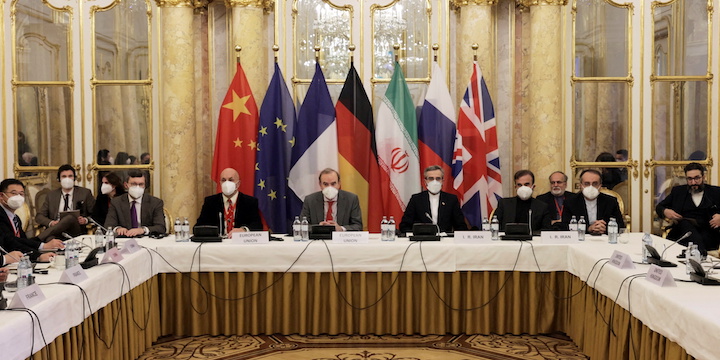
Deputy Secretary General of the European External Action Service (EEAS) Enrique Mora and Iran’s chief nuclear negotiator Ali Bagheri Kani and delegations wait for the start of a meeting of the JCPOA Joint Commission in Vienna, Austria December 17, 2021. EU Delegation in Vienna/EEAS. Photo: Handout via REUTERS
On the night of March 20-21, 2026, Iran launched two ballistic missiles at the joint US-UK base on Diego Garcia, an atoll in the Indian Ocean nearly 4,000 kilometers from Iranian territory. One failed in flight; the second was intercepted. Neither struck the base.
Iran’s Foreign Minister had stated weeks earlier that Tehran had deliberately capped its missile range at 2,000 kilometers. The gap between that claim and this week’s launch is not merely a military story. It is the story of the Iran nuclear deal (known as the Joint Comprehensive Plan of Action — JCPOA), and a direct answer to the question dividing Western foreign policy for a decade: what happens when the world tries to engage diplomatically with Iran?
On July 14, 2015, President Obama announced the JCPOA, and declared: “This deal is not built on trust. It is built on verification. We will be in a position to know if Iran is violating the deal.”
In 2026, that verification looks like a missile fired at a base 4,000 kilometers away, when Iran claimed its range limit was half that distance.
The Iran nuclear deal rested on a core assumption: that Tehran had come clean about its military history. The exposure of Iran’s nuclear archive by the Mossad, presented by Prime Minister Netanyahu in 2018, proved otherwise. Tehran had transferred its ambitions to a classified track, preserving its knowledge base intact and waiting for the restrictions to expire.
The JCPOA’s sunset clauses tell the story plainly. In October 2020, the UN arms embargo expired, allowing Iran to legally purchase tanks and aircraft from Russia and China. In October 2023, all restrictions on Iran’s ballistic missile and drone programs expired. In October 2025, the nuclear file was removed from the UN Security Council’s agenda.
Obama acknowledged this in an April 7, 2015 NPR interview with Steve Inskeep: in years 13 through 15, breakout times would shrink toward zero. The deal bought time. The question was always what that time would be used for.
The financial consequences were immediate. Iran gained access to over $100 billion in frozen assets. EU-Iran trade peaked at 20.7 billion euros in 2017. Airbus signed a $19 billion aircraft deal. TotalEnergies signed a $5 billion energy contract. Iran’s GDP grew 12.5 percent in 2016, per IMF data.
When asked in April 2016 whether this windfall would empower the Revolutionary Guard Corps, President Obama, speaking to Jeffrey Goldberg for The Atlantic’s “The Obama Doctrine,” argued that Iran’s infrastructure needs were too vast to leave room for IRGC expansion.
The evidence did not support that premise. The precision-guided munitions transferred to Hezbollah, the drones supplied to the Houthis, and the missile program that reached Diego Garcia were not funded by a government that ran short of money for domestic investment. The capital was fungible, and a revolutionary government proved capable of allocating it accordingly.
In that same interview, Obama called on Saudi Arabia and Iran to share the neighborhood, treating their rivalry as symmetrical rather than as a confrontation between a US partner and a state committed to violently reordering the region.
Within the administration, JCPOA preservation had become the flagship foreign policy achievement, generating a powerful institutional logic: any action risking Iranian withdrawal had to be weighed against losing the agreement. Governments in Jerusalem and Riyadh did not need to be told that escalation carried costs in Washington. Tehran read the architecture with precision. The years between 2015 and 2018 were among the most consequential in the construction of Iran’s regional proxy network.
The deal’s defenders argue, correctly, that it extended Iran’s nuclear breakout time from roughly two months to approximately one year, and that the 2018 withdrawal accelerated the nuclear advances it was meant to prevent. Iran today enriches uranium to 60 percent, a level prohibited under the agreement. These are factual claims.
The harder question is whether the framework was ever capable of a durable outcome. The sunset clauses suggest it was not designed to be. It was designed to buy time. In effect, it risked enabling Iran to reach a nuclear arsenal with international legitimacy. In such a scenario, the Middle East would face a new reality in which Iran possesses nuclear capability and reshapes the regional balance of deterrence. The missiles fired at Diego Garcia offer one answer.
Obama said in 2015 that the best outcome was to place Iran inside a box. The execution rested on assumptions that the nuclear archive, the proxy wars, and the Diego Garcia launch have each challenged in turn.
The next framework will need a different foundation: one that does not schedule its own obsolescence, does not assume capital flows moderate revolutionary ideology, and does not treat military responses to Iranian aggression as threats to diplomatic progress. Building it, before the current conflict forces the question under far worse conditions, is the most urgent task in Western foreign policy today.
Sagiv Steinberg is the CEO of the Jerusalem Center for Security and Foreign Affairs (JCFA), a leading Israeli research institute. He has an extensive background in senior leadership positions across the Israeli and global media landscape.
Uncategorized
US Owners of Irish Soccer Team Fire Chair for Saying Ireland Should Not Compete Against ‘Genocidal’ Israel

Soccer Football – UEFA Nations League Draw – Brussels Expo, Brussels, Belgium – Feb.12, 2026, General view during the draw. Photo: REUTERS/Benoit Tessier
The director and co-chairperson of the professional Irish soccer club Drogheda United has been fired after saying that Ireland should not compete against Israel in the upcoming UEFA Nations League and that the Jewish state should be “banned and boycotted by all.”
The Trivela Group, the American investment firm that owns the League of Ireland team, said in a statement on Monday that Joanna Byrne was dismissed and thanked her for her “longstanding and ongoing dedication to the Club and its success.” The move came after Byrne said in February that the Football Association of Ireland (FAI) should not play their scheduled UEFA Nations League match against Israel and accused the Jewish state of committing a “genocide” against Palestinians.
Ireland was drawn to go head-to-head against Israel and will play an away game against the Jewish state on Sept. 27 before hosting the Israeli team in Dublin on Oct. 4.
“Trivela Group can confirm that, pursuant to its authority as sole shareholder of Drogheda United FC, Joanna Byrne has been removed by Trivela Group as a director of the Club,” read a statement posted on Drogheda’s website. “At this time, the Board of Directors consists of Benjamin Boycott, Marc Koretzky, Barton Lee, and club CEO Rian Wogan. Mr. Boycott for the time being, will serve as the sole Chairperson, and the club will look to appoint a local director and Co-Chair in due course.”
In a Facebook post on Monday, Byne reiterated her “strong stance” that Ireland “should not play Israel in the UEFA Nations League while a genocide against the Palestinian people continues.” She called her firing a “cold, underhand move by Trivela, initiated in the dark of the night, which was planned and coordinated without any consultation with me. This is symptomatic of the way they do business.”
“I am deeply committed to Drogheda United and want to see it flourish,” she added in part. “I will continue to elevate it, and the League of Ireland more broadly at every opportunity.”
Byrne is the Sinn Féin spokesperson on culture, communications, and sport. Drogheda United was the first League of Ireland Club to appoint a female chairperson.
In February, after the FAI confirmed that it would compete against Israel in the UEFA Nations League, Byrne released a statement denouncing the decision. She noted that the FAI submitted a motion to UEFA in November to ban Israel from its European club and international competitions.
“In November, the FAI voted to submit a motion to UEFA to ban Israel … That was the correct moral and principled position to take,” she said in February. “Therefore, I am extremely angry and dismayed that the FAI have confirmed they will play against Israel. It appears that their morals, and principled position, was only on paper – not in actions where it counts. Israel should not be in this competition.”
“UEFA should have expelled them as soon as Israel went into Gaza on a genocidal, ethnic cleansing mission that has seen tens of thousands of innocents murdered, including hundreds of sports men and women,” she added. She said Israel “should be treated the same as Apartheid South Africa was, and be banned and boycotted by all.”
Byrne also accused the UEFA of having “double standards” for banning Russia after it invaded Ukraine in 2022 but not banning Israel following its military actions in Gaza. Israel launched a military campaign against Hamas after the Palestinian terrorist group invaded southern Israel on Oct. 7, 2023, massacring 1,200 people and taking 251 hostages to Gaza.
“I hope the FAI knows the furor that will be coming for them from the Irish football fans – the vast vast majority will not want to see our Boys In Green in the same stadium as the Israeli team,” she said in her statement at the time. “I have said it before when I was asked about Israel’s participation in Eurovision and in other sporting fixtures and I will repeat it again now: Israel is an apartheid state who have engaged in ethnic cleansing and genocide. Their behavior cannot be accepted or normalized.”
After she made the anti-Israel comments in February, Bryne claimed the board of Drogheda United said her position as chairperson of the club “was no longer tenable” because of her remarks. The board also expressed “an expectation that I would resign, something I have told them that I intend to resist,” she added.
Trivela Group confirmed last week that it issued a written instruction demanding she resign as director and co-chair of the club.
Uncategorized
Bahrain Pushes UN-Backed Action for Hormuz Shipping; France Tables Rival Text

A map showing the Strait of Hormuz is seen in this illustration taken June 22, 2025. Photo: REUTERS/Dado Ruvic/Illustration
UN Security Council members have begun negotiating resolutions to protect commercial shipping in and around the Strait of Hormuz, including a Bahraini draft that would authorise the use of “all necessary means” — language France has warned will be difficult to adopt.
The move underscores mounting regional concern that Iran could continue to threaten the strategic chokepoint, which carries about a fifth of global oil supplies and underpins Gulf economies.
Shipping through the waterway has already slowed to a near‑halt after Iran struck vessels amid its conflict with the United States and Israel.
Diplomats said Bahrain‘s draft, seen by Reuters and backed by other Gulf Arab states and the United States, uses diplomatic language to authorize force.
France circulated a more conciliatory alternative text, also seen by Reuters, and diplomats said talks were under way to assess whether the two drafts could be reconciled.
France‘s Foreign Minister Jean‑Noel Barrot told lawmakers that there was little certainty Bahrain‘s bid to permit the use of force — a power the Security Council can grant under Chapter VII of the UN Charter, which allows measures from sanctions to military action — would win enough backing among member states. “The coming days will tell,” he said.
BAHRAINI RESOLUTION DETAILS
The Bahraini resolution describes Iran’s actions as a threat to international peace and security.
It would authorize countries — acting alone or through voluntary multinational naval coalitions — to use “all necessary means” in and around the Strait of Hormuz, including in the territorial waters of countries along its shores, to ensure passage and to prevent moves that block or interfere with international navigation.
It also expresses readiness to impose measures, including targeted sanctions.
Bahrain‘s Ambassador to France, Essam al-Jassim, told Reuters discussions were at an early stage.
“External protection has clear limits. International coalitions help secure sea lanes and stabilize markets, but their response remains largely reactive,” he earlier told a defense forum in Paris.
“They do not address, for example, escalating state-backed attacks, and without doing so, disruptions will persist.”
The Bahraini and US missions to the United Nations did not immediately respond to requests for comment.
The text “demands that the Islamic Republic of Iran immediately cease all attacks against merchant and commercial vessels and any attempt to impede lawful transit passage or freedom of navigation in and around the Strait of Hormuz.”
FRENCH RESOLUTION MAKES NO MENTION OF IRAN
Diplomats said there was little prospect of such a resolution being adopted by the Security Council as Iran’s partners Russia and China were likely to veto it if necessary.
A Security Council resolution needs at least nine votes in favor and no vetoes by Russia, China, the US, Britain, and France. The Russian and Chinese missions to the United Nations were not immediately available for comment.
France on Monday submitted its own draft, taking a more conciliatory tone and aiming to build broader support within the council.
President Emmanuel Macron, who has suggested having a UN framework for any action in the Hormuz, has refused to take part in any immediate operations to secure the strait, saying that international efforts could only happen once hostilities calm, insurance and shipping firms are consulted and with Iran’s consent.
The French resolution makes no mention of Iran and is not under Chapter VII. It “urges all parties to refrain from further escalation, calls for a cessation of the ongoing hostilities in the Persian Gulf, the Strait of Hormuz and the Gulf of Oman, and calls for a return to the path of diplomacy.”
Rather than authorizing action, the text encourages states with an interest in commercial maritime routes in the strait to coordinate strictly defensive measures — including escorting merchant vessels — in full respect of international law, including the law of the sea.
Uncategorized
Airstrikes Target HQ, Leader of Iran-Backed Shi’ite Militia Umbrella Group in Iraq

Mourners carry the coffin of Saad al-Baiji, the Popular Mobilization Forces’ Anbar operations commander, who was killed in airstrikes that targeted a PMF site in Iraq’s western Anbar province, during his funeral, in Baghdad, Iraq, March 24, 2026. Photo: REUTERS/Ahmed Saad
Airstrikes hit a headquarters of Iraq‘s umbrella group for Iran–backed Shi’ite militias and a residence belonging to its leader on Tuesday, killing at least 15 fighters in an escalation of US-Israeli strikes on one of Tehran’s main regional allies.
At least 30 other people were wounded in the strikes on a headquarters of the Popular Mobilization Forces in Iraq‘s Euphrates valley province of Anbar, according to medical officials who said some were in serious condition and the death toll could rise. Reuters filmed ambulances bringing the wounded to hospital in the regional capital Ramadi during the night.
The dead included the PMF’s operations commander in the province, Saad al-Baiji. Later on Tuesday, a large crowd of angry mourners carried his coffin and portraits through the streets of Baghdad.
Two security sources said the strikes had hit the PMF headquarters during a meeting attended by senior commanders.
A separate airstrike hit a residence belonging to the PMF’s leader Falih al-Fayadh in the northern city of Mosul. He was not present at the building which he uses only during visits to the city, according to the two security sources. A PMF statement said its office in the city was destroyed and one fighter wounded there.
Such damaging strikes against the PMF create political difficulty for Prime Minister Mohammed Shia al‑Sudani, who has to walk a careful line maintaining the support both of Washington and of factions in the Shi’ite-majority country that are aligned with Iran.
Sudani ordered an emergency meeting of the Ministerial Council for National Security to be convened, said a statement from the Iraqi military’s joint operations command.
The statement said the 15 PMF fighters were killed in a “US-Zionist airstrike”, the first time Iraq‘s military has blamed Israel alongside the United States for bombing the PMF.
The PMF, known in Arabic as Hashd al-Shaabi, is an umbrella group of mostly Shi’ite paramilitary factions that was formally integrated into Iraq‘s state security forces and includes several groups aligned with Iran.
Tehran-backed armed groups have launched attacks on US bases in Iraq and the US embassy since the United States and Israel launched their war on Iran on Feb. 28. Washington has had an influential presence in Baghdad since its 2003 invasion that overthrew dictator Saddam Hussein, a Sunni Muslim, and replaced him with Shi’ite-led governments friendly with Iran.
The US-Israeli war on Iran has spilled across Iran‘s borders, with Tehran launching strikes on Israel and Gulf Arab states hosting US military installations, while Israel has carried out attacks in Lebanon following cross-border fire by Iran-aligned Hezbollah.