



Uncategorized
The New ‘Tokyo Roses’: How Social Media Influencers Amplify Authoritarian Propaganda

People stand near a destroyed vehicle as smoke rises after a reported strike on Shahran fuel tanks, amid the US-Israeli conflict with Iran, in Tehran, Iran, March 8, 2026. Photo: Majid Asgaripour/WANA (West Asia News Agency) via REUTERS
At 04:38 on the morning of March 11, 2026, the alert blasted onto my phone: “Red Alert – Tel Aviv.”
Like millions of Israelis during the current war with Iran, my family and I moved quickly into our mamad — the reinforced safe room built into Israeli homes constructed after 1993 — grateful for the air-defense systems intercepting incoming missiles overhead.
Fifteen minutes later, the sirens stopped. I climbed back into bed.
That has become the rhythm of daily life here. Restaurants reopened. Businesses operate. Children move between Zoom classes and the occasional dash to a shelter when sirens sound.
But if you relied solely on social media — particularly X or TikTok — you might believe Tel Aviv had already been reduced to rubble.
Videos circulate claiming the city is burning and the electric grid destroyed. Posts declare Israel is collapsing under missile fire. Influencers insist the truth is being “censored.”
The problem is that this supposed “evidence” turns out to be fabricated, misrepresented, or recycled footage — often not even from Israel.
In other words: propaganda.
The tactic itself is not new.
During World War II, Allied soldiers in the Pacific heard English-language propaganda broadcasts from personalities collectively known as “Tokyo Rose.” Their purpose was to undermine morale, spread disinformation, and convince American troops their cause was hopeless.
The technology has changed, but the tactic hasn’t.
Today, the propaganda battlefield is on social media, and the new “Tokyo Roses” are often Western influencers with enormous audiences.
Consider the viral claims that Iran’s missile attacks have “devastated” Israel.
Several widely shared posts attempted to support this narrative with dramatic footage supposedly showing Iranian strikes on Israeli cities.
Basic fact-checking revealed something else: AI-generated fabrications or recycled clips from earlier events.
Repackaging old footage to fabricate a new narrative is one of the oldest tricks in propaganda. What has changed is the speed. In the social media age, recycled footage and fabricated videos spread globally in minutes, while corrections rarely travel as far as the original lie.
A similar pattern appeared recently when Putin- and Houthi-supporting influencer Jackson Hinkle circulated a video claiming to show massive crowds in Iran mourning the assassination of Ayatollah Khamenei. Fact-checkers later identified the footage as coming from the 2020 funeral of Islamic Revolutionary Guard Corps commander Qasem Soleimani. By the time the clarification appeared, the misleading version had already spread widely across social media.
Other influencers have gone further by promoting narratives that closely mirror those pushed by authoritarian regimes.
Social media personality Myron Gaines recently argued that Iran “poses no real threat to the United States” and that the war should end because it is “Israel’s problem, not ours.”
But Iran’s regime has spent decades building precisely the opposite reality. Since the 1979 Islamic Revolution, Tehran has treated the United States as a principal enemy. Iranian leaders regularly chant “Death to America,” and Iran and its proxies have been responsible for the deaths of hundreds of American service members, including attacks in Beirut, Iraq, and Saudi Arabia.
Through the Islamic Revolutionary Guard Corps, Tehran has built a network of proxy militias across the Middle East — Hezbollah in Lebanon, Hamas in Gaza, Shiite militias in Iraq, and the Houthis in Yemen.
These groups have launched thousands of rockets, drones, and missiles against America and its allies while Iran continues expanding its ballistic-missile arsenal and advancing toward nuclear-weapons capability.
This buildup also fits into the broader ambitions of the China-Russia-Iran axis, which seeks to weaken American global influence.
To describe such a regime as posing “no real threat” requires ignoring one of the most documented security challenges in modern geopolitics.
Unless one believes that the world — and especially the United States — would be freer or safer with China, Russia, and Iran ascendant, the stakes should be obvious.
In other cases, the rhetoric moves from distortion into outright antisemitic conspiracy.
Social media personality Dan Bilzerian has posted messages accusing Western leaders and the Muslim governments cooperating with Israel of “selling out” their people. His posts frequently invoke conspiratorial claims about hidden Jewish forces nefariously controlling Western governments.
These narratives mirror themes long promoted by state-controlled media in Iran and Russia.
Whether intentional or not, the effect is the same: Western audiences are fed narratives that erode trust in democratic institutions while portraying authoritarian regimes as misunderstood and even noble victims.
In some cases, the messaging goes further still.
Recent posts from Candace Owens, widely shared across social media, have encouraged Americans not to serve in the US military and urged those currently serving to quit, while framing the conflict through very dark and conspiratorial accusations about hidden motives to serve supposedly prurient and venal Jewish interests.
Messages designed to discourage military service during wartime have long been tools of psychological warfare. In the 1940s such efforts were broadcast over enemy radio. Today they appear in US based social media feeds.
None of this occurs in a vacuum.
For years the Islamic Revolutionary Guard Corps has treated information warfare as a central element of its strategy. Iranian state media and proxy networks attempt to shape global narratives by portraying the Islamic Republic as a victim while depicting Israel and the United States as degenerate and corrupt aggressors.
These campaigns rely on familiar tactics: recycled footage, conspiracy narratives, and emotionally charged messaging designed to spread rapidly online. What makes the modern environment different is that these narratives no longer need to originate inside Iran to reach Western audiences. Influencers with large followings amplify them instantly.
The propaganda circulating online often revives and relies on something far older than modern geopolitics: classic antisemitic tropes.
Many viral posts go far beyond criticism of US or Israeli policy. They invoke conspiracies about Jewish control of governments, repeat blood-libel accusations, and frame global events as the result of a shrouded Jewish plot.
Versions of these accusations have circulated for centuries. What is striking today is how seamlessly these myths have merged with contemporary geopolitical propaganda.
Authoritarian regimes hostile to Israel have long understood that antisemitic narratives can serve as powerful mobilizing tools. Portraying Israel as the center of a global conspiracy transforms a regional conflict into an ideological crusade.
When influencers with large Western audiences repeat these themes, they normalize ideas that have historically fueled violence against Jews.
The modern “Tokyo Rose” no longer sits behind a microphone in an enemy capital. He or she posts on social media.
The voices spreading propaganda today are influencers with millions of Western followers — many living safely and prosperously inside the democratic societies whose resolve they undermine. Some claim they are offering contrarian commentary. Others are motivated by attention or the financial rewards of viral outrage.
But the effect is the same: narratives promoted by authoritarian regimes are amplified to vast audiences, often stripped of context, facts, or accountability.
Meanwhile here in Tel Aviv, life continues between missile alerts. Millions of Israelis move between normal routines and red-alert interruptions as air defenses intercept incoming missiles. But it bears little resemblance to the apocalyptic fantasies circulating online.
That contrast — between lived reality and digital narrative — reveals something important about modern information warfare.
Propaganda no longer requires governments to broadcast lies. It only requires enough people willing to repeat them — and in the age of social media, there are always volunteers.
Micha Danzig is an attorney, former IDF soldier, and former NYPD officer. He writes widely on Israel, Zionism, antisemitism, and Jewish history. He serves on the board of Herut North America.
Uncategorized
Three simple rules for navigating a new season of protest against Israel
Spring. The season of graduations and protests.
A tenured professor and faculty chair at my alma mater, the University of Michigan, recently used the commencement stage to denounce Israel’s war in Gaza — remarks that drew applause from some as others experienced them as alienating and unwelcome. At New York’s Park East Synagogue, a group of masked, hate- spewing demonstrators waving Hezbollah flags while protesting the “Great Israeli Real Estate Event.”
If the settings of these incidents differ, one underlying question they raise remains the same: What are the ethics of protest? At what point does dissent deepen democratic life and moral accountability, and when does it begin to fray the trust, dignity and shared sense of belonging upon which a society depends?
While these tensions may be hard to resolve, I’d like to put forward three guiding principles for how best to engage on the subject of free expression in such a hot-zone climate.
Protest is essential
Protest is foundational to what it means to be both a Jew and an American.
Look to Abraham standing before God at Sodom and Gomorrah; Moses standing before Pharaoh; the prophets calling kings and nations to conscience; and Esther risking all for her people. All of their examples show that to be a Jew is to take note of the gap between the world as it is and as it ought to be, and then to summon the moral courage, communal will, and spiritual audacity to help close that gap.
Jews understand that to protest is a religious act. That’s why rabbis so often quote Abraham Joshua Heschel’s famous reflection after marching alongside Martin Luther King Jr. in Selma in 1965: “I felt my legs were praying.”
And as the United States turns 250 years old, it’s worth remembering that our country began with a protest movement. Since then, many of our country’s finest moments have emerged from moral protest — including the labor movement, the fight for women’s suffrage, and the Civil Rights Movement.
As Jews and as Americans, we are heirs to two traditions of protest.
So is self-interrogation
Where we draw the lines around acceptable protest says as much about us as it does about the protest itself.
A prime example of this: During my 25-plus years as a rabbi, no congregant has ever told me that the pulpit is no place for politics — so long as they agree with my politics.
I had little difficulty admiring the activist Greta Thunberg when she sailed across the Atlantic to raise awareness about climate change. I found it much more challenging to view her kindly when she joined a flotilla protesting Israel’s war in Gaza.
Similarly, the faculty speaker at Michigan’s commencement sounded pretty good when championing the university’s first Jewish faculty member and a curriculum more attentive to Black American history. It was only when he condemned Israel that many listeners, myself included, recoiled at his remarks.
None of us are the neutral arbiters of protest ethics we may imagine ourselves to be. Progressives who passionately defend buffer zones around abortion clinics but not around houses of worship should ask why one form of vulnerability warrants protection and another does not. Student activists who champion on-campus encampments protesting Israel’s actions in Gaza, but would never tolerate a white nationalist rally on campus, should ask where principle ends and preference begins. Conservatives who invoke the First Amendment to defend provocative speech they favor, yet denounce positions they dislike as treasonous or un-American, should examine where principle gives way to ideology. And activists who mobilize when civilians die in Gaza but remain deafeningly silent when tens of thousands of Iranians are murdered by their own regime must interrogate what moral framework governs that selective outrage.
Where we draw the lines — whom we applaud, what we excuse and what we denounce — reveals not only our principles, but also our loyalties, fears and tribal attachments. Moral seriousness requires the humility to examine ourselves before we protest — to check ourselves before we express ourselves.
Just because you can, doesn’t mean you should
As Jews, we believe in buffer zones — not just the kind debated at City Hall. The rabbis believed in moral buffer zones, a principle they referred to as living “lifnim mishurat hadin” — “beyond the strict line of the law.”
Rabbinic tradition in part explains the semi-somber period between Passover and Shavuot, in which we currently find ourselves, using precisely this idea. When 24,000 of Rabbi Akiva’s students died in one day, the Talmud teaches, they perished because they followed the letter of the law but failed to go beyond it and treat one another with respect — “kavod zeh lazeh.” They failed to embody the deeper demand of leadership: to live not merely according to what one is allowed to do, but by what one ought to do.
What might that mean for us today?
The answer: just because you have the legal right to express yourself doesn’t mean you should.
The Michigan commencement speaker may have been within his rights to voice his objections to Israel. But his decision to do so in that setting reflected a breathtaking failure of leadership, reminding us there is no direct correlation between tenure and wisdom, expertise and judgment. Like a teacher who hijacks a classroom to air political grievances under the guise of education, the speaker demonstrated an astonishing lack of discernment by alienating a sizable portion of the very students and families he was there to honor and congratulate.
Regarding the protests outside Park East Synagogue, the letter of the law may protect those who wave the flags of a terrorist organization, chant antisemitic slogans, or proclaim that the Jewish state itself should cease to exist. That such speech is protected does not mean it is right. It is, instead, intimidation masquerading as activism.
I was also deeply troubled by the response of New York Mayor Zohran Mamdani, who prefaced his condemnation of the protests by first denouncing the event itself. The mayor should have simply said: no house of worship should be targeted or intimidated, full stop.
To imply that the nature of the event somehow mitigated the harassment outside was not only irresponsible, offering moral cover for behavior that crossed the line from protest into menace, but also a troubling form of moral equivocation that shifted responsibility onto those being targeted — if not outright victim blaming. A peaceful protest calling for Palestinian self-determination alongside Jewish self-determination? As a liberal Zionist, that sounds like my kind of protest! But in an age in which there is a direct line between anti-Israel rhetoric and antisemitic violence, our mayor must do more than merely follow the letter of the law. True leadership begins where the letter of the law ends.
The issue is not whether dissent is permitted, but whether we are not losing the capacity for kavod zeh lazeh.
As the secular prophet of our time, Bruce Springsteen, has been reminding audiences across the country on his current tour: “America, from the beginning, was born out of disagreement. It was built on argument, on disagreement. We can argue about what course we thought the country should take while recognizing our common humanity, our dignity and, yes, our unity.”
Whatever our differences, the challenge before us is whether we can disagree without severing the ties that bind us — as Americans, Jews and human beings.
The post Three simple rules for navigating a new season of protest against Israel appeared first on The Forward.
Uncategorized
Alleging conflicts, California judge boots Jewish DA from trying Stanford pro-Palestinian protesters
(JTA) — This story originally appeared in J. The Jewish News of Northern California.
Jewish groups in the Bay Area are protesting a judge’s removal of a local Jewish district attorney from a case involving pro-Palestinian protesters accused of vandalizing Stanford University’s president’s office.
The district attorney, Jeff Rosen, was disqualified from retrying a felony case against five protesters after the judge ruled that Rosen had crossed a legal line when suggesting in a campaign message that the protest was antisemitic.
“Rosen is allowed to take a strong stance against crime in the community, against antisemitism. But caution and care need to be taken when utilizing active litigation in campaign communication,” Judge Kelley Paul said from the bench.
The judge said Rosen had erred when publicly labeling the incident antisemitic when it was not charged as a hate crime.
“This case is not a hate crime,” Paul said. “The characterization of the prosecution as a fight against antisemitism runs afoul of case law.”
In an email to J. The Jewish News of Northern California, Rosen’s office wrote that while it “disagrees with the judge’s ruling, we respect it.”
In a joint statement, the Jewish Community Relations Council Bay Area and Jewish Silicon Valley wrote that they are “deeply troubled” by Paul’s decision and that the case “must proceed.”
“This decision uniquely targets minority prosecutors, suggesting they are incapable of pursuing justice in cases perceived to be impacting their own communities,” the statement says, adding that it “risks reinforcing longstanding antisemitic prejudices and invites future defendants to weaponize a prosecutor’s identity against them.”
The five protesters face felony vandalism and conspiracy counts stemming from a June 2024 protest in which 13 people broke into Stanford’s executive offices and caused an estimated $300,000 in damages. A jury deadlocked in February, splitting 9-3 on the vandalism count and 8-4 on conspiracy. Rosen quickly announced his plan to retry them.
The disqualification motion was filed by deputy public defender Avi Singh, who argued that Rosen had compromised his office’s neutrality by featuring the prosecution on a campaign fundraising page titled “DA Rosen Fighting Anti-Semitism,” alongside a donation button.
Singh argued that the fundraising campaign falsely implied that the defendants were antisemitic. None was charged with a hate crime.
Rosen, who has spoken publicly about his commitment to fighting antisemitism and supporting Israel, has denied any conflict of interest.
In her decision, Paul pointed to Rosen’s remarks in a March 2025 speech he gave for the San Jose Hillel, about a month before his office filed charges against the protesters. A video of the speech is linked on the “Fighting Anti-Semitism” page on his campaign website.
In the speech, Rosen equated antisemitism and “anti-Americanism,” a phrase that Deputy District Attorney Robert Baker also used to describe the conduct of the protesters during the trial’s closing arguments. Paul ruled that the similarities in the language disqualified the entire DA’s office from the case, not just Rosen.
In their own statement, the local Jewish groups suggested Rosen was being disqualified because he is Jewish.
“Generations of American Jews in positions of public trust have all too often been treated as suspect or inherently conflicted,” JCRC Bay Area and Jewish Silicon Valley said. “This decision risks reinforcing longstanding antisemitic prejudices and invites future defendants to weaponize a prosecutor’s identity against them, casting any public opposition to hate as grounds for disqualification.”
Rosen’s challenger in his June primary election, former prosecutor Daniel Chung, has turned the ruling into a campaign video. Chung called Rosen’s pursuit of the Stanford case “overzealous” and “a waste of time and money.”
“This is a humiliating loss for DA Rosen and his entire office,” Chung said in an Instagram video. “For years, millions of dollars have been spent trying to prosecute Stanford student protesters with felony charges.” Rosen’s actions, Chung said, “jeopardized the due process of the defendants” and “exemplifies the undermining of integrity, competence and compassion under DA Rosen for the last 16 years.”
The ruling hands the case to California’s attorney general, which will decide whether to retry the defendants — German Gonzalez, Maya Burke, Taylor McCann, Hunter Taylor-Black and Amy Zhai — or drop the charges.
The post Alleging conflicts, California judge boots Jewish DA from trying Stanford pro-Palestinian protesters appeared first on The Forward.
Uncategorized
Iran’s Deepening Water Crisis Threatens 35 Million as Economy Buckles Under US Pressure, Mounting Domestic Strain
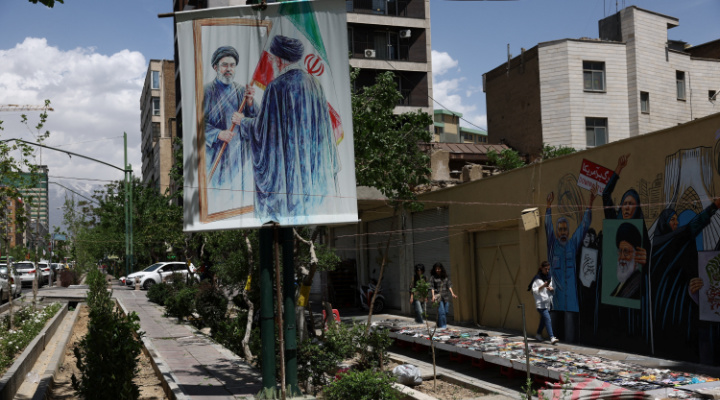
People walk on a street near a mural featuring an image of the late Supreme Leader of Iran, Ayatollah Ali Khamenei, in Tehran, Iran, May 6, 2026. Photo: Majid Asgaripour/WANA (West Asia News Agency) via REUTERS
As talks with the United States over a possible deal to end the war remain uncertain, Iran’s economy is under mounting strain, with prolonged water shortages, pressure on energy infrastructure, and slowing industrial output deepening what authorities describe as an “economic war.”
With Iran entering the summer months amid a deepening water and electricity crisis, government officials estimate that around 35 million people will face water shortages, intensifying concerns over deteriorating living conditions, mounting economic strain, and daily hardship across the country.
On Monday, Issa Bozorgzadeh, a spokesman for the country’s water industry, reported that rainfall has fallen “below normal” levels across 11 provinces, warning that Tehran is among the worst affected as it enters its sixth consecutive year of drought.
Now, Iranian authorities are urging citizens to cut consumption and adopt stricter usage habits, pointing to deep structural failures in the water and power sectors as public frustration rises over supply disruptions, mismanagement, and declining living standards.
Officials have also announced planned summer power outages, warning that the deepening energy crisis could lead to factory shutdowns, reduced industrial output, rising unemployment, and higher prices.
On Sunday, Arash Najafi, head of the Energy Commission of Iran’s Chamber of Commerce, noted that household, commercial, and office blackouts are likely to continue daily throughout the summer, while the industrial sector will continue to be targeted for power cuts” or “will continue to bear the brunt of power cuts.
Given the damage to several petrochemical facilities in Israeli and US strikes and their reliance on electricity from the national grid, Najafi said most available power would now be directed toward keeping these complexes operational around the clock.
“The Islamic Republic will be forced to impose electricity consumption restrictions for about 120 days, and given the lack of effective means for people to significantly reduce usage, this will result in widespread blackouts,” the Iranian official said in a statement.
Amid growing public frustration over the ongoing crisis, Majid Doustali, a member of Iran’s parliamentary planning and budget committee, called on citizens to cut back on electricity, water, and fuel consumption as part of the country’s resistance efforts in what he described as an “economic war.”
“Every effort by the public to save resources represents a direct challenge to the enemy’s economic conspiracy,” Doustali said.
Even as the crisis continues to weigh heavily on the Iranian people, a nationwide internet blackout remains in place, having exceeded 1,728 hours as of Monday, after authorities imposed the shutdown more than two months ago, effectively isolating millions of Iranians from independent reporting on the war and access to global news.
Across much of the country, unstable internet forces many people to rely on illegal black-market virtual private networks (VPNs) — tools that bypass government censorship — to stay connected beyond Iran’s borders, with access costing millions, and users risking imprisonment and national security charges.
According to a CNN estimate, Iranians have spent roughly $1.8 billion on internet access over the past two months.
Soaring costs and crumbling infrastructure have also forced businesses to cut jobs on a massive scale, leaving many workers unemployed and intensifying social and economic pressures across the country, The New York Times reported.
Dozens of major companies have reportedly laid off hundreds of employees across multiple industries, with the industrial sector alone potentially putting up to 3.5 million workers at risk, as the country’s economy reels from the impact of a US naval blockade on Iranian ports that began in mid-April.
The US blockade has prevented the regime from exporting energy through the Strait of Hormuz — a critical global energy chokepoint through which about one-fifth of the world’s oil supply passes.
With companies sharply reducing or freezing production amid shutdowns and mass layoffs, the private sector downturn is further threatening the regime by reducing tax revenues, which the government has come to rely on heavily amid mounting sanctions and trade restrictions.
Iran’s new supreme leader, Ayatollah Mojtaba Khamenei, has attempted to contain the fallout by urging companies to avoid layoffs “to the extent possible.”
But the regime’s internet shutdown alone has cost businesses and companies an estimated $80 million in daily losses, The New York Times reported.
As the Iranian currency continues to plunge and inflation peaks near 60 percent, senior official Gholamhossein Mohammadi said the war has already cost around one million jobs, alongside “the direct and indirect unemployment of two million people.”
Meanwhile, Iran’s energy sector is also under severe strain, with exports falling sharply, storage capacity nearing its limits, and infrastructure under growing pressure.
According to data from commodity analytics firm Kpler, Iran could exhaust its oil storage capacity within 25 to 30 days if the crisis continues, prompting cuts in output at several oil fields to ease pressure.
Amid an export collapse exceeding 70 percent, the government now faces a critical decision between shutting wells to manage storage constraints or risking long-term damage to key oil fields.
Even though Kpler’s report estimates Tehran may not feel the full revenue hit for another three to four months due to payment delays and pre-existing sales flows, the regime is expected to face a heavy blow, with losses potentially reaching $200–250 million per day.
With domestic tensions rising and the internal economic crisis worsening, Iranian officials are increasingly wary that renewed protests could erupt in the coming days, further destabilizing an already volatile situation.