


Uncategorized
The Passover Seder: An Ancient Jewish Ritual That Solves Modern Loneliness

The Israel Project and the World Jewish Congress host a pre-Passover seder for foreign diplomats in Israel in 2018. Photo: Avishai Zigman.
We are living through a loneliness crisis unlike anything in recorded history.
In 2023, the US Surgeon General declared loneliness a national epidemic — one with health effects comparable to smoking fifteen cigarettes a day. Nearly 3 in 5 Americans report feeling profoundly unknown. Millions feel lonely every single day.
We have more ways to connect than ever before. And fewer places where we feel fully known.
This Wednesday night, Jewish families will gather around the table and do something radically different, and yet very much the same as their ancestors have done for thousands of years — they will participate in the Passover Seder.
The Seder may also be one of the most sophisticated social technologies ever built to counter loneliness — less by accident than by design.
Researchers and clinicians have begun to distinguish between different kinds of loneliness — not one experience, but many. Social loneliness. Conditional belonging. Epistemic loneliness. Existential loneliness. Each has its own texture, its own particular ache.
The Seder, it turns out, has an answer for each one.
Through the Seder, the number four shows up as a leitmotif: Four cups of wine. Four questions. Four children. Four languages of redemption. It’s as if the ritual is circling something — returning to it from different angles. In this vein, the Seder responds to loneliness not as a single issue, but as four.
When There Is No Table: Social Loneliness — the Absence of Connection
The most visible form of loneliness is the simplest to name: there is nowhere to go. No table. No room where you are expected. No one waiting.
The Seder answers this with something simple and radical: an open door. As the story begins, it does so not with explanation, but with invitation: “All who are hungry, come and eat. All who are in need, come and celebrate Passover with us.”
Before the narrative unfolds, belonging is already assumed. You don’t have to be family. You don’t have to be Jewish. You don’t have to be doing okay. You just have to show up.
In an era when loneliness research points to the collapse of what sociologists call “third places” — not home, not work, but the communal spaces in between — the Seder table functions as something even more radical: a space of belonging that precedes qualification.
The stranger is not an afterthought. The stranger is built into the ritual’s opening breath.
When You Cannot Show Up Whole: Conditional Belonging — the Loneliness of the Edited Self
There is a quieter form of loneliness that does not announce itself. You are in the room. You are welcomed, even. And yet something remains unspoken — because you have learned, through experience, that it is safer that way.
For many Jews, this has taken on a particular shape.
As antisemitism has increased across campuses, workplaces, and public life, something more subtle has shifted beneath it: a growing sense that parts of one’s identity must be edited, softened, or left unspoken in order to remain comfortable, or even safe, among others.
This happens not necessarily through overt hostility, but more often through silence — through the moment when something is said and no one responds. Through the calculation of whether it is easier not to explain, not to correct, and not to reveal.
This kind of loneliness is different. It is not the absence of people. It is the absence of recognition.
People become fluent in partial belonging. They show up — but not entirely. What makes this kind of loneliness so corrosive is not just exclusion. It is the constant mental calculus: what to say. What to soften. What to leave unsaid.
The Seder, in its way, removes the need for this calculus. From the moment the story begins — Avadim hayinu, “we were slaves” — there is no distance, no qualification, no version of the self that stands outside the narrative. The language, in the first person plural, is the language of unconditional belonging.
When the Story Is Taken From You: Epistemic Loneliness — the Loneliness of the Denied Reality
There is a form of loneliness that goes deeper than exclusion or invisibility. It is the experience of watching what you know to be true –your history, your present-day reality — denied, distorted, or minimized in real time.
Holocaust denial. October 7th denial. Ancient blood libels resurfacing in modern language.
Not just disagreement, but the erosion of what is knowable. The ground beneath the memory made unstable. This is epistemic loneliness: not merely feeling unseen, but feeling that what you have witnessed cannot be verified, that the story of your own life is somehow in dispute.
The Haggadah does not argue with this. It bypasses it: “In every generation, they rise against us.”
Not as a claim to be defended—but as something already known. The Seder does not ask for validation. It assumes memory. It transmits it. It lives inside it. You do not gather to prove what happened. You gather so that it cannot easily be undone.
In this way, the Seder answers the loneliness of having to defend what is real — by placing truth inside a structure that does not depend on consensus.
When Memory Has No One to Receive It: Existential Loneliness — the Loneliness of Inherited Trauma Carried Alone
And then there is the loneliness that is hardest to name — the weight of carrying something that cannot easily be put down. Not the loneliness of the present moment, but of accumulated history. Of experiences so heavy, so particular, that they seem impossible to transfer to anyone who was not there.
This is existential loneliness: the isolation that comes not from lacking connection, but from holding something that feels transmittable. The Seder was built, in part, for exactly this. It does not ask you to observe the Exodus from a safe historical distance. It asks you to collapse the distance entirely.
“In every generation,” the Haggadah instructs, “a person is obligated to see themselves as if they personally left Egypt.”
Not your ancestors. Not your people, abstractly. You. You were a slave. You crossed through the sea. You stood at the foot of the mountain.
Psychologists who study narrative identity have found that shared story is one of the most powerful tools for creating social cohesion. When a group shares not just information but identity through story, they build a sense of common fate — a shared origin, a shared memory, and therefore a shared future.
The Seder takes this further. It insists that the story be re-entered, not merely retold. The matzah is still flat because there was no time for the bread to rise. The maror is bitter because slavery was bitter. The charoset is sweet because even suffering contains the labor of building something.
Every element is a sensory anchor back into the experience — not as history, but as inheritance.
The Seder is an act of multi-generational memory and trauma processing.
For years, my husband’s grandparents — both Holocaust survivors — rarely spoke about what they endured. Like many of their generation, they carried it in silence. It lived beneath the surface, present through recurring night terrors and tattooed numbers on arms.
It was a silence shaped not only by trauma and the human need to cope, to rebuild, to run from the pain of the past, but also by loneliness — the kind that comes from holding experiences that feel impossible to share, from living with memories that set you apart from the people around you.
One Passover Seder, when their grandchildren were old enough to hear, something shifted. The silence broke. They began to tell their story. About the concentration and death camps. About the death marches my husband’s grandfather survived. About the years his grandmother’s family spent in hiding — near starvation, moving from place to place, surviving against all odds.
These were not abstractions. They were memories that had been carried alone for decades.
And then, they were no longer carrying it alone. That is what the Seder makes possible. It transforms memory from something isolating into something shared. It allows even the most painful truths to be spoken — and held — without needing to be defended.
The loneliness does not disappear because the past changes. It shifts because the burden of carrying it alone does. We have known this for 3,000 years: that loneliness is not singular, and that whatever answers it rarely is. The Seder meets each form in its own way –through invitation, through inclusive language, through the stubborn continuity of memory, and through the act of transmission itself.
Maybe that is what the ritual has been protecting all along. Not just the story — but the conditions under which it might no longer have to be carried alone.
Daniella Kahane is a Peabody Award–winning filmmaker, co-founder of ATOOF luxury Judaica, and co-founder of WIN (Women in Negotiation).
Uncategorized
Why the ‘No Kings’ marches reminded me of Germany in 1933
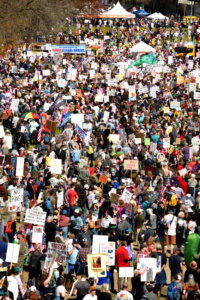
Germany’s parliamentary election on March 5, 1933 was the most fateful in the nation’s history, securing Hitler’s hold on power and launching 12 years of despotic rule and, eventually, a world war.
Like Germany nearly a century ago, as the United States enters the campaign season for our midterm elections, we too stand at destiny’s threshold. The outcome will determine whether Donald Trump can continue his assaults on democratic institutions, or whether he is checked by a Congress he has rendered virtually powerless since beginning his second term.
The moods of Germans in the spring of 1933 and Americans in the spring of 2026 are strikingly similar — a shroud of foreboding hangs over defenders of democracy. Yet beneath the gloom runs a pulse of defiance. In the United States, that defiance took visible form this past Saturday, when millions joined anti-Trump No Kings marches and rallies across the country.
As impressive as the Saturday protest was, America’s protectors of the republic would do well to heed what happened in Germany in the run-up to the two parliamentary elections of 1932 and the Weimar Republic’s final parliamentary election in March 1933 — moments when democratic hopes briefly rose, only to be extinguished.
In America under Trump, Indivisible has emerged as the most visible national organization in the anti-Trump resistance. During the Weimar Republic, its counterpart was a broad pro-democracy coalition called the Reichsbanner, led by the Social Democrats. Over the past century, memory of the Reichsbanner has nearly vanished, which is a shame given its dauntless devotion to democracy in the face of constant danger.
During the Weimar Republic’s final election campaigns, multitudes of Germans — rank upon rank, singing and chanting — marched through Berlin and other cities and towns across the country, gathering at rallies where orators denounced the fascists and vowed to defend the republic.
“1932 will be our year, the year of final victory of the republic over its enemies,” declared Karl Höltermann, the Reichsbanner’s national leader.
As the Weimar Republic was attacked by extremists on the right and left in its early years, and after Hitler’s abortive Beer Hall Putsch in 1923, the Social Democrats, the German Democratic Party, and the Center Party joined forces in 1924 to create a pro-republic defense organization, which they called the Reichsbanner.
In 1931, the Nazis, the German National Peoples’ Party, the veterans’ association Stahlhelm, and other anti-democratic forces joined to form the Harzburg Front. The Reichsbanner and its allies countered by marshaling Germany’s democratic constituencies — workers, veterans, liberals, Catholics — into a coordinated force known as the Iron Front.
As the Great Depression threw millions out of work, street violence intensified, cracks widened, and fragile coalition governments collapsed. The ranks of the Nazi and Communist parties swelled. Votes for Nazi candidates in the July 1932 election more than doubled — from 6.4 million to 13.1 million — making Hitler’s party the largest in the Reichstag with 230 seats, about 100 more than the Social Democrats, although short of a majority.
Enthusiasm for Hitler waned as Germany’s economic crisis eased, reflected in the November 1932 election. The Nazi bloc fell from 230 to 196 seats. It was a blow, but they remained the largest party.
The Reichsbanner’s years of defending democracy hurtled toward an ignominious end as Hitler used the burning of the Reichstag as a pretext to suspend civil liberties, the Nazis won a slim majority of parliamentary seats in coalition with the Nationalists in the March 5, 1933 election, and the last nail was driven into the republic’s coffin 14 days later when the parliament voted to give Hitler complete power.
During these tumultuous months defenders of democracy were intimidated, beaten, murdered and tortured, and many wound up in concentration camps, including Reichsbanner members. Höltermann fled to Britain, where he lived out the rest of his life in exile, dying in 1955.
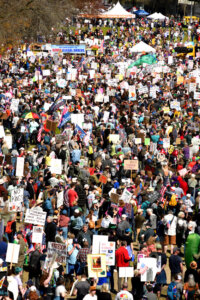
This past Saturday’s No Kings protests looked nothing like the anti-Hitler demonstrations led by the Reichsbanner nearly a century ago. But the posters carried by anti-Trump activists, their anti-fascist slogans, the frogs, unicorns and other creatures cavorting among the marchers, and above all, the dauntless defiance, all came from the same impulse that drove the defenders of the Weimar Republic.
As in communities across the nation, Saturday’s rally and march here in Portland, Ore. was truly impressive. There were so many people in the march that they simultaneously filled two bridges spanning the broad Willamette River dividing downtown from the east side.
A drum corps of anti-Trump activists was so precise in close-order drill that they might have surprised out-of-town visitors who think of Portland as a hipsters’ paradise. But the Portlandia stereotype was rescued by a guy on a unicycle riding in front of the drum corps — wearing a frog costume and juggling tennis balls.
Equally striking were three 13-foot puppets created by an Indivisible Oregon arts team and towed along the parade route — Donald Trump stuck in an oil barrel and holding a Boeing 747 in one of his tiny hands, Stephen Miller dressed as Dracula, and RFK Jr. as a mad scientist with a giant worm coming out of his head.
Although the Saturday nationwide protests appeared peaceful, confrontations broke out that night outside Portland’s ICE facility and at the Los Angeles Metropolitan Detention Center. Federal officers in Portland used tear gas to move protesters away from the gates, and in Los Angeles, authorities arrested dozens during a brief clash outside the detention center.
What’s next?
Indivisible co-founder Ezra Levin — sort of a Karl Höltermann of the 21st century — said plans are in the works for a general strike on May 1 to protest government policies that favor billionaires over workers. It is an idea inspired by a January 2026 general strike in Minneapolis, shuttering more than 700 businesses, to demand a halt to an escalation of federal immigration enforcement that led to the shooting deaths of two activists. Labor unions, religious organizations, community advocacy groups, teachers and students were among those involved.
“The next major national action of this movement is not just gonna be another protest. It is a tactical escalation,” Levin said at the No Kings rally in Saint Paul. “It is an economic show of force, inspired by Minnesota’s own day of truth and action,” .
I wish Levin well. But I worry.
General strikes are extremely rare in the United States. And there are reasons for that. Before Minneapolis, the last one occurred in Oakland, Calif., in 1946, when 100,000 workers staged a two-day walkout. Over the decades, as labor muscle has weakened, general strikes have become more difficult to organize. While workers have the right to strike, the Taft-Hartley Amendments of 1947 prohibit strikes organized for political purposes or directed at secondary targets..
A nationwide general strike in Germany in 1920 indicates some potential pitfalls.
In March 1920, when right-wing officers attempted to overthrow the republic in the far-right Kapp Putsch, the nation’s democratic forces responded with a general strike so vast that it quickly brought the coup to its knees. But the victory came at a steep price. Instead of unifying Germans around the defense of their republic, the strike widened the fissures already running through the nation.
As I was riding the bus to Portland’s protest on Saturday, I thought back to Karl Höltermann and the Reichsbanner. And I reflected on this fact: Germany’s anti-Hitler movements failed because not enough Germans thought democracy was worth preserving. Back then, democracy was not a historic tradition in Germany, unlike our 250 years of experience.
If we rescue our democracy, it will be because enough of us chose to.
The post Why the ‘No Kings’ marches reminded me of Germany in 1933 appeared first on The Forward.
Uncategorized
Outrage First, Facts Later: Jerusalem’s Palm Sunday Story

Pope Leo XIV delivers a homily during the Palm Sunday Mass in Saint Peter’s Square at the Vatican, March 29, 2026. REUTERS/Francesco Fotia
News that Israeli police had blocked Latin Patriarch Cardinal Pierbattista Pizzaballa from entering the Church of the Holy Sepulchre in Jerusalem on Palm Sunday spread rapidly across social media this week.
The reaction was swift and severe, with Israel accused of restricting Christian worship and violating religious freedom at one of Christianity’s holiest sites.
But much of the outrage was missing key facts.
Israeli police, along with the Prime Minister and President, said the measures were driven by security concerns at Jerusalem’s holy sites during wartime.
With Iranian missile fire ongoing and fragments already landing near religious locations, authorities cited the risk of mass casualties in an area with limited shelter and difficult emergency access.
The decision, they said, was about protecting both the cardinal and worshippers.
What was also largely overlooked is that the situation was quickly resolved.
Following coordination between Israeli authorities and the Catholic Patriarchate, an agreement was reached allowing prayer under agreed limitations, and access was restored.
There is room to criticize what was, at best, a clumsily handled situation that should have been resolved before escalating publicly. But there was no evidence of malice — only an attempt to enforce safety regulations under wartime conditions.
That context, however, was almost entirely absent from the viral narrative.
Pro-Palestinian accounts on X portrayed the incident as a deliberate act against Christians. Some framed it as persecution; others as proof of systematic religious discrimination.
One widely shared post by Quds News Network claimed Israel had prevented the cardinal from entering the church with no reason given, omitting any reference to security measures or crowd control, and reinforcing the perception of deliberate obstruction.
Israeli police just prevented Roman Catholic cardinal Pierbattista Pizzaballa from entering the Church of the Holy Sepulchre in occupied Jerusalem to hold the Palm Sunday service, which marks the beginning of the Catholic Easter observances. pic.twitter.com/WNvcGsLfh5
— Quds News Network (@QudsNen) March 29, 2026
In another post, Palestinian writer Mosab Abu Toha — previously criticized for disparaging Israeli hostages in Gaza — cast the incident as part of a broader pattern of restrictions on worship, again without mentioning the security rationale cited by Israeli authorities.
Israel is preventing Christians from celebrating one of the holiest days in Christianity for the first time in centuries.
Israel must realize that Jerusalem is not its city to decide who enters or leaves.
Al-Aqsa Mosque has been closed to Muslims for over a month, particularly… pic.twitter.com/m4CzE9V2YN
— Mosab Abu Toha (@MosabAbuToha) March 29, 2026
Susan Abulhawa went further, using the incident to promote inflammatory rhetoric about “parasitic Jewish supremacists,” falsely claiming that Jews were granted unrestricted access while Christians and Muslims were barred.
Israel closed the holiest sites to Muslims and Christians, but they’re allowing parasitic Jewish supremacists into the compounds to defile these sites.
Israel must be destroyed for humanity’s sake. https://t.co/PQn46UZ4Qd— susan abulhawa | سوزان ابو الهوى (@susanabulhawa) March 29, 2026
Other commentators, including Ethan Levins, Carrie Prejean, and longtime Israel critic Mehdi Hasan, echoed similar claims — all reinforcing the same stripped-down narrative: denial of access, devoid of context.
For the first time in centuries, Christians were blocked by the Israeli government from celebrating Palm Sunday at the Church of the Holy Sepulchre.
The Latin Patriarch of Jerusalem Cardinal Pierbattista Pizzaballa was prevented from entering Church by Israel Police.
The… pic.twitter.com/UJAyUg0Nqw
— Carrie Prejean Boller (@CarriePrejean1) March 29, 2026
Israel is the enemy of Christianity. https://t.co/2F1ubfqWaW
— Ethan Levins
(@EthanLevins2) March 29, 2026
Missing from much of the online reaction was the perspective of Cardinal Pizzaballa himself. He stated that he was treated with politeness and emphasized the importance of respectful dialogue moving forward.
Cardinal Pizzaballa: “It is true that the police had said that the orders from the internal command prevented any kind of gathering in places where there is no shelter, but we had not asked for anything public, just a brief and small private ceremony to preserve the idea of the… https://t.co/uGNwus8RAw
— Rich Raho (@RichRaho) March 29, 2026
In reality, Israel faced a difficult choice: allow unrestricted access during Holy Week amid an active war and credible security threats, or impose temporary limitations and face international backlash.
Either option carried consequences. Had a mass casualty event occurred, the criticism would likely have been far more severe.
This is the nature of a lose-lose scenario.
Events in Jerusalem, particularly around religious sites, do not unfold in a vacuum. They are shaped by security realities, historical sensitivities, and the challenge of balancing competing religious claims.
Reducing such incidents to a single viral image strips away that complexity.
The Palm Sunday episode is a case study in how quickly a misleading narrative can take hold when context is omitted, and how rarely subsequent clarifications receive the same attention as the initial outrage.
In the end, the situation was resolved not through outrage, but through dialogue.
That, too, is part of the story.
The author is a contributor to HonestReporting, a Jerusalem-based media watchdog with a focus on antisemitism and anti-Israel bias — where a version of this article first appeared.
Uncategorized
The Media Ignores Iran’s Crimes, Because It Wants to See the Regime Prevail

Members of the Islamic Revolutionary Guard Corps (IRGC) attend an IRGC ground forces military drill in the Aras area, East Azerbaijan province, Iran, Oct. 17, 2022. Photo: IRGC/WANA (West Asia News Agency)/Handout via REUTERS
Start with three facts from this past week.
Not rumors. Not slogans. Not social media noise.
Facts — reported in mainstream outlets, documented by international human rights bodies, and, in part, reflected in the regime’s own conduct and admissions.
First, a 19-year-old wrestler — Navid Afkari — was executed by the Iranian regime after a trial widely condemned by international observers. Hung. Killed. His crime: protesting.
Second, officials tied to the Islamic Revolutionary Guard Corps (IRGC) advancing frameworks where children as young as 12 can be integrated into war-support roles — patrols, logistics, internal enforcement. Not speculation. Not anonymous leaks. Positions reflected in both external reporting and Iranian media.
Third, multiple independent investigations — and mainstream media reports — documenting the systematic use of rape and sexual violence by the IRGC and Basij against detainees, particularly protesters, as a tool of repression.
Stop there.
You don’t need embellishment. You don’t need a fourth example. You don’t need a roundtable parsing “context.” What you need is to understand what kind of regime produces all three of these facts consistently, predictably, and without apology.
Because in the Islamic Republic of Iran, these are not aberrations. They are not excesses at the margins of an otherwise functioning system. They are the system.
Authoritarian systems do not need to announce what they are. They demonstrate it. Not in their slogans — which are often framed, for many Western audiences, in the language of justice and resistance — but in what they do to people, particularly their own citizens.
For 47+ years under this Iranian regime, the pattern is direct and repeatable. That is not hyperbole or metaphor. It is a description of how the Iranian regime operates.
And yet — and this is where the second scandal should begin — this regime still receives the benefit of the doubt, if not outright support, in significant parts of Western discourse.
Watch almost any show on MSNBC or CNN and you can hear it happen in real time.
The language shifts. It hedges. Or it flips into outright advocacy.
Iran becomes “complicated.”
The regime becomes “reactive.”
Its brutality is sometimes acknowledged, but immediately diluted with qualifiers — history, geopolitics, grievance. Explanations that are rarely extended to democratic states defending themselves.
And then there is the next tier — those who go further and actively sanitize what is happening as they also effectively cheerlead for this regime in its current war against America, Israel, and every moderate Sunni Arab state in the region.
They do not talk about the crimes happening in Iran, because those facts are disqualifying.
Once stated plainly, without euphemism or ideological filtering, these facts collapse the narrative that these groups rely on to excuse or deflect from the regime’s conduct.
You cannot claim moral seriousness or concern for human rights and dignity while excusing executions of protesters, the integration of children into state security structures, and the systematic use of sexual violence as a tool of repression.
You can argue politics. You can criticize Israel. You can debate foreign policy or military strategy.
But if you ignore or minimize these facts about the Iranian regime, you are not making an argument tied to human rights. You are abandoning it.
There is a sad, long and well-documented history of this kind of intellectual evasion and duplicity.
In the 1930s, Western journalists like Walter Duranty downplayed or denied Stalin’s famine in Ukraine while millions died. Soviet show trials and purges were explained away as internal necessities. In Mao’s China, the Great Leap Forward and Cultural Revolution were rationalized or ignored by sympathetic observers even as tens of millions perished. Later, Pol Pot’s Cambodia was dismissed by some Western voices as exaggerated propaganda until the killing fields could no longer be concealed.
Evidence is available. Documentation exists. But it is discounted, reframed, or ignored because it conflicts with a preferred political narrative.
If you excuse or downplay executions after sham trials, as well as these other crimes, you are providing political cover for a regime routinely and regularly engaged in brutality and systematic repression.
Large parts of the anti-Israel, self-described “pro-Palestinian” movement are not engaged in a human rights campaign. They are engaged in a selective political project that ignores abuse when it is inconvenient and amplifies (and lies about) it when it is useful. If human rights were the standard, the Iranian regime would be at the center of their outrage. It isn’t.
And that tells you everything you need to know.
Micha Danzig is an attorney, former IDF soldier, and former NYPD officer. He writes widely on Israel, Zionism, antisemitism, and Jewish history. He serves on the board of Herut North America.