



Uncategorized
This Jewish activist was arrested and deported for her book ‘Lesbian Love.’ 100 years later, will NYC apologize?

In 1926, New York City police arrested Eve Adams, a Polish-Jewish immigrant who ran a lesbian bar in Greenwich Village, for the crime of being gay.
The formal charges were more euphemistic. Officially, Adams was charged with disorderly conduct — that is, flirting with an undercover police officer who had entrapped her, and obscenity, for writing and possessing the book Lesbian Love.
The following year, the U.S. government deported Adams to Poland, in what was effectively a death sentence: 16 years later, Adams would be murdered at Auschwitz.
Now, a century after Adam’s arrest, Manhattan Borough President Brad Hoylman-Sigal — the first openly gay person to hold the elected position — is urging New York City Mayor Zohran Mamdani to formally recognize the city’s role in Adams’ persecution.
He sent a letter to Mamdani requesting that the city issue a formal declaration acknowledging Adams’ conviction in 1926 “was unjust and rooted in discriminatory law enforcement and affirming that New York City failed her as a pioneer of LGBTQ+ life, as an immigrant, and as a Jewish woman who was ultimately deported to her death.”
“Adams’s story is among the most unjust in our city’s history,” the letter reads. “One hundred years after her arrest, we have the obligation and the opportunity to say plainly that she deserved better.”
In a statement to the Forward, the Mayor’s office said they are reviewing the request.
“The Mamdani Administration is deeply committed to uplifting the stories of New Yorkers that have gone unheard throughout history,” deputy press secretary Sam Raskin said.
A pioneer
Born with the name Chawa Zloczower in Poland in 1891, Adams immigrated to the United States through Ellis Island at age 20.
In America, she adopted the name Eve Adams — a playful nod to her androgyny, invoking the biblical Adam and Eve — and wore men’s clothing.
“She was a vibrant activist, who was daring. She had an androgynous appearance, which immediately identified her as a lesbian,” said Jonathan Ned Katz, author of The Daring Life and Dangerous Times of Eve Adams. “Wearing pants for women was just unthinkable in the time period.”
Adams soon immersed herself in New York’s anarchist circles, befriending prominent Jewish anarchists Emma Goldman and Alexander Berkman. She worked as a traveling saleswoman for leftist publications including Mother Earth, activities that landed her on the Bureau of Investigation’s watch list during the First Red Scare.
In 1923, Adams published Lesbian Love, a collection of essays about the romantic lives of dozens of women in Greenwich Village. Katz described the book as far ahead of its time.
“The word “lesbian” was not used much. It was like a dirty word at the time, so you didn’t say it out loud,” Katz said. “Here she was, putting it on a book jacket.”
Two years later, Adams opened Eve’s Hangout in Greenwich Village. The underground tearoom became a rare refuge where lesbian women could socialize openly.

But the haven proved short-lived. In 1926, an undercover detective named Margaret Leonard visited Eve’s Hangout, where she met Adams. The following day, the two attended a play in Times Square together. Adams gave Leonard a copy of Lesbian Love — evidence of “obscenity” that prosecutors later used against her — and Leonard alleged Adams made sexual advances toward her during the taxi ride to the theater.
Adams was convicted and spent 18 months in jail before the United States deported her to Poland.
She settled in Paris, where she began a relationship with Jewish cabaret singer Hella Olstein Soldner. In 1943, the two women were arrested and sent to the Drancy internment camp. From there, they were deported to Auschwitz, where both were murdered.
Adams’ legacy
Over the years, Adams has come to be recognized as a Jewish LGBTQ icon. Her life inspired the play The Great Lesbian Love of Eve Adams, and she was the subject of a New York Times obituary published as part of the newspaper’s “Overlooked” series, which chronicles the lives of notable people throughout history whose deaths went unreported.
Hoylman-Sigal said he was inspired to commemorate Adams by the NYC LGBTQ Historic Sites Project, a nonprofit that documents local queer history, which asked him to send the letter to Mamdani. The Sites Project also offers historic walking tours of the city featuring Adams’ story.
“Their jaws drop when we tell them these stories, standing in front of the building where her tea room was,” said Ken Lustbader, co-founder of the NYC LGBT Historic Sites Project.

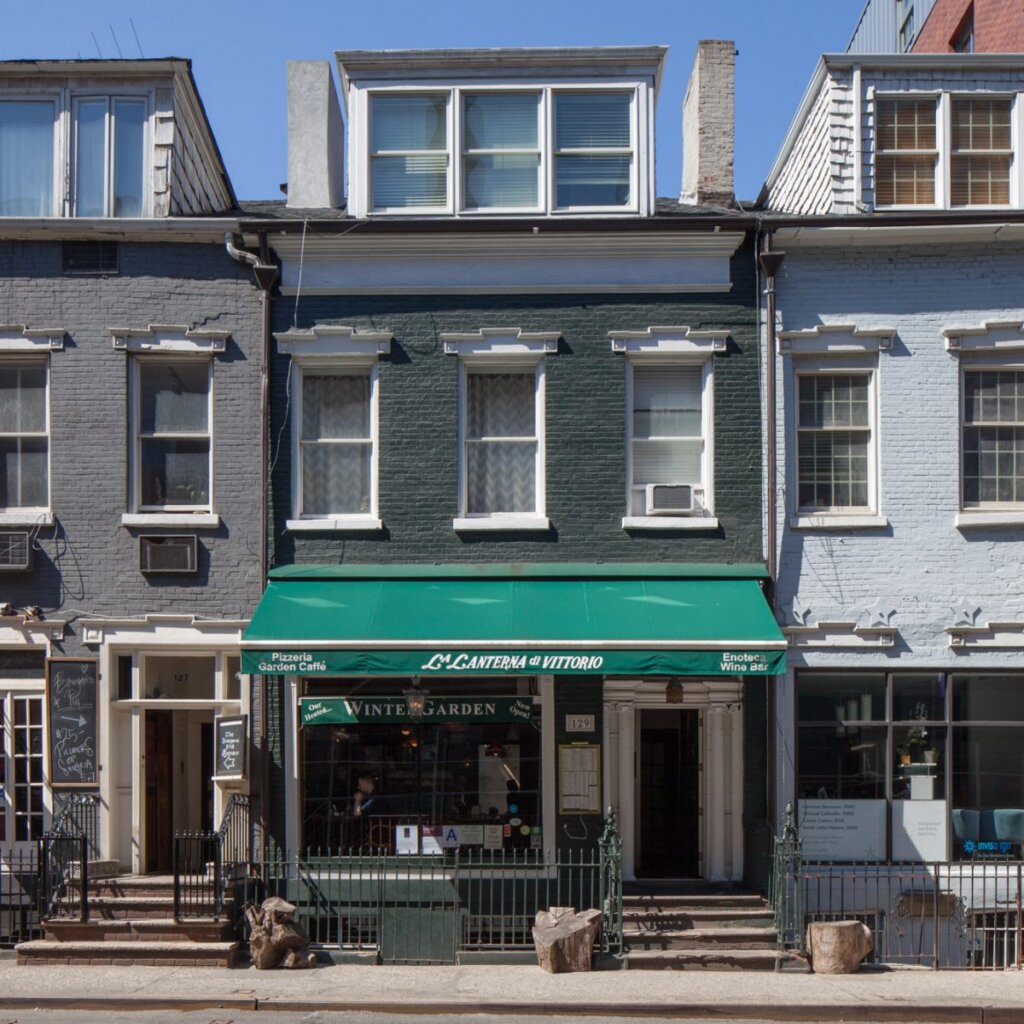
On Wednesday, the centennial of Adams arrest, the Sites Project is hosting a performance and vigil in Adams’ honor at the former site of Eve’s Hangout — today, home to La Lanterna, an Italian cafe and pizzeria.
The site of Eve’s Hangout has also been recognized by the National Park Service as part of a roundup of Greenwich Village landmarks significant to LGBTQ history.
New York City, however, has never formally acknowledged the injustice of Adams’ arrest, conviction and deportation.
A posthumous apology would be unusual, though not without precedent: In 2019, the NYPD formally apologized for its 1969 raid on the Stonewall Inn, describing the department’s actions as “discriminatory and oppressive.”
“I would love to see the mayor do it, but we could have one from the police department — an apology for sort of framing her,” Katz said. “They sent in a plainclothes policewoman to entrap her, and so that was really beyond a democratic process.”
The NYPD did not respond to the Forward‘s request for comment.
Whether or not the city issues an official acknowledgement, Hoylman-Sigal said he hopes the campaign will help keep Adams’ story alive.
“It’s an extremely poignant story, sorrowful, outrageous, sad — and one that most people don’t know about,” he said. “So I thought bringing attention to it was a righteous cause.”
Jacob Kornbluh contributed reporting.
The post This Jewish activist was arrested and deported for her book ‘Lesbian Love.’ 100 years later, will NYC apologize? appeared first on The Forward.
Uncategorized
Jewish Democratic support weakened slightly in midterms, survey finds
(JTA) — Democrats lost a small amount of Jewish support overall in the midterm elections, even as an overwhelming majority of Jews voted for the party, according to the results of a new survey published Tuesday.
The poll also found that significant shares of both Jewish Democratic and Jewish Republican voters believe their respective parties have become too accepting of antisemitism.
The survey from the Jewish Electorate Institute, a nonpartisan think tank that often works with Democrats, was the latest data pointing to simmering Jewish discomfort with the majority of the community’s longtime electoral home — even as actual voting patterns have remained largely consistent. Conducted by research firm The Mellman Group, the survey polled 800 national Jewish registered voters online from Oct. 29-Nov. 6, including both early and day-of voters.
The data “reveal warning signs for both political parties” in their relationship to Jews, institute chair Barbara Goldberg told reporters in a briefing.
Researchers found that 69% of Jewish respondents voted for Democrats, a six-point drop from the 2024 election. There was a 3.5% margin of error.
That drop occurred even as several other groups that have consistently voted for Democrats increased their shares in 2026, including voters under 45, voters of color, women and white, college-educated voters.
In the run-up to what would become a historic “blue wave” election, the Jewish vote – a reliably Democratic bloc — received particular attention as several high-profile candidates, including Michigan Senator-elect Abdul El-Sayed, broke with longtime party consensus on Israel or otherwise unnerved the Jewish community throughout the campaign. Studies of Jewish voting attitudes published since Election Night, which have also included polls from the liberal Zionist lobby J Street and the pro-Israel group The Jewish Majority, have found that the Jewish party-line vote was largely unchanged despite those reservations.
While the Jewish Electorate Institute did not isolate any polling on Jews in Michigan specifically, it did poll all Jews about their views on El-Sayed and found that his favorability in the group had climbed since September. He is now viewed favorably by 44% of all Jews and 59% of Jewish Democrats, the survey found, with 40% of the former group and 25% of the latter viewing him unfavorably — giving the senator-elect a net favorability rating in both camps. The same polling also found that 41% of Jewish voters view pro-Israel lobbyists AIPAC favorably, and 35% unfavorably.
The survey also found that 36% of Jewish Democratic voters expressed concern about the direction of the party, agreeing with the statement that it has become “too accepting of antisemitic rhetoric within the Party.” One in four Jewish Republicans believed their party was becoming too friendly to white nationalists and the far right.
“The one place both parties are having problems is on rising antisemitism,” Michael Bloomfield, managing director of the Mellman Group who oversaw the survey, told reporters. The questions about antisemitism within the party had not been asked in previous election surveys conducted by the Mellman Group.
In addition, 28% of Jewish Democratic voters said they voted for candidates whose views on Israel caused them concern, saying that other issues outweighed those reservations. One in six Jewish Republicans said they did the same.
In results that echoed an earlier survey put out by the liberal Zionist lobby J Street, 14% of Jewish Democrats said supporting Israel was one of the most important factors in their vote. A higher share of the Jewish Electorate Institute respondents, 27%, said fighting antisemitism was one of their most important issues, while preserving democracy was the top concern.
The Jewish Republican voters surveyed ranked fighting antisemitism as their top concern, and support for Israel as among their top concerns.
This article originally appeared on JTA.org.
The post Jewish Democratic support weakened slightly in midterms, survey finds appeared first on The Forward.
Uncategorized
Museum cancels Dutch synagogue’s tricentennial celebration over Israel tensions
(JTA) — An exhibition honoring the nearly 300-year-old Amersfoort Synagogue was supposed to be a celebration of Jewish life in Amersfoot, a small city in the central Netherlands.
Instead, Dutch Jews say, it could become the latest casualty of anti-Israel cancel culture that has targeted Jews in the Diaspora.
The city’s mayor in the last week has scrambled to save a planned exhibit on the synagogue after it was canceled, but so far has not been able to guarantee that it will open as planned early next year.
On Nov. 4, Paul Baltus, the director of Amersfoort in C, an organization that oversees the Museum Amersfoort and several of the city’s other cultural institutions, said he was canceling the upcoming synagogue exhibition due to “pressure,” an apparent reference to possible confrontations by pro-Palestinian activists.
Pro-Palestinian protesters have held dozens of demonstrations in the Netherlands since the Oct. 7 Hamas attack. On Nov. 8, tens of thousands of people gathered in Amsterdam to demand that the Dutch government impose stricter sanctions on Israel.
Although the museum started planning the exhibition five years ago, Baltus said in a statement, “Since then, the social climate has changed significantly. The situation in the Middle East is also having an impact on Dutch society. The public debate on this subject can be heated and, at times, lacking in nuance.”
Baltus said he is finding the “tension” surrounding the exhibition, which was slated to begin in early 2027, difficult to manage. “As a small and vulnerable organization, I do not want to expose my staff to that kind of pressure,” he said. While he acknowledged that he could hire security guards and install cameras, “the reality is that our volunteers would still have to deal with a range of reactions.”
Jewish community leaders in the Netherlands said they were shocked by the museum’s actions and called on city officials to ensure the exhibition would go on as planned.
The exhibition is one of several cultural events scheduled to mark the 300th anniversary of the Amersfoort synagogue, which opened in 1727. It is the oldest Ashkenazi synagogue in Western Europe still in use today.
On Nov. 4, Mayor Lucas Bolsius told the City Council that the municipality would begin discussions with the museum and other stakeholders “to ensure that the exhibition can proceed.” The museum’s decision to cancel “has caused considerable pain within the Jewish community, particularly by reinforcing the feeling that its members are not welcome or even allowed to exist,” he told council members.
Following a meeting the next day, Bolsius and Baltsus jointly announced on Nov. 6 that they would work together to try to find a solution.
Over the past week, the mayor said, “helping hands have been offered from the city, central government and across the country to address organizational matters. People and organizations want to help make this exhibition possible.”
Baltus said the help being offered has alleviated some of his concerns. “With this support, we will explore the possibilities with an open mind and a positive intention, in consultation with the Jewish community.”
While Jewish leaders told Jewish Telegraphic Agency that they welcomed these efforts, they said the museum controversy is just the latest example of hostility toward Jewish historical and cultural events in the Netherlands, where anything Jewish – even a 300-year-old diaspora synagogue – is often seen as inseparable from the Israeli-Palestinian conflict.
“We are very glad the mayor intervened. Let this be an example for other authorities,” said Hans Weijel, vice chairman of the Centraal Joods Overleg (CJO), the umbrella advocacy organization that represents the interests of the Netherlands’ 40,000 Jews.
Emile Schrijver, director-general of Amsterdam’s Jewish Cultural Quarter, which encompasses the Jewish Museum, the National Holocaust Museum, the Portuguese Synagogue and other Jewish cultural institutions, said the Museum Amersfoort had made its decision without first consulting the Jewish community or the organizations involved in the planned exhibition.
“Largely since Oct. 7, Jewish artists have had a difficult time finding a stage, and Jewish events, including cultural, can’t find a venue. Jewish events are being cancelled for no reason,” he said.
Schrijver rejected Baltus’s contention that security concerns made the museum exhibition unmanageable, given that the Jewish institutions Schrijver runs in Amsterdam frequently host events, despite pro-Palestinian demonstrations and related security concerns.
“We train our staff all the time. We deal with this every day. Yes, it’s difficult, but no, it’s not impossible,” he said.
Schrijver warned that treating Jewish cultural events as potential security problems risks pushing Jewish communities out of public life.
“The effect of this is that the normality of Jewish presence in a town is being pushed away,” he said. “Suddenly anything Jewish is considered a security hazard or prone to cause problems.”
Cultural institutions have a responsibility to distinguish between their views on Israeli government policy and the history of Jewish communities in the Netherlands, Schrijver said.
“You have to separate your private opinion from the long history of a small town in the Netherlands. What they’re effectively doing is pushing the Jewish community to the fringes of society.”
CJO’s Weijel said the Jewish community has played an important role in Amersfoort’s civic life since the mid-1600s.
“We think it is ridiculous that a museum in a city doesn’t want to have an exhibition about a 300-year-old synagogue and its history in that city. The conflict is in the Middle East, not here,” he emphasized. “If you want proof that this is antisemitism, this is the proof.”
Weijel accused Baltus of being “a coward.”
“He’s afraid something bad will happen, but if you’re that afraid, you should stay in bed.”
In his Nov. 4 statement, Baltus acknowledged the Jewish community’s disappointment and offered to contribute his museum’s “expertise and collection” of Jewish historical artifacts to an exhibition in the synagogue instead. He also offered to incorporate the synagogue’s history into the museum’s permanent exhibition on the history of Amersfoort.
For Schrijver, the Amersfoort controversy is yet another attempt to marginalize Jews in a country they have lived in for generations.
“The moment you make Jewish history dependent on what is happening in the Middle East, you are making Jewish existence conditional,” he said.
This article originally appeared on JTA.org.
The post Museum cancels Dutch synagogue’s tricentennial celebration over Israel tensions appeared first on The Forward.
Uncategorized
Donald Trump actually faced a few tough questions on ’60 Minutes.’ So, why does Marine Le Pen get a pass?
Last Sunday, the news show “60 Minutes” hosted an outgoing president of one country and, quite possibly, the incoming president of another. While falsehoods and fatuities flowed from President Donald Trump, his interviewer, Ross Douthat frequently, if futilely, tried to push back. Yet when Marine Le Pen, running for the presidency of France, also fibbed or fudged the truth, her interviewer, Trevor Phillips, did little more than arch an eyebrow.
This split-screen experience was unsettling for a few reasons. First, it reminded us that our president’s famous “weave” reflects a mind that is declining as surely as his poll numbers. A glance at the interview transcript reflects the deepening incoherence of the man who occupies the world’s most powerful office. This made all the most startling the cogency of his reply to a question Douthat posed at the end of the interview: whether he could stop hating his enemies if that was the price to enter heaven. To a flabbergasted Douthat, Trump replied, “I probably cannot do that, no, because I do hate some of my enemies and I always will.”
While no one can say whether Trump is destined for heaven or hell, Le Pen’s remarks in her interview suggest that she will make life hell for those men and women who fail to qualify, in her eyes, as French.
Yet, in his interview, Trevor Phillips, formerly of The (London) Times and a recent Bari Weiss recruit, failed to make this as clear as a Mike Wallace, a Dan Rather, or a Scott Pelley would have. Nattily dressed and well-spoken, Phillips presented a segment on the violence that has “erupted in Paris’ romantic boulevards” where “the scent of warm croissants and fresh baguettes has been overwhelmed by the whiff of tear gas.”
Overwhelmed by the weight of silly clichés, Phillips could not help but add “They used to call Paris la ville de l’amour — the City of Love. But there hasn’t been much amour on show lately.” While Phillips does not state who “they” are — given the hoariness of the clichés, perhaps they asked to remain anonymous — he should think twice about his assertion that there is not much love. Of course, the protestors are expressing their anger towards the government of President Emmanuel Macron, but they are also expressing their deep attachment, even love, to the republican tradition that has made Paris la ville de la révolution.
More important than his potted account of the social upheavals in Paris, however, was Phillips’ problematic interview with Le Pen. “In 2011,” he explained, “Le Pen took over leadership of what was then a fringe movement from her father, a tough army veteran convicted and fined for Holocaust denial and hate speech.” Yet nine years earlier, in 2002, Jean-Marie Le Pen, the candidate of this “fringe party” then called the National Front, made it into the second round of the presidential election. Though Le Pen failed to make it into the second round in 2007, that more than 4 million French voted for him suggests that his party and person were hardly fringe. It is also odd that while Phillips noted Le Pen’s Holocaust denialism, he omitted Le Pen’s confession that he had tortured Algerian captives while serving in French Algeria.
No less stunning was Phillips’ description of Marine Le Pen’s decision to banish her father from the party in order “to rid it of its stain of bigotry.” If only it were mere bigotry. The National Front was founded, in part, by former members of the French division of the Waffen SS and sympathizers of the wartime collaborationist regime of Vichy. While the daughter has largely succeeded in removing these elements from the party, which she rebranded as the National Rally, she has not removed the “stain” of antisemitism. Little more than a month ago, the French newspaper Mediapart revealed that Le Pen’s second-in-command, Jordan Bardella, was trafficking in antisemitic bilge even after he joined the party as a teenager.
Time and again, Phillips posed questions but had not adequately prepared for Le Pen’s predictable replies. When he asked, in his opening question, “What is happening in Europe? Has politics here just become more radical?” Le Pen answered that “the extreme left creates chaos. They generate violence against people.” If Phillips had done his due diligence, he would have confronted Le Pen with the recent study by the historian Nicolas Lebourg revealing that while six murders in France since 1986 were “generated” by the extreme left, nearly sixty were “generated” by the extreme right. Phillips might also have mentioned last month’s mass killing and wounding of French Muslims in the town of Trappes by an individual who marinated in the literature of the extreme right.
Finally, when Le Pen made the jaw-dropping claim that “discrimination does not exist in France” and, moreover, is “the least racist country in the world,” Phillips did, in fact, raise an eyebrow while repeating her words. But it would have been more effective, perhaps, to raise the findings of various organizations, like the Defenseur des droits, which concluded in 2024 that the “perceived origin” of a job applicant weighs more than any other factor in hiring decisions in France.
As for his lack of follow-up questions to Le Pen’s assertion that France is the world’s least racist country, Phillips’ professional malfeasance was made fully manifest. In every presidential campaign, Le Pen has committed to establishing the law of national priority, which in effect would constitutionalize a racist agenda. Based on the extreme rightwing hobbyhorse of the “great replacement” — namely, that France’s white population is deliberately being replaced by third world immigrants — the law will limit employment opportunities, social and housing benefits to French citizens. Such a law not only runs counter to the laws of the European Union, but also to the humanist and universalist grounding of France’s constitution.
Phillips failed to contest this claim. Ironically, he closed the interview with Le Pen’s assurance that “French people have got to know me.” If only Phillips had done so, as well.
.
The post Donald Trump actually faced a few tough questions on ’60 Minutes.’ So, why does Marine Le Pen get a pass? appeared first on The Forward.
