


Uncategorized
Tragically, ‘genocide’ has become a meaningless word
One of the hallmarks of our degraded political discourse is the abuse of language. Consider some of the words that have either been drained of meaning or coined in order to mislead: terrorist, racist, fascist, anti-fascist, woke, grooming — and lately, in some cases, antisemitism.
And now, sadly: genocide.
Coined in 1944 to refer to the most heinous of crimes against humanity, the term ‘genocide’ has now become a meaningless shibboleth, a touchstone for virtue-signaling by the Right and Left.
And worst of all, some of Israel’s defenders are now joining in the degradation.
Israel’s critics started it. Israel’s military response to the atrocities of Oct. 7 had barely begun when critics began labeling it a genocide. On Oct. 20, 2023 — just a week into the war — I wrote in this publication that “if ‘genocide’ means any horrible action by one group against another, then it loses its specific moral and legal meaning. It becomes just another word that partisans use against one another.”
That didn’t win me any friends on the Left, but it was true.
But Israel’s tactics and statements of intent changed as the war dragged on. In May 2025, I wrote that Israel’s post-ceasefire tactics, including mass starvation and ‘sociocide’ (the destruction of a society’s physical and social infrastructure), and numerous statements from Israeli politicians in favor of ethnic cleansing, would likely qualify as genocide under the legal definition.
That didn’t win me any friends on the Right or the Center, but it was also true.
In both cases, the question was not whether one supported or opposed Israel’s actions or the suffering of innocent Palestinians. It was whether Israel’s actions were “committed with intent to destroy, in whole or in part, a national, ethnical, racial or religious group.”
There was almost no evidence of that in October 2023. There was a lot more evidence of it in May 2025. But it is still an open question, one that should be settled in courts of law.
Recently, however, it has become a litmus test. At political events, Democratic candidates are being asked to raise their hands if they think Israel’s actions in Gaza are genocide or not. Yes or No, those are the only choices available. Not “maybe — it has not been decided in court” or “there is evidence on both sides.” Just up or down. Indeed, the candidates are often not even allowed to speak.
And in progressive spaces, if you don’t raise your hand, you’re out.
This is a spectacular display of the ignorance of the mob. Imagine a forum in which candidates are asked to opine on whether someone has committed second-degree murder or manslaughter, or what the correct ratio of contributory negligence is in a multi-party tort action, or the appropriate emissions levels for sulfur dioxide pursuant to the Clean Air Act. That would be preposterous; these are complex legal questions that require careful deliberation based on the meanings of the statutes in question and the evidence presented on both sides.
Like it or not, the crime of genocide is the same.
The Netanyahu government’s actions in Gaza were, in my view, unambiguously horrifying. At least 70,000 lives were lost. Cities were destroyed; 80% of homes and 70% of farmlands as well. War crimes and crimes against humanity appear to have been committed many times over. It is extremely hard to justify the magnitude of the military action with reference to legitimate military objectives. And, particularly in 2025, several Israeli leaders made statements that would satisfy the ‘intent’ prong of the Genocide Convention if they were deemed to be speaking on behalf of the Israeli government. Even worse, polls from mid-2025 showed that 82% of Jewish Israelis support expelling all Palestinians from Gaza under threat of violence, which constitutes genocide under the legal definition.
But establishing whether that evidence is sufficient to conclude that genocide has taken place is a job of the International Criminal Court (for states) or International Court of Justice (for individuals), not a politician raising their hand at a campaign event.
And now, as if inspired by the ignorance and oversimplification of the Left, a group of centrist rabbis and journalists have joined them in the degradation of language, alleging in a petition now circulating online that “the lie that Israel committed ‘genocide’ in Gaza” is “the latest blood libel to be inflicted on the Jewish people.”
I hasten to point out that this petition does not come from the Hard Right — it includes journalist Yossi Klein Halevi and rabbis Yitz Greenberg and Shmuly Yanklowitz. Many who have signed are friends and spiritual mentors of mine.
Yet it is just as misguided as the misuse of language it seeks to condemn — perhaps even more so, as it now adds “blood libel” to the pile of terms rendered meaningless by misuse.
None of the evidence I have adduced above is mentioned in the petition. There is no mention of the inhabitability of Gaza today, or the insane plan to ethnically cleanse the territory and replace it with Trump-branded resorts. There are no citations to Ben Gvir and Smotrich’s clear statements of genocidal intent or the Israeli public’s support for genocide. Only Israel’s case is made.
Which would be fine, if the petition were a blog post in defense of Israel. But it is much more than that. It is a claim that to use the word genocide is, itself, a blood libel — a baseless, hateful and antisemitic claim.
Why is this helpful, in any way? What could this hateful, factually-challenged slander possibly hope to accomplish?
There are many thoughtful, reasonable people who believe Israel committed genocide in Gaza. There are many thoughtful, reasonable people who believe it has not. Scholars of genocide have made strong arguments on both sides, both backed up by evidence. This is a close case, a serious matter, and a serious charge. Denigrating the “other side” in such brutal and absolutist terms accomplishes nothing.
On the contrary, this petition is so extreme and so preposterous that, in attempting to exculpate Israel, it makes Israel look more guilty. There are arguments to be made in defense of Israel’s actions, and the petition makes some of them. But this accusation is so outlandish that it makes it look like Israel can’t possibly prevail on the merits and must, instead, depict its opponents as bigots.
It also defies common sense. Those who have accused Israel of genocide include many Jewish scholars, religious leaders, journalists and activists. Are they all complicit in vile, murderous acts of antisemitism? What about the Israeli organization B’Tselem and several Jewish progressive organizations? Perhaps they, like Amnesty International, Human Rights Watch, and Physicians for Human Rights are deluded, or wrong or careless about the facts. Perhaps they are all jumping on some progressive bandwagon, or improperly focused on Israel, or whatever. Fine. But blood libel?
Moreover, as Shaul Magid has recently written, the refusal even to engage with the horrors of Gaza — except in one self-congratulatory line about internal disagreement being “a sign of moral health” — itself bespeaks a profound loss of conscience. The level of destruction relative to legitimate military goals and the overt statements of genocidal intent by some Israeli leaders demand more than that. They demand teshuvah, not tochechah — introspection, not rebuke.
All of this degradation of discourse is deeply regrettable. The Left was wrong to make the word “genocide” into a Yes/No test of one’s political acceptability, and these would-be defenders of Israel are wrong to make it a test of whether one is an antisemite.
The accusation of ‘genocide’ is not a card played at a political poker game. It is a grave moral and criminal charge, rooted in the Holocaust, and it warrants a serious and objective investigation. Not the further diminishment of our humanity.
The post Tragically, ‘genocide’ has become a meaningless word appeared first on The Forward.
Uncategorized
Jewish communities can help save trans lives — here’s how
In the 16 months since the 2024 election, the lives of hundreds of thousands of transgender, nonbinary and intersex people in the United States have been upended. A new survey shows that, during that time period, 9% of the country’s transgender population moved from one U.S. state to another over concerns for their personal safety. Andjust today, as we celebrate Transgender Day of Visibility, the Supreme Court released a decision that harms transgender people, as well as the entire LGBTQ+ community, by striking down a state law that protected LGBTQ+ youth and their families from so-called conversion therapy, a dangerous, disproven practice.
Jews have a religious obligation to protect transgender lives; a key tenet of our faith is the belief that to save a life is to save the whole world. Research shows that religious groups can play a particularly significant role in the lives of transgender youth. With the support of such groups, trans kids experience dramatically lower rates of depression and suicide. Conversely, when social support is stripped away, the risks rise.
That’s why more than 1,000 rabbis, cantors, and other spiritual leaders representing all major Jewish denominations — Orthodox, Conservative, Reform, Reconstructionist and Renewal — from 48 U.S. states and the District of Columbia recently signed an open letter publicly declaring that Jewish tradition compels us to support the full equality of transgender, nonbinary and intersex people.
The letter was spearheaded by Keshet, the leading national Jewish organization dedicated to LGBTQ+ equality, and the Religious Action Center for Reform Judaism — the organizations for which we respectively work. For us, the need for Jews to make a strong statement of support for the trans community was urgent.
In recent years, almost every state in the U.S. has proposed or passed legislation to take away the rights of transgender, nonbinary and intersex people. In the first quarter of 2026 alone, politicians in 42 state legislatures have introduced a staggering 740 laws targeting transgender people. At this horrifying rate, they’re on track to surpass last year’s 1,022 anti-trans bills, proposed in 49 states.
Only some of these bills will become law. But all of them aim to take away rights and erase transgender people from public spaces — by ending gender-affirming healthcare, restricting restroom use, forcibly outing students at school, banning books, and more. Kansas passed a particularly terrifying example of this sort of legislation in February, with a law that revoked the IDs of transgender people — passed in the dead of night, and put into effect the very next day.
Jewish communities are painfully aware of the dangers of policies and laws that try to legislate minority groups out of the public square. That clarity gives us a particular mandate to combat such efforts.
So many American Jews have ancestors whose lives were shaped by exclusionary laws, scapegoating, censorship and attempts to erase us from public life. So many of us who immigrated to this country have firsthand experience of that same torment. This strategy of disenfranchisement and persecution has appeared repeatedly throughout Jewish history, often preceding profound tragedy.
As Jewish leaders, we see echoes of those dangerous patterns today in rhetoric that portrays LGBTQ+ people as a threat to society. We know, from our own history, that these are not the actions of a functioning democracy.
Our congregants and community members have been asking us what they can do to support our trans youth in their circles. And LGBTQ+ Jews want to know how Jewish organizations are working to stand up for their existence, dignity and safety. We must answer both questions more vigorously and decisively.
Even as we work to protect and advance LGBTQ+ rights in the public square, we have the power — and the responsibility — to make our Jewish communities safe havens. We have a unique role to play.
There are things all of us can do to create Jewish communities of belonging and affirmation for our transgender, nonbinary and intersex community members:
- Commit to using the names and pronouns that LGBTQ+ members use for themselves.
- Push your Jewish community leaders to take proactive steps to turn your community into a safe and affirming space for all transgender and LGBTQ+ people.
- Establish gender-neutral restrooms. Then, create and post a policy that encourages people to use the restroom, locker room or other gendered facilities that align with their gender.
- Implement anti-harassment, anti-bullying and non-discrimination policies that affirm the dignity and safety of all community members.
The rights and lives of our neighbors are in our hands. As many of our political leaders fail to protect members of our community, we must lead by example to build a world of affirmation and belonging for all.
The post Jewish communities can help save trans lives — here’s how appeared first on The Forward.
Uncategorized
Why the ‘No Kings’ marches reminded me of Germany in 1933
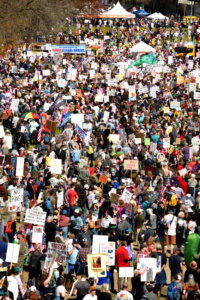
Germany’s parliamentary election on March 5, 1933 was the most fateful in the nation’s history, securing Hitler’s hold on power and launching 12 years of despotic rule and, eventually, a world war.
Like Germany nearly a century ago, as the United States enters the campaign season for our midterm elections, we too stand at destiny’s threshold. The outcome will determine whether Donald Trump can continue his assaults on democratic institutions, or whether he is checked by a Congress he has rendered virtually powerless since beginning his second term.
The moods of Germans in the spring of 1933 and Americans in the spring of 2026 are strikingly similar — a shroud of foreboding hangs over defenders of democracy. Yet beneath the gloom runs a pulse of defiance. In the United States, that defiance took visible form this past Saturday, when millions joined anti-Trump No Kings marches and rallies across the country.
As impressive as the Saturday protest was, America’s protectors of the republic would do well to heed what happened in Germany in the run-up to the two parliamentary elections of 1932 and the Weimar Republic’s final parliamentary election in March 1933 — moments when democratic hopes briefly rose, only to be extinguished.
In America under Trump, Indivisible has emerged as the most visible national organization in the anti-Trump resistance. During the Weimar Republic, its counterpart was a broad pro-democracy coalition called the Reichsbanner, led by the Social Democrats. Over the past century, memory of the Reichsbanner has nearly vanished, which is a shame given its dauntless devotion to democracy in the face of constant danger.
During the Weimar Republic’s final election campaigns, multitudes of Germans — rank upon rank, singing and chanting — marched through Berlin and other cities and towns across the country, gathering at rallies where orators denounced the fascists and vowed to defend the republic.
“1932 will be our year, the year of final victory of the republic over its enemies,” declared Karl Höltermann, the Reichsbanner’s national leader.
As the Weimar Republic was attacked by extremists on the right and left in its early years, and after Hitler’s abortive Beer Hall Putsch in 1923, the Social Democrats, the German Democratic Party, and the Center Party joined forces in 1924 to create a pro-republic defense organization, which they called the Reichsbanner.
In 1931, the Nazis, the German National Peoples’ Party, the veterans’ association Stahlhelm, and other anti-democratic forces joined to form the Harzburg Front. The Reichsbanner and its allies countered by marshaling Germany’s democratic constituencies — workers, veterans, liberals, Catholics — into a coordinated force known as the Iron Front.
As the Great Depression threw millions out of work, street violence intensified, cracks widened, and fragile coalition governments collapsed. The ranks of the Nazi and Communist parties swelled. Votes for Nazi candidates in the July 1932 election more than doubled — from 6.4 million to 13.1 million — making Hitler’s party the largest in the Reichstag with 230 seats, about 100 more than the Social Democrats, although short of a majority.
Enthusiasm for Hitler waned as Germany’s economic crisis eased, reflected in the November 1932 election. The Nazi bloc fell from 230 to 196 seats. It was a blow, but they remained the largest party.
The Reichsbanner’s years of defending democracy hurtled toward an ignominious end as Hitler used the burning of the Reichstag as a pretext to suspend civil liberties, the Nazis won a slim majority of parliamentary seats in coalition with the Nationalists in the March 5, 1933 election, and the last nail was driven into the republic’s coffin 14 days later when the parliament voted to give Hitler complete power.
During these tumultuous months defenders of democracy were intimidated, beaten, murdered and tortured, and many wound up in concentration camps, including Reichsbanner members. Höltermann fled to Britain, where he lived out the rest of his life in exile, dying in 1955.
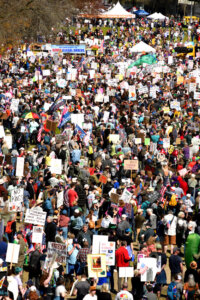
This past Saturday’s No Kings protests looked nothing like the anti-Hitler demonstrations led by the Reichsbanner nearly a century ago. But the posters carried by anti-Trump activists, their anti-fascist slogans, the frogs, unicorns and other creatures cavorting among the marchers, and above all, the dauntless defiance, all came from the same impulse that drove the defenders of the Weimar Republic.
As in communities across the nation, Saturday’s rally and march here in Portland, Ore. was truly impressive. There were so many people in the march that they simultaneously filled two bridges spanning the broad Willamette River dividing downtown from the east side.
A drum corps of anti-Trump activists was so precise in close-order drill that they might have surprised out-of-town visitors who think of Portland as a hipsters’ paradise. But the Portlandia stereotype was rescued by a guy on a unicycle riding in front of the drum corps — wearing a frog costume and juggling tennis balls.
Equally striking were three 13-foot puppets created by an Indivisible Oregon arts team and towed along the parade route — Donald Trump stuck in an oil barrel and holding a Boeing 747 in one of his tiny hands, Stephen Miller dressed as Dracula, and RFK Jr. as a mad scientist with a giant worm coming out of his head.
Although the Saturday nationwide protests appeared peaceful, confrontations broke out that night outside Portland’s ICE facility and at the Los Angeles Metropolitan Detention Center. Federal officers in Portland used tear gas to move protesters away from the gates, and in Los Angeles, authorities arrested dozens during a brief clash outside the detention center.
What’s next?
Indivisible co-founder Ezra Levin — sort of a Karl Höltermann of the 21st century — said plans are in the works for a general strike on May 1 to protest government policies that favor billionaires over workers. It is an idea inspired by a January 2026 general strike in Minneapolis, shuttering more than 700 businesses, to demand a halt to an escalation of federal immigration enforcement that led to the shooting deaths of two activists. Labor unions, religious organizations, community advocacy groups, teachers and students were among those involved.
“The next major national action of this movement is not just gonna be another protest. It is a tactical escalation,” Levin said at the No Kings rally in Saint Paul. “It is an economic show of force, inspired by Minnesota’s own day of truth and action,” .
I wish Levin well. But I worry.
General strikes are extremely rare in the United States. And there are reasons for that. Before Minneapolis, the last one occurred in Oakland, Calif., in 1946, when 100,000 workers staged a two-day walkout. Over the decades, as labor muscle has weakened, general strikes have become more difficult to organize. While workers have the right to strike, the Taft-Hartley Amendments of 1947 prohibit strikes organized for political purposes or directed at secondary targets..
A nationwide general strike in Germany in 1920 indicates some potential pitfalls.
In March 1920, when right-wing officers attempted to overthrow the republic in the far-right Kapp Putsch, the nation’s democratic forces responded with a general strike so vast that it quickly brought the coup to its knees. But the victory came at a steep price. Instead of unifying Germans around the defense of their republic, the strike widened the fissures already running through the nation.
As I was riding the bus to Portland’s protest on Saturday, I thought back to Karl Höltermann and the Reichsbanner. And I reflected on this fact: Germany’s anti-Hitler movements failed because not enough Germans thought democracy was worth preserving. Back then, democracy was not a historic tradition in Germany, unlike our 250 years of experience.
If we rescue our democracy, it will be because enough of us chose to.
The post Why the ‘No Kings’ marches reminded me of Germany in 1933 appeared first on The Forward.
Uncategorized
Outrage First, Facts Later: Jerusalem’s Palm Sunday Story

Pope Leo XIV delivers a homily during the Palm Sunday Mass in Saint Peter’s Square at the Vatican, March 29, 2026. REUTERS/Francesco Fotia
News that Israeli police had blocked Latin Patriarch Cardinal Pierbattista Pizzaballa from entering the Church of the Holy Sepulchre in Jerusalem on Palm Sunday spread rapidly across social media this week.
The reaction was swift and severe, with Israel accused of restricting Christian worship and violating religious freedom at one of Christianity’s holiest sites.
But much of the outrage was missing key facts.
Israeli police, along with the Prime Minister and President, said the measures were driven by security concerns at Jerusalem’s holy sites during wartime.
With Iranian missile fire ongoing and fragments already landing near religious locations, authorities cited the risk of mass casualties in an area with limited shelter and difficult emergency access.
The decision, they said, was about protecting both the cardinal and worshippers.
What was also largely overlooked is that the situation was quickly resolved.
Following coordination between Israeli authorities and the Catholic Patriarchate, an agreement was reached allowing prayer under agreed limitations, and access was restored.
There is room to criticize what was, at best, a clumsily handled situation that should have been resolved before escalating publicly. But there was no evidence of malice — only an attempt to enforce safety regulations under wartime conditions.
That context, however, was almost entirely absent from the viral narrative.
Pro-Palestinian accounts on X portrayed the incident as a deliberate act against Christians. Some framed it as persecution; others as proof of systematic religious discrimination.
One widely shared post by Quds News Network claimed Israel had prevented the cardinal from entering the church with no reason given, omitting any reference to security measures or crowd control, and reinforcing the perception of deliberate obstruction.
Israeli police just prevented Roman Catholic cardinal Pierbattista Pizzaballa from entering the Church of the Holy Sepulchre in occupied Jerusalem to hold the Palm Sunday service, which marks the beginning of the Catholic Easter observances. pic.twitter.com/WNvcGsLfh5
— Quds News Network (@QudsNen) March 29, 2026
In another post, Palestinian writer Mosab Abu Toha — previously criticized for disparaging Israeli hostages in Gaza — cast the incident as part of a broader pattern of restrictions on worship, again without mentioning the security rationale cited by Israeli authorities.
Israel is preventing Christians from celebrating one of the holiest days in Christianity for the first time in centuries.
Israel must realize that Jerusalem is not its city to decide who enters or leaves.
Al-Aqsa Mosque has been closed to Muslims for over a month, particularly… pic.twitter.com/m4CzE9V2YN
— Mosab Abu Toha (@MosabAbuToha) March 29, 2026
Susan Abulhawa went further, using the incident to promote inflammatory rhetoric about “parasitic Jewish supremacists,” falsely claiming that Jews were granted unrestricted access while Christians and Muslims were barred.
Israel closed the holiest sites to Muslims and Christians, but they’re allowing parasitic Jewish supremacists into the compounds to defile these sites.
Israel must be destroyed for humanity’s sake. https://t.co/PQn46UZ4Qd— susan abulhawa | سوزان ابو الهوى (@susanabulhawa) March 29, 2026
Other commentators, including Ethan Levins, Carrie Prejean, and longtime Israel critic Mehdi Hasan, echoed similar claims — all reinforcing the same stripped-down narrative: denial of access, devoid of context.
For the first time in centuries, Christians were blocked by the Israeli government from celebrating Palm Sunday at the Church of the Holy Sepulchre.
The Latin Patriarch of Jerusalem Cardinal Pierbattista Pizzaballa was prevented from entering Church by Israel Police.
The… pic.twitter.com/UJAyUg0Nqw
— Carrie Prejean Boller (@CarriePrejean1) March 29, 2026
Israel is the enemy of Christianity. https://t.co/2F1ubfqWaW
— Ethan Levins
(@EthanLevins2) March 29, 2026
Missing from much of the online reaction was the perspective of Cardinal Pizzaballa himself. He stated that he was treated with politeness and emphasized the importance of respectful dialogue moving forward.
Cardinal Pizzaballa: “It is true that the police had said that the orders from the internal command prevented any kind of gathering in places where there is no shelter, but we had not asked for anything public, just a brief and small private ceremony to preserve the idea of the… https://t.co/uGNwus8RAw
— Rich Raho (@RichRaho) March 29, 2026
In reality, Israel faced a difficult choice: allow unrestricted access during Holy Week amid an active war and credible security threats, or impose temporary limitations and face international backlash.
Either option carried consequences. Had a mass casualty event occurred, the criticism would likely have been far more severe.
This is the nature of a lose-lose scenario.
Events in Jerusalem, particularly around religious sites, do not unfold in a vacuum. They are shaped by security realities, historical sensitivities, and the challenge of balancing competing religious claims.
Reducing such incidents to a single viral image strips away that complexity.
The Palm Sunday episode is a case study in how quickly a misleading narrative can take hold when context is omitted, and how rarely subsequent clarifications receive the same attention as the initial outrage.
In the end, the situation was resolved not through outrage, but through dialogue.
That, too, is part of the story.
The author is a contributor to HonestReporting, a Jerusalem-based media watchdog with a focus on antisemitism and anti-Israel bias — where a version of this article first appeared.