



Uncategorized
US authors, artists launch PEN America offshoot amid divisions over Gaza
(JTA) — Ta-Nehisi Coates, Viet Thanh Nguyen and more than 100 other authors, illustrators and publishing industry workers have launched an alternative to PEN America, saying their new group will defend free expression amid disputes over cultural boycotts of Israel.
The breakaway group announced on Monday that they were establishing PEN Writes US as “an aspiring PEN center dedicated to defending free expression” that would help support colleagues at risk.
“Writers who arrive here having fled censorship and persecution should find a community ready to stand with them, not a new set of silences,” novelist Maaza Mengiste, a founding member of PEN Writes US, said in a news release.
PEN America, a literary group also founded on principles of free expression and human rights, has faced criticism from activists who say the organization has not adequately condemned Israel’s war in Gaza or defended Palestinian writers. While PEN America says it will defend the rights of writers to participate in boycotts against Israel, the new group will support the boycotts themselves, a member told the Associated Press.
Other members of the offshoot include novelist and former PEN America president Dinaw Mengestu, who resigned from his role in July, and Jewish writers Gary Shteyngart, M. Gessen and Molly Crabapple.
Mengestu resigned just after PEN America published a report that presented accounts of the “rising isolation and exclusion” of Jewish and Israeli writers, noting that many such authors “feel that the mainstream literary world is increasingly shutting them out.” Mengestu criticized the report as evidence that PEN America was failing to defend free expression equitably.
Tensions around PEN America began to boil over about two years earlier, however, when Writers Against the War on Gaza called for a boycott of the organization and accused it of “normalizing Zionism and ‘Israeli’ apartheid” and engaging in “months of genocide apologia.”
PEN America has a longstanding policy of opposing cultural and academic boycotts, deeming them “efforts to inhibit the free international exchange of literature,” but more recently, the organization updated that policy to defend the rights of writers to participate in or advocate for such boycotts.
But as the war in Gaza dragged on and the anti-war group ramped up its boycott calls, authors began refusing to participate in PEN America’s awards events.
The upheaval led PEN America to create an emergency fund for Palestinian writers and to publish a September 2025 report about “the Israeli military’s widespread destruction” of sites in Gaza. Following these initiatives and a slate of other individual actions, Writers against the War on Gaza lifted its boycott in December 2025.
Nonetheless, the founding members of PEN Writes US said in a press release Monday that their new center would “seek full membership in the global PEN network at the PEN International Congress in September 2027.” The group added that PEN Writes US would mobilize literary community members “to protect our right to speak, imagine and create without fear of persecution.”
“Threats to free expression are reshaping what Americans can read, write and say,” novelist and founding member Francine Prose, a former president of PEN America, said in a statement.
Gessen added that the center would “defend protected speech without carve-outs for whatever is politically inconvenient this year.”
Although the announcement mentioned neither Israel nor Jewish authors, the PEN Writes US “About Us” page specifically challenges the use of the International Holocaust Remembrance Alliance’s definition of antisemitism.
That definition, adopted in 2016, describes antisemitism as “a certain perception of Jews, which may be expressed as hatred toward Jews.” Its accompanying guidance says manifestations can include “the targeting of the state of Israel, conceived as a Jewish collectivity,” while noting that criticism of Israel is not in and of itself antisemitic.
Although the definition is not legally binding, U.S. institutions, including the State Department, have used it as a guide for recognizing antisemitism. Supporters of the definition argue that codifying it could help law enforcement officials identify such discrimination, while critics maintain that such action could violate rights to free speech.
PEN Writes US, the new group, is among those critics, claiming on its About Us page that “campuses and public institutions are using the IHRA definition of antisemitism to police protected political speech.” The page adds that “publishers and editors face pressure from the government over what they choose to print” and that “writers who flee authoritarian governments desperately need safety, work, and community.”
PEN America has also previously warned that codifying the definition in law risks suppressing legitimate criticism of Israel.
In response to the launch of the new group, PEN America told JTA in a statement that it remains focused on “defending free expression as a universal right that must be protected regardless of viewpoint.”
“We are committed to building a literary community that makes room for a diversity of voices to defend the very things that unite us — our freedom to write, read and speak our minds,” the statement added. “Free expression only means something if we defend it consistently, and we are committed to building a literary community that can contain a diversity of views.”
This article originally appeared on JTA.org.
The post US authors, artists launch PEN America offshoot amid divisions over Gaza appeared first on The Forward.
Uncategorized
NYC Council members push civil rights probe into Hunter College event cancellation
(JTA) — Three New York City Council members are calling for a civil rights investigation into the cancellation of a recent Hunter College event that was set to include the campus Hillel among its participants.
The Undergraduate Student Government called off the Cultural Arts Night on Nov. 14, two days before its scheduled date. In an initial Instagram statement, the student leaders said that they “failed” and that the event “should never have moved forward” because it did not align with their values.
They followed up with a second post that cited safety concerns regarding the event and pledged the student government’s commitment “to fostering a welcoming environment for students of all cultures, religions, identities and backgrounds.”
Eric Dinowitz, chair of the New York City Council’s Jewish Caucus, told the Times of Israel on Nov. 16 that he was calling for a civil rights investigation into the cancellation, which he said “appears to be another chapter in the troubling history of antisemitism at CUNY and Hunter.”
Hunter College acknowledged that day in a statement that circumstances surrounding the event had “become the subject of some speculation” and said that administrators were working with the student government to clarify its intentions.
Two days later, Nancy Cantor, president of Hunter College, published a letter to students explaining that the Undergraduate Student Government canceled the Cultural Arts Night because too few student groups agreed to co-sponsor it.
“It is very important first and foremost for our college community members to know that the event was not cancelled by USG in order to exclude Hillel, which was among the early co-sponsors of the event,” Cantor stated.
“At the same time, we are deeply concerned by reports that some groups withdrew their co-sponsorship of the event because of Hillel’s announced participation,” she added.
Cantor said the college was “investigating those circumstances under CUNY and Hunter policies on discrimination and harassment.” She cautioned against characterizing the nature of the cancellation until those efforts had concluded.
By Friday, however, Dinowitz and two other council members sent a letter to Félix Matos Rodríguez, chancellor of the City University of New York, urging the institution to launch a Title VI civil rights investigation.
Dinowitz and two council colleagues, Virginia Maloney and Lynn Schulman, noted that any group’s exclusion because of its members’ actual or perceived shared ancestry or national origin would violate Title VI.
“We therefore ask that CUNY Central initiate and oversee a Title VI investigation into the cancellation of this event and ensure accountability for any discriminatory conduct,” they said.
The council members cited past incidents they described as antisemitism and exclusion at Hunter College, including a 2024 protest at which demonstrators chanted “Jews on campus pick a side.”
“Given the tumult at Hunter, CUNY has the obligation to redouble its efforts and increase its investment in bringing all communities together at Hunter and promoting positive dialogue,” the lawmakers stated.
Asked to address Dinowitz’s demands, a spokesperson for Hunter College told JTA in a statement that the institution “is conducting a timely and comprehensive investigation into the circumstances surrounding the cancellation” and that the results “will determine whether university policy was violated.”
Hunter College “will not hesitate to take action if so,” the spokesperson said.
This article originally appeared on JTA.org.
The post NYC Council members push civil rights probe into Hunter College event cancellation appeared first on The Forward.
Uncategorized
Military aid to Israel may continue despite Trump’s Election Day promise to end it, Huckabee says
(JTA) — U.S. Ambassador to Israel Mike Huckabee said he’s “not sure” the abrupt cessation of U.S. military aid to Israel is possible, despite President Donald Trump’s Election Day pledge that he would stop support by the end of the year.
The Memorandum of Understanding between the U.S. and Israel provides military aid through 2028. Huckabee said that Israeli officials recognized that they were getting “beat up” by critics of U.S. aid to Israel. It’s the same political rationale Trump acknowledged when he said the morning of the Nov. 3 midterm election that aid to Israel was a “bad talking point” for Republicans and that it would end by year’s end.
“I’m not certain that there will be a cessation on an abrupt basis by the end of this year,” Huckabee said in an interview with Israel’s Institute for National Security Studies released Tuesday. “I’m not sure it can happen unless Congress were to act. Otherwise there are appropriations in place that will extend into that period of time.”
Huckabee also said that Trump is open to restarting military action against Iran if the administration’s demands are not met. He also blamed Hamas for delays in implementing Trump’s Gaza peace plan.
Allowing Iran to obtain a nuclear weapon or control the Strait of Hormuz would be unacceptable from a U.S. perspective, the ambassador said. If Iran can accept these terms, “we can possibly get to some diplomatic solution,” he added, though he also said the Iranians are “not known” for keeping their end of a bargain.
If Iran is unwilling, “the President has already demonstrated twice in the last year and a half that he is willing to use military action, and he’s made it very clear he’s willing to do it again,” Huckabee said.
In recent months, Israeli Prime Minister Benjamin Netanyahu reportedly pushed for additional strikes against Iran but was rebuffed by Israeli military commanders.
On the war in Gaza, Huckabee broke with recent comments from other Republicans pressing Israel to advance to a ceasefire agreement. “Hamas has failed to live up to its agreement that they would disarm,” he said. “They’ve not given up one bullet, one bomb, one rifle, one pistol, one rocket, nothing.”
Earlier this week, U.S. Republican Sen. Dave McCormick of Pennsylvania, chair of the Foreign Relations Middle East subcommittee, called on Israel to “fulfill its commitments” to Trump’s Board of Peace. U.S. special envoy Jared Kushner, President Trump’s son-in-law, said that Israel’s “current trajectory” could make the country a global pariah. Yet Huckabee reiterated his belief that “the real stall in the peace process is Hamas.”
Huckabee called opposition to Israel from some Democrats “unfortunate,” and he emphasized that the United States benefits from its relationship with Israel, directly and indirectly. “I want America to recognize that this is not a one-way street,” he said. “Every day, American lives are saved because we pick up intelligence from our partners in Israel.”
This article originally appeared on JTA.org.
The post Military aid to Israel may continue despite Trump’s Election Day promise to end it, Huckabee says appeared first on The Forward.
Uncategorized
Israel wants to jail a peace activist without trial. That should alarm American Jews.
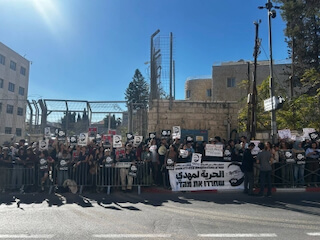
Mahdi Tounsi went before a Jerusalem court Tuesday to determine whether he will go free or will be heading to prison without a trial.
The judges’ decision, expected in the next few days, will say a lot about where Israel itself is heading.
“This dehumanization is not going to stop at Palestinians,” Ruth Onik, a friend of Tounsi’s and fellow activist told me via the Signal app, “and if Mahdi gets arrested now, at some point it is going to reach his fellow Jewish activists too.”
In other words, will Israel’s government become the illiberal, oppressive force that its Western critics claim it already is?
Israeli police arrested Tounsi, a 26 year-old sociology student and peace activist at Hebrew University, from his dormitory room on Mount Scopus three weeks ago on suspicion of involvement in a terrorist act. Only after his family reported him missing did they discover he had been arrested.
The police presented no evidence against him at a preliminary hearing and Shin Bet, Israel’s internal security service, is seeking to hold Tounsi under administrative detention, a period of six months behind bars without charge or trial that can be renewed indefinitely.
Hundreds of Arab and Jewish peace activists showed up outside his hearing in a Jerusalem courtroom at noon Nov. 24 to protest his detention and call for his release. Tounsi has been active in Standing Together, an Arab-Jewish movement committed to coexistence and equal rights, and has also joined in protests against the demolition of Arab homes in the Silwan neighborhood of Jerusalem, where he lives.

“He has been active in Jewish-Palestinian peace work for years,” Adam Ghawanmeh, a Hebrew University engineering student and friend of Tounsi’s, told me via Signal. “He has many Jewish and Arab friends at the university.”
Meanwhile, three senior officials at Hebrew University wrote a letter to authorities expressing concern about Tounsi’s detention.
“Mahdi is a student in our faculties, and as such we feel responsibility for him,” the deans wrote.
The arrest reveals three dangerous trends in Israel. The first is a crackdown on peaceful activism. According to police statements cited by the Times of Israel, Israel deported 40 foreign nationals between Oct. 9 and Nov. 8, 2026, after arrests in the West Bank — including two groups of activists deported about a week apart in early November.
In October 2026 alone, soldiers detained roughly 80 Israeli, British, and American volunteers near Bethlehem — including American and Israeli rabbis and U.S. Rep.-elect Brad Lander — in what lawyers called the largest mass detention of activists in the West Bank in a decade. Days later, around 60 people were detained in Burin, with Palestinian organizer Ghassan Najjar placed under a four-month administrative detention order.
Those senseless arrests should answer the common refrain of all those in the pro-Israel camp who wonder where the Palestinian nonviolent activists are: They’re in Israeli prisons.
The second trend is the use of administrative detention, which allows authorities to keep a suspect in custody without charge indefinitely, based on covert intelligence information.
The number of Palestinians held in administrative detention rose from 1,319 on Oct. 1, 2023 to 3,324 as of June, according to Israel Prison Service data published by the Israeli rights group Moked. Though it has long been used against Palestinians in the West Bank, authorities increasingly use administrative detention against Palestinians inside Israel.
Meanwhile, Defense Minister Israel Katz barred administrative detention against Jewish suspects.
“This arrest is not happening in a vacuum,” said Onik. “We are in days of Arab witch-hunting.”
The witch-hunting goes with the third trend: the demonization of Arabs in public life. That trend began in earnest after Arab citizens turned out in record numbers to vote in the recent election, with the Arab parties winning 19 seats in the new Knesset.
Immediately, Prime Minister Benjamin Netanyahu’s office accused Arab politicians of serving as foreign agents and Arab parties as “supporters of terrorism who hate Israel.” (Unsurprisingly, Netanyahu’s own party had held secret coalition negotiations with at least one Arab party leader.)
On Israeli TV, commentator Eyal Berkovic mocked Arab anchor Lucy Aharish, saying “Calm down, you’re not in the village here,” while others demeaned Bedouins and Arab Knesset members.
Against these trends there are some hopeful signs. Channel 13 later suspended Berkovic for racist remarks. In response to Netanyahu’s provocations, Gadi Eisenkot, the opposition leader tasked with forming the next government, posted to X, “Arab citizens of Israel are an integral part of the Israeli story. The attempt to marginalize them and vilify them collectively is a profound violation of the principles of civic responsibility.”
Eisenkot also correctly called the West Bank settler rampages against Palestinians “Jewish terrorism.”
And early this month, after about 15 security officers raided the Jaffa home of journalist Abed Abou Shehadeh and arrested him on suspicion of “contacts with a foreign agent,” authorities released him amid an outcry from international journalists and at least three members-elect of the U.S. Congress.
Activists are hoping outside pressure and attention will bring about Tounsi’s release. American Jews need to speak out to ensure Tounsi’s freedom — and bring about a better Israel.
The post Israel wants to jail a peace activist without trial. That should alarm American Jews. appeared first on The Forward.
