



Uncategorized
US, Iran May Resume Talks This Week Despite Port Blockade

A vessel at the Strait of Hormuz, off the coast of Oman’s Musandam province, April 12, 2026. Photo: REUTERS
Talks to end the Iran war could resume in Pakistan over the next two days, US President Donald Trump said on Tuesday, after the collapse of weekend negotiations prompted Washington to impose a blockade on Iranian ports.
Gulf, Pakistani, and Iranian officials also said negotiating teams from the US and Iran could return to Pakistan later this week, though one senior Iranian source said no date had been set.
“You should stay there, really, because something could be happening over the next two days, and we’re more inclined to go there,” Trump was quoted as saying in an interview with the New York Post.
While the US blockade drew angry rhetoric from Tehran, signs that diplomatic engagement might continue helped calm oil markets, pushing benchmark prices below $100 on Tuesday.
The highest-level talks between the two adversaries since the 1979 Islamic Revolution ended in Islamabad without a breakthrough, raising doubts over the survival of a two-week ceasefire that still has a week to run.
Since the United States and Israel began the war on Feb. 28, Iran effectively shut the Strait of Hormuz to nearly all vessels except its own, saying passage would be permitted only under Iranian control and subject to a fee. Nearly a fifth of global oil and gas supplies previously flowed through the narrow waterway, making the fallout widespread.
In a countermeasure, the US military said it began blocking shipping traffic in and out of Iran‘s ports on Monday. Tehran has threatened to hit naval ships going through the strait and to retaliate against its Gulf neighbors’ ports.
IMF CUTS GROWTH OUTLOOK
US Central Command said the blockade of Iranian ports involved more than 10,000 US military personnel, more than a dozen warships, and dozens of aircraft.
“During the first 24 hours, no ships made it past the US blockade and 6 merchant vessels complied with direction from US forces to turn around to re-enter an Iranian port on the Gulf of Oman,” CENTCOM said in a statement posted on X.
Shipping data showed the blockade had made little difference to Strait of Hormuz traffic on Tuesday, with at least eight ships crossing the waterway.
The latest standoff has further clouded the outlook for global energy security and the supply of goods that rely on petroleum.
On Tuesday, the International Monetary Fund cut its growth outlook and said the global economy would teeter on the brink of recession if the conflict worsens and oil stays above $100 per barrel into 2027.
The International Energy Agency slashed its forecasts for global oil supply and demand growth, saying both are now expected to fall from 2025 levels.
The US’ NATO allies including Britain and France said they would not be drawn into the conflict by taking part in the blockade, although they have offered to help safeguard the strait by drawing together a defensive multilateral mission to assist when an agreement is in place.
China, the main buyer of Iranian oil, said the US blockade was “dangerous and irresponsible” and would only aggravate tensions.
PROPOSAL FOR 20-YEAR SUSPENSION OF NUCLEAR ACTIVITY
US Vice President JD Vance, who led Washington’s delegation in Pakistan, has said Trump was adamant that any enriched nuclear material must be removed from Iran and a mechanism be established to verify that Iran is not developing nuclear weapons.
A source briefed on the matter confirmed reports that the US had proposed a 20-year suspension of all nuclear activity by Iran “with all sorts of restrictions.”
Two Iranian sources said Iran had rejected the proposal, suggesting a halt of just three to five years.
One source involved in the negotiations in Pakistan said backchannel talks since the weekend had produced good progress in closing the gap on the nuclear issue, bringing the two sides closer to a deal that could be put forward at a new round of talks.
Complicating Pakistan’s mediation efforts, Israel has continued targeting Iran-backed terrorist group Hezbollah in Lebanon. Israel and the United States say that campaign is not covered by the ceasefire, while Iran has insisted it is.
Israeli and Lebanese envoys were to meet in Washington on Tuesday in a rare encounter also expected to be attended by Secretary of State Marco Rubio. Lebanon’s government has sought negotiations with Israel despite objections from Hezbollah.
Israel continued to target Hezbollah after the Iran ceasefire was announced last week, but later said it was willing to discuss a separate ceasefire with the Lebanese government.
Regarding Iran, Israeli Foreign Minister Gideon Saar told reporters in Jerusalem on Tuesday: “We will never allow Iran to obtain nuclear weapons … The enriched materials must be removed from Iran.”
CEASEFIRE STILL HOLDING
With the war unpopular at home and rising energy prices causing political blowback, Trump paused the US-Israeli bombing campaign last week after threatening to destroy Iran‘s bridges and power grid unless it reopened the strait.
A Reuters/Ipsos poll conducted from April 10 to 12 after the ceasefire was announced showed that 35% of Americans approve of US strikes against Iran, down from 37% a week earlier.
The ceasefire has largely held over its first week despite sharp rhetoric from both sides.
An Iranian military spokesperson called any US restrictions on international shipping “piracy,” while Trump said that Iran‘s navy had been “completely obliterated” and that only a small number of “fast-attack ships” remained.
“Warning: If any of these ships come anywhere close to our BLOCKADE, they will be immediately ELIMINATED,” Trump wrote on social media.
Uncategorized
Brooklyn Nets Forward Michael Porter Jr. Defends Deni Avdija Against Hate for Representing Israel

Mar 2, 2025; Cleveland, Ohio, USA; Portland Trail Blazers forward Deni Avdija (8) drives to the basket against Cleveland Cavaliers guard Ty Jerome (2) and forward Dean Wade (32) during the second half at Rocket Arena. Photot: Ken Blaze-Imagn Images via Reuters Connect
Brooklyn Nets forward Michael Porter Jr. defended fellow NBA player and Trail Blazers forward Deni Avdija against the hate he receives for representing his home country of Israel.
Porter Jr. recently made an appearance on a live stream with YouTuber N3on and mentioned that Avdija is a player who gets to the free-throw line often. N3on then commented that Avdija “gets a lot of hate,” referring to hate messages on social media, even though “he’s a good player.” When Porter asked the streamer if Avdija is criticized because he is Jewish, N3on replied yes.
“Really? What are people mad about?” Porter asked.
“Because he wore a flag or something,” N3on replied, referring to Avdija’s public display of pride for Israel, such as wearing a jersey featuring an Israeli flag or draping himself in an Israeli flag on the court.
“It’s so weird,” Porter said in response. “Do people not want others to represent their country? What do they expect from him?”
Michael Porter Jr. tells N3on people are weird for hating on Deni Avdija just because he proudly represents Israel
“Why hate someone for repping their country?”
pic.twitter.com/C945Xr0dhB
— luci. (@inmaxera) May 2, 2026


Avdija, who is set to become a free agent in 2028, is the first Israeli to be named an NBA All-Star and last month became the first Israeli to reach and win an NBA Playoff game. Unfortunately, the Portland Trail Blazers ended their 2025-26 season last week with a 114-95 loss to the San Antonio Spurs in the first round of the 2026 playoffs.
Earlier the year, Avdija spoke to The Athletic about the hate that he receives as an NBA player from Israel.
“I obviously stand for my country, because that’s where I’m from. It’s frustrating to see all the hate,” he said. “Like, I have a good game or get All-Star votes, and all the comments [on social media] are people connecting me to politics. Like, why can’t I just be a good basketball player? Why does it matter if I’m from Israel, or wherever in the world, or what my race is? Just respect me as a basketball player.”
“You don’t have to love what I stand for or how I look, but if I’m a good player, give props,” Avdija added. “All this hate … for no reason, like I’m deciding things in the world … I’m from there, and I respect my country, and I stand behind it. I’m a proud Israeli because that’s where I grew up. I wouldn’t be where I am today if it weren’t for Israel and the support the people and fans gave me. But all the extra stuff around it? It’s just unnecessary.”
Uncategorized
Mike Stoller and Iris Rainer Dart talk ‘Beaches’ and reviving their Yiddish musical
A Peanuts poster in the background of our video call reminds Iris Rainer Dart of her brief time starring in a musical.
“I was the understudy for Judy Kaye in the L.A. company of You’re A Good Man, Charlie Brown,” recalled Dart, 82, the author of the bestselling novel Beaches and the book and lyrics for the new Broadway musical based on it. “She wanted to go home for Thanksgiving, and so they let me go on one time to see if I could do it. And then for Thanksgiving, I had a peanut butter and jelly sandwich and then went on as Lucy!”
After that, it was curtains. “That’s my distinguished acting career,” Dart said. “Boy, am I glad it gave me up!”
But Dart never gave up on musicals, which she started writing as an undergrad at Carnegie Mellon with an up-and-coming composer named Stephen Schwartz. She worked as a writer for Sonny and Cher’s variety show, and used Cher as a partial model for the character of Cee Cee Bloom, the brassy diva whose friendship with the more refined Bertie White is the center of Beaches. (There’s a bit of Dart in Bloom, too — namely the Jewishness.) Years later, after Garry Marshall directed the 1988 film version of Beaches, Bette Midler, who gave life to Cee Cee on screen, asked Dart to write a new vehicle for her.
Searching for subject matter, Dart remembered her stint as a replacement teacher at her daughter’s Jewish school in her largely Judenrein neck of California. She felt unprepared to take over — “The understudy doesn’t know the lines” — but she got mailers from Jewish institutions to develop her lesson plans. One was a catalog of Yiddish films.
Growing up in Pittsburgh with Yiddish-speaking immigrant parents, she didn’t need subtitles to watch them. Inspired, she wrote what would become The People in the Picture, a memory play of Yiddish theater and the Holocaust.
Midler wouldn’t go on to star in the show, which debuted on Broadway in 2011 with Donna Murphy, but she made the shidduch between Dart and Mike Stoller, the legendary songsmith who, with lyricist Jerry Leiber, penned “Hound Dog,” “Jailhouse Rock,” “Yakety Yak” and, yes, a tune called “Charlie Brown” for the Coasters.
When it came time to adapt Beaches, a story built in part around backstage drama, and an enduring friendship that grows out of it, Dart reconnected with Stoller after working with a different composer on a previous run of the show.
Stoller, 93, has had his music feature in many Broadway musicals — mostly of the jukebox variety, long after they had already been hit records. He says he approaches crafting an original score differently, writing for characters rather than an artist like Elvis. With Beaches he set out to write a “musical-musical,” that was traditional and book-driven. In the case of both Beaches and People in the Picture, there’s a heaping helping of Yiddishkeit.
One line that has audiences rolling in the aisles comes when Cee Cee (played by Jessica Vosk) pays a visit to her friend Bertie (Kelli Barrett), whose mother is dying at a Catholic hospital. She tells the nuns “my mother used to point you out to me on the street and say, ‘At least they married a Jewish guy.’”
Stoller spent some of his early years living in the converted basement of his grandparents’ house in Bell End, Queens. His grandmother spoke Yiddish, Russian, Polish and English with a Cockney accent.
“She left Bialystok and moved to Whitechapel in London on her way to America,” Stoller explained.
Stoller never had a bar mitzvah, and learned his father didn’t either. It was only when the family moved to California that Stoller learned his dad, A.L. Stoller’s, full name.
“I was thrilled to find out that his name was really ‘Abraham Lincoln Stoler,’” Stoller recalled. “In a way, it sounded Black, and I was working primarily with African American people when I started writing along with Jerry, and those were the singers that inspired us, and so I felt additional pride in his name.”
The People in the Picture brought Stoller to tears. Beaches, which (spoilers for a 41-year-old story) ends with Bertie’s untimely death, has audiences cracking up before they reach for a Kleenex.
The one song Stoller didn’t compose for the show is “The Wind Beneath My Wings,” which became a standard from the film. But beyond that, the story stays truer to Dart’s novel than the movie did.
“I always knew, because I wasn’t writing it, that it would not be the story that I wanted to tell,” said Dart of the film version. “The story I wanted to tell was in the book and in this musical.”
In the meantime, Stoller and Dart want to bring back People in the Picture. Dart said she has a new draft ready to go.
“I’m hoping that maybe we can get Jeff Goldblum, who says he loves Yiddish,” Dart said. “He’s from Pittsburgh also, and I think his father, Dr. Goldblum, may have been the doctor to my family, to my mother. Because there were two Dr Goldblums, and one of them was an eye doctor, and my mother was always trying to fix him up with my cousin.”
“Need I say more?” Dart asked.
The post Mike Stoller and Iris Rainer Dart talk ‘Beaches’ and reviving their Yiddish musical appeared first on The Forward.
Uncategorized
Trump Says Iran ‘Should Wave White Flag of Surrender’ as Shaky Ceasefire Holds Despite Exchange of Fire
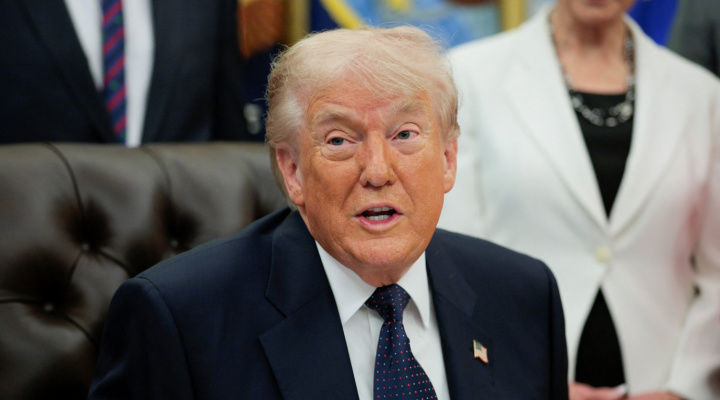
US President Donald Trump speaks during an event to sign a memorandum in the Oval Office at the White House in Washington, DC, US, May 5, 2026. Photo: REUTERS/Evan Vucci
US President Donald Trump on Tuesday dismissed Iran‘s military capability and said Tehran “should wave the white flag of surrender” but is too proud to do so.
Trump’s comments to reporters in the Oval Office came as the United Arab Emirates said it was under attack from Iranian missiles and drones, even as Washington said a shaky ceasefire was intact despite an exchange of fire the previous day as US forces attempted to force open the Strait of Hormuz.
Despite the escalation, Iran‘s military has been reduced to firing “peashooters,” Trump said, adding that Tehran privately wants to make a deal despite its public saber-rattling.
“They play games, but let me just tell you, they want to make a deal. And who wouldn’t, when your military is totally gone?” he said.
Trump heaped praise on the US blockade of Iranian ports in the region. “It’s like a piece of steel. Nobody’s going to challenge the blockade. And I think it’s working out very well,” he said.
When asked what Iran would need to do to violate the ceasefire, Trump said: “Well, you’ll find out, because I’ll let you know … They know what not to do.”
Trump argued that Iran “should save the white flag of surrender,” adding, “If this were a fight, they’d stop it.”
The US military said it had destroyed six Iranian small boats, as well as cruise missiles and drones, after Trump sent the navy to escort stranded tankers through the strait in a campaign he called “Project Freedom.”
US Defense Secretary Pete Hegseth said the operation to protect commercial ships was temporary and the four-week-old truce was not over. “We’re not looking for a fight,” he told a press conference. “Right now, the ceasefire certainly holds, but we’re going to be watching very, very closely.”
Iran fired missiles at US ships on Monday and attacked the UAE, a key regional ally of Washington, with missiles and drones. After issuing a new map of the Strait of Hormuz with an expanded Iranian area of control, Iran‘s Revolutionary Guards warned vessels on Tuesday to stick to the corridors it had set or face a “decisive response.”
Shortly after Hegseth spoke on Tuesday, the UAE’s defense ministry said its air defenses were again dealing with missile and drone attacks coming from Iran.
‘RIGHT TO RESPOND’
The Gulf Arab state’s foreign ministry said in a statement that the attacks were a serious escalation and posed a direct threat to the country’s security, adding that the UAE reserved its “full and legitimate right” to respond.
There was no immediate comment on that from Iran, though earlier its parliament speaker, Mohammad Baqer Qalibaf, had said breaches of the ceasefire by the US and its allies endangered shipping through the strait, which carries a large share of the world’s oil and fertilizer supplies.
“We know well that the continuation of the current situation is unbearable for the United States, while we have not even begun yet,” he said in a social media post.
The Strait of Hormuz has been virtually shut since the United States and Israel began attacks on Iran on Feb. 28, triggering disruptions that have pushed up commodity prices around the world.
Iran has effectively sealed off the strait by threatening to deploy mines, drones, missiles, and fast-attack craft. The United States has countered by blockading Iranian ports and mounting escorted transits for commercial vessels.
Hegseth said the US had successfully secured a path through the narrow waterway and that hundreds of commercial ships were lining up to pass through.
The US military said two US merchant ships made it through the strait, without saying when, with the support of Navy guided-missile destroyers.
Iran denied any crossings had taken place, though shipping company Maersk said the Alliance Fairfax, a US-flagged ship, exited the Gulf under US military escort on Monday.
Several merchant ships in the Gulf reported explosions or fires on Monday, and an oil port in the UAE, which hosts a large US military base, was set ablaze by Iranian missiles.
Iran also said it fired warning shots at a US warship approaching the strait, forcing it to turn back.
Reuters could not independently verify events in the strait as the two sides issued contradictory statements.
General Dan Caine, the chairman of the US Joint Chiefs of Staff, said Iranian attacks against US forces fell “below the threshold of restarting major combat operations at this point.”
PAKISTAN’S MEDIATION EFFORTS CONTINUE
The war has killed thousands as it spread beyond Iran to Lebanon and the Gulf, and has roiled the global economy. The head of the International Monetary Fund said on Tuesday that even if the conflict ended immediately, it would take three to four months to deal with the consequences.
US and Iranian officials have held one round of face-to-face peace talks, but attempts to set up further meetings have failed.
Iranian state media said on Sunday that the US had conveyed its response to a 14-point Iranian proposal via Pakistan, and Iran was reviewing it. Neither side gave details.
Iranian Foreign Minister Abbas Araqchi said peace talks were still progressing with Pakistan’s mediation and warned the US and the UAE against being drawn into a “quagmire.”
He was traveling to Beijing on Tuesday for talks with his Chinese counterpart, his ministry said. Trump is also due to visit China this month.
A senior Pakistani official involved in talks said: “We have put in a lot of efforts – actually both the sides have narrowed gaps on a majority of the issues.”
Trump has said the US-Israeli attacks aimed to eliminate what he called imminent threats from Iran, citing its nuclear and ballistic missile programs and its support for terrorist groups Hamas and Hezbollah.
Trump has insisted Iran must surrender its enriched uranium stockpiles to prevent it producing a nuclear weapon – an ambition Tehran denies.