



Uncategorized
US Legal Adviser Says Iran War Justified by Tehran’s ‘Aggression’ Over Decades
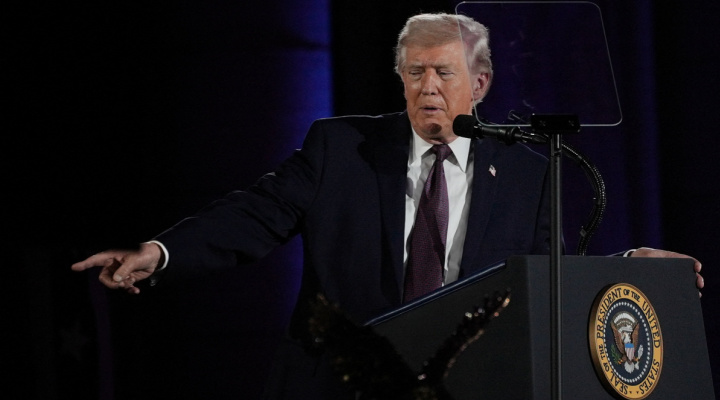
US President Donald Trump points as he delivers a speech during the National Republican Congressional Committee (NRCC) annual fundraising dinner in Washington, DC, US, March 25, 2026. Photo: REUTERS/Ken Cedeno
The US State Department’s top lawyer has argued that President Donald Trump’s war with Iran was launched in self-defense and to defend US ally Israel, arguing the bombing campaign was not the start of a new war but the continuation of an ongoing conflict.
State Department Legal Adviser Reed Rubinstein made the arguments in a statement released days before a May 1 deadline for the Trump administration to obtain approval for the war from Congress under the 1973 War Powers Act or move to end it.
The US and Israel began air strikes on Iran on Feb. 28, killing Iran‘s then-Supreme Leader Ayatollah Ali Khamenei and much of the country’s leadership in the initial attacks. Trump said at the time the strikes, which happened just days after inconclusive talks between US and Iranian negotiators, were aimed at destroying Iranian missiles and annihilating its navy and preventing Tehran from obtaining a nuclear weapon. Trump also urged Iranians to overthrow their government.
Many legal experts say the attacks were unjustified under the United Nations Charter, which states that member states must refrain from using force or the threat of force against other states except when force is authorized by the UN Security Council or used in self-defense.
The U.S. was “engaged in this conflict at the request of and in the collective self-defense of its Israeli ally, as well as in the exercise of the United States’ own inherent right of self-defense,” Rubinstein said, citing what he called “Iran‘s malign aggression over decades” since the Islamic Revolution of 1979, including attacks by Iranian proxies on US forces and Israel, Iranian missile strikes against Israel in 2024, and Tehran’s pursuit of nuclear weapons.
“In truth, the United States is acting well within the recognized contours of international law relating to the use of force and self-defense,” he added.
Iran has long denied accusations by Western powers that it is seeking to develop nuclear weapons.
The statement, entitled “Operation Epic Fury and International Law,” was posted on the State Department’s website on Tuesday but, unlike most of the department’s statements, it was not sent to the media or published on official social media channels.
Iran responded to the US and Israeli attacks by launching missiles and drones against US targets, its Middle East neighbors, and shipping, snarling the vital Strait of Hormuz waterway. The war, which has sparked an energy shock and concerns about wider economic fallout, has been paused since an April 8 ceasefire.
Opinion polls show the war is unpopular with Americans, who have seen the prices of fuel, food, and other products jump during the past eight weeks. Reuters/Ipsos poll results released on Friday showed a clear majority of Americans blame Trump for surging gasoline prices, which are weighing on his Republican Party ahead of the midterm elections in November.
Rubinstein concluded the campaign that began in late February was “part of an armed conflict with Iran that has been ongoing for years” and said it was unnecessary to assess whether an Iranian attack on the US or an ally was imminent.
“The US has acted well within its international law obligations with respect to its use of force since operations began in late February. Iran, by contrast, has acted as any reasonable observer would have expected – lashing out against its neighbors, targeting Israeli civilians, murdering its own people, unlawfully closing the Strait of Hormuz, and wreaking havoc throughout the region,” Rubinstein said.
Congressional aides said Rubinstein’s statement was issued by the Trump administration likely to get ahead of a May 1 deadline to ask Congress to authorize the war. The War Powers Act says the US president must end any ongoing conflict after 60 days until he obtains that authorization to continue. A president can obtain a 30-day extension if he certifies in writing, to Congress, that the continuing use of armed force is necessary.
Democrats, who are in the minority in both chambers of Congress, have tried repeatedly since the war began to pass resolutions ending the conflict until Trump obtains congressional approval, but almost all Republicans have voted to block them.
Uncategorized
US Sen. Rand Paul’s Son Apologizes After Drunken Antisemitic Insults Against Catholic Congressman

US Sen. Rand Paul (R-KY) is trailed by reporters as he arrives for the weekly Senate Republican caucus luncheon at the US Capitol in Washington, US, May 22, 2018. Photo: REUTERS/Jonathan Ernst
William Paul, the adult son of frequent Israel critic US Sen. Rand Paul (R-KY), has apologized following reports that he made antisemitic and homophobic statements while defending Rep. Thomas Massie (R-KY) to Rep. Mike Lawler (R-NY) at a Capitol Hill restaurant on Tuesday evening.
NOTUS reporter Reese Gorman witnessed the encounter at Tune Inn and wrote that the younger Paul, 33, sat a few seats down from Lawler at the bar when he introduced himself and told the congressman that if Massie lost in his upcoming primary, “your people” would be responsible.
Lawler, an Irish Catholic, asked, “My people?”
This prompted Paul to say, “Yeah, you Jews.”
Lawler then clarified his religious background, saying, “Do you think I’m Jewish? I’m not.”
Paul apologized for his error, replying, “Oh wow, I’m so sorry for calling you a Jew.”
Lawler later told reporters the comment was “just a remarkable statement in and of itself,” adding that “at one point, you know, said that he hates Jews and hates gays and doesn’t care if they die. And I think that’s f**king disgusting.”
Lawler told the New York Post that he responded to Paul mistakenly identifying him as a Jew with, “And even if I was, what’s the problem?”
“Then he got into the Middle East,” the lawmaker recounted. “And he was talking about, like, us trying to steal Iran’s land for the Jews and steal the West Bank, and I’m like, ‘What are you talking about?’”
Paul then reportedly proclaimed Jews were “un-American” and more loyal to Israel. Lawler argued back against Paul’s dual-loyalty accusations and accused him of being antisemitic.
“Paul Singer serves Israeli interests, not American interests,” Paul also said during the encounter, referring to the billionaire Republican donor and prominent Jewish supporter of pro-Israel causes.
Singer has supported Ed Gallrein, a retired Navy SEAL challenging Massie in Kentucky’s 4th Congressional District.
A new campaign ad that aired in Kentucky this week and was sponsored by Hold the Line PAC, a group backing Massie, characterized Singer as a “pro-trans billionaire” and featured a rainbow-colored Star of David behind his image while attacking Gallrein’s allies.
Critics condemned the imagery as antisemitic, arguing it invoked longstanding tropes about Jewish financial influence and used Jewish symbolism in a way designed to inflame cultural resentment.
Massie himself has been a fierce critic of Israel, condemning its military operations in Gaza and Lebanon and arguing that the Jewish state has targeted civilian infrastructure and should not receive assistance from the US.
US President Donald Trump has endorsed Gallrein and actively campaigned against Massie, who like Paul’s father is a libertarian-leaning Republican known for frequently breaking with party leadership and advocating an isolationist foreign policy.
During his outburst this week, the younger Paul also urged Lawler to watch far-right podcaster Tucker Carlson more and claimed that Massie and his father were the only legislators who care about America. In multiple postings on X, Paul promoted “Save the Republic Money Bomb” donations for Massie.
In December 2023, Massie sparked condemnation for posting a meme suggesting that Congress was more loyal to Zionism than “American patriotism.”
In recent years, meanwhile, Carlson has emerged as the leading anti-Israel commentator on the American political right, routinely advancing conspiracy theories condemning the Jewish state while heaping praise on Qatar, the longtime supporter of Hamas and the Muslim Brotherhood.
Tuesday’s exchange concluded with Paul performing an obscene gesture.
Lawler responded by asking, “Did you just give me the middle finger?”
Paul replied, “I’m sorry, yeah, I did. I’m just really drunk. I’m going to leave.” He reportedly stumbled on his way leaving the bar.
Paul attempted to apologize on X on Wednesday from his @TastyBrew1776 account, writing, “Last night, I had too much to drink and said some things that don’t represent who I really am. I’m sorry and today I am seeking help for my drinking problem.” He has struggled with his alcohol use before, pleading guilty to a drunk driving charge in 2015.
Rabbi Uri Pilichowski responded to the apology.
“You don’t just have a drinking problem, you have a Jew-hating problem,” he posted. “The Jewish sages taught, ‘Wine goes in, and secrets come out.’ You need some Jewish friends so you can correct your image of Jews.”
Conservative columnist Bethany Mandel, an advocate for Jewish outreach to antisemites, responded with an invitation to Paul, asking him, “Care to come for Shabbat dinner sometime?”
Addressing the admission of excessive drinking, Lawler told reporters, “That’s not an excuse for that type of hatred and vitriol. It’s my fourth year in Washington; that was arguably the most shocking thing I’ve witnessed.”
Lawler explained how he saw the encounter in the context of today’s rising antisemitism.
“But I mean, look, I think it speaks to a larger issue, obviously, in society and what we’re seeing among young people and what we see online,” he said. “And this is the level of hatred and vitriol, frankly, that some of my Jewish colleagues experience, but many of my constituents experience.”
Paul’s father chose not to comment on his son’s antisemitic outburst, saying to reporters on Wednesday only, “I don’t have anything for you.”
He and Massie have both faced substantial criticism for their positions on Israel.
On numerous occasions, Massie voted as the lone Republican in the House opposing bills supporting Israel and denouncing antisemitism. In October 2023, he voted against House Resolution 771, which stated that Congress “stands with Israel as it defends itself against the barbaric war launched by Hamas and other terrorists” and “reaffirms the United States’ commitment to Israel’s security.” In September 2021 he was likewise the sole Republican to oppose the Iron Dome Supplemental Appropriations Act.
In May 2022, Massie earned the distinction of being the only member of Congress to oppose a resolution honoring Jewish Americans’ heritage and denouncing a rise in antisemitic violence. He also distinguished himself further on Nov. 28, 2023, as the only legislator to vote against a resolution reaffirming Israel’s right to exist.
In January 2024, former South Carolina Gov. Nikki Haley condemned Massie as “the most anti-Israel Republican in Congress” and challenged her primary rival Florida Gov. Ron DeSantis to denounce his support.
Paul has also faced opposition for his actions against the Jewish state. In November 2018, he blocked two bills to continue military funding of Israel. Then-Florida Sen. Marco Rubio said then that “at a time when Israel faces unprecedented threats, blocking a bipartisan bill that empowers the US to stand with Israel is inexplicable.” Paul claimed that he supported Israel and that his move was intended toward encouraging the Jewish state to support its own defense.
Former Texas Rep. Ron Paul — the father of Rand and grandfather of William — has faced accusations of bigotry for decades, originating in his decision to publish a series of 1980s newsletters bearing his name which promoted racism, antisemitism, homophobia, and conspiracy theories, including one since identified by analysts as disinformation deployed by the KGB accusing the United States of creating the AIDS virus.
According to former Cato President Ed Crane, Ron Paul once told him that “his best source of congressional campaign donations was the mailing list for the Spotlight, the conspiracy-mongering, antisemitic tabloid run by the Holocaust denier Willis Carto.”
Rand has previously spoken fondly about the influence of one of his father’s antisemitic mentors, Murray Rothbard, the founder of the anarcho-capitalist and paleo-libertarian traditions who frequented the Paul family’s dinner table. During his career, Rothbard promoted Holocaust deniers, used antisemitic slurs in private correspondence, called for abolishing the Constitution to return to the Articles of Confederation, and urged Republicans to support former Ku Klux Klan leader David Duke.
“I have one of the largest Jewish populations anywhere in the country in my congressional district, and I’m not going to stop standing up for my constituents,” Lawler told reporters. “I’m going to stand up for the Judeo-Christian values that are at the core of our nation, our Constitution, and our rule of law, as I reminded Mr. Paul.”
Uncategorized
Israel to Extend F-35 Flight Range in Push to Build Up Military Force

A US Marines F-35C Lightning II is staged for flight operations on the flight deck of the US Navy Nimitz-class aircraft carrier USS Abraham Lincoln in support of the Operation Epic Fury attack on Iran from an undisclosed location March 3, 2026. Photo: US Navy/Handout via REUTERS
Amid a multi-front conflict and a broader drive to bolster its military capabilities, Israel has signed a new contract with Elbit Systems subsidiary Cyclone to develop an extended-range capability for the F-35 Lightning II, marking its latest effort to extend the aircraft’s operational reach and endurance.
On Thursday, Israel’s Defense Ministry announced it signed a $34 million contract with Cyclone to develop and integrate external fuel tank systems for the Lockheed Martin-manufactured platform, aimed at enhancing its operational reach and in-flight persistence during extended missions.
Based on an existing Cyclone design used on F-16 aircraft, the system is expected to reduce reliance on aerial refueling and enhance the Israeli Air Force’s flexibility in long-range operations.
The aircraft integrates stealth capabilities, advanced data fusion, and internal weapons carriage, alongside Israeli-developed electronic warfare, communications, and computing systems that are incorporated into the US-built platform architecture.
Israeli officials said the agreement is part of a broader effort to strengthen domestic defense-production capabilities, improve readiness for a prolonged period of security challenges, and preserve Israel’s regional air and strategic superiority, amid an expanding multi-front conflict against Iran and its regional terrorist proxies.
After more than three years of war, Israel is now expected to increase defense spending over the next decade by roughly $95 billion, on top of an annual defense budget that has already grown from under $27 billion to nearly $40 billion.
Earlier this month, Israel also announced a major expansion of its combat air fleet, effectively doubling its planned procurement of F-35 Lightning II aircraft from 50 to 100, while increasing its next-generation F-15 Eagle fleet from 25 to 50, as part of one of its largest long-term force modernization programs in decades.
Uncategorized
I run The Jewish Theological Seminary. Here’s the real story about President Isaac Herzog speaking at our commencement
Because there have been many public misstatements and mischaracterizations, I believe it is incumbent on me as chancellor of The Jewish Theological Seminary to clarify the facts about our invitation to Israeli President Isaac Herzog to serve as our commencement speaker this year.
Herzog’s leadership and public service reflect the core principles and values that underlie JTS’s enduring commitment to the state of Israel, and to a vision of Zionism that is central to our institution. His life and work, including his advocacy for strengthening Israel’s democracy and his defense of a two-state solution, align with JTS’s mission.
Our seminary’s leadership felt that awarding him an honorary degree, and having our students hear him speak directly to them, would be both a privilege and fully consistent with our love for Israel and the people of Israel. (Herzog can no longer attend the commencement in person, but will be delivering his commencement address virtually, and will receive his honorary degree in person at some date in the future.)
I am proud that JTS serves as a forum for respectful disagreement, which our choice of Herzog as speaker prompted. The Jewish world encompasses a wide range of perspectives, particularly regarding the political situation in Israel. That diversity of thought exists both within our classrooms and beyond. I welcome the voices of those who may disagree.
What is regrettable is the extent to which respectful disagreement has been drowned out by a public media spectacle.
After our initial announcement of Herzog as commencement speaker, six seniors in JTS’s undergraduate dual-degree programs with Barnard College and Columbia University wrote a letter expressing their opposition to our decision.
Those students’ concerns focused on the policies of the Israeli government in its recent wars, and in no way challenged the legitimacy of the state of Israel. They also asked some additional students and alumni of other JTS schools to sign on in support of their objections. This list of supporters included four rabbinical students, three of whom are first-year students.
As too often happens in such circumstances, the letter was shared more widely, without the students’ prior knowledge or consent. This was dismaying to several of the students, who had intended to hand deliver it to me to spark conversation. What should have been a private exchange between students and their administrators escalated in alarming ways.
The authors were publicly criticized, misidentified as rabbinical students, and labeled “anti-Zionist,” including by some parties who purport to care deeply about JTS. Calls were made for their expulsion, and unfounded accusations were directed at their characters.
Few individuals from the community called me for clarification about what was actually transpiring before rushing to judgment publicly. Absent was the principle of “dan l’chav zechut” — that we should assume the best unless proven otherwise. I was deeply saddened by the outcry.
Here’s what actually happened: After I was made aware of this letter, I invited the undergraduates who authored it to meet with me for an extended and honest conversation. What they said in that conversation made it clear that anyone who labels them as anti-Zionist is misguided.
Rather, they are thoughtful individuals whose consciences are deeply troubled by many of the actions of Israel’s current government. Our conversation gave us an opportunity to discuss the role of dissent within a committed community, the importance of understanding the totality of a public figure’s career rather than focusing on isolated statements, and the distinct responsibilities of the offices of prime minister and president of Israel.
We at JTS take our responsibility as educators seriously. First and foremost, we are here to teach our students to engage with difficult issues thoughtfully, navigate disagreement and move forward in constructive and meaningful ways.
But just as important is our obligation to support and defend them when they are portrayed unfairly in public forums by those who do not know them as we do.
We take equal pride in the students who wrote the letter raising concerns about Herzog’s role in commencement, and those who wrote a letter to me expressing strong support for it — a response I heard echoed by many.
As Noam Pianko wrote in the Forward, this kind of thoughtful and respectful exchange about Israel and Zionism at JTS is not new; it is part of a longstanding tradition and precisely the kind of engagement we should continue to foster. One of our students who favored Herzog’s appearance reflected that in our courses, “the focus is not on advancing a single vision of Zionism but on confronting the deep and often irreconcilable disagreements within it. We read competing Zionist thinkers … Each author offers fundamentally different answers to what a Jewish state should be and what it should prioritize.”
We hope the Jewish community joins us in taking pride in the thoughtful young people who are working to navigate a complex Jewish world. By embracing, supporting and educating them, we can help ensure they remain deeply connected to the Jewish community, continue to be nourished by it, and contribute to its future in meaningful ways.
The post I run The Jewish Theological Seminary. Here’s the real story about President Isaac Herzog speaking at our commencement appeared first on The Forward.