


Uncategorized
Recalling Millie Baran, whose mark on the Yiddish world lives on
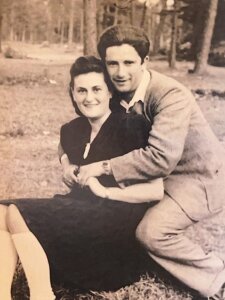
Millie Baran, a Holocaust survivor who served for many years as a “camp mother” at the socialist Yiddish summer camp, Hemshekh, and spoke publicly, even on television, about her Holocaust experiences, passed away on April 3. She was 100 years old.
Millie, whose late husband, Mikhl Baran, was the camp’s director, was known for her warmth and mentshlekhkeyt (kindness). As many former Hemshekh campers will tell you: Nishto keyn tsveyte — no one could replace her.
Born Mila Persky in 1926 in the town of Oszmiana (Oshmene in Yiddish) in what was then Poland and is now Belarus, she attended a Tarbut school, a secular Zionist Hebrew-language school. An ardent Zionist herself, she often praised the education she received there.
After Millie’s passing, her daughters, Ruth Baran Gerold and Janice Baran Blatt, talked about her fluency in both Yiddish and Hebrew in an interview with the author. “She spoke a beautiful, elegant Yiddish,” Ruth said. “In fact, her Hebrew education at Tarbut enriched her Yiddish.”
During the war, Millie was interned in the Oszmiana ghetto, the Vilna ghetto and several labor camps. She credited her survival to a specific forced labor detail on a Polish farm where the prisoners were permitted to eat the apples that had fallen on the ground.
“My mother said, ‘This farmer wasn’t the worst, and this guard wasn’t the worst, so they let us eat,’” Ruth said. “This source of nutrition was key to her survival.”
One day, when Millie’s hands became bloody from shoveling, a Polish woman, also a slave laborer, approached her. “She heard Millie singing and was so captivated, she offered to do Millie’s shoveling if Millie would sing as they worked,” Ruth said. “Throughout her life, she always emphasized that even the smallest acts of kindness from strangers could have a tremendous impact.”
Despite starvation rations, Millie would not eat the meat given to the prisoners in their soup, since it wasn’t kosher. She valued Jewish tradition even in the most dire conditions, trading the non-kosher dish for a piece of bread, or whatever another prisoner would be willing to exchange for it.
Many years later, this devotion was apparent to Forverts editor Rukhl Schaechter.
“Millie was very principled, whether it was about supporting Israel or keeping Jewish traditions,” Schaechter said. “When I worked with her husband Mikhl at Camp Kinder Ring during the 1980s, Millie, who would come up on weekends, always asked the waiter for a fish or pasta meal; she never ate the chicken or meat dishes. I once asked her if this was because she was vegetarian, and she said no, she simply didn’t eat meat in a non-kosher establishment. I was still a secular Jew then and was in awe of her willpower. Little did I know that many years later, I would do the same.”
After the war, Millie and Mikhl, who was also from Oszmiana, encountered each other in Lodz, Poland, a city that drew many survivors. They fell in love and married. In 1949, they emigrated to the United States.
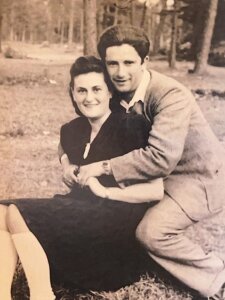
As a camp mother, Millie’s loving nature impacted the lives of hundreds of children of survivors. One former camper, Moish Russ, recalled her warmth and gentleness when he was a young boy in the 1960s. “I was still homesick at times. Millie was extraordinarily kind and carried herself with a confidence and gentleness I didn’t know in my own mother. The feeling of her comforting, soapy hands was a joy. I felt loved.”
“I remember her examining my fingernails to be certain they were clean,” said another former camper, George Rothe. “Years later, whenever I saw her, I’d hold out my hands to let her inspect them. It became a joke between us.”
Millie’s daughters both spoke of their mother’s elegance and fastidious nature, even in the clothes she wore as a prisoner in the ghettos and labor camps.
“Millie always made sure she kept a needle,” Ruth said.“She hid it in her blanket. Even in the camps, she made sure she never had a dropped hem.”
That commitment to dressing properly came up again years later, after Millie and Mikhl had immigrated to New York. Janice, then six, was sitting with her mother on the bus when a woman passed by with her hem undone. “Can you believe it?” Millie said, “She’s free here, and yet she goes around like that!”
While Millie had an enormous impact on the campers and staff at Camp Hemshekh, admiration for her goes far beyond. Her life inspired a jazz collaboration by Albert Marques and Amplify Voices called “Mir Zaynen Do” (“We Are Here”) that was performed at the iconic Joe’s Pub in January 2025.
Millie’s and Mikhl’s stories also made their way onto television when they were invited to share their Holocaust experiences on The View in 2020. After Millie’s passing, The View’s host Whoopie Goldberg shared the sad news on the show and paid tribute to Millie’s accomplishments.
Millie never took her freedom for granted, Ruth said. “Her favorite holiday was pesakh (Passover), and she died right before pesakh. Every year, she would stand by the kids’ table and say, ‘We were slaves in Egypt and I was a slave by Hitler. Now I’m an American and a free Jew.’ ”
In addition to her daughters Janice and Ruth, Milllie is survived by grandsons Ben, Jonathan, and Sam, and great-grandchildren Sophia, Joshua, Ava, Olivia and Billie.
The post Recalling Millie Baran, whose mark on the Yiddish world lives on appeared first on The Forward.
Uncategorized
UK adopts sweeping measures against antisemitism in schools
(JTA) — The U.K. has adopted sweeping measures to combat antisemitism in English schools, prompting pushback from the country’s largest teachers’ union.
The move came after a new government-commissioned review found that three in five Jewish students reported experiencing antisemitism in English schools. The most common incidents were jokes, stereotypes and comments about Jewish people. About half of respondents who witnessed or experienced antisemitism said the incidents were not reported, most often because they did not think they would be taken seriously.
The government on Wednesday accepted 27 recommendations from the report, including dedicated antisemitism training for leaders and staff, improved recording of antisemitic incidents and moves to build a better understanding of Jewish life, identity and contemporary antisemitism.
The government commissioned the report following a spate of high-profile attacks on Jews in Britain, including an attack on a synagogue in Manchester last year that left two men dead.
The report’s author, Sir David Bell, the vice chancellor of the University of Sunderland and former chief inspector of schools in England, recommended addressing antisemitism distinctly from other forms of racism. He argued that antisemitism was a “uniquely complex” problem because of intertwined racial and religious dimensions, since Jewish identity can encompass both an ethnicity and a religion, along with expressions of prejudice that hold all Jews responsible for the actions of Israel.
The government will also encourage English schools to adopt the International Holocaust Remembrance Alliance (IHRA) working definition of antisemitism. The definition is supported by many mainstream Jewish organizations and has been adopted by 47 countries, including the U.K., but critics say that it conflates some forms of antisemitism with criticism of Israel.
British Education Secretary Lucy Powell called Bell’s review a “generational moment” and said that “implementation is now my priority.”
However, the National Education Union, the largest union representing teachers, lecturers, teaching assistants and support staff in the United Kingdom and Europe, raised concerns on Wednesday about recommending the IHRA definition for schools. NEU general secretary Daniel Kebede said in a statement that the definition “risks deepening the problem rather than tackling it, and actively undermining efforts to confront antisemitism.”
“The IHRA’s contested framing risks blurring the line between antisemitism and legitimate criticism of the Israeli government and the genocide in Gaza, leaving teachers with uncertainty when they need clarity,” said Kebede. He cited a risk that “children who cannot critically explore issues through classroom discussion will instead seek their answers in online and unsafe groups.”
Kebede also encouraged Britain’s Department for Education to strengthen guidance on all forms of racism, not only antisemitism, saying that 65% of teachers report they have not received any antiracism training in the past year.
The Board of Deputies of British Jews, an umbrella organization for British Jewish communities, celebrated the antisemitism report and the government’s adoption of its proposed measures. The group specifically praised the report’s “clear recommendations that schools and local authorities follow government guidelines by adopting the IHRA Working Definition of Antisemitism as a tool to deepen understanding of contemporary antisemitism.”
“We remain concerned about undue external influence on schools driven by narrow political agendas, and tendentious materials seeping into schools and increasing disharmony, and we will continue to press for vigilance against this,” said the Board of Deputies.
The post UK adopts sweeping measures against antisemitism in schools appeared first on The Forward.
Uncategorized
Orthodox Jewish man stabbed in midtown Manhattan
(New York Jewish Week) — An Orthodox Jewish man is in stable condition after being stabbed on Wednesday evening in the Diamond District of midtown Manhattan. Police are investigating the attack as a possible hate crime.
Police told the Jewish Telegraphic Agency that the NYPD’s Hate Crimes Task Force is investigating the incident as a possible antisemitic attack, and Manhattan Shomrim — the Jewish community watch group — has asked people to share footage as police search for the suspect. No arrests have been made.
The victim was identified by police as a 26-year-old man, and Orthodox Jewish outlet COLLive identified him as a resident of Crown Heights, the neighborhood that is home to the Chabad-Lubavitch Hasidic movement’s headquarters.
He was taken to Bellevue Hospital in stable condition. Police said they were called at about 5:50 p.m. on Wednesday after the man was stabbed in the back with “an unknown sharp object” on 47th Street near Fifth Avenue. ABC7 reported that the victim told investigators he believed he was stabbed with a needle or syringe.
According to the Chabad website, which published an interview with the victim, he is a recently ordained Hasidic rabbi named Joseph, who commutes to Midtown each day to wrap tefillin with Jewish merchants. The attacker, Joseph told the website, was a woman who seemed to be following him prior to the stabbing.
The attack comes as Jewish New Yorkers have been targeted in more than half of the hate crimes committed in New York City this year, despite making up about 12% of the city’s population.
In July, an assailant stabbed two men on the Upper West Side, including one who was leaving a synagogue, while yelling “Allahu akbar,” and was charged with committing hate crimes.
Louis Keene contributed reporting.
The post Orthodox Jewish man stabbed in midtown Manhattan appeared first on The Forward.
Uncategorized
VIDEO: A Hasid gives us a tour of Morocco in Yiddish
דער ירושלימער יוטוב־שטערן וועלוול קירשנבוים האָט לעצטנס אַרויסגעשטעלט אַ ווידעאָ אויף ייִדיש פֿון אַ פּרעכטיקן וויזיט, וואָס ער האָט געמאַכט אין מאַראָקאָ. עס באַגלייט אים זײַן חבֿר אַבֿרהם פּרץ.
אינעם ווידעאָ זעט מען ווי קירשנבוים דאַוונט שחרית מיט די אָרטיקע ייִדן און באַזוכט אַ גוט אָפּגעהיטענעם בית־עולם, וווּ עס ליגן באַערדיקט גרויסע צדיקים ווי למשל הרבֿ חיים בן עתר (1696–1743), באַקאַנט ווי דער „אור החיים“. „מענטשן מיינען, אַז נאָר אין אייראָפּע זענען דאָ קבֿרים פֿון צדיקים!“ זאָגט קירשנבוים.
מיר זעען אַ גרויסע, שיינע שיל מיט אַ פֿײַנער אַרכיטעקטור אין קאַזאַבלאַנקאַ; דעם גרויסן אַראַבישן שוק, וווּ קירשנבוים קויפֿט זיך אײַן מלבושים פּונקט ווי די מאַראָקאַנער גייען אָנגעטאָן. ער באַוווּנדערט אויך די שיינע טיי־גלעזער און טשײַניקן, וואָס מע פֿאַרקויפֿט דאָרט, און באַקענט זיך מיט אַ ייִדישן סוחר וואָס האַנדלט מיט זילבער און גאָלד, פּונקט אַזוי ווי זײַן טאַטע און זיידע האָבן געטאָן פֿאַר דור־דורות.
The post VIDEO: A Hasid gives us a tour of Morocco in Yiddish appeared first on The Forward.
