



Uncategorized
What You Haven’t Heard About: The Looming Hezbollah Threat Across Israel’s Northern Border

Lebanese army members and residents inspect the damages in the southern village of Kfar Kila, Lebanon, Feb. 18, 2025. Photo: REUTERS/Karamallah Daher
On November 27, 2024, Israel and Hezbollah agreed to a ceasefire after more than one year of war, which started when the Lebanese-based terrorist organization launched a front in support of Hamas on October 8, 2023.
From the beginning of the fragile ceasefire through January 2026, Hezbollah committed 1,925 violations.
Today, the threat of Hezbollah continues to loom, amplified by the increasing regional tensions as Israel and the entire Middle East wait to see if and when the US will launch any military operation against the Islamic Republic of Iran.
In addition to preparing for a possible Iranian retaliation in the event of a US strike, Israel is also contemplating the possibility that Iranian proxy Hezbollah will support its sponsor by joining in an attack on the Jewish State.
Despite being severely weakened after IDF operations took out senior leadership and destroyed between 70–80% of its firing capabilities, Hezbollah remains a significant threat not only to Israel’s northern border, but to the entire country, as it still possesses several hundred medium and long-range missiles.
Because of this volatile reality, the IDF has conducted a series of operations targeting both senior and lower levels of leadership in Hezbollah to degrade its ability to regroup and rearm. From February 16 through February 22, 2026, the IDF conducted operations in 25 areas of Lebanon, including air strikes, artillery missions, drone strikes, and ground operations.
The threat posed by Hezbollah is not isolated. It is part of a broader regional network backed by Iran, designed to encircle Israel with multiple fronts and sustained pressure. Since the outbreak of anti-regime protests in Iran, the IDF has remained on heightened alert, suspecting renewed rocket and missile attacks against the country.
New reports have warned that if Israel and the Iranian regime are to return to war, Hezbollah will likely join the fight. This would be a change in the terror organization’s strategy, after having sat out of the war between Israel and Iran in June 2025.
With Hezbollah’s degraded military capabilities, the military organization has effectively handed much of its restructuring and rebuilding efforts to the Iranian Revolutionary Guard Corps (IRGC). IRGC officers have been meeting with Hezbollah operatives in Lebanon. Following one of these meetings between the IRGC and Hezbollah at a missile unit site in the Beqaa Valley, the IDF targeted the site, killing eight Hezbollah terrorists.
When this strike was reported in the international media, none of the above context was provided. Instead, the BBC, The Guardian, and Sky News all omitted from their headlines that those killed included eight terrorists. The lede was buried as the outlets suggested that the IDF operation was not based on precise intelligence to remove a looming threat, but rather an indiscriminate targeting of Lebanese civilians. The media have previously similarly framed any targeted strike as an Israeli violation of the ceasefire, rather than a measure to prevent Hezbollah from rebuilding its military infrastructure.
All of this unfolds against the larger reality that Hezbollah continues its refusal to adhere to the ceasefire agreement it signed. In a speech on February 16, Secretary-General Naim Qassem made clear the organization’s refusal to disarm.
While the Lebanese Armed Forces have claimed the disarmament has begun and that it has taken “operational control” of the area south of the Litani River — from which Hezbollah is required to withdraw — Israel’s targeting of Hezbollah infrastructure in those areas suggests the process is far from complete.
Hezbollah today is a fractured version of the terrorist organization it once was. Its leadership is weakened, and its rocket arsenal is nowhere near the extent it was before October 2023. Yet the presence of the terrorist organization on Israel’s northern border remains. Its apparent willingness to join the Iranian regime if a new round of fighting is to break out only goes to display that it has not strayed from its goal of destroying the Jewish state.
The media might try to look away from this reality, but Israel cannot — nor can it afford the consequences of ignoring the security threat.
The author is a contributor to HonestReporting, a Jerusalem-based media watchdog with a focus on antisemitism and anti-Israel bias — where a version of this article first appeared.
Uncategorized
At Trump’s Christian revival on the National Mall, one rabbi made a Jewish case for America
On the National Mall Sunday, Christian worship music boomed from giant speakers as “Adonai” and other names of God flashed across jumbo screens behind a praise band. Pastors invoked America’s biblical destiny. Sadie Robertson, the Christian social media personality and granddaughter of Duck Dynasty patriarch Phil Robertson, preached from both the Old and New Testaments.
And then Rabbi Meir Soloveichik — the lone Jewish speaker at the planned nine-hour “Rededicate 250” rally called by President Donald Trump, billed as a national “jubilee of prayer, praise and thanksgiving” — stepped to the podium and began talking about Irving Berlin.
Soloveichik, 48, a scion of one of modern Orthodoxy’s most revered rabbinic families and a member of Trump’s Religious Liberty Commission, used his remarks to offer a Jewish case for American exceptionalism, a contrast to the explicitly Christian vision of the nation’s founding that defined the day.
Recalling how Berlin wrote “God Bless America” as fascism spread across Europe and antisemitism consumed the continent, Soloveichik described the song as both a patriotic anthem and a prayer of gratitude from a Jewish immigrant who found refuge in the United States. The hymn, he said, represented “a plaintive prayer to God that America continue to be blessed.”
The four-minute speech fit squarely within Soloveichik’s broader worldview. A senior scholar at the conservative Tikvah Fund and rabbi of Congregation Shearith Israel in Manhattan, the oldest Jewish congregation in the United States, he has long argued that America’s civic ideals are aligned with traditional Judaism and biblical morality. His 2024 book, Providence and Power: Ten Portraits in Jewish Statesmanship, examines Jewish political leadership through the lens of faith and moral responsibility.
For Soloveichik, the connection between Judaism and American identity culminated in the Second World War. He noted that “God Bless America” was first broadcast publicly the day after Kristallnacht, when Nazis destroyed Jewish homes and synagogues across Germany. “At the very moment when darkness deepened,” Soloveichik said, “America raised its voice united in the song that Irving Berlin wrote.”
He added that “in the years that followed 1938, the prayer that is ‘God Bless America’ was carried by American soldiers who defeated evil, liberating Europe and the world.”
Then came the line that drew some of the loudest applause of his remarks: “It is a reminder, as hatred of Jews makes itself manifest again, that antisemitism is utterly un-American.”
Separation of church and state
The moment captured the complicated role Jews increasingly occupy within the Trump-era religious right: embraced as part of America’s Judeo-Christian heritage, even as critics warn that the broader movement surrounding events like Rededicate 250 blurs the line between religious pluralism and Christian nationalism.
Rachel Laser, the Jewish CEO of Americans United for the Separation of Church and State, denounced the rally before the event. “If President Trump and his allies truly cared about America’s legacy of religious freedom, they would be celebrating church-state separation as the unique American invention that has allowed religious diversity to flourish in our country,” she said in a statement. “Instead, they continue to threaten this foundational principle by advancing a Christian Nationalist crusade to impose one narrow version of Christianity on all Americans.”
Sunday’s event — part revival meeting, part patriotic pageant — was the centerpiece of the Trump administration’s religious programming tied to this year’s 250th anniversary of the founding of the United States. Secretary of Defense Pete Hegseth and House Speaker Mike Johnson were slated to appear alongside evangelical pastors, worship leaders and conservative Christian influencers. President Trump and Vice President JD Vance were scheduled to address the crowd by video, while Trump himself spent the weekend golfing after returning from an overseas trip to China.
“This is a recognition of the deeply embedded history and religious and moral tradition of the country,” Johnson said Sunday on Fox News, dismissing criticism that the rally blurred the separation of church and state. Those objecting to the event, he added, “want to erase the history of America.”
No Muslim speakers appeared on the lineup. Organizers promoted Trump’s declaration of a national “Shabbat 250” observance the day prior as evidence of interfaith inclusion.
One of the Sunday event’s chief promoters, Trump spiritual adviser Pastor Paula White-Cain, had reassured supporters beforehand that the gathering would celebrate America’s Christian foundations without “praying to all these different Gods.”
Soloveichik did not address those tensions. Instead, he closed by returning to the image of America as a nation uniquely capable, in his telling, of transforming a Jewish refugee into the composer of one of the country’s most enduring patriotic hymns.
“To sing this song,” he said, “is to be reminded that America’s story is unique.”
“GOD BLESS AMERICA IS NOT JUST A SONG. IT’S A PRAYER.” 🇺🇸🙏
Rabbi Meir Soloveichik delivers a powerful reminder that America’s love of liberty has always been tied to faith — tracing its story and why anti-Semitism is fundamentally un-American. pic.twitter.com/aKMg42nS2I
— Real America’s Voice (RAV) (@RealAmVoice) May 17, 2026
The post At Trump’s Christian revival on the National Mall, one rabbi made a Jewish case for America appeared first on The Forward.
Uncategorized
Israel to Establish Defense Offices in Former UNRWA Compound

A man handles fallen cables at the Jerusalem headquarters of the United Nations Relief and Works Agency for Palestine Refugees (UNRWA) as the headquarters is dismantled by Israeli forces, in East Jerusalem, January 20, 2026. Photo: REUTERS/Ammar Awad/File Photo
Israel’s cabinet on Sunday approved a plan to build a defense compound on the site of the recently demolished premises of the United Nations Relief and Works Agency in East Jerusalem.
Israel in January demolished structures inside the UN Palestinian refugee agency’s East Jerusalem compound after seizing the site last year, in an act condemned by the agency as a violation of international law.
In a joint statement, the Defense Ministry and Jerusalem Municipality said the new compound would include the establishment of a military museum, a recruitment office and a defense minister’s office.
Defense Minister Israel Katz called the decision one of “sovereignty, Zionism, and security.”
UNRWA, which Israeli authorities accuse of bias, had not used the building since the start of last year after Israel ordered it to vacate all its premises and cease its operations.
A UNRWA spokesperson declined to comment on the Israeli plan.
The agency operates in East Jerusalem, which the U.N. and most countries consider territory occupied by Israel as it was captured from Jordan in the 1967 Middle East war. Israel considers all Jerusalem to be its indivisible capital.
UNRWA also operates in Gaza, the West Bank and elsewhere in the Middle East, providing schooling, healthcare, social services and shelter to millions of Palestinians.
“There is nothing more symbolic or justified than establishing the new IDF recruitment office and defense establishment institutions precisely on the ruins of the former UNRWA compound — an organization whose employees took part in the massacres, murders, and atrocities committed by Hamas terrorists on October 7,” Katz said.
Israel has alleged that some UNRWA staff were members of the Palestinian terrorist group Hamas and took part in the attack on Israel on October 7, 2023, that killed about 1,200 Israelis and led to Israel’s war against Hamas.
Uncategorized
Palestinian Leader’s Son Wins Role in Abbas’ Party, Official Says
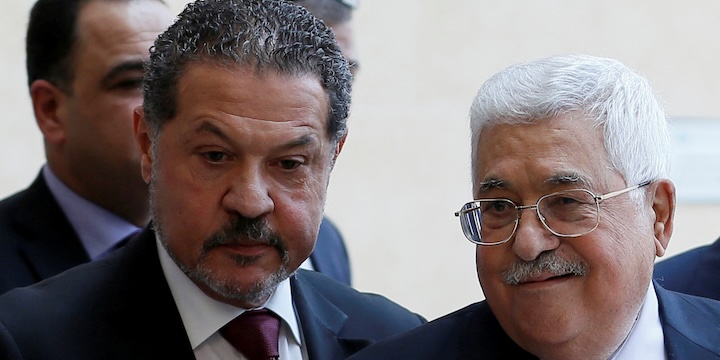
Palestinian President Mahmoud Abbas, accompanied by his son Yasser, leaves a hospital in Ramallah in the Israeli-occupied West Bank, May 28, 2018. REUTERS/Mohamad Torokman
The millionaire businessman son of Palestinian President Mahmoud Abbas has won a steering role in his father’s political party Fatah, a party official said on Sunday, as a succession fight looms for control of the embattled Palestinian Authority (PA).
Yasser Abbas won a seat in elections for the Fatah Central Committee, the party’s highest decision-making body, at its first general conference in almost a decade. Mahmoud Abbas, 90, will remain chairman, it decided.
The PA was set up as an interim administration under the 1990s Oslo accords between Israel and the Palestine Liberation Organization, an umbrella group still internationally recognized as the representative of the Palestinian people. The powerful Fatah party dominates both the PA and the PLO.
Abbas’ son’s foray into politics has fueled speculation that the president may be seeking to position Yasser, 64, to succeed him as head of Fatah.
That has drawn criticism from some Fatah officials, who say Yasser would be unable to unify Palestinians or help them chart a new political future after years without national elections or tangible steps toward statehood.
In the more than two decades since Mahmoud Abbas was elected to succeed Fatah founder Yasser Arafat, Palestinians have come to view the PA as ineffective and corrupt, something denied by Abbas, who has ruled by decree since his mandate expired in 2009.
In 2007, Abbas’ Fatah forces in the Gaza Strip were overpowered by Hamas militants who seized control of the enclave, a year after Hamas swept the Palestinian parliamentary elections.
Peace talks with Israel meant to lead to the creation of a Palestinian state in the West Bank, Gaza and East Jerusalem collapsed in 2014, with expanding Israeli settlements since carving up areas slated for Palestinian statehood. The PA is also grappling with a financial crisis.
Yasser Abbas, who has never held an official role within Fatah or the PA, runs tobacco and contracting firms in the parts of the West Bank where the PA exercises limited self rule. Critics have long alleged that he and his brother Tarek have used public funds to help their businesses, allegations both men reject.
Among others to have won seats on the Central Committee are Majed Faraj, head of the General Intelligence Agency, and former militant group leader Zakaria Zubeidi, released in a Hamas-Israel prisoner-hostage exchange as part of a 2025 Gaza ceasefire.