



Uncategorized
When Jews Are Attacked, the Media Won’t Say ‘Jew’

Orthodox Jews stand by a police cordon, after a man was arrested following a stabbing incident in the Golders Green area, which is home to a large Jewish population, in London, Britain, April 29, 2026. Photo: REUTERS/Hannah McKay
As soon as the words “attack in Golders Green” were uttered, everyone in Britain — Jewish or not — understood what that likely meant: another antisemitic attack.
Golders Green is one of the most recognizably Jewish areas in the UK, with around half its population identifying as Jewish. When violence erupts there, the context is not ambiguous.
Witness accounts quickly confirmed what seemed obvious. Two visibly Jewish men, in a well-known Jewish neighborhood, were stabbed. The suspect — a 45-year-old Somali national — was arrested at the scene.
Video footage showed police tasering the attacker and using force to disarm him as he refused to drop his weapon. Yet as news of the attack spread, something else became clear: major British media outlets were struggling to name who had been targeted.
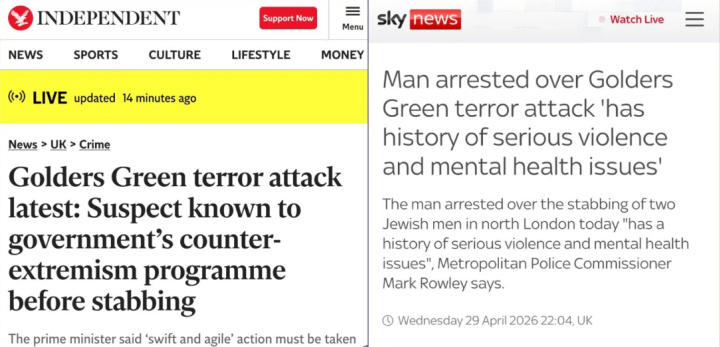
The BBC reported that “two people” had been stabbed, attributing key details to a “Jewish security group,” as though the identity of the victims was uncertain or subjective. Sky News similarly opted for “two people,” stripping the attack of its clear antisemitic context in the headline. Later, Sky went further, running a headline emphasizing the attacker’s “history of mental health issues” — a framing that deflects from the antisemitic motive. The Independent, while calling it a terror attack in its headline, still avoided explicitly stating that Jews were targeted.
You mean two Jews, @SkyNews. https://t.co/OdU8YWw7CT
— HonestReporting (@HonestReporting) April 29, 2026
This is not a minor omission. It is a pattern that repeats with disturbing consistency. When Jews are the victims, the language shifts. Attacks are softened, anonymized, universalized. Victims become “people.” Targeted violence becomes generic crime. The specificity disappears.
But antisemitism is not generic. It is not abstract. And it is not universal.
Jews are being targeted as Jews.
The data makes that impossible to ignore. According to the Community Security Trust (CST), 3,700 antisemitic incidents were recorded in the UK in 2025 – the second-highest total on record and a 4 percent increase from 2024. That followed 4,298 incidents in 2023, itself a historic peak. The trajectory is clear: antisemitic violence is escalating.
And it is visible beyond statistics. In recent weeks alone, Hatzola ambulances were firebombed, synagogues in Finchley and Kenton were targeted in arson attacks, and a building that formerly hosted a Jewish charity in Hendon was targeted. Now, Jews have been stabbed in one of Britain’s most prominent Jewish communities.
Yet even as this reality intensifies, large parts of the media still struggle — or refuse — to name it plainly.
Why?
Part of the answer lies in a broader narrative environment. For months, British audiences have been exposed to coverage that portrays the Jewish state as uniquely malevolent, often with little context or balance. Mass protests openly invoking “intifada” have been downplayed or sanitized. Extremism, when directed at Jews, has too often been reframed as legitimate grievance.
Within that climate, the reluctance to say “Jew” is not accidental. It reflects a deeper discomfort with acknowledging Jews as a distinct and targeted group.
But language matters. When the media erases victims’ identities, it erases the nature of the crime. And when the nature of the crime is blurred, so too is the urgency to confront it.
This is how normalization happens – not through a single headline, but through repetition. Through omission. Through the quiet reshaping of reality.
If the trend continues, the consequences will not remain confined to headlines. Britain’s Jewish community is already questioning its future in a country where anti-Jewish violence is rising — and where even that violence is not always named for what it is.
Two men were not simply stabbed in Golders Green. Jews were attacked for being Jews. And the media should be able to say so.
The author is a contributor to HonestReporting, a Jerusalem-based media watchdog with a focus on antisemitism and anti-Israel bias — where a version of this article first appeared.
Uncategorized
Israel’s Eurovision Delegation Departs for Austria Led by Singer Noam Bettan

Noam Bettan, Israel’s representative for the Eurovision Song Contest 2026, poses in this undated handout photo. Photo: Courtesy of Kan, Timor Elmalach/Handout via REUTERS
The Israeli delegation for the 70th Eurovision Song Contest, led by Israel’s representative in the competition Noam Bettan, departed the Jewish state on Friday morning and traveled to Austria for the annual event taking place this month.
Israel’s national airline El Al shared photos on Facebook of Bettan aboard the plane taking him to Vienna, where he will compete in the Eurovision with his original song “Michelle.” The song features lyrics in Hebrew, French, and English. Bettan, 27, will perform the track at the Eurovision with five dancers on stage, Israel’s national broadcaster Kan announced.
The Ra’anana native, whose parents are French, will represent his home country in the Eurovision this year after winning the latest season of the Israeli televised singing competition “Hakochav Haba” (“The Next Star”) in January.
“I am very happy and excited to represent our beautiful country in the biggest music competition in Europe, on the biggest stage in the world,” Bettan said before taking off on Friday morning, as reported by Kan. “I am coming with an open heart, and I want to give all the light and love I receive from everyone, back to the whole world … We have given our souls to bring the most amazing performance possible on stage with lots of surprises. There is going to be great joy on stage! It is a great privilege and responsibility, and I will do everything to represent with honor.”
El Al CEO Levi Halevi said he is confident Bettan will be successful in the competition. “Noam is going to represent us in a challenging time when it is of great significance to represent the country with honor around the world,” he added.
The first semi-finals for the Eurovision, in which Bettan will perform, will take place on May 12, followed by another semi-final on May 14. The grand final will be held on May 16.
Thirty-five countries are participating from around the world. Ireland, Slovenia, and Spain have announced they will not air the 70th Eurovision Song Contest or compete because of Israel’s participation. Iceland and the Netherlands will also not compete in the Eurovision this year due to Israel’s inclusion, but they will broadcast the competition.
Eurovision Song Contest Asia will launch in November 2026 and will be hosted in Bangkok, Thailand.
Uncategorized
Albanian Prime Minister Promotes Kanye West’s Upcoming Concert in New 60,000-Seat Stadium

Ye, formerly known as Kanye West. Photo: BANG Showbiz via Reuters Connect
Albanian Prime Minister Edi Rama confirmed on Thursday an upcoming concert in the country by Ye, formerly known as Kanye West, despite a number of the rapper’s previous shows being canceled across Europe because of his past antisemitic behavior.
Rama shared a video on Facebook that features footage of the Grammy winner during his previous concerts, along with a message that announces the date of the concert in Tirana, Albania. The “Flashing Lights” singer will perform one night only on July 11.
The Yeezy founder will also reportedly have a temporary venue built for him in the city that will be called “Eagle Stadium.” It is expected to hold approximately 60,000 people and will be located near the Tirana-Durra axis, Albania’s Minister of Tourism, Culture, and Sports Blendi Gonxhja confirmed in a Facebook post, which was also shared on the ministry’s official Facebook page.
The Ministry of Culture noted that the concert will be paid for through ticket sales, but some partnered institutions will “facilitate” its progress, according to BalkanInsight.
“In every aspect, it is our obligation to welcome and facilitate the development of such events that bring numerous benefits to tourism and the economy,” the ministry reportedly said. It added that the concert “will have an extraordinary impact on the promotion of tourism and the local economy.”
The United Kingdom, France, Poland, and Switzerland have all recently canceled Ye’s concerts amid controversy over his past antisemitic actions and comments, which include selling T-shirts that feature a Nazi swastika, expressing admiration for Nazi leader Adolf Hitler, releasing a song titled “Heil Hitler,” and posting several antisemitic comments about Jews on X. Australia banned Ye from entering the country last year.
Italy is still set to have Ye headline its Hellwatt Festival in July, but Pina Picierno, vice president of the European Parliament and senior member of Italy’s Democratic Party, said the government should take action to prevent the concert from taking place. “The United Kingdom denied the visa. France effectively prevented the Marseille concert. Italy, meanwhile, is just staying idle with 68,000 tickets sold, as if nothing had happened,” Picierno told the local newspaper La Gazzetta di Reggio.
Ye apologized for his antisemitic and pro-Nazi comments in January in an advert in the Wall Street Journal. He attributed his offensive behavior to manic episodes related to untreated bipolar disorder and declared, “I am not a Nazi or an antisemite.”
As part of his world tour, Ye is set to perform this summer in India, Turkey, The Netherlands, Spain, and Portugal.
Uncategorized
Iran Hands Over New Proposal for Talks With US to End War

An Iranian flag lies amidst the rubble of a building of the Sharif University of Technology, which was damaged in a strike, amid the US-Israeli conflict with Iran, in Tehran, Iran, April 7, 2026. Photo: Majid Asgaripour/WANA (West Asia News Agency) via REUTERS
Tehran has submitted its latest proposal for negotiations with the United States, Iranian state media and a Pakistani official said on Friday, a move that could break a deadlock in efforts to end the Iran war.
The official, involved in Pakistani mediation over the war, said Pakistan had received the proposal late on Thursday and had forwarded it to the US.
Neither the official nor Iranian state news agency IRNA gave details, and the White House declined to comment, while saying negotiations continued. Global oil prices, which remain well above $100 a barrel, eased following news of the proposal.
The closure of the Strait of Hormuz has caused unprecedented disruption to energy markets, choking off 20% of the world’s oil and gas supplies and causing a record rally in oil prices.
The blockade of the vital sea channel has also increased concerns that there will be an economic downturn. The US Navy is blocking exports of Iranian crude oil, and on Friday the US Treasury warned shippers that they risked sanctions if they paid tolls to Iran to pass through the strait.
A ceasefire has been in place since April 8 but reports that US President Donald Trump was to be briefed on plans for new military strikes to compel Iran to negotiate had pushed global oil prices up to a four-year high at one point on Thursday.
Iran has activated air defenses and plans a wide response if attacked, having assessed that there will be a short, intensive US strike, possibly followed by an Israeli attack, two senior Iranian sources told Reuters on condition of anonymity.
‘TREACHEROUS AGGRESSION’
Washington has not said what its next steps are. Trump said on Tuesday he was unhappy with the previous proposal from Iran, and Pakistan has not set a date for new talks on ending a war that has killed thousands, mainly in Iran and Lebanon.
After US and Israeli airstrikes on Feb. 28, Iran fired at US bases, infrastructure, and US-linked companies in Gulf states, while the Iran-backed Lebanese terrorist group Hezbollah launched missiles at Israel, which responded with strikes on Lebanon.
Underlining the concerns of the Gulf states, UAE presidential adviser Anwar Gargash said the “collective international will and provisions of international law” were the primary guarantors of freedom of navigation through the strait.
“And, of course, no unilateral Iranian arrangements can be trusted or relied upon following its treacherous aggression against all its neighbors,” Gargash wrote.
Trump faces a formal US deadline on Friday to end the war or make the case to Congress for extending it under the 1973 War Powers Resolution.
The date looks set to pass without altering the course of the conflict after a senior administration official said that, for the purposes of the resolution, hostilities had terminated due to the April ceasefire between Tehran and Washington.
Financial and energy markets remained on edge because of concerns about the impasse over negotiations and worries that there could be a prolonged closure of the Strait of Hormuz.
IRAN SAYS NOT TO EXPECT QUICK RESULTS FROM TALKS
Iranian Foreign Ministry spokesman Esmaeil Baghaei cautioned on Thursday against expecting quick results from talks.
A senior official of Iran‘s Revolutionary Guards said any new US attack on Iran, even if limited, would usher in “long and painful strikes” on US regional positions, while Aerospace Force Commander Majid Mousavi was quoted by Iranian media as saying: “We’ve seen what happened to your regional bases; we will see the same thing happen to your warships.”
Trump repeated on Thursday that Iran would not be allowed to have a nuclear weapon, and said the price of gasoline – an important concern for his Republican Party before midterm elections in November – would “drop like a rock” as soon as the war ended.
Iran says its nuclear program is solely for civilian purposes.
The conflict has aggravated Iran‘s economic plight, which could head toward total collapse. However, the regime looks able to survive a standoff for now, despite the US blockade that has curtailed its energy exports.
Axios news site reported that one plan to be shared with Trump during a briefing by top US military leaders that was scheduled for Thursday involved using ground forces to take over part of the strait to reopen it to commercial shipping. Trump is also considering extending the US blockade or declaring a unilateral victory, officials have said.
Washington did not immediately announce any details of its plans.
In a sign that the US was also envisaging a scenario where hostilities cease, a State Department cable due to be delivered orally to partner nations by May 1 invited them to join a new coalition, called the Maritime Freedom Construct, to enable ships to navigate the strait.
France, Britain, and others have held talks on contributing to such a coalition but said they would help to open the strait only when the conflict ends.