



Uncategorized
With anti-Arab campaign ad, Netanyahu stoops to new moral and political lows
Israeli election campaigns have often been ugly. They have featured exaggeration, fearmongering and outright deception. But even by those standards, the first major campaign advertisement by Prime Minister Benjamin Netanyahu’s Likud party, posted on Netanyahu’s X account on Tuesday, managed to shock much of the country.
The AI-generated video depicts former military chief Gadi Eisenkot, who has become the standard-bearer for the opposition, walking through a sunlit field toward a young Jewish man before passing him by to embrace Mansour Abbas of Ra’am, the United Arab List, instead.
The young man looks strikingly like Eisenkot’s son, Gal, who was killed fighting in Gaza in late 2023 — although Likud insists he isn’t meant to. Strictly speaking, there is enough difference to sustain the protestations. The young man has longer, wavier hair than Gal Eisenkot did — just enough, perhaps, to preserve plausible deniability. Yet almost everyone I know believed they were watching a father joyfully approaching his slain son, seemingly restored to life, only to ignore him in favor of an Arab political leader at a time when Arab political participation in Israel is particularly contentious.
The only possible explanation: Likud wants their campaign to be as mean as possible. Or perhaps that they believe that anything that creates a buzz — and therefore distracts from the governing coalition’s disastrous and controversial policies, including a wildly unpopular recent legislative blitz — is a good thing.
And buzz there is. The perception that a father’s personal loss had been weaponized for electoral gain struck many as a line that simply should not be crossed. “This is Netanyahu, and this is his machine of incitement”, wrote Einav Zangauker, whose son was held hostage in Gaza by Hamas, on social media. “This isn’t politics,” Zangauker added, but rather “an attack on a bereaved father and an assault on his dignity. It is the lowest of the low.”
“I turn to elected representatives, activists, and all candidates from all parties, and demand that you do not cross red lines. Do not turn rivals into enemies,” Israeli President Isaac Herzog said. “I call on the people of Israel, in a clear voice: Remember that elections are not a civil war.”
But even if one puts aside the controversy surrounding the young man altogether, the advertisement remains deeply troubling. It is, at its core, an exercise in incitement against Ra’am — and, by extension, against the very idea that Arab citizens may legitimately participate in governing Israel.
Abbas himself accused Netanyahu of “trying to incite between different parts of society”; about a fifth of Israelis are Arab, and the ad was obviously trying to delegitimize collaboration with the parties who generally represent them.
From Likud’s perspective, that too is logical — so long as they ignore the goal of Israel remaining a democratic country in which component ethnic groups live in harmony. It’s logical because Arab parties have always been part of the opposition to Likud and the chances are high that Eisenkot might need them, even passively, to successfully craft a coalition after the Oct. 27 election.
This isn’t just dangerous. It ignores the essential role that Arab parties have played in building toward a strong Israeli future.
Ra’am, under Abbas, has been the most integrationist Arab party Israel has ever seen. Abbas broke with decades of Arab political orthodoxy by arguing that Arab citizens should seek influence through practical cooperation with whichever Zionist government Israelis elected. He has repeatedly recognized Israel as the nation-state of the Jewish people while demanding full equality for its Arab citizens.
Whatever one thinks of his politics, these choices have represented one of the boldest experiments in Jewish-Arab partnership since the state’s founding.
That experiment briefly succeeded. Ra’am joined Naftali Bennett and Yair Lapid’s coalition in 2021 and demonstrated that Arab participation in government could become something ordinary rather than revolutionary.
More awkward still for Likud, Netanyahu himself spent some weeks after the 2021 election attempting to persuade Abbas to support — or even participate in — his own coalition. Those negotiations failed for one principal reason: Far-right firebrand Bezalel Smotrich — now Netanyahu’s finance minister — refused to countenance a government dependent on an Arab party. Without Ra’am, Netanyahu lacked a majority.
It is therefore surreal to portray Eisenkot’s willingness to work with Ra’am as somehow beyond the democratic pale, when not so long ago, Netanyahu himself tried to do precisely the same thing.
Nor should anyone pretend that Arab parties suddenly became relevant because of Eisenkot. Since the emergence of today’s political blocs, Arab parties have almost invariably belonged to the anti-Likud camp. Any center-left coalition aspiring to govern has depended, directly or indirectly, on their parliamentary support. That is not a distortion of Israeli democracy. It is one of its enduring structural realities.
Which brings us to the larger significance of this episode.
Many Israelis have long predicted that this Likud campaign would barely concern policy at all. They expected, instead, an effort to delegitimize any prospective change government by portraying it as illegitimate because it relied on Arab parties. They expected renewed attempts to cast Arab political participation as inherently suspect. They expected emotional manipulation to substitute for argument and personal attacks to eclipse serious debate. Some feared renewed efforts to discourage Arab turnout and disqualify Arab parties from the ballot.
That appears to be exactly what they’re getting.
The remarkable thing is not merely that Likud produced this advertisement, but that doing so was effectively its first act of the campaign, which kicked off after the Knesset recently went into recess.
Before voters had heard competing visions for Israel’s economy, security or diplomacy, the country’s governing party chose to launch its campaign by inflaming fears about Arab political participation while employing imagery that countless Israelis immediately interpreted as mocking one father’s unbearable personal loss.
By the next day, competing ads using a similar aesthetic were put out by opponents of Netanyahu. One depicted Netanyahu on a similar field running past a soldier to hug a Haredi politician holding a sign that says — as many Haredi anti-draft protesters chant — “we’d rather die than serve.”
One reason AI is so attractive to political strategists is because it blurs responsibility. Images can be carefully engineered to evoke a conclusion while remaining just different enough to deny that such a conclusion was ever the intention. The technology offers something every spin doctor craves: emotional impact coupled with plausible deniability.
“I do not think we can allow this to continue,” lamented David Lau, a former chief rabbi of Israel, who has served in the military. “We must stop all these disputes, all this talk, and all these behaviors. This path does not lead to building anything. It does not lead to peace. It is a bad path, and I am even more concerned about the next generation.”
It is entirely possible that this advertisement will prove to have established the moral tone of the campaign. Israel deserves better.
The post With anti-Arab campaign ad, Netanyahu stoops to new moral and political lows appeared first on The Forward.
Uncategorized
Capers Funnye wasn’t a ‘Black Jew’ — he was a good Jew
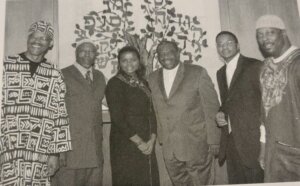
This morning, when I woke up, it was the first time in my entire life that my spiritual leader, my rabbi and my friend, was gone. People are born and die every day, and we live totally oblivious to that fact, but I feel the absence of this one human being almost on a cellular level. And the very person I would call to help me make sense of a time like this is the one who is gone.
Rabbi Capers Funnye wasn’t your typical rabbi. How could he be, though? After all, his congregation was full of Black folks and people of color. There were also some white congregants, but for the most part, his temple was a place created for people like me to have somewhere to go and practice Judaism freely without suspicion or judgment. Beth Shalom was established over one hundred years ago by Black Jews who knew at that time that they could actually be arrested here in America, in Chicago, for daring to say out loud that they were Jewish. I know that sounds unthinkable, but it’s a historical fact: It used to be illegal in Chicago for Blacks to claim that they were Jewish.
Rabbi Funnye dedicated his life to ensuring that Black Jews wouldn’t have their Jewishness questioned.

White Jews love to reminisce about the Civil Rights Movement and their close relationship to the Black community, and this coalition brought about monumental changes to American society. But those same white Jews who marched in Selma and rode buses to Mississippi had little to no interaction with Black Jews. We were nonexistent. A myth, if you will. Some people had heard that there were Black people who called themselves Jews, but no one had actually ever seen one or met one.
We were there, but just as other Jews had hidden before, we were hiding too. We worshipped in basements, living rooms, and the backs of storefronts. We were in the shadows until Rabbi Funnye came along. He was born to leave the world a better place than he found it, and that’s exactly what he did.
Rabbi Funnye was supposed to be an AME pastor, but the church didn’t need him. The synagogue, the Jewish people, did.
I used to joke with him that I’d known him so long I could remember when he had a full head of black hair. And I did. I can remember going to services and seeing him on the bimah on Shabbat. Even as a little kid, I recognized he was different. He had a voice that could command the attention even of a pew full of antsy five-year-olds. But he also had a smile so warm that we never felt scolded. When he spoke, people couldn’t help but listen, and eventually he started saying what people wanted and needed to hear.
I watched him rise from assistant rabbi to leader.He could teach Torah in a way that held the congregation’s interest, imparting important lessons while adding levity with razor-sharp wit and perfectly timed humor.
If I’d been born male, I probably would’ve wanted to be a rabbi my whole life. I wanted to be like him. But I was a girl, and that was unthinkable.
But he made me believe I could do things.
I can remember when he started to integrate the Chicago Jewish community. When we’d go to events like Shabbat dinners or Black and Jewish seders, he was unfazed by the whispers and stares when he’d ask where the tables were for those who were both Black and Jewish. While this made the rest of us uncomfortable and, for some, unwilling to ever go back into any room where we were treated as oddities, he was undeterred.
He went back, over and over again. He would not allow the existence of Black Jews to go unacknowledged any longer. And many of us went with him. I was one. I saw how he was treated at times by white rabbis and even just by people who were white and Jewish and still felt that somehow they were better than him. It would infuriate me, but not him. He’d smile, tell a joke or one of his signature stories that would completely disarm them.
And while the behavior of some of my white co-religionists would thoroughly anger me, Rabbi Funnye understood how to deal with bigotry and hate in other ways. He grew up in it. He knew how to rise above it. Another lesson learned. He never met hate with hate or derision with derision. He met it with love.
He knew that was the only way he could move us from the shadows and out of the margins, into the mainstream. And it was also the only way that he could show white Jews we were nothing to fear or exclude.
At times, his message wasn’t popular with Black Jews who wanted nothing to do with white Jews or with white Jews who weren’t ready to accept the fact that G-d made Black Jews too.
None of that changed the fact that it was the right one.
Chief Rabbi Funnye wasn’t a Black Jew. He was a good Jew. And that is the lesson that I, and hopefully all who knew him, will learn from his life.
The post Capers Funnye wasn’t a ‘Black Jew’ — he was a good Jew appeared first on The Forward.
Uncategorized
All Jewish eyes are on Michigan as heated El-Sayed-Rogers Senate campaign draws to a close
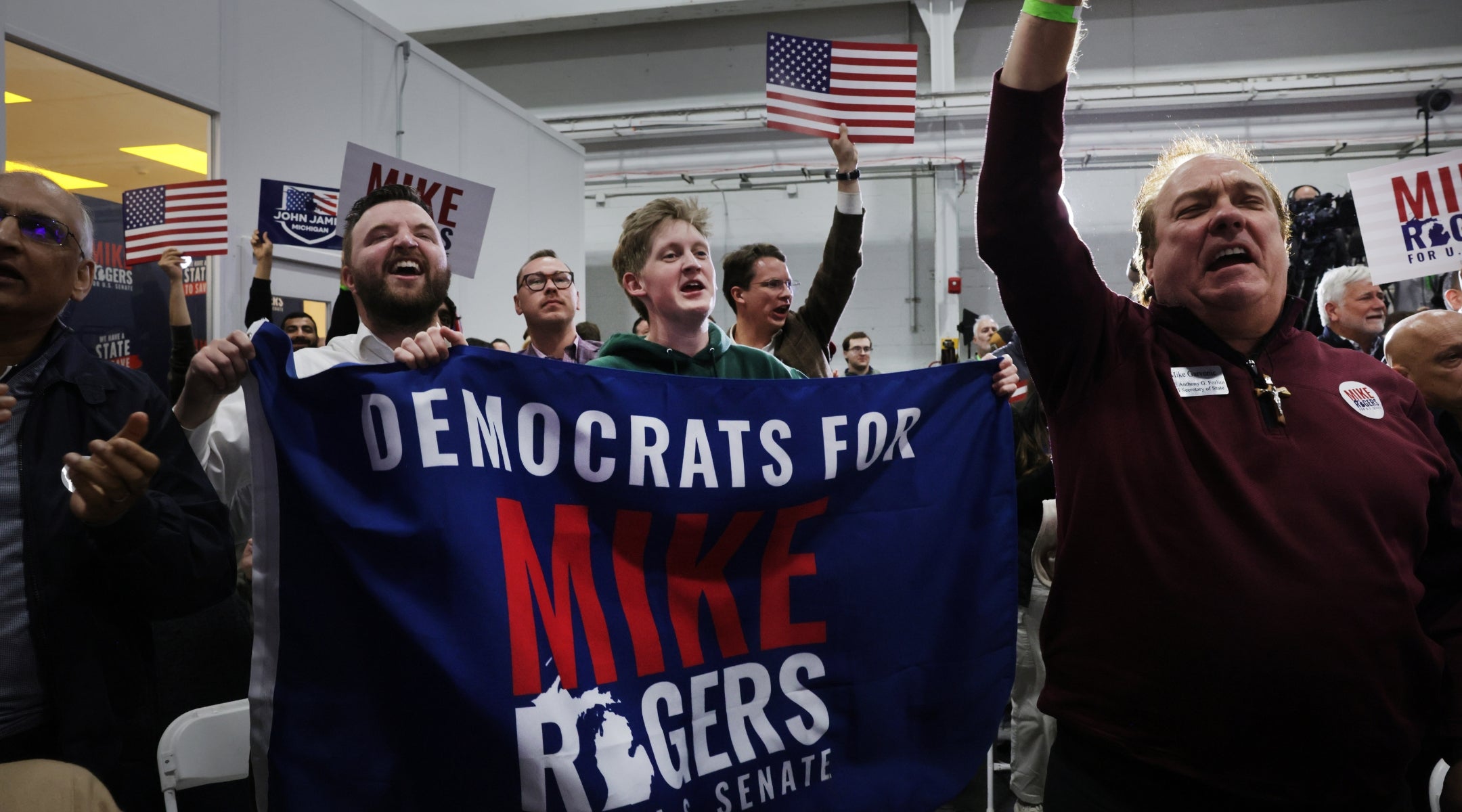
(JTA) — DETROIT – The U.S. Senate race in Michigan, a deeply contentious contest that has strained Jewish relationships with the Democratic Party, drew to a bitter close Tuesday as voters headed to the polls in a race that could shape which party controls the chamber.
At its center is Abdul El-Sayed, the former county health director and Democratic nominee whose anti-corporate, Medicare For All candidacy has become a rallying cry for the national progressive movement.
His uncompromising stances on Israel have also made him a target among pro-Israel groups, including AIPAC, which has spent heavily against him in both the primary and general election. AIPAC’s rare entry into a general election race came to support El-Sayed’s opponent, Republican former congressman Mike Rogers.
One of El-Sayed’s positions on Israel — to end all U.S. military aid — was once thought a far-left pipe dream. But that has changed. On Election Day morning, Trump announced that, under his watch, nearly $4 billion in annual U.S. military aid to Israel would wind down by the end of the year. Trump said Israeli Prime Minister Benjamin Netanyahu was in agreement with the need to end aid and deny Democratic critics a point of attack.
In his announcement of the plan, Trump cited El-Sayed.
“Why should we suffer the slings like lunatics like an El-Sayed when they don’t need it?” Trump said on Fox News, referring to Israel’s financial strength.
Representatives for the El-Sayed and Rogers campaigns, and for the Republican Jewish Coalition, did not immediately return requests for comment on Trump’s new pledge. It is unclear whether it will be straightforward for the White House to halt the funding by the end of 2026, given that the existing memorandum of understanding that governs it extends to 2028.
El-Sayed’s campaign has galvanized young voters and a range of other constituencies, and he pulled ahead in the polls in the race’s final stretch. But his questioning of Israel’s existence as a Jewish state and whether it or Iran posed a greater threat to the United States, as well as his prior associations with figures such as Hasan Piker, the streamer who has spread extreme rhetoric about American Jews, have sparked concern among Jewish Michiganders.
So, too, did comments the candidate made following the March terror attack on Temple Israel, a major synagogue in the state, in which El-Sayed appeared to link the attack to Israel’s war in Lebanon after reports that the attacker lost family in an Israeli strike. Hostile behavior from some of El-Sayed’s supporters toward pro-Israel Democrats, most prominently on display at the state party’s spring convention, have also alarmed Jews. El-Sayed has pledged to stand up to antisemitism.
Some Jews who had long considered themselves Democrats, including several local Jewish leaders, have cited such controversies in pledging to vote for Rogers. In some Michigan Jewish neighborhoods, yard signs proclaim that a vote for Rogers is a vote “against antisemitism.”

Accordingly, Rogers has made a play for the Jewish vote. He told the Jewish Telegraphic Agency in October that his opponent is “anti-Jew,” while running ads that played up El-Sayed’s tenuous family associations with the Muslim Brotherhood.
Top Republicans have seized on the narrative, with President Donald Trump calling Jews “crazy” if they back El-Sayed, and Texas Sen. Ted Cruz calling him a national security threat. A Trump administration event to address antisemitism was held at a Michigan synagogue weeks before the election, though El-Sayed’s name was not mentioned there.
Jewish Democrats who had broken with El-Sayed found major validation in the race’s dramatic closing days. Democrat Haley Stevens, a strongly pro-Israel congresswoman who had narrowly lost to El-Sayed in the primary, flipped sides to endorse Rogers days after her Jewish fiancé, a Democratic megadonor, did the same.
The surprise move, which Jewish Democratic leaders joined many other prominent Democrats in criticizing, came after days of back-and-forth between Stevens and El-Sayed as she sought to publicly pressure him to condemn a PAC ad that had linked rising grocery prices to U.S. aid to Israel.
Meanwhile, some prominent Jewish Democrats in the state either avoided endorsing El-Sayed or did so with heavy reservations. Michigan’s Jewish Democratic Caucus, whose leadership has been deeply divided on El-Sayed, issued a statement Monday declaring the caucus would never vote for a Republican.
“Our commitment to the Democratic ticket remains resolute as we work to build a more inclusive coalition,” the caucus stated.

Throughout the campaign, El-Sayed has sought to reassure Jewish voters. He apologized for his Temple Israel comments; distanced himself from Piker; hired a Jewish outreach director; said in a recent “60 Minutes” interview that Israel has a right to exist; and sent mailers to Jewish households stating, “I am committed to protecting all Michigan Jews against hatred and injustice.” He told JTA in August that “the prerequisite of Jewish safety is never in question to me.”
More than 1,000 Michigan Jews have signed an open letter pledging to vote for El-Sayed, compared to 560 who have done the same for Rogers. Progressive Jewish figures of note have held salons throughout the state in a bid to convince on-the-fence Jews to back him.
Yet El-Sayed also has continued to stake out positions many Jews find alienating. He asserted in the campaign’s closing weeks that Israel was “not actually our friend” and declined during a debate to say whether Israel or Iran was the bigger danger to the U.S. His campaign also released an ad, designed to appeal to conservatives, that featured a brief clip of Tucker Carlson, the right-wing pundit who has promoted conspiracy theories about Israel. In addition, El-Sayed’s careful sidestepping of objectionable material about Jews and Israel from his ostensible allies, such as Piker and his uncle, left-wing anti-Israel pundit Cenk Uygur, has continued up to Election Day.
Ahead of Election Day, some liberal-leaning Zionist Jews tried to put pressure on El-Sayed to speak more directly to their concerns. A group of rabbis and other Jewish leaders launched Nonnegotiable Michigan in a bid to have him affirm what they called five core principles of Jewish participation in the Democratic Party, including “Jewish sovereignty in Israel.” After silence from the campaign, some of Nonnegotiable’s figureheads urged their followers to write in the 19th-century Jewish poet “Emma Lazarus” instead of voting for either candidate.
Michigan’s already small Jewish population, which numbers around 105,000 adults, has further splintered over El-Sayed’s candidacy. But it could prove pivotal to the outcome of a race that may determine control of the chamber. In 2024, the state’s Senate race was decided by fewer than 20,000 votes.
Either way, the race has crystallized the Democratic Party’s shifting fault lines over Israel — and many Jews’ growing uneasiness with their place in the liberal coalition.
This article originally appeared on JTA.org.
The post All Jewish eyes are on Michigan as heated El-Sayed-Rogers Senate campaign draws to a close appeared first on The Forward.
Uncategorized
Trump says US aid to Israel will stop at end of year
(JTA) — President Donald Trump on Tuesday morning said that the United States would halt billions of dollars in annual aid to Israel by the end of 2026, potentially ending decades of military support for one of America’s closest allies in the Middle East.
“We were giving them $4 billion. We are. But it gets cut off at the end of the year,” Trump declared during a call-in appearance on the “Fox & Friends” morning program on Fox News. Israel’s 10-year memorandum of understanding with the United States, which currently gives Israel $3.8 billion annually, runs through 2028 so it’s unclear how easy it would be for the White House to stop the funding this year.
Referencing Israeli Prime Minister Benjamin Netanyahu’s statement in January that he wanted to taper off aid to zero at some point in the future, Trump questioned why Republicans should have to deal with criticism from hardline pro-Palestinian Democrats like Michigan Democratic Senate candidate Abdul El-Sayed when “we give them more than anybody else and they no longer need it.”
“It’s a bad talking point,” he added. His comments came as Americans across the country are voting Tuesday in midterm elections that will determine control of the U.S. House and Senate.
“We reached an agreement on that” and Netanyahu “brought it up,” Trump continued. “He said: ‘I think it would be appropriate if we do not receive aid,’ because he understands that this is one of their points of contention.”
A growing number of Democratic congressional candidates across the United States have campaigned on a platform of reducing or halting military aid to Israel during the run-up to today’s midterm elections. This April, dozens of senators — almost all of them Democrats — voted in favor of a failed motion to block the sales of certain weapons to Israel.
Yair Golan, chairman of Israel’s liberal Democrats party, slammed Netanyahu in the wake of Trump’s statement, tweeting that “precisely at a time when Israel’s defense spending has reached enormous proportions, when Israel needs to replenish its offensive weapons stockpiles, and after air defense capabilities have been depleted following such a long war—Netanyahu logs another massive failure under his name.”
“The cessation of U.S. aid is heavy damage to Israel’s security” and “a responsible prime minister would have fought to increase American aid, not eliminate it,” added Golan, whose party opposes Netanyahu’s and is trying to form a coalition to oust Netanyahu from power following Israel’s own elections last Tuesday.
This article originally appeared on JTA.org.
The post Trump says US aid to Israel will stop at end of year appeared first on The Forward.
