Connect with us

Uncategorized

With Israel Facing PTSD Emergency, New App Seeks to Help IDF Soldiers Heal

Israel Defense Forces Chief of Staff. Lt. Gen. Herzi Halevi salutes fallen soldiers at the Mount Herzl military cemetery in Jerusalem in a picture published on Oct. 27, 2024. Photo: IDF.

When one of Tzur Kurnedz’s cousins woke from a coma after fighting Hamas terrorists on Oct. 7, 2023, the first person he asked to see was Kurnedz.

The soldier, who had served in the Israel Defense Forces (IDF)’s Golani Brigade and lost most of his unit in the fighting, wanted to speak with someone who could understand what he had just lived through. For Kurnedz, that need was painfully familiar.

Kurnedz, who served in an elite IDF unit and as a sharpshooter during the 2014 Gaza war, known in Israel as Operation Protective Edge (Tzuk Eitan), had developed post-traumatic stress disorder (PTSD) himself. He spent years working through his trauma with the help of family, friends, and body-and-mind therapy. Over time, he came to see how many gaps existed in the support system for former soldiers — and how difficult it was for many to access the tools they needed.

That experience became the foundation for Bishvilenu, a digital platform Kurnedz launched with his wife, Nomi Weiss, a social worker and lawyer, to provide long-term recovery support for soldiers, their families, and their communities.

What began as trauma in Kurnedz’s own life became a resource he could use to help others. “It’s healing. It’s growth,” Kurnedz said. “I wasn’t really willing to share my story before, and now it’s a powerful tool for me to help others.”

In Hebrew, “Bishvilenu” means “for us,” while shvil also means “path” — a fitting name for a platform built around the idea that trauma recovery is not a single intervention, but a long-term process. The app, which is free for soldiers and their families, creates individualized care plans built around three pillars: mind, body, and community. More than 400 IDF soldiers and family members are already using it, and that number continues to grow.

Bishvilenu offers clinically proven practices and tools, including narrative therapy techniques as well as breathing and physical exercises. Weiss serves as vice president and Kurnedz as CEO, but the team behind the platform includes medical and trauma experts from Israel and the United States. Among them are an emotional intelligence coach, a clinical social worker trained in trauma care, and a Brown University professor who previously led PTSD research at the Providence Veterans Affairs Medical Center.

As Weiss put it, the couple moved quickly to build a platform that could use technology “as a bridge” to help people receive support and empower themselves in the long process of trauma recovery.

“It’s a place to try to create a shared knowledge from all these trauma experts who have been working in the field,” Weiss said. “We’re the digital infrastructure. We’re not trying to be the trauma experts. We let the NGOs be the trauma experts, with the final say of what exactly their soldiers need, and we build the infrastructure as people who understand trauma. It’s more about having a place for all the expertise to be gathered than for us to try to be another voice in this oversaturated field of trauma experts.”

The need has only grown since Oct. 7.
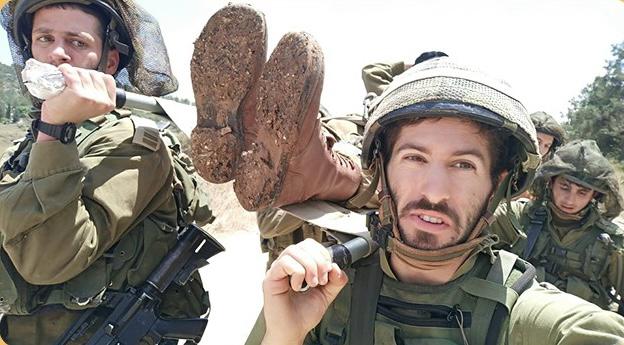

Tzur Kurnedz, right, during his IDF service. Photo: Provided

A Mounting Crisis

Israel is facing a mounting mental health crisis, with post-traumatic stress disorder rising sharply among soldiers and the broader mental health system under extraordinary strain with no end in sight.

A report released in February 2025 by Israel’s State Comptroller Matanyahu Englman, following an audit of mental health care, revealed that in the aftermath of the deadly Hamas-led massacre in southern Israel on Oct. 7, 2023, and the subsequent Iron Swords War, approximately 3 million adults in Israel have experienced anxiety, depression, and symptoms of PTSD.

These numbers are astronomical, underscoring the scale of the psychological fallout Israel has faced since Oct. 7. They also point to a mental health system under extraordinary strain, with hundreds of thousands of Israelis expected to seek care in the years ahead.

The scale of the need has overwhelmed existing systems. According to Bishvilenu, more than 70,000 IDF soldiers are on the waiting list for the IDF Rehabilitation Department, including at least 9,539 diagnosed with PTSD. Reuters recently reported that Israel’s Defense Ministry has recorded nearly 40 percent more PTSD cases among Israeli soldiers since September 2023 and expects that number to rise by 180 percent by 2028. Of the 22,300 troops and security personnel currently being treated for war wounds, 60 percent suffer from post-trauma.

The crisis has also brought a rise in suicide attempts. Reuters cited findings from an Israeli parliamentary committee showing that 279 IDF soldiers attempted suicide between January 2024 and July 2025, and that combat soldiers accounted for 78 percent of soldier suicide cases in 2024.

The backlog positions Bishvilenu as part of a familiar Israeli pattern, in which civil society organizations step in to provide support when public systems are overwhelmed.

Weiss said the trauma of the current war has been compounded by public distrust in the government and by the exhaustion of a long conflict.

“People don’t really believe in the government. People don’t trust the people sending them to war,” she said. “Everyone is tired.”

Using Technology for Togetherness

Weiss said that while she and Kurnedz started Bishvilenu for deeply personal reasons, it quickly grew into something much larger than they had expected.

“Each person’s individual journey can also become a resource for others, and we’re trying to create togetherness where trauma creates isolation,” Weiss said.

Bishvilenu is designed not to be a replacement for trauma professionals but rather as a piece of critical digital infrastructure connecting soldiers, families, and the NGOs already working with them.

Since Oct. 7, NGOs and other organizations have offered soldiers short-term trauma support, often using their own specialized methods and rarely sharing data or insights with one another. Bishvilenu is designed to fill that gap.

The platform is distributed through NGOs working with IDF soldiers and gives soldiers and their families access to clinically validated tools focused on mental, physical, and community-based healing.

For the NGOs, the app extends the relationship with soldiers and their families beyond initial intervention. It helps organizations stay in contact, monitor needs, and measure outcomes. Soldiers, meanwhile, receive tools for self-assessment and self-regulation.

Bishvilenu now works with 10 NGOs, including the Jerusalem-based organization OneFamily, and is in talks to partner with about 10 more.

“We’re at a point now where NGOs are calling us,” she said, “and we see that we have a service we can offer that is really meaningful.”

The platform, she said, can identify red flags during treatment or signal when soldiers need specific aftercare. “For soldiers and families, it gives them tools to assess themselves, help themselves, and regain a sense of agency over their own process.”

The Bishvilenu team and its volunteers working in a bomb shelter. Photo: Provided

Behind the platform’s technology is a simpler idea that Kurnedz learned through his own recovery: trauma isolates, but healing often begins when people feel heard.

One of the most important steps in his recovery, he said, was finally opening up about his trauma to his family, beginning with his wife.

“It was hard for me to share. It took a few years,” he said. “Last Hanukkah we had a family meeting, and it was the first time my family heard my story from Tzuk Eitan. It was very meaningful to feel heard. With trauma, you feel very isolated, like nobody can understand you. For me, it started with the small community I had — my family, my friends, even my military team. I did a lot of body and mind therapy, but the sense of community was the strongest part of the work for me.”

Continue Reading

Uncategorized

‘It’s the Jews’: San Diego mosque shooters decried ‘the universal enemy’ in hate-filled manifesto

San Diego Police Chief Scott Wahl credited the mass convergence on the mosque by police with ending the shooters’ pursuit of maximum damage. Photo by Zoë Meyers / AFP via Getty Images

The two young men who killed three people at a San Diego mosque on Monday published a conspiracy theory-filled manifesto whose primary focus was on Jews, calling them the “universal enemy.”

The manifesto’s contents also suggest they may have had additional plans to target  Jewish institutions.

Authorities have identified Cain Lee Clark, 17, and Caleb Liam Vazquez, 18, as the shooters who killed a security guard and two members of the Islamic Center of San Diego. The two livestreamed the attack before both were found dead in a car by apparent suicide, blocks away from the mosque.

The three killed at the mosque were Amin Abdullah, 51, Mansour Kaziha, 78, and Nadir Awad, 57.

Jewish leaders across the country and in San Diego widely condemned the attack.

The 74-page manifesto, which contains a section written by each shooter, reveals a wide-ranging hatred rooted in white Christian nationalist ideas, including Great Replacement Theory, and fueled by the two teenagers’ own social alienation. Among the other groups attacked in the document are Muslims, women, Black people, gay and transgender people, and immigrants.

But the shooters’ deepest resentment seemed reserved for Jewish people.


‘The universal enemy’

The manifesto listed previous antisemitic shootings at the Tree of Life synagogue and Chabad of Poway among the teens’ many sources of inspiration, calling the assailant in the latter incident a “saint.” It called the Jews “the children of Satan.” It denied the Holocaust as a “complete fabrication.” Vazquez called Adolf Hitler his hero; in his section, Clark wrote out the Fourteen Words, a neo-Nazi declaration.

“Everyone has their own idea of who is to blame for all the wrong in the world,” Vazquez wrote in a section titled “The Universal Enemy.”

He printed his answer to the question four times in a row in all capital letters: “It’s the Jews.”

Authorities have said the shooters met online before realizing they both lived in the San Diego area, without specifying the platform where they met.

But the document’s cover pages also provided a clue to their radicalization, bearing the insignia of Atomwaffen Division, a neo-Nazi group that emerged during the first Trump administration.

Atomwaffen members are part of a network of mostly online extremist groups that subscribe to “accelerationism,” the idea that forcing societal collapse through an all-out race war is the only way to restore white supremacy and save civilization. The idea is propounded by a white nationalist named James Mason, author of a book called Siege that both shooters cited.

“Though officially I was not a part of any groups or organizations there are many I support, I would even go so far as to say I did it for Atomwaffen Division, Terrorgram, The Base, and North Korea,” Vazquez wrote.

Atomwaffen members have been convicted in previous antisemitic murders. In 2019, one named Samuel Woodward lured a gay and Jewish college student named Blaze Bernstein to an Orange County park before stabbing him to death. Woodward, who was 20 at the time, is now serving a life sentence, and Atomwaffen fractured into other groups in the years after his arrest.

Secondary targets

Whereas the shooters were unsparing toward Jews in the manifesto, with Vazquez calling them the “most evil creature in the world,” they espoused mixed feelings about Muslims in the document before they killed three. “I don’t hate Muslims, at least not really,” Vazquez wrote. “What I hate is the religion of Islam itself and them invading my country.”

He added that Islam “is completely contradictory to both Western morals and values and Christianity.”

But he wrote only three paragraphs about Islam and Muslims — about one page — before the section ends with the word “unfinished” in brackets.

Clark appeared more committed to the eradication of Islam in his writing. Muslims and Jews, he said, “must be isolated and exterminated.” Yet he, like Vazquez, wrote several pages denigrating Jewish people.

The shooters did not state why they ultimately targeted a mosque. Vazquez wrote their plan was to “cause as much death and destruction” as fast as possible with a “diverse” selection of targets. The document provides lines for listing three separate locations, but none of them are filled out.

“All locations were surveyed and mapped out to the best of our ability,” he wrote.

The post ‘It’s the Jews’: San Diego mosque shooters decried ‘the universal enemy’ in hate-filled manifesto appeared first on The Forward.

Continue Reading

Uncategorized

Rep. Dan Goldman urges ‘no’ vote on proposed Brooklyn Israel boycott, warning of antisemitism

Rep. Dan Goldman of New York and his primary challenger Brad Lander are wading into the contentious debate over a proposed boycott of Israeli products at a Brooklyn cooperative grocery store ahead of an expected vote next week.

In a statement shared exclusively with the Forward on Wednesday, Goldman urged members of the popular Park Slope Food Coop in Brooklyn to attend a May 26 vote and cast ballots against the boycott resolution — and condemned the measure as antisemitic.

“Everyone is free to criticize the Israeli government — which I do not hesitate to do — but joining a movement that was founded on the principle of the elimination of Israel will have no impact on the Israeli government or the Israeli economy,” Goldman said in his statement. “Instead, it only succeeds at shifting the responsibility for the Israeli government’s actions to American Jews — which is quintessential antisemitism.”

Goldman said that he is aligning himself with Rabbi Rachel Timoner of Congregation Beth Elohim, a progressive leader, as the debate has spilled into local politics and Jewish communal life in the progressive neighborhood.

The resolution says the boycott would persist “Until Israel complies with international law, including by ceasing unlawful discriminatory practices, in its treatment of Palestinians.”

Timoner addressed the proposal in her weekly Shabbat sermon earlier this month.

“Many simply want to see the Palestinian people be free and safe and equal, and I do too, but this is not the way,” Timoner said. “This way is wrong.

Calling it a “proxy war” to what has been dividing Americans in recent years over the Israeli-Palestinian conflict, one “that is laced with antisemitism, Timoner said that many members of her congregation — she and herself — would be forced to resign from their co-op membership if the resolution passes.

The rabbi’s sermon reflected the careful line she has tried to walk since the Oct. 7, 2023 Hamas attack and the war in Gaza — openly criticizing Israeli government policies while rejecting the singling out of Israel. In March 2024, Timoner attended for the first time what was then a weekly protest to call for a bilateral ceasefire and hostage deal, one that Lander attended regularly. In her remarks she said that she had held back until then from calling for a ceasefire in Gaza “because it was being used by people who celebrated Oct. 7, people who do not hold Hamas responsible, and people who want to eliminate the state of Israel — and I did not want to be associated with that.”

Timoner is a co-founder and board member of the New York Jewish Agenda, a progressive advocacy group formed in 2020 to be a voice for liberal Jews in New York. Lander is a member of NYJA’s leaders network. A Goldman campaign official noted that the congressman and Timoner have met several times privately to discuss issues affecting the district and that Goldman has attended services at Beth Elohim in the past.

Goldman, the two-term incumbent, challenged his Democratic primary rival to publicly oppose the measure as well, “to stand with our neighbors, and make it clear that this dangerous bigotry has no place in our city.”

Lander, a close ally of New York City Mayor Zohran Mamdani, told the Forward he isn’t a member of the Coop but would vote against the resolution if he were, pointing to Timoner’s sermon. “Principled people can disagree here,” Lander said in a statement that did not take a position on the resolution. “Boycotts, divestments, and sanctions are legitimate tools of advocacy campaigns. Unlike my opponent, I don’t believe all opposition to Israel is antisemitic.”

A long-running boycott fight

The proposal to boycott Israeli products has riven the Brooklyn institution’s roughly 16,000 members. It was introduced in 2024 by a local advocacy group called Park Slope Food Coop Members for Palestine. The resolution would require the Coop to boycott Israeli-made products “until Israel complies with international law in its treatment of Palestinians.”

Coop4Unity, opposing the resolution, is urging shoppers to “bring back cooperation” and “stop polarization.”

The measure is largely symbolic, given that the Coop only carries a handful of items imported from Israel, like EcoLove shampoo and conditioner. At least one, Al Arz tahini, is made by an Israeli Arab in Nazareth. The coop first considered a boycott resolution in 2012.

The debate has grown increasingly heated in recent months, erupting most recently publicly during a general meeting when a member made said “Jewish supremacism is a problem in this country,” a remark that many attendees and Jewish organizations condemned.

The comment — which received applause at the meeting — came during a second resolution that would  lower the voting threshold for boycott measures from 75% to 51%.

Goldman strongly condemned the remarks in his statement on Wednesday. “That is not a critique of Israeli policy or advocacy for Palestinian rights,” he said. “It is an old and ugly antisemitic conspiracy theory that fueled the Nazis and then was used by David Duke and the Ku Klux Klan.”

A heated primary over support for Israel

The boycott fight is the latest issue in an already heated primary challenge to Goldman being largely battled over Israel and antisemitism.

Last month, Lander, who has described himself as a liberal Zionist, joined some progressive House members in calling for an end to U.S. aid to Israel. Lander — who described Israel’s actions in Gaza as “genocide” — said he would apply that as well to Israel’s defensive Iron Dome system, high-tech missile interception that protects lives, property and infrastructure against assaults from Iran and allied groups, including Hamas and Hezbollah. Lander said  that Israel has the ability to purchase its defense with its own funds.

The 10th Congressional District, which includes Borough Park and Park Slope in Brooklyn as well as parts of lower Manhattan, voted heavily for Mamdani, an outspoken critic of Israel. Mamdani is backing Lander in the primary.

Goldman, an heir to the Levi Strauss fortune and former Trump impeachment prosecutor who was elected in 2022,  is aligned with the mainstream positions of national Democrats on Israel: supportive of Israel’s security while finding a pathway for a two-state solution, sharply critical of Prime Minister Benjamin Netanyahu’s right-wing government, and opposed to settlement expansion and settler violence.

Recent polling has shown Goldman trailing Lander in the June 23 primary.

Goldman framed the Coop dispute as about something larger than electoral politics. “It’s time we unite together on this issue,” he said, “and fight for the safe, loving, inclusive community we all deserve.”

Additional reporting by Mira Fox.

The post Rep. Dan Goldman urges ‘no’ vote on proposed Brooklyn Israel boycott, warning of antisemitism appeared first on The Forward.

Continue Reading

Uncategorized

Itamar Ben-Gvir draws criticism from Netanyahu for video taunting detained flotilla activists

(JTA) — Prime Minister Benjamin Netanyahu has joined a chorus of Israelis and Jews denouncing his national security minister, Itamar Ben-Gvir, for posting a video that showed Ben-Gvir taunting detained activists from a Gaza-bound aid flotilla that had been intercepted by the Israeli navy.

“Welcome to Israel, we are the masters,” Ben-Gvir said in the video as he waved a large Israeli flag above the detained activists, who could be seen blindfolded and kneeling on the ground with their hands behind their backs.

Roughly 430 activists that took part in the Global Sumud Flotilla, which set sail from Turkey last Thursday, were brought to the city of Ashdod aboard Israeli naval ships on Wednesday, marking the latest in a long-running series of confrontations between Israel and activists seeking to break its naval blockade of Gaza.

In a second video posted on social media, Ben-Gvir said that the activists “came here all full of pride like big heroes. Look at them now,” appealing to Netanyahu to grant him permission to imprison them.

Netanyahu said in a statement that he had instructed authorities to deport the activists “as soon as possible.” But he also offered a public rebuke of Ben-Gvir.

“Israel has every right to prevent provocative flotillas of Hamas terrorist supporters from entering our territorial waters and reaching Gaza,” Netanyahu said. “However, the way that Minister Ben Gvir dealt with the flotilla activists is not in line with Israel’s values and norms.”

The foreign ministers of several countries, including Canada, Spain, France, the Netherlands and Italy, also condemned the videos and summoned their Israeli diplomats to answer for the display.

But some of the sharpest criticism came from within Israel, where Ben-Gvir plays a crucial role in maintaining the governing coalition while also engaging in antics that threaten to flare tensions and undercut the country’s claims that it behaves in accordance with international law.

Ben-Gvir is “not the face of Israel,” tweeted Foreign Minister Gideon Saar in English.

“You knowingly caused harm to our State in this disgraceful display — and not for the first time,” Saar wrote. “You have undone tremendous, professional, and successful efforts made by so many people — from IDF soldiers to Foreign Ministry staff and many others.”

Ben-Gvir’s videos come as his antics and rhetoric have drawn new scrutiny in recent days. Last week, he departed from longstanding norms and waved an Israeli flag on the Temple Mount, a Muslim holy site, in a show of Jewish supremacy. His oversight of Israeli prisons, where he has said he wants to see prisoners given only the minimum of food and comfort as required by law, also drew attention because of a New York Times column alleging sexual abuse of Palestinian prisoners.

Progressive groups heavily criticized Ben-Gvir’s video, saying that it was inappropriate for him to be part of the Israeli government.

“The disgusting images of Israel’s National Security Minister abusing detainees from the Gaza flotilla are not just bad optics,” tweeted Mickey Gitzin, the acting CEO of the New Israel Fund. “A government that gives a Kahanist this kind of power has already abandoned any notion of decency. These grotesque images are the real face of current Israeli policy.”

Ben-Gvir’s videos showing the treatment of participants in the latest flotilla offered a contrast to other recent interceptions in which Israel has released footage appearing to show activists being treated without force. When past arrestees from flotillas have alleged abusive treatment, Israel has denied it.

The organizers of the Global Sumud Flotilla said all of its boats had been intercepted by Israel by Tuesday evening, accusing Israel of employing “illegal, high-seas aggression.” The Israeli Foreign Ministry said no live munition was used during the operation, which it said was necessary because it will “not permit any breach of the lawful naval blockade on Gaza.”

Among the activists aboard the more than 50 boats in the flotilla was the sister of Irish President Catherine Connolly. On Tuesday, Connolly, who was elected in October and has a record of anti-Israel rhetoric, called the detention of Irish activists aboard the flotilla “unacceptable.”

The post Itamar Ben-Gvir draws criticism from Netanyahu for video taunting detained flotilla activists appeared first on The Forward.

Continue Reading

Copyright © 2017 - 2023 Jewish Post & News