



World Views
Polish Lawmaker Challenges School Displaying Israeli Flag, Sparking Debate Over Holocaust Memory

A contentious political dispute has erupted in Poland over the display of an Israeli flag at a school dedicated to a revered Holocaust rescuer. A lawmaker from the far-right Confederation of the Polish Crown has demanded the immediate removal of the blue-and-white banner, challenging the institution’s right to commemorate its patron, Henryk Sławik, whose life was dedicated to saving thousands of Jewish lives during World War II.
Clash Over Commemoration and National Identity
The conflict centers on a technical school in Rybnik, Silesia, named after Sławik, who was honored by Israel as a Righteous Among the Nations. During the patron’s celebrations, the school displayed the Israeli flag alongside Polish and Hungarian flags. The local representative, Roman Fritz, initiated an intervention in parliament demanding the flag’s removal and requiring a formal response within two weeks. Fritz, who aligns with Grzegorz Braun, a political figure known for revisionist views on historical atrocities, questioned the inclusion of the foreign state’s banner.
The School’s Defense and Historical Context
The school director firmly rejected the lawmaker’s demands, asserting that the educational institution should not be a venue for political demonstrations. She objected to the intrusive nature of the camera crew and the political nature of the visit. Defenders of the flag argue that the inclusion of the banner is a vital part of the historical narrative. Sławik, a socialist who worked in Hungary after the German invasion of 1939, provided aid to Polish refugees, helping save an estimated five thousand people. His actions directly contributed to the survival of the communities that later formed the State of Israel.
A Broader Political Indicator
Critics of the lawmaker’s stance point out that the argument fails on its own historical grounds. While Fritz attempted to frame the issue chronologically—arguing that Sławik worked before Israel’s founding—this ignores the broader context of the Jewish national movement, which existed throughout his life. The school’s position reflects a widely understood tradition in Poland, where the Israeli flag is a familiar symbol of remembrance at Holocaust memorials, representing the survivors’ state, not a political declaration against the government in Jerusalem. Furthermore, this incident is viewed by observers not as a local eccentricity, but as symptomatic of a growing trend among certain populist right-wing groups in Poland. These factions have recently used similar tactics, challenging other national and international symbols, indicating a wider ideological push against established Western alliances and historical memory.
World Views
A Potential National Pivot: Could Netanyahu Step Down for a Strategic Reset?
A highly unconventional political scenario has emerged, suggesting that Benjamin Netanyahu, who has dominated Israeli political life for decades, might voluntarily relinquish the premiership. This hypothetical move, which would see Gadi Eisenkot assume the role of Prime Minister, is being framed not as a political defeat, but as a potential, massive demonstration of national foresight. Proponents of the idea argue that such a transition could be one of the most consequential decisions of Netanyahu’s career, ultimately strengthening his historical standing.
The Case for a Leadership Change
Despite significant military achievements in recent years, the nation faces complex diplomatic headwinds. The political analysis suggests that while Israel’s operational capabilities have been impressive, these gains have come at the expense of its standing globally. International relations have become increasingly strained, particularly with traditional European allies, and the future trajectory of the relationship with the United States remains uncertain. Analysts contend that the country requires a period of consolidation—a ‘breathing room’—to stabilize diplomatic ties and prepare for a volatile geopolitical future.
Structuring the Transition
The proposal outlines a sophisticated arrangement where Netanyahu steps down from the top executive post but retains a crucial, influential national role. Instead of disappearing from the public sphere, he could become a senior diplomatic envoy, continuing the monumental effort to expand the Abraham Accords and build new connections with Arab and Muslim nations. Furthermore, this transition could be coupled with a comprehensive legal resolution, granting him a pardon and clearing all outstanding legal matters. This structure is designed to allow him to contribute to Israel’s future without holding the premiership.
A Strategic Portfolio
Alternatively, or in addition to diplomatic duties, Netanyahu could maintain a senior strategic defense position, focusing specifically on the escalating threats posed by Iran and the wider regional security environment. The core principle of this model is that the leader could surrender the highest office while simultaneously preserving his capacity to serve the nation’s interests. This voluntary act would serve as a powerful refutation to critics who frequently claim that his political longevity is driven purely by self-interest.
The Legacy of Letting Go
The symbolic weight of such a decision cannot be overstated. By prioritizing the national interest over personal ambition, Netanyahu could cement a legacy far beyond that of the longest-serving leader. This move would demonstrate extraordinary internal political maturity during a period of existential challenges. It would provide Israel with the opportunity for a national reset—a chance to repair international relationships and demonstrate political stability. The argument concludes that the greatest display of leadership is not the ability to cling to power, but the wisdom to know when it is time to yield it for the greater good.
World Views
Major South African Charity Under Fire for Alleged Ties to Hamas Network

A prominent South African humanitarian organization, Gift of the Givers Foundation, is facing intense international scrutiny after a detailed report alleged extensive financial and operational links to groups sanctioned by the United States for supporting Hamas. The Institute for the Study of Global Antisemitism and Policy (ISGAP) released a comprehensive document that calls upon the US Treasury Department to launch a full investigation into the charity’s activities and its founder, Imtiaz Sooliman.
Tracing Financial Connections to Sanctioned Entities
The 76-page ISGAP report focuses heavily on the charity’s partnerships with the Turkish Hayat Yolu Association, which was designated by the American Treasury in March 2026 for materially aiding Hamas and serving as a funding hub for the Muslim Brotherhood. ISGAP claims that Gift of the Givers maintained a relationship with Hayat Yolu long before this designation. For instance, the organizations collaborated on a humanitarian convoy into northern Syria in November 2022 and worked on a housing initiative in Idlib.
The concern is compounded by evidence that the charity continued to publicly acknowledge this partnership months after the US sanctions were put in place. Furthermore, the report details a significant financial transaction: an Israeli Islamic charity transferred over $650,000 to Hayat Yolu’s bank account, which was also used by Gift of the Givers, and pledged $1.85 million for infrastructure projects in Syria.
Operations and Political Advocacy in Gaza
The investigation also examines Gift of the Givers’ long-running presence in Gaza, which has been maintained since at least 2009. The charity has allegedly operated in territories controlled by Hamas, including maintaining relationships with the Gaza Ministry of Health and working at facilities like Nasser Hospital in Khan Younis. ISGAP documented instances where the charity’s social media accounts published images of cash being distributed to medical personnel in November 2023. This timeline coincides with former hostages testifying that they were held at the hospital under the supervision of Hamas-affiliated medical staff.
Founder’s History and Political Dimension
The report delves into the past of Sooliman, noting his earlier involvement with organizations that were subsequently blacklisted by the US Treasury. He had established the South African branch of the Al-Aqsa International Foundation in 1991, an organization sanctioned in 2003. Additionally, in 2004, the charity was listed as a member of the Union of Good, an international coalition of Islamist charities designated by the United States in 2008 for transferring funds to Hamas. The scrutiny extends to Sooliman’s newer organization, the Coalition for Good, which ISGAP characterizes as a political vehicle coordinating advocacy against Israel, including campaigns related to the International Court of Justice (ICJ).
While the charity reports distributing approximately $430 million globally, ISGAP states it lacks sufficient publicly available, audited financial statements to verify the ultimate destination of these funds. The institute urges the US government to obtain the necessary financial records and determine if any transactions continued after Hayat Yolu’s designation, emphasizing that the investigation is necessary to clarify the flow of money in high-risk zones.
World Views
Former Hostage’s Testimony Leads to Nobel Peace Prize Nomination for 2027
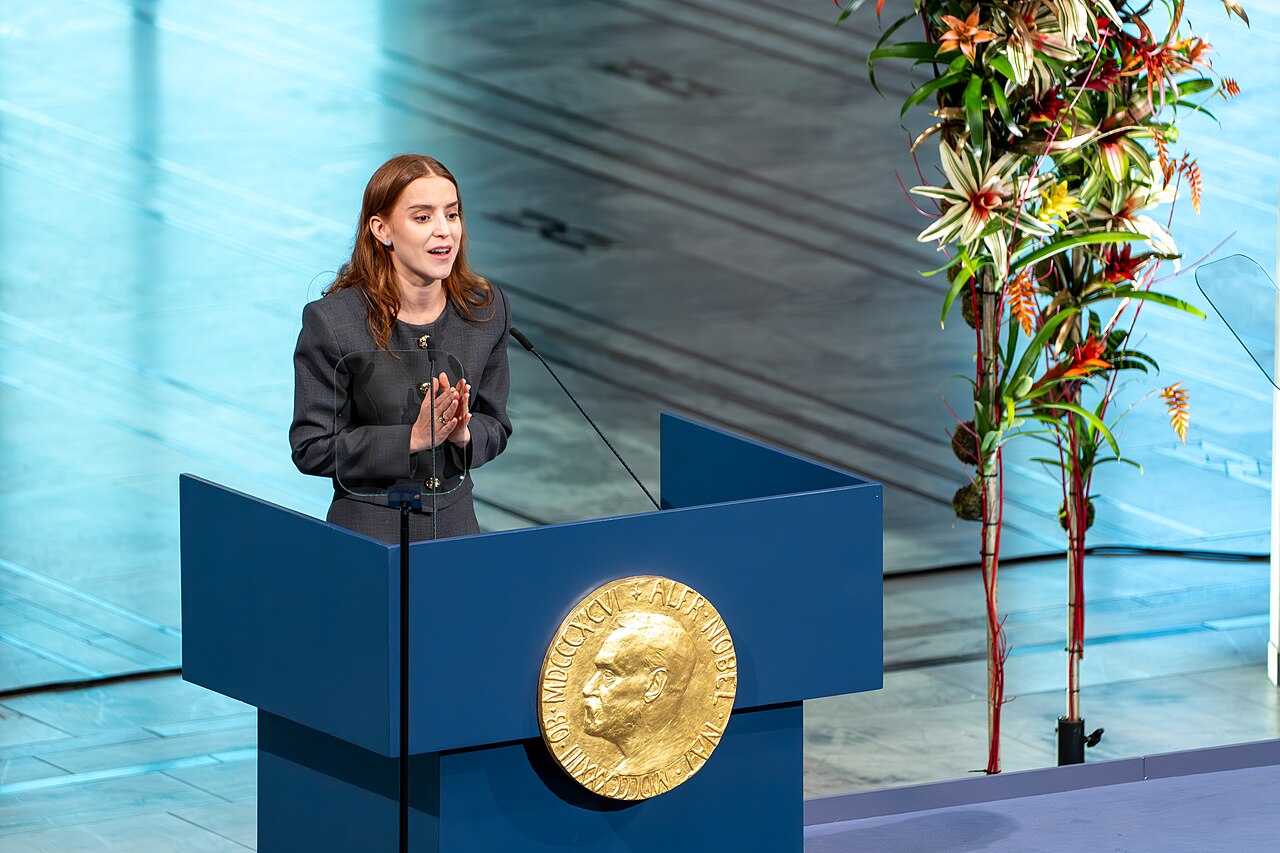
The global campaign against the use of sexual violence in conflict may gain significant momentum as Israeli Minister of Innovation, Science, and Technology, Gila Gamliel, has announced her intention to nominate former hostage Amit Soussana for the 2027 Nobel Peace Prize. Soussana, a lawyer whose life was shattered after her abduction by Hamas-affiliated militants on October 7, 2023, is recognized for her extraordinary courage in speaking publicly about the atrocities she endured during her 55 days of captivity.
The Path to Global Recognition
The decision to put forward the nomination was made coinciding with the International Day for the Fight Against Violence Against Women. Minister Gamliel, who also serves as a member of the nation’s security cabinet, plans to submit the official paperwork alongside Anat Vidor, President of the World Women’s International Zionist Organization. The submission will be directed to the esteemed Norwegian Nobel Committee. Gamliel, in her official capacity as a government representative and Knesset member, is qualified to propose candidates for the prestigious award, with the submission deadline set for January 31, 2027.
A Voice for Survivors
Gamliel emphasized in a public post that Soussana has exhibited profound bravery. She highlighted how the former captive has openly discussed the sexual brutality she suffered, transforming her personal experience into a worldwide movement aimed at dismantling the practice of using sexual violence as a tool of war. Since her release in 2024, Soussana became the first former detainee to publicly share the details of her assault without maintaining anonymity. This powerful disclosure has inspired other survivors worldwide to share their own harrowing accounts.
Impact and Precedent
Soussana’s narrative has reached international platforms; she has spoken about her experiences both in New York City and Washington D.C., and her story was featured in a notable documentary. She also received a major humanitarian honour in March 2025, recognizing her dedication to human rights.
The recognition of her plight is not unprecedented. In 2018, the Nobel Peace Prize honoured Nadia Murad and Dr. Denis Mukwege for their tireless efforts to halt the exploitation of sexual violence during periods of armed conflict. Murad, who survived being held as a sex slave by militants in northern Iraq, and Dr. Mukwege, whose medical work addresses these traumas, set a powerful precedent for the acknowledgment of survivors’ advocacy.
The nomination underscores a growing global consensus that the fight against wartime sexual abuse is a critical component of international peace and human rights advocacy.
