


Local News
International President and CEO of Bridges for Peace, Rebecca Brimmer, visits Winnipeg
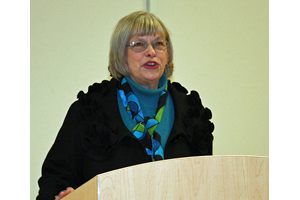
By BERNIE BELLAN Two years ago we ran a press release from Bridges for Peace, in which the organization announced that an interview that I had been planning on doing with BFP International President and CEO Rebecca Brimmer when she was slated to arrive in Winnipeg that April had to be postponed because of – you guessed it: the onset of Covid.
That seems like eons ago, but when I was invited to attend a luncheon at the Asper Campus to hear from Becky (which is what everyone who knows her calls her), along with other representatives of BFP, I was only too glad to do so (although, as I explained to the person who contacted me from BFP: I wanted to be absolutely sure that proper protocols were in place, including safe distancing, also that I would be wearing a mask. I said that I’m still not comfortable being in public places where there are large groups of people, when not everyone is masked.)
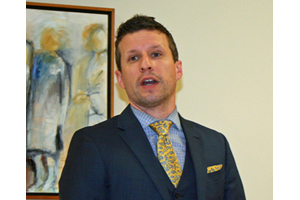
As it was, it was only a very small group of invited guests, representing various Jewish organizations, who were on hand to hear from Becky, also from Peter Fast, Executive Director of BFP Canada (and soon to be CEO of BFP International, taking over from Becky next year). We were also told that we were going to be hearing from one more speaker: Tom Brimmer (Becky’s husband), whom I had the pleasure of meeting – along with Becky, in 2011, when they were both here to attend a function at the Shaarey Zedek honouring then-Executive Director of BFP Canada John Howson, upon his retirement from that position.
Tom Brimmer, by the way, is a licensed tour guide in Israel. I told him that I recalled meeting him back in 2011 when he was wearing a plaid shirt and heavy boots. I told him that he looked like a lumberjack back then. If you take a look at his picture here, I think you’ll agree that he is still not likely to make the cover of GQ.
For those of you not familiar with Bridges for Peace, it’s a Christian organization whose purpose is to foster good relations between Christians and Jews and to provide a range of services for Israeli citizens (of all denominations) who are in need of assistance. Through food banks which it operates in two Israeli cities (Jerusalem and Karmiel), BFP provides over three tons of food a day to over 24,000 Israelis. Now, with the influx of refugees from Ukraine, BFP has stepped up its food donations to meet the needs of many of those refugees, also refugees who have arrived from Ethiopia, Becky explained during her talk. In addition to food banks, BFP volunteers also do home repairs, and help Israelis with medical and dental needs.
During Becky’s talk, she told of her own experiences with BFP in Israel, where she has lived since 1993 (although she and Tom have now moved to Missouri, she told me during lunch, but they both travel back and forth from there to Israel on a regular basis).
Explaining what it is that BFP is attempting to achieve, Becky said the primary purpose is “having a future when Christians and Jews are good friends. There are so many things we share in common.”
While Peter Fast’s role in Canada has been to promote good relations between Jews and Christians, primarily by reaching to members of over 500 churches across Canada, Becky noted, her role in Israel has been “on the other side of the bridge” – reaching out to Jews to demonstrate how supportive so many Christians are of the State of Israel.
By doing so, she continued, “We are doing everything we can to educate the Christian world to undo the damage done in the past. We want to show a different face (to Jews) by acts of kindness.”
While one may have thought that, with the advent of Covid in 2020, donations to BFP and subsequently, support for Israel, might have dried up, just the opposite has happened, Becky observed.
“Christians saw the need to give more,” she stated. In 2022 already, “we’ve raised 50% more than we had budgeted” as a result of the generosity of donors. Becky gave the specific example of BFP in Japan, which has only a very small Christian community. Since the war in Ukraine began, however, and thousands of Ukrainian Jewish refugees have arrived in Israel, over $500,000 has been donated to BFP Japan, she said.
Referring to the Holocaust and how few Christians intervened to help save Jewish lives, Becky noted that many people like to say: “If I had been alive then I would have helped.”
“Well, this is my time to help now,” Becky said. Bridges for Peace “will help as many Jews from Ukraine as we can, also Jews from Ethiopia.”
Since Bridges for Peace officially began (in 1976), it has helped over 100,000 individuals make aliyah to Israel, Becky noted.
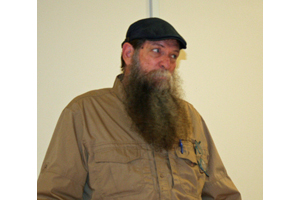
Following Becky’s remarks, her husband Tom took the podium. Tom explained that he wanted to talk about tourism – and how much of a hit Israel has taken to its tourism industry since Covid first emerged worldwide in 2020.
For Tom Brimmer, tourism has given him the opportunity to show Christian tourists what Israel is all about, he said. “Tourism changes people,” he observed.
“Christians come to Israel with every kind of attitude you can imagine,” he said, “but they leave with a changed attitude.”
“The tourism industry,” in Israel, he added however, “has suffered a terrible blow the last two years.”
Yet, while it now appears that tourism is set to make a huge rebound in Israel, as Covid restrictions have been lifted, there is one huge problem, Tom suggested: Almost all the tour guides who lost their jobs as a result of Covid have found other jobs in the meantime. Will they want to leave those new jobs and return to being tour guides? he wondered.
Further, “90 percent of the restaurants that depended on tourists closed,” he added.
Something else Tom noted: Seven hotels were transformed into Covid hotels exclusively. Are they going to revert to normal hotel operations now?
Still, he was optimistic. “We’re going to make a comeback. It’s going to be okay,” he predicted.
As of this moment, “it’s hard to book a tour – they’re in such great demand,” Tom said. On top of that, he said, “we’re training a whole new crop of tour guides, but it does take two years to train a tour guide.”
At that point Tom switched gears and began talking about a Bridges for Peace program with which he’s been heavily involved since it first began in 2006, something called the “Zealous Israel Project.”
How that project began, Tom explained, was with his idea of taking a leaf out of the very successful Birthright program, and bring groups of from 18-30 young Christian adults to Israel for 10-12 days at a time.
In time the project morphed into something quite a bit more comprehensive when it was transformed into an 11-month internship program, based in Jerusalem, with ten different young adults participating at a time. (The mix is usually five males and five females, Tom noted, although it doesn’t always work out that way.)
“We want participants to see the land and experience training sessions with Israelis,” he added. “We teach young Christian adults why Israel is important.”
One of the first graduates of the program was none other than Peter Fast, who has gone on to become Executive Director of Bridges for Peace Canada and, as noted, is about to step into the role of International CEO of BFP.
In his own remarks, Peter Fast paid tribute to two of his predecessors who served as Executive Director of BFP Canada: John Howson, who was Executive Director from 1997-2011 (and who hardly looks much older than when I first met him over 15 years ago) and Eric Malloy, who served in that role until 2019.
Peter said that he and his young family will be moving to Israel in January next year and that he hoped to visit Winnipeg often once he moves into his new position in Israel.
Local News
Gavin Katz: “The next great Jewish football player”
By BERNIE BELLAN Back about 15 years ago I had the idea to hire renowned sports writer Scott Taylor to write occasional columns for The Jewish Post & News. Although the great Harvey Rosen – who passed away in 2022, was still our regular sports columnist, I thought that having Scott contribute his own takes on sports might add some additional flavour to the paper.
And it did – for several years – until Covid hit and I had to pare back expenses, including for freelance writers.
Scott has kept in touch from time to time since he last wrote for us though, so it was with great delight that I received an email from him the second week in June that had in the subject line: “Next Great Jewish Athlete.”
Here’s what Scott wrote in that email: “I was talking with Fort Garry Lions head coach John Makie last night.
“Thought you might like to know about the next great Jewish football player … if you don’t know already.”

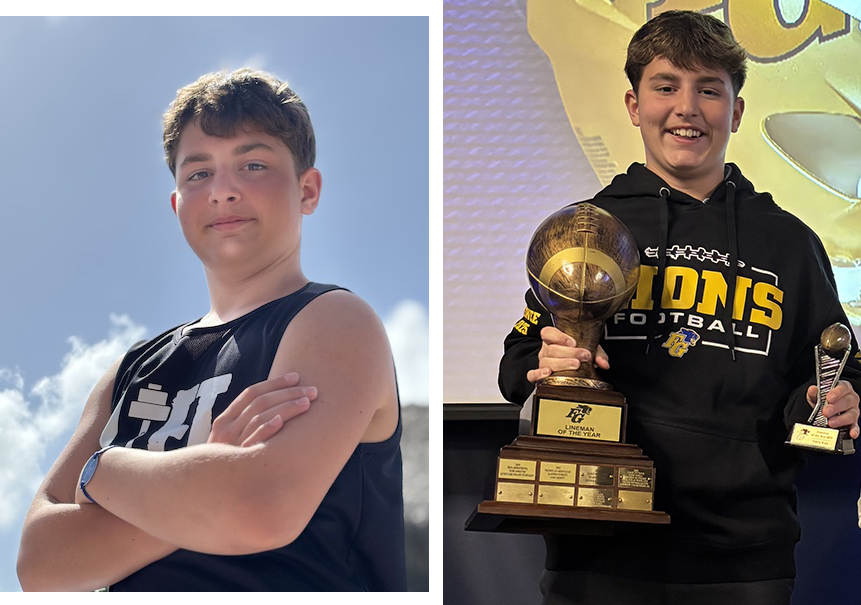
Attached to the email was a poster that was a montage of different images – all highlighting someone by the name of Gavin Katz. Part of the poster is attached here – and in it you can see all sorts of accolades for young Gavin, including his having been designated “lineman of the year” by Coach Makie last year, as well as his having captained his Pee Wee team (which is limited to players under 14 years of age).
I followed up Scott’s suggestion and contacted John Makie to try and get some comments from him about Gavin Katz, as well as contact information for Gavin’s parents.
Here’s what Coach Makie wrote to me about Gavin who, last year, was in his second (and final) year playing for the pee-wee level Fort Garry Lions:
“I’ve known Gavin Katz for a season of football. In this season, I’ve come to learn his grit, toughness and his sheer willingness to get to the ball. A lot of our players on the team would run to the ball, but Gavin sprinted. If he was challenged, he rose to the occasion. We made him our Most Outstanding Lineman not only because of his talents on the field but his leadership. He was committed to the process, he began to lead others to this through guidance and exemplary attendance.
“I am quite proud of Gavin and what he did for us this year.”
“Unfortunately, we came up just short last season, but Gavin taught us how to become a champion and the Lions will be hungry for success next season.”
“I really hope he continues to play football!”
That was high praise for Gavin Katz, indeed. During my conversation with Makie he told me that Gavin’s father was Regan Katz and that Regan was the vice-president and Chief Operating Officer of the Winnipeg Goldeyes baseball team.
I contacted Regan and asked him whether I could get in touch with Gavin. Regan gave me Gavin’s phone number, but when I tried calling him all that I got was his voice messaging. I did leave a voice message, but didn’t hear back from Gavin right away – which should come as no surprise for anyone who’s tried contacting a teenager by phone: They simply don’t use their phones for phone calling – only for texting.
So, on a Saturday morning – when I figured Gavin would probably be at home, I emailed Regan again, asking him whether he could have Gavin call me. It was 10:40 in the morning. Regan responded that Gavin was still asleep.
I wrote back: “What? I thought he’d be up jogging or doing some heavy exercise at 7 AM. What kind of pro football player is he anyway?” (Um, if you’re reading this and not familiar with my writing style, I do veer into sarcasm quite readily.)
In any event, around 11 am Gavin did call me back and we had a most pleasant conversation. After talking to him I could well understand why Coach Makie was so effusive in his praise for him.
I began by asking Gavin where he goes to school?
He said he’s currently in the French immersion program at Ecole River Heights and before that he was also in the French immersion program at Sir William Osler School. Next September Gavin will be going to Kelvin, he said.
We then began to discuss his football career. I asked Gavin when he first started to play organized football?
He said that he started playing flag football five years ago – and that he still plays flag football (which has only five players on a side, as opposed to the 12 players on a side in tackle football). Gavin added that, in addition to playing flag football – which he really loves, he noted, he also coaches and referees flag football.
Gavin’s interest in playing tackle football though, was piqued by his attending a Winnipeg Blue Bombers camp for putative young players four years ago.
“That’s when I first put on pads,” he explains.
Gavin added that he’s been going to Blue Bomber games ever since he was quite young and that, at various times he’s had the privilege of meeting such Blue Bomber greats as Adam Bighill, Nick Demski, Brady Oliveira, and Zach Collaros.
Two years ago Gavin joined the Fort Garry Lions Pee Wee level team (when he was 12).
“My first year I was on the offensive line,” he notes. “My second year (last year) I started as a linebacker, but then I was moved to the defensive line.”
Here’s a link to a clip of Gavin showing his prowess as a defensive lineman in a game last fall: Gavin in action (He’s number 50 in the video.)
Now, while Gavin was not overly tall for his age last year… he was 5’4″ and weighed 135 pounds, he was certainly big enough to play on the defensive line at the Pee Wee level.
But – talk about a growth spurt! Gavin says he grew four inches since the Lions season ended in October; he’s now 5’8″, but even more impressive – he says he’s put on another 35 pounds – and in Gavin’s case, it’s all muscle.
I asked him where he works out and he answered that the family has a home gym, which he uses assiduously, in the evenings.
Gavin says he’s ready to move up to the next level of football, which would be at the Bantam level or Junior Varsity, and that he will try out for the Kelvin Clippers when he enters Kelvin this fall. He says though that he would probably “end up on the practice roster” for the Clippers varsity team where he will be fighting for a playing role, because if he does make the team he’d be among the youngest players on the team (usually Grades 11 & 12 only).
Our conversation then turned to my asking Gavin about his family. I already knew his father’s name, I told him (and that his father was former mayor Sam Katz’s nephew), so I asked him what his mother’s name was? He said it was Mandy or Amanda and that her maiden name was Falk. Gavin also has a younger sister, Brynlee, who is eight, he said.
Gavin notes that he was bar mitzvahed last year. He’s also maintained very high marks in school, he says, getting a 91 in math and an 87 in science.
So, since Scott Taylor had billed Gavin as the “next great Jewish athlete” in his email to me about Gavin, I asked Gavin how far he wants to pursue football?
His answer was that “I’ll go as far as I can.”
Considering that he grew four inches and gained 35 pounds in less than a year, Gavin could very well be big enough soon to play on the defensive line for a team of under 16 year olds but, he says, “I like playing linebacker,” which requires a great deal more mobility than playing on the defensive line.
Still, linebackers have to combine a great many skills, including mobility, strength – and most of all, toughness, as they not only have to stop running backs, they often have to take on offensive linemen as well.
I asked Gavin what he likes most about playing linebacker? His answer: “I like hitting.” (Now, don’t take that the wrong way. It’s simply the enjoyment that many football players derive from the contact that comes with playing tackle football. And these days many young women have begun taking up tackle football for the same reason.)
But, what about injuries? I wondered. Has Gavin suffered any? I asked him.
“I’ve had a few injuries,” he answered. “I dislocated the growth plate in my elbow,” he noted and, “when I was ten I injured my achilles tendon,” he added. However, in neither case did Gavin require surgery – lucky for him.
How far into the future did Gavin see his football career headed? I asked him. He was ready with the answer: “I’d like to play for the Arizona Sun Devils” (the name of the Arizona State football team).
I told Gavin that, in past years (when I was more active as a writer) I’d profiled many young Jewish athletes for The Jewish Post & News. One of the athletes with the most potential was a young hockey player who could skate like the wind, I told Gavin, but unfortunately, he stopped growing and, as his coach at the time told me, he could teach skills, but he couldn’t teach “height.”
In Gavin Katz’s case though, since he’s only 14 and is already growing rapidly, it seem certain that his height and weight are not going to hold him back from continuing to excel at football when he moves up the ladder of stiffening competition as he grows older.
It will be interesting to check in with Gavin on a regular basis in the coming years to see how he’s progressing. Winnipeg’s Jewish community hasn’t produced too many star football players over the years, although I did mention to Gavin that I had done a story about a young man who had played for the Grant Park Pirates several years ago – and that my writing now about Gavin was going to lead me to try to look in our archives for that story to remind me who it was that I had written about – and perhaps whether I could find out anything about where he had gone with his football career.
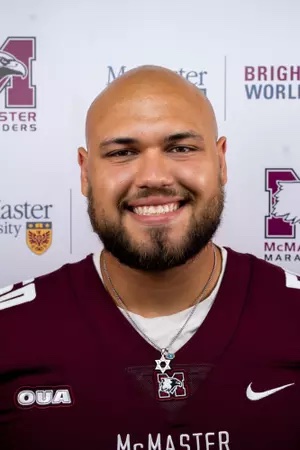
It turned out that the young man’s name was Nahaniel Lisak and that he had been nominated for the Jewish Athlete of the Year award back in 2022 when he was 17 years old, but was already 6’2″ and weighed an impressive 295 pounds. Here’s what the Rady JCC had written about Lisak prior to that year’s sports dinner: “He was named to the CFC (Canada Football Chat) All-Canadian First Team and was the recipient of the Winnipeg High School Football League (WHSFL) Kas Vidruk Lineman of the Year. At the school level he was named the Grant Park Football Most Valuable Player and was awarded the school’s Football Captain Award. He was runner up for the 2021 WHSFL Defensive MVP & 2021 Harry Hood Citizenship Award. In grade 10 he became a known player in Manitoba and was named a Nationally ranked top 100 player in Canada, being a top 5 Manitoban and top three defensive tackle in the 2022 graduating class.”
I Googled Nathaniel Lisak to see if I could find out anything about him now and saw that he’s realized his dream of attending McMaster University (where he’s in his fourth year of Commerce) and is also a star player for the McMaster Marauders.
So Gavin, if you’re reading this – there’s a stellar example of someone whose career you could emulate. But the Arizona Sun Devils? Couldn’t you settle for the University of Manitoba Bisons? Why do our best and brightest almost always want to leave Winnipeg?
Local News
Chesed Shel Emes project to improve safety, accessibility and parking after acquiring fire-damaged property
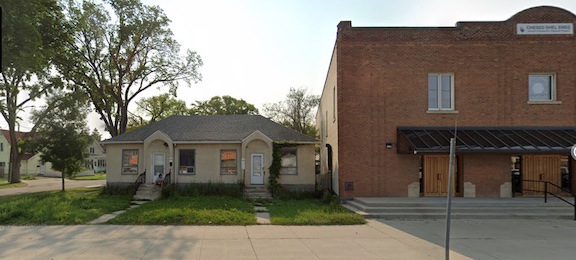
By MYRON LOVE The Chesed Shel Emes, Winnipeg’s non-profit funeral chapel and ritual tahara house, has embarked on a new project that will enhance safety, accessibility and provide more parking opportunities.
The new project stems from the Chesed’s acquisition of the property immediately north of the chapel on Main Street at Magnus Avenue. The plan will involve the demolition of the existing house and paving of the lot. This will allow the use of a pre-existing side door in the chapel to be used to transfer coffins directly to the hearse — thus freeing some additional parking in front of the building.
Rena Boroditsky, the Chesed’s long-time executive director, points out that pallbearers will no longer have to carry coffins down the front steps but, instead, walk along a level surface and place the caskets directly into the back of the hearse. As well, the new parking lot will have room for accessible parking.
“We weren’t looking for a new project,” Boroditsky reports. “About a year ago, we learned that the family who owned the home — and had been renting it out for a number of years — was looking to sell after the property suffered a devastating fire. We seized on the opportunity rather than have a retail business open or an apartment block be built that would further complicate the parking in front of our building.”
Boroditsky notes that the finished product will take a couple of years to complete. “Permits take time,” she says. “I expect that we will be able to demolish the house in the fall and have the paving done next year.”
She estimates that the budget for the work will come to about $190,000. “We have applied to the Jewish Foundation of Manitoba and the Asper Foundation for grants,” Boroditsky reports. “We are also appealing to our many generous supporters in the community.”
She proudly points out that Chesed succeeded in raising $4-million for its most recent redevelopment program, in which the 100 year old office and tahara building was replaced with a new structure designed specifically to meet the needs of the Chevra Kadisha.
The new building includes state-of-the-art equipment for the care of the deceased — a larger tahara room with stainless steel counters, new up-to-date refrigeration, mechanical lifts for transferring bodies more safely, and enhanced safety features to improve the experience of volunteers and ensure the dignity of the deceased. The accessible facility also includes expanded storage space for caskets, shrouds, and supplies, a lending library, and private meeting spaces for mourners to gather. That project was completed five years ago.
“We are happy to report that we don’t have a mortgage,” Boroditsky says. “We have always exercised good fiscal management, and have been blessed with community support”.
Chesed Shel Emes began operations in 1930, serving all members of the community regardless of denomination, affiliation, or level of observance. No one is denied service due to financial constraints. Everyone is guaranteed a dignified funeral and burial care. The chapel was opened in 1947 as an active synagogue and community center.
“Over the past few years, we have been hosting more funerals,” Boroditsky notes, “in part because the Shaarey Zedek was closed for renovations for almost two years, and the Etz Chayim relocated to Wilkes Ave. As a result, more people were able to see that we offer a clean, warm and welcoming space.
Readers who wish to make a gift to support the “Opening New Doors” campaign can phone Rena at 204-582-5088, or visit the website at www.chesedshelemes.org New Chesed Shel Emes project will improve accessibility, allow for more parking in front
Local News
Dina Raihman’s lifelong journey in education
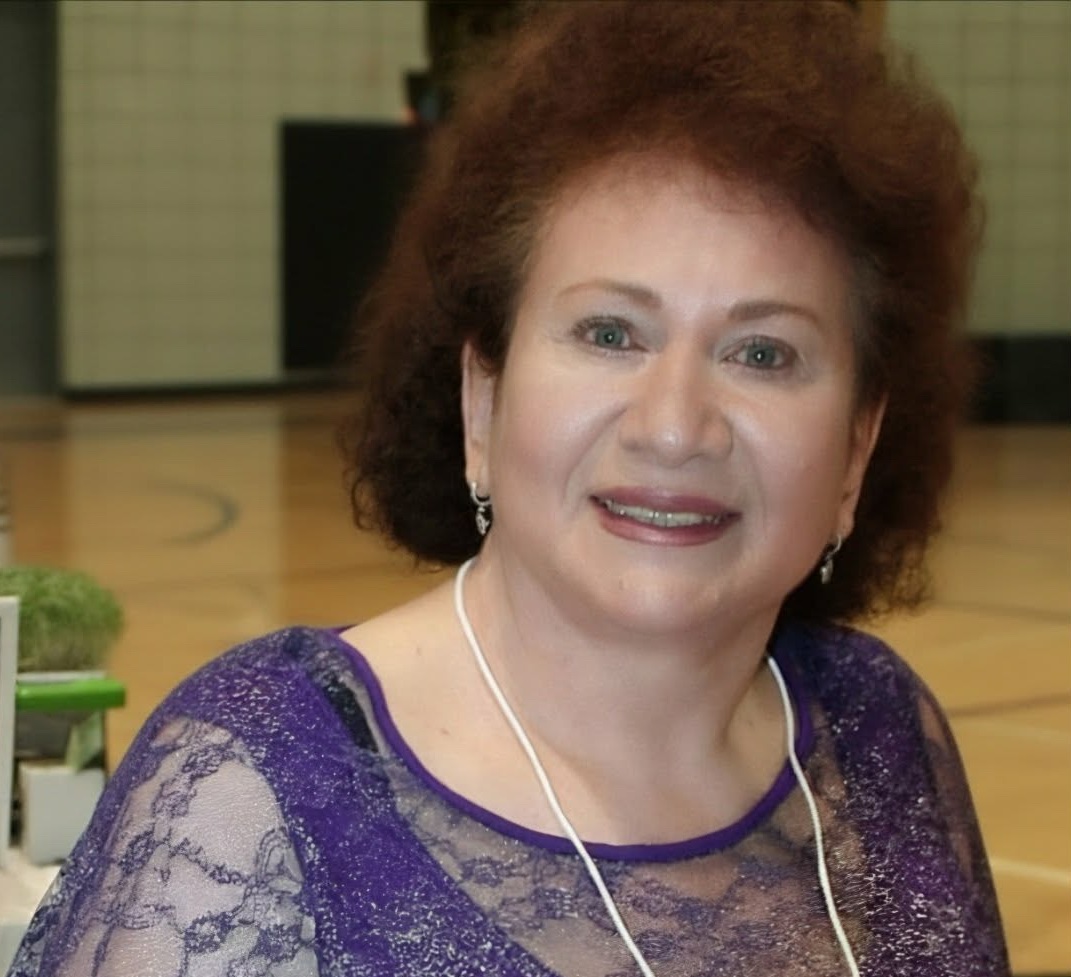
Foreword by BERNIE BELLAN Seven years ago, The Jewish Post & News published a story by Rebeca Kuropatwa about a woman who had arrived in Winnipeg from Israel in 2008. That woman was Dina Raihman.
Before moving to Canada, Dina had spent 25 years working as an educator in Israel. As Rebeca wrote at the time, Dina brought her passion for teaching with her and eventually opened her own private after-school program specializing in mathematics and science.
Over the years, Dina has kept in touch with us as her educational programs have continued to grow. What began as evening classes held in rented classrooms throughout Winnipeg gradually evolved into permanent school locations.
In 2022, she opened Integral School at 1080 Waverley Street in Linden Woods. Since then, a second location has opened in Transcona, and Dina says plans are already underway to open a third location in Sage Creek. All three locations offer after-school educational programs for students of different ages and abilities.
As we noted in a 2022 follow-up article to Rebeca Kuropatwa’s original story, Dina quickly identified a problem after beginning work as a substitute teacher in Manitoba’s public and private schools. She noticed that many mathematically gifted students were not being sufficiently challenged and, as a result, were failing to reach their full potential.
In 2014, she decided to do something about it.
Starting with only 17 students, her evening school steadily expanded. Today, approximately 270 students are enrolled in her programs.
When Dina recently contacted me to tell me about the opening of her second location in Transcona, I told her that rather than simply writing another update about the school, I wanted to know the story behind the educator herself.
Both Rebeca and I had previously written about Dina’s success working with children from many immigrant families, including those from countries where mathematics and science education has traditionally been emphasized, such as Israel and Ukraine. But neither of us had ever explored the experiences that shaped Dina’s own lifelong commitment to education.
So I asked Dina to tell her story in her own words.
Here it is:
My Story
By DINA RAIHMAN My story began long before I was born.
During World War II, my parents, along with my grandparents, were forced to leave Ukraine to escape the war. Fate brought them to Georgia, where our family eventually settled. It was there, after the war, that I was born.
My childhood, school years, and youth were spent in Georgia. It was there that I first discovered my love for mathematics and realized I wanted to become a teacher. I have always believed that a great teacher changes a child’s life not only by teaching a subject, but by teaching a child how to think.
I later attended the Voroshilovgrad Pedagogical Institute (now located in the city of Luhansk, Ukraine), where I earned a Master’s Degree in Mathematics and Physics. Even then, I knew teaching would become my life’s work.
In 1990, my husband and I made an important decision to begin a new chapter of our lives in Israel.
We lived there for seventeen years, raised our two children, and continued building both our family and our careers.
Then, in 2006, we made another life-changing decision.
We immigrated to Canada after my older sister had moved here. Like many newcomers, we knew we were starting almost from scratch, but we believed the opportunities available for our children made every sacrifice worthwhile.
As with many internationally trained professionals, I needed to have my education recognized in Canada. Although I already held a master’s degree and many years of teaching experience, I was required to earn Canadian teaching qualifications.
For a period of time, I worked at the University of Winnipeg. I was even offered the opportunity to pursue a PhD and continue an academic career.
Although it was an exciting opportunity, our family had only recently arrived in Canada. Financially, it was impossible for me to devote several years to graduate research while supporting my family. Instead, I chose another path—one that allowed me to continue studying while working.
I became a substitute teacher in Winnipeg.
Looking back, those years were among the most valuable of my professional life.
Over several years, I taught in approximately 80 percent of Winnipeg’s schools. Every school, every classroom, and every group of students gave me new experiences and broadened my understanding of Canadian education.
While teaching, I also continued studying at the University of Winnipeg to earn my Permanent Professional Teaching Certificate.
In 2010, I successfully received my Permanent Professional Teaching Certificate, allowing me to teach permanently in Manitoba schools.
My first full-time teaching position took me far north to the community of Pukatawagan, where I taught Biology to students in Grades 9 through 11.
The experience taught me resilience, adaptability, and the importance of understanding every student’s individual background.
After one year, I returned to Winnipeg and continued substitute teaching.
During the 2012–2013 school year, I accepted a one-year teaching replacement position in Saskatchewan, where I taught Mathematics to students in Grades 9 through 12.
By then, an idea that had been growing inside me for years had become impossible to ignore.
I wanted to create my own educational program—one that would help students truly understand mathematics, develop logical thinking, build confidence, and prepare for future academic success.
That dream became reality in 2014 when I founded the Physics and Mathematics Integral School.
The school first opened on Corydon Avenue before later moving to St. Vital.
Today, we operate permanent locations on Waverley Street and in Transcona, and we are preparing to open our third Winnipeg location in Sage Creek.
Since opening our doors, our mission has never been simply to teach mathematics.
We have always wanted to create an environment where children learn to think independently, analyze problems, embrace mistakes as part of learning, and believe in themselves.
Over the years, more than 1,000 students have studied with us.
One of our greatest sources of pride is seeing our graduates continue their education at Canadian universities in fields such as engineering, computer science, medicine, economics, and the natural sciences.
Since opening in 2014, we have helped more than 430 students successfully graduate from high school, many of whom have continued into university programs requiring strong mathematical foundations.
For us, however, success means much more than university admission.
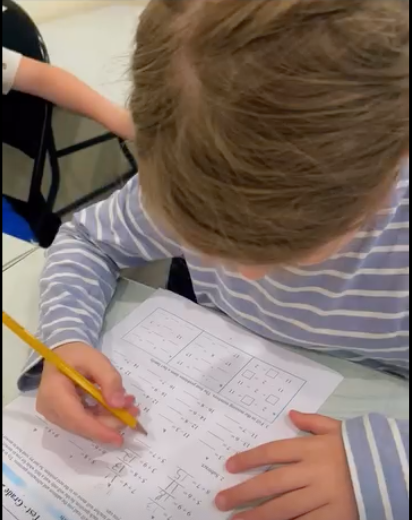
We strive to develop logical thinking, independent problem-solving, confidence, perseverance, concentration, and the ability to learn from mistakes.
I often tell my students:
“Mistakes are not failures. They simply show us what we still have to learn.”
Today, approximately 270 students attend our programs.
We offer both in-person and online classes, making our programs accessible to students throughout Winnipeg and beyond.
Our youngest learners begin at 3 to 5 years of age, where they develop early mathematical thinking, logic, concentration, and problem-solving skills through engaging activities designed specifically for preschool children.
For school-age students, we offer both Beginner and Advanced groups, ensuring that every child learns at the level best suited to their abilities.
Our programs include:
Mathematics
Logic
Geometry
Mental Math using the Japanese Abacus program
Biology
Chemistry
Physics
In addition to our regular classes, we prepare students for mathematics competitions. Each year, many of our students participate in contests organized through their schools, where they apply not only mathematical knowledge but also logical reasoning, analytical thinking, and effective time management.
One of our proudest achievements is that 15 of our students have earned certificates recognizing them among the top 25 percent of young mathematics students in Canada through these prestigious competitions.
For me, these accomplishments represent much more than awards.
They demonstrate that every child has the potential to succeed when they are given encouragement, effective instruction, and the opportunity to believe in themselves.
Throughout my career, I have come to believe one simple truth:
Children are not born “good” or “bad” at mathematics.
They become successful when they have a teacher who can explain difficult ideas in simple ways, encourage them during challenging moments, and inspire them never to give up.
That is why every student who walks through our doors becomes part of one large family.
Looking back today, I realize that the journey that began many years ago in Georgia has become far more than a teaching career.
It has become a lifelong mission to help children discover confidence, develop their abilities, and understand that with the right guidance, they are capable of achieving far more than they ever imagined.
