Local News
Quebec premier urges Montreal mayor to take a harder line on rioters after a weekend of violence
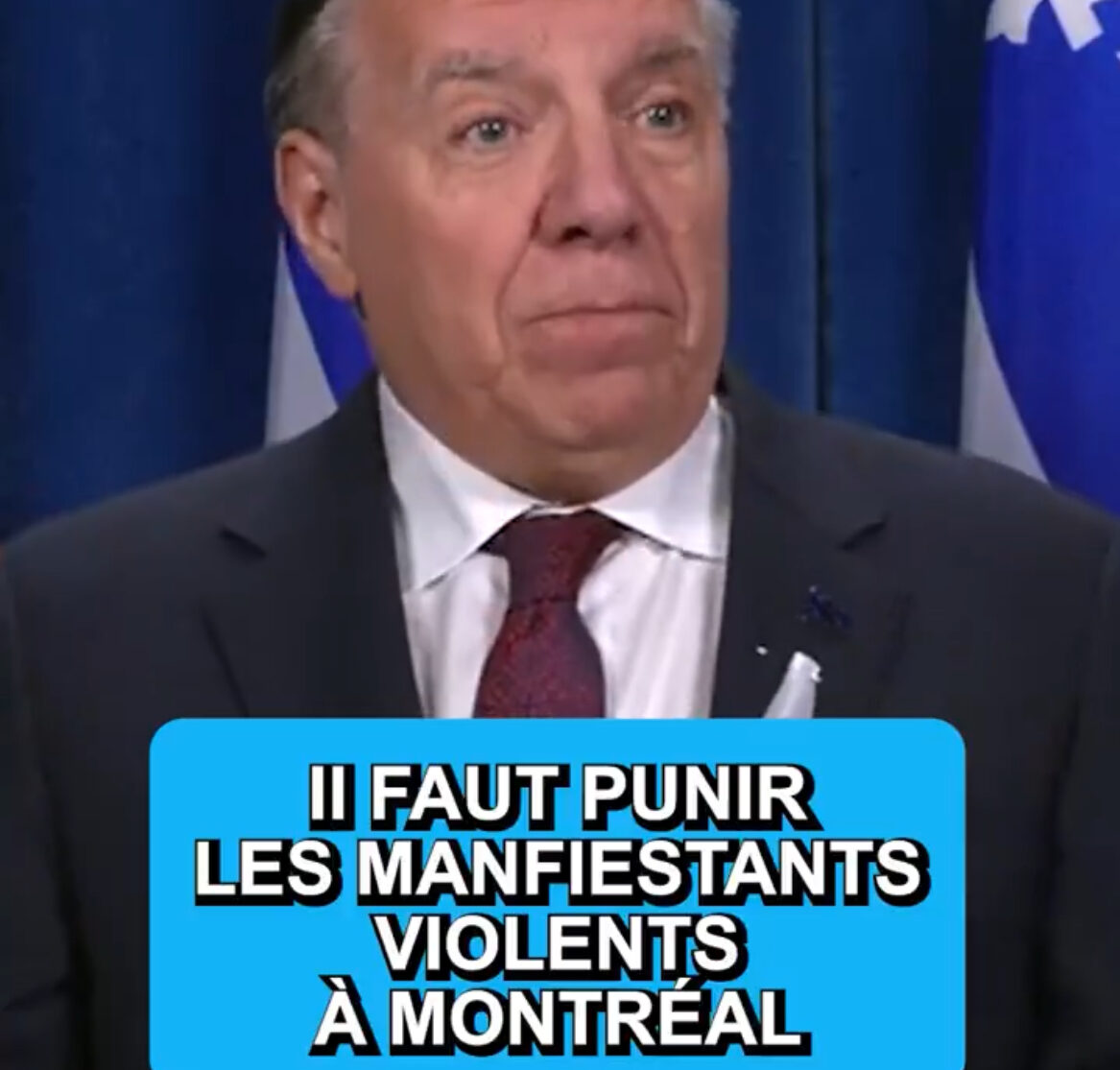
(Nov. 27, 2024) By Joel Ceausu (Canadian Jewish News) François Legault wants Valérie Plante to get her house in order.
Speaking to reporters in Quebec City on Nov. 26, the premier talked about the violent demonstrations over the previous weekend in Montreal, where fires were started, and Service de police de la Ville de Montréal (SPVM) officers were assaulted at a joint demonstration in support of Palestine and protesting a visiting NATO parliamentary assembly.
“These thugs, they will be punished, they will be arrested. There will be consequences for what they did, for what they are doing now in Montreal.” After the National Assembly passed a unanimous motion condemning the violence, Legault said it’s time for the mayor of Montreal to deal with demonstrators who set fires, smashed windows, and attacked police officers.
François Legault wants Valérie Plante to get her house in order.
Speaking to reporters in Quebec City on Nov. 26, the premier talked about the violent demonstrations over the previous weekend in Montreal, where fires were started, and Service de police de la Ville de Montréal (SPVM) officers were assaulted at a joint demonstration in support of Palestine and protesting a visiting NATO parliamentary assembly.
“These thugs, they will be punished, they will be arrested. There will be consequences for what they did, for what they are doing now in Montreal.” After the National Assembly passed a unanimous motion condemning the violence, Legault said it’s time for the mayor of Montreal to deal with demonstrators who set fires, smashed windows, and attacked police officers.
https://platform.twitter.com/embed/Tweet.html?creatorScreenName=TheCJN&dnt=true&embedId=twitter-widget-0&features=eyJ0ZndfdGltZWxpbmVfbGlzdCI6eyJidWNrZXQiOltdLCJ2ZXJzaW9uIjpudWxsfSwidGZ3X2ZvbGxvd2VyX2NvdW50X3N1bnNldCI6eyJidWNrZXQiOnRydWUsInZlcnNpb24iOm51bGx9LCJ0ZndfdHdlZXRfZWRpdF9iYWNrZW5kIjp7ImJ1Y2tldCI6Im9uIiwidmVyc2lvbiI6bnVsbH0sInRmd19yZWZzcmNfc2Vzc2lvbiI6eyJidWNrZXQiOiJvbiIsInZlcnNpb24iOm51bGx9LCJ0ZndfZm9zbnJfc29mdF9pbnRlcnZlbnRpb25zX2VuYWJsZWQiOnsiYnVja2V0Ijoib24iLCJ2ZXJzaW9uIjpudWxsfSwidGZ3X21peGVkX21lZGlhXzE1ODk3Ijp7ImJ1Y2tldCI6InRyZWF0bWVudCIsInZlcnNpb24iOm51bGx9LCJ0ZndfZXhwZXJpbWVudHNfY29va2llX2V4cGlyYXRpb24iOnsiYnVja2V0IjoxMjA5NjAwLCJ2ZXJzaW9uIjpudWxsfSwidGZ3X3Nob3dfYmlyZHdhdGNoX3Bpdm90c19lbmFibGVkIjp7ImJ1Y2tldCI6Im9uIiwidmVyc2lvbiI6bnVsbH0sInRmd19kdXBsaWNhdGVfc2NyaWJlc190b19zZXR0aW5ncyI6eyJidWNrZXQiOiJvbiIsInZlcnNpb24iOm51bGx9LCJ0ZndfdXNlX3Byb2ZpbGVfaW1hZ2Vfc2hhcGVfZW5hYmxlZCI6eyJidWNrZXQiOiJvbiIsInZlcnNpb24iOm51bGx9LCJ0ZndfdmlkZW9faGxzX2R5bmFtaWNfbWFuaWZlc3RzXzE1MDgyIjp7ImJ1Y2tldCI6InRydWVfYml0cmF0ZSIsInZlcnNpb24iOm51bGx9LCJ0ZndfbGVnYWN5X3RpbWVsaW5lX3N1bnNldCI6eyJidWNrZXQiOnRydWUsInZlcnNpb24iOm51bGx9LCJ0ZndfdHdlZXRfZWRpdF9mcm9udGVuZCI6eyJidWNrZXQiOiJvbiIsInZlcnNpb24iOm51bGx9fQ%3D%3D&frame=false&hideCard=false&hideThread=false&id=1861518154888867889&lang=en&origin=https%3A%2F%2Fthecjn.ca%2Fnews%2Flegault-vs-plante%2F&sessionId=8b418151423742a1f9e30446b7101b60b50adde5&siteScreenName=TheCJN&theme=light&widgetsVersion=2615f7e52b7e0%3A1702314776716&width=500px
“A lot of Quebecers are appealing to me, but it is not the Quebec government or the Sûreté du Québec (SQ) that remains responsible for the territory of Montreal. It is the City of Montreal, it is the SPVM.”
A visibly frustrated Legault said he spoke with Plante earlier in the day, “and I told her, it’s time to restore order in Montreal, and I offered to send the SQ. There has to be a very clear message sent to these thugs, that they are going to be punished.
“I expect that there will be a lot more than three arrests in the coming days,” Legault said.
Three arrests were made Friday for obstruction, assaulting a police officer and mischief.
Quebec’s public safety minister François Bonnardel told French-language television the number of arrests will rise, among “rioters and anarchists” who participated, and reiterated what the SPVM has said for more than a year, that arrests are typically more easily made after an incident rather than in the midst of chaos, which could inflame a situation.
That strategy in particular has angered many Montrealers, who have noted that the dissuasive effect of a robust police response during incidents has been all but invisible over the last year.
On the weekend, SPVM chief Fady Dagher said he’s also confident more arrests will be made, and that the groups responsible for the chaos are very well known to Montreal police, who will be going over abundant surveillance camera footage over the next days and weeks.
Also on Tuesday, Bonnardel—along with Westmount-Saint-Louis MNA Jennifer Maccarone and three other opposition —introduced a motion, affirming that the National Assembly strongly condemn the violent acts and antisemitic acts that took place during the demonstrations of Nov. 21 and 22 in Montreal; condemn any attack targeting the Jewish community; condemn “any form of support for Hamas”; and recalls the right to demonstrate freely and peacefully.
“Finally, that it reiterates, as unanimously stated on Oct. 3, 2024, that the National Assembly does not condone civil disobedience.” The motion passed 103 to 0.
On Friday night, just a few hours after police restored order, Montreal Opposition Leader Aref Salem said “Like many, I feel bad for my city tonight. These intolerable acts serve no cause. The right to protest does not justify chaos. For its part, the Plante administration’s silence resonates, aggravating Montreal’s wounds.”
Plante posted on social media on Nov. 23, that “the outbursts of last night’s demonstration are shocking and have no place in a peaceful metropolis like Montreal. Neither chaos, violence or mayhem against shopkeepers are tolerated and I thank the SPVM who made several arrests yesterday.”
Then on Monday, the mayor tried to quell some of the growing criticisms of her management of the city’s unrest for more than a year, saying, “Antisemitic gestures, destruction, violence and brutality against the police or fellow citizens have no place. It’s not how to express yourself.”
She says, “shameless thugs” broke windows, set cars on fire and wreaked havoc, adding, “it’s the last thing we want to see, and the last thing we want in a city like Montreal,” before praising the SPVM and their high level of training and skills in crowd control and handling rowdy demonstrations. “I am proud of the police we have here in Montreal,” she said. “And the work will continue.”
Plante said that over several months, she has read comments “and received messages from families, from communities, Arab-Muslim, but also from the Jewish community, and I think we must reiterate, as I have always done, that acts and words we heard during the weekend that were clearly antisemitic have no place in Montreal.”
Plante’s comments also came two days after Rabbi Adam Scheier of Congregation Shaar Hashomayim, who was standing silently filming a demonstration downtown as he drank coffee from the Second Cup—as a show of support for the coffee chain, which quickly cut ties with a Jewish General Hospital franchisee due to her antisemitic expressions amid a prior protest—was asked by police to leave the area for fear that the presence of a kippah-wearer would incite demonstrators.
The right to demonstrate is a constitutional right, Plante affirmed, “but not to the detriment of a community that is made to feel that they do not belong.”
Rioters, she said, were there to provoke. “They are known to police… and the demonstration was no longer about housing, the economy or support for Palestine.” They exploited the situation, she said, infiltrating a demonstration “where there were citizens, parents with strollers and children. These were professionals… and they stole the demonstration from people who came out of conviction and did so peacefully.”
Local News
Epic court battle shaping up next week between Etz Chayim Congregation and two former members who are now barred from setting foot in Etz Chayim

By BERNIE BELLAN This story was originally posted August 14, but with the date of the court battle soon approaching we thought it timely to repost it to the top of our website.
Here’s how it read when it was first posted: When we first posted this story Friday morning, August 14 – with a photo of Etz Chayim Synagogue, we received an email from Morissa Granove, COO of Etz Chayim Congregation:
“Hi Bernie.
“This request is not about the article itself but the safety of our shul. We have been advised not to post the address or photos of our Jewish organizations publicly for some time for security reasons. Can I please ask that you change the image posted online (and planned for print if needed) and that in this be kept in mind for the future?
“Thank you so much for your understanding,
“Morissa”
We replied:
“Gee Morissa – I’ll do that but maybe you better ask Google to remove any mention of any Winnipeg synagogue because all anyone has to do is do a Google search and they’ll come up with a complete list of Winnipeg synagogues and their addresses – also photos! Do you want me to contact Google for you? Can’t be too careful, can we?
Now, here’s the story as it was originally posted:
The date October 7 carries a huge amount of significance for Jews around the world: It was the date that members of Hamas and other terrorist groups launched a murderous attack on innocent Israelis (and members of other nationalities) that resulted in the deaths of more than 1200 people and the abduction of 251 others.
But it is also a date that may have a significance of a different sort come this October 7 when a Winnipeg courtroom will be the scene of a court case in what is shaping up to be a momentous legal battle between Congregation Etz Chayim and two former members of the congregation who have been barred from attending services – or even setting foot inside the building that houses Congregation Etz Chayim.
Before publishing this article I had sent copies to both sides in the dispute – and offered both sides the opportunity to correct any mistakes they might have found in what I had written. I did receive responses from both sides and have incorporated their suggested corrections into what follows.
The two individuals involved at the heart of this dispute are both former longstanding members of Etz Chayim – and before that, Rosh Pina Congregation: Dr. Emet Eviatar (previously known as Hadass), who had been the Torah reader at Etz Chayim for many years, and who had also led Sunday services; and her husband, well known scientist Dr. David Hoult (who played a leading role in the development of MRI technology and was also very active in the congregation). Drs. Eviatar and Hoult have filed suit against CEC over what they claim was the illegal termination of their membership.
In response, however, Congregation Etz Chayim asserts that it was not a question of membership when CEC exercised its right to refuse entry on the advice of the WPS and security experts who were consulted after a deeply concerning letter was received from one of the plaintiffs by the synagogue.
The filings in this particular case are in the hundreds of pages. I spent two recent afternoons at the Law Courts poring over the filings, and photographed pages of what I thought were some of the most relevant issues at hand so that I could quote accurately from those filings.
While the case may seem hugely complicated, given the number of pages of documents that have already been filed, it seems that it boils down to two essential issues: Did CEC violate its own bylaws (or its own constitution, as the case may be, because at the time of the events in question a bylaw which would have governed who might be excluded from belonging to the congregation had not yet been passed) by terminating the memberships of Dr. Emet Eviatar and Dr. David Hoult? The argument advanced by the plaintiffs is not that a congregation cannot decide who can belong to that congregation. Rather, it is an argument that CEC did not properly adhere to its own bylaws in the manner in which it has excluded the plaintiffs from attending – or even setting foot inside Etz Chayim.
But, a second issue in play – and one which is argued forcefully by CEC in one of its briefs is that the argument Emet Eviatar and David Hoult are advancing has no place in the courts in the first place. As is noted in one of the briefs filed on behalf of CEC: “The dispute is, at its core, about the internal governance of a religious congregation. It concerns who may participate in communal worship, who may participate in communal religious life, and how a synagogue governs itself in response to legitimate security concerns. If it is accepted that the dispute was about ideological differences, as alleged by the Applicants, then these are fundamentally religious questions. The court has no jurisdiction to adjudicate such matters, and ought not to intervene.”
How the parties arrived at this situation is a complicated – but very interesting story.
I, myself was first made aware that something unusual was going on between CEC and David Hoult when I received this email from Dr. Hoult on Friday afternoon May 30, 2025, at 12:42 pm:
“Hi Bernie,
“I have just had a pair of police officers at the door telling me that we are now banned from Etz Chayim and if we show up the police will be called, no reasons given. I suspect it was an accumulation of things, including a letter I sent.
“Shabbat shalom,
“David.”
Later that afternoon I received another email, this time from a member of CEC, who forwarded me an email that had been sent to congregation members by Morissa Granove, Chief Operating Officer of CEC. That email had a letter attached, which said, in part:
“On Tuesday, May 27th, we received deeply troubling correspondence from a member of our community. The nature of this communication raised serious concerns about the safety of our congregants and staff. After careful and deliberate consultation with our Board of Directors, Clergy, the Winnipeg Police Service, the Jewish Security Network, and the Secure Community Network (in partnership with the USCJ), and on their recommendations we have made the difficult but necessary decision to terminate the membership of this individual and all members of their household, effective immediately.
“These individuals are no longer permitted on the premises of Congregation Etz Chayim, nor may they participate in any of our synagogue’s programs or activities.”
The letter was signed by Morissa Granove, Chief Operating Officer of CEC, and Allan Cogan, President of CEC.
What the heck was going on? I wondered. So, I emailed Morissa Granove that same afternoon:
“Hi,
“I received an email from David Hoult telling me that he is now banned from the Etz Chayim. I assume Emet Eviatar is also banned too, judging by the way your email is worded.
“I don’t know David at all – other than having received a piece he wrote about Israel and Gaza that I published to my website. I can’t begin to imagine what he might have written, but in the interest of fair reporting and fuller disclosure, can you say anything more about what he wrote in his letter?
“-Bernie Bellan
“Publisher,
“jewishpostandnews.ca
“also Associate Editor,
“The Jewish Post Winnipeg”
But, Morissa Granove did not offer any more information as to what might have been contained in that “troubling correspondence” which was received by CEC.
It was only when I went down to the Law Courts on August 10 that I was actually able to see what was in that “troubling correspondence.”
But, before I get into what was in that particular communication, even more background to this strange case is necessary.
In an email I received from CEC COO Morissa Granove following my having sent her a draft of this article, she wrote: “Congregation Etz Chayim …has never taken action based on political views. Further, CEC argues that other members, congregants, and guests share Dr. Eviatar’s views and yet there has never been an issue with their behaviour and as such, Congregation Etz Chayim has never taken action against anyone, revoked a membership, or refused entry to anyone based on their political stance.” Dr. Eviatar, in her own words, notes that she had already provoked the displeasure of some members of CEC, including staff members, by certain of her behaviours while, according to Morissa Granove, “volunteering in a leadership role and officially representing Congregation Etz Chayim. CEC …is ‘a Zionist organization’.”
Yet, according to CEC, Dr. Eviatar’s family’s attendance at Etz Chayim was never in question – until a letter was received from Dr. Eviatar’s husband.
As is noted in a brief for the plaintiffs, the following is taken from an affidavit given by Emet Eviatar, which might suggest that her membership in CEC had been called into question long before May 2025:
“In July 2024, I co-founded Manitoba Friends of Standing Together, a chapter of the international support network created by Standing Together. Standing Together is a grassroots joint Jewish and Palestinian organization in Israel which was originally created in 2015 to fight for equal rights for Palestinian citizens of Israel. Since the October 7, 2023 attack by Hamas they have pivoted to protesting the war in Gaza.
“On October 6, 2024, I appeared as a guest on the local CBC Radio Weekend Morning Show, together with Mr. Ramsey Zeid, president of the Canadian Palestinian Association of Manitoba to discuss the importance of having local conversations between Jews and Palestinians…
“Later that week, I received a phone call from CEC Rabbi Kliel Rose and Cantor Tracy Kasner. They informed me that I would no longer be allowed to lead Sunday services. The rabbi also suggested that ‘for my own peace of mind’ I might want to consider finding another congregation (that aligns with my views.”)
“On November 4, 2024, I received an unsigned letter from CEC which was provided to me by the then executive director, Jonathan Buchwald…
“While the letter contains various false statements, and is clearly a reference to my having contact with Mr. Zeid and others in the local Palestinian community, the assertion that I was aligned with an ‘ideology which is mutually exclusive and contrary to the existence of the Jewish people and the state of Israel’ was extremely offensive and hurtful to my being an Israeli citizen, having family who live in Israel, and having served in the Israel Defence Forces.”
Later, on March 3, 2025, Emet Eviatar appeared a second time on the CBC morning weekend radio show, again with Mr. Zeid.
In an affidavit taken from Morissa Granove, Ms. Granove explained the CEC’s objection to Emet Eviatar’s publicly associating with certain individuals while officially representing Congregation Etz Chayim (noting that CEC’s objection bore no consequence to Dr.Eviatar’s or her the family’s membership.)
“This public alignment with parties opposed to Israel raised concern within CEC about potential risks surrounding the Synagogue, especially in times of heightened safety risks and awareness of antisemitic vitriol. These concerns were brought to the attention of Dr. Eviatar. She took no action to mitigate these concerns. As a result, she was removed from a volunteer leadership position she held with CEC. CEC took no action regarding either of the Applicants’ ability to attend the Synagogue as congregants.” In the email I received from Morissa Granove in response to a draft of this article, Ms. Granove added: “Still, her family’s membership was never in question.”
But, in May 2025 something happened that led the CEC to take drastic action against Emet Eviatar, David Hoult and the other members of their household. It should be explained that, according to an affidavit taken from Morissa Granove, who had stepped into the role of Chief Operations Officer of CEC in January 2025, in May 2025 CEC announced it would be adding new security measures, based on a “site security assessment from the Winnipeg Police Service. Officer Constable Justin Remillard (who) attended the Synagogue and provided guidance on improving security.
“Among other things, he advised:
“a) access to the Synagogue should be controlled;
“b) registration and entry lists should be used for programs and services at the Synagogue;”
On May 5, 2025 CEC held its Annual General Meeting. According to an affidavit taken from Ms. Granove, “During discussion relating to security protocols…David Hoult expressed opposition to security procedures such as locked doors at the Synagogue, registration requirements, and screening of visitors.”
The following is taken from an affidavit taken from Ms. Granove: “On May 22, 2025, CEC received a letter from Dr. Hoult. The most significant concern with the letter was that it stated:
‘If, G-d forbid, I wanted to attack the shul on Shabbat morning it would be trivial. A stolen motorbike, onto the lawn, Kalashnikov to shatter the windows, gun down the congregation, drive away, ditch the bike, gun, mask and clothes…” (Emphasis added)
The same affidavit states that, “In that correspondence, he again expressed opposition to security measures and described them as ‘hysteria,’ ‘paranoia,’ and ‘psychologically stupid.’ “
According to an affidavit taken from David Hoult, “My wife and I received no direct communication from CEC advising of the termination of our membership until a cheque with no accompanying letter was received in the mail on June 9, 2025.”
In an email received from Morissa Granove after I sent her a draft of this story she asked that this sentence be inserted: “Congregation Etz Chayim was interviewed extensively by the WPS before going to the home of Dr. Hoult for the service call and had all of the details which were required in order to qualify their actions.”
On September 16, 2025, Hadass (Emet) Eviatar and David Hoult filed an application in Court of King’s Bench to have the termination of their membership declared “null and void,” also seeking an “order to comply with bye-laws” (of the CEC).
In response, CEC asserts that it “has never terminated the Applicants’ membership. Rather the applicants were advised they were no longer permitted to attend the synagogue.” Morissa Granove asked that this be added: CEC “exercised its right to refuse entry on the advice of the WPS and security experts.’
Did it boil down to semantics? I wondered. CEC was saying that it hadn’t “terminated the Applicants’ membership,” yet it returned the cheque they had sent in to pay for renewal of their membership.
However, if it is the CEC’s position that, based on the plaintiffs’ claims as written, this matter is not one that should even be considered by the courts – as is noted at the beginning of this article, then arguments over whether CEC abided by its own bylaws would be moot.
Yet, if the courts might be willing to consider the issue whether CEC did not properly follow its own rules – as set out in its bylaws, then the Eviatar-Hoult case becomes more compelling.
For instance, the issue whether CEC “terminated” the memberships of Dr. Eviatar and Dr. Hoult might take on added importance.
As is noted in a brief for the plaintiffs, the letter sent out by Morissa Granove to members of CEC on May 30, 2025 states quite clearly that “We have made the difficult but necessary decision to terminate the memberships of this individual (Dr. Hoult) and all members of their household effective immediately.”
In this case the plaintiffs (Drs. Eviatar and Hoult) are arguing the nowhere within CEC’s governing constitution (which was adopted in 2014) were there “provisions for the termination of membership.” Therefore, their argument goes, “CEC had no authority to terminate their membership.”
Morissa Granove asked that this be added: “The defendant (CEC), however, argues that the CEC’s governing constitution says that “directors ‘may pass by-laws’ regulating, among other things, ‘the suspension and termination of membership by the corporation and by a member.’ The word ‘may’ is permissive.”
“Thus, CEC is arguing, therefore, that it had no obligation to actually pass a by-law governing the termination of a membership.”
As it was, the by-law was never voted upon, as, according to an affidavit given by Dr. Eviatar, CEC leadership “had not complied with the correct procedure, including giving proper notice.,
However, in her email to me Morissa Granove wrote that “the very same bylaw was passed at a Special General Meeting of the members when Congregation Etz Chayim and its lawyers provided clarity on the proposed changes, which was requested by the members at the conclusion of the AGM to clear up any issue or confusion.”
Further, the letter to CEC members that was sent on May 30, 2025, which said that “These individuals (i.e., Dr. Hoult and any members of his family) are no longer permitted on the premises of Congregation Etz Chayim, nor may they participate in any of our synagogue’s programs or activities” was signed only by the COO and President of CEC.
Whether or not CEC followed proper procedure in whatever happened to Dr. Hoult, Dr. Eviatar, and their other family members will be up to the courts to decide.
But, there is a larger issue at hand. Are there are any rules that might govern how a private organization such as a synagogue should govern itself? And, perhaps even more important, can the courts intervene at all in such a situation?
This case is shaping up to have some fascinating implications.
Local News
Brian Glow: magician on a mission

By MYRON LOVE Anyone who has been to a sporting event in recent years is sure to be familiar with the hot dog and t-shirt launchers that propel hot dogs and t-shirts into crowds. What you probably don‘t know is that the launcher was invented right here in Winnipeg – by Brian Glow.
“I have always been an inventor,” says the son of Freda and the late Syd Glow. “I came up with the concept for the launcher in the early 1980s. It has many other uses in addition to sporting events. It can be used to spew out streamers or confetti. It can shoot out a guide rope from a ship to tie the vessel to a dock and fire out life-saving vests to swimmers or boaters in trouble.”
While few probably know about Glow’s avocation as an inventor, people all over the world will know him from his “day job” as one of North America’s most in-demand magicians.
Brian Glow has been making magic for almost all of his life. His resumé includes more than 10,000 corporate shows under his belt, including sales meetings, trade shows, banquets, annual general meetings, and award ceremonies. He has also performed and produced shows for the 1988 Calgary Winter Olympics and the Pan American Games.
Glow’s multi-award winning one-man “Comedy, Magic and Mindreading” production has become one of the favourite touring magical shows in North America. He has entertained in casinos, on television and film, and for corporate events and public spectacles in over 45 countries worldwide.
In a recent interview with Glow in his West St. Paul home, he recalled his first performance. “I was the entertainer for my eighth birthday party,” he recounts. “I have been in demand ever since.”
It was from the old Ed Sullivan show – which those of us of a certain age will well remember – that Glow was introduced to magic. “My family and I never missed an Ed Sullivan broadcast,” he says. “It was like a religion.”
As a magician, Glow was self-taught. “I learned my first magic tricks from reading books at the West Kildonan Library,” he recalls. “There were two books about magic at the library. One was called ‘Magic of the World,’ which was published in 1965. The other was Houdini’s ‘Biography of Magic for Kids.’ Those books were amazing teachers. I still use some of those same tricks today.”
“In our corporate shows,” he continues, ”we incorporate our sponsors’ products in the production. For example, if we are doing a show for an auto dealership or manufacturer, I make a car magically appear.”
Glow points out that while many people can do simple magic tricks, the key to taking it to the next level is the presentation.”That takes skill,” he says. “The presentation is what makes an act magical, amazing, fun.”
While Brian Glow truly is an amazing magician, what really separates him from his brethren is that he is also a man on a mission. That mission is to build his magic act as a framework around which he teaches children and teenagers how to counter bullying. And, over the past 40 years, he has brought his anti-bullying training to tens of thousands of children primarily living in remote – largely Indigenous – communities across the north – from Nunavut to Alaska, also northern Manitoba, Saskatchewan, and Northwestern Ontario.
Why does he focus on those regions? He explains that in larger, more easily accessible centres, there are professionals – doctors, psychologists, social workers – who can provide counselilng for individuals who are being victimized by bullies. That help is simply not available in large swaths of our country.
When it comes to surviving bullying, Brian Glow speaks from his own personal experiences growing up. He notes that he has lost some friends to suicide because of the torments they suffered from bullies.
In his shows focusing around countering bullying, he intersperses magic with his own stories about experiencing bullying. Glow tries to provide strategies for standing down bullies and working on creating more positive self-images for victims of bullying, that include calling up audience members to engage in role playing among other techniques.
“Bullying involves an imbalance of power,” he explains. “One of the more effective ways of disarming a bully is to refuse to react to the insults. You have to try to keep calm and respond in an even voice. The bully wants to humiliate you. If he can’t, he will lose interest.”
Glow concedes that is not easy when someone is telling you that you are fat or ugly. “You have to keep at it to a make a difference,” he says.
He further points out that the exponential growth in social media over the past 25 years has made the bullying problem much worse. Social media can amplify your public humiliation,” Glow observes. “You can be left with a sense of worthlessness and really spiral down.”
He notes that he continues to stay abreast of the latest research related to bullying and learn new techniques in countering this pernicious practice.
Brian Glow may now be past what is still generally considered retirement age, but he has no intention currently of slowing down. In fact, he recently left on another two-month round of anti-bullying performances in the north – starting with northern Saskatchewan.
“I am a lucky man,” he concludes. “I have been able to spend my life doing what I love, also using magic to help others. And, I am still learning.”
One can certainly say that Brian Glow has lived a magical life.
Local News
Group of crocheters create a sea of anemones as part of third annual community commemoration of October 7
By MYRON LOVE On Wednesday, October 7, we will be commemorating the third anniversary of the horrific events of October 7, 2023 – when an estimated 1,200 of our Israeli brothers and sisters were slaughtered in a Hamas-led attack on southern Israel – with the third annual Walk for Israel.
The estimated 50-minute walk is scheduled to start at 5:30.
“Last year, we had about 2,000 members of the community and supporters turn out,” reports Judi Shuster, one of the walk organizers. “We would like to see as many or more people this year. It is such as empowering feeling, participating in this walk.”
She notes that the International Fellowship of Christians and Jews is contributing a large number of Israeli flags.
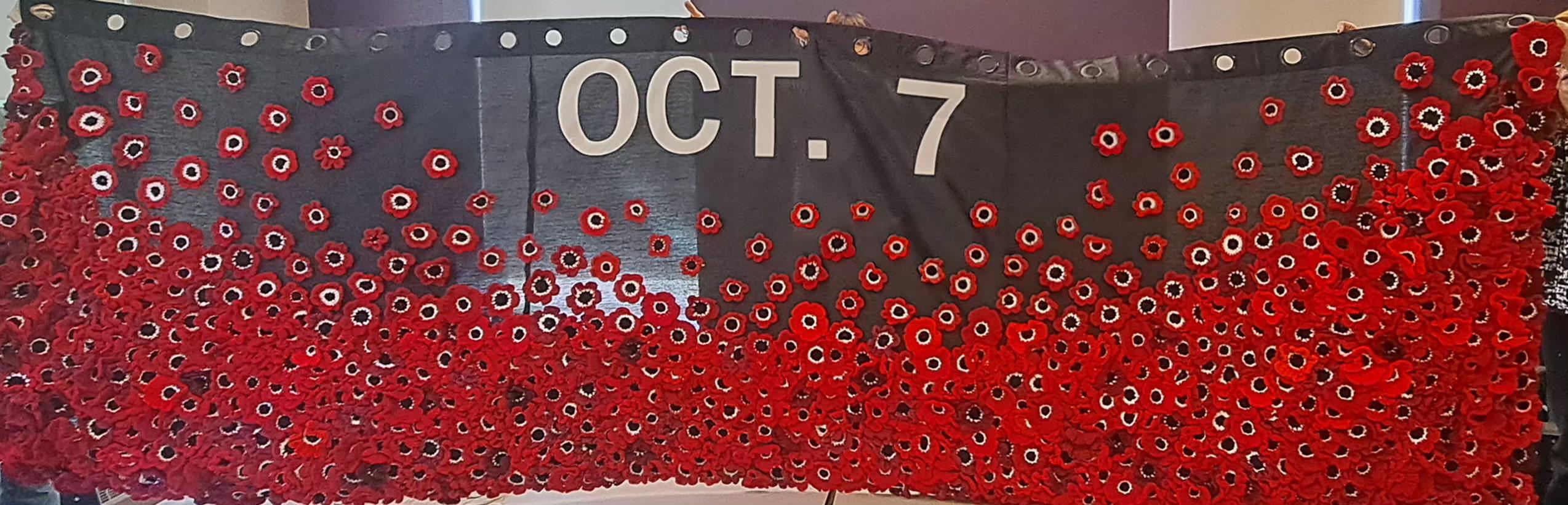
Shuster is also one of a group of 17 women who are adding something new to the commemoration. Over the past few months, the group members – including -Vanesa Harari, Tanya Chanas, Florencia Katz, Francyn Martini, Gail and Clara Garland, Claudia Griner, Faye Rosenberg Cohen, Judi Shuster, Patricia Lempert, Adriana Josebachvili, Valeria Senderowich, Tali Hassan, Orit Reuter, Kristin Gislason, Karyn Glass, and Michaela Kaplan – have crocheted 1,400 anemones (the original goal was 1,200) – to attach to a creative display that will be displayed throughout the month of October at the entrance to the Asper Campus.
Why anemones (kalaniot in Hebrew)? Florencia Katz, a member of the commemoration organizing committee, explains that kalaniot grow extensively throughout southern Israel and are the country’s national flower. During her visit to the site of the ill-fated Nova Festival in May, 2024, Katz notes that pictures of the victims with kalaniot in the background had been put up in the field.
Katz points out that it was Judi Shuster’s idea for the banner. Shuster had also seen the pictures at the Nova festival location.
“I contacted Florencia about this idea for crocheting the Kalaniot for the display and she was enthusiastic about it,” she says. “Originally, eight of us got together to plan this. We recruited a cross section of crocheters – Jewish and non-Jewish.”
“We had our first creative meeting on February 5,” Katz reports..
“We had the help of some other creative people with the background and design.”
She further points out that the October 7 date was ironed onto the piece of art.
The commemoration will conclude with a short gathering with anthems and prayers.
Readers who may want to participate in the Walk for Israel can register at www.jewishwinnipeg.org/october7.