


Uncategorized
In Brooklyn, a shared studio empowers Mizrahi women artists

On the second floor of a nondescript commercial building in Gravesend, Brooklyn, is a small artists’ studio. There, four long wooden tables are pushed together to create one massive table covered with oil paints, canvases, watercolors and other tools of the trade. The white walls are adorned with dozens of drawings and paintings; along one wall, a dozen cubbies are filled with even more art supplies.
It could be one of countless shared studio spaces for artists that are hidden in corners throughout the five boroughs. But this particular space is designed expressly for Jewish women artists: It’s closed on Shabbat and Jewish holidays, and among the art and design books on the shelves are siddurs, or prayer books.
Welcome to Muse Brooklyn, a coworking space built by and for Jewish women artists. The brainchild of Lenore Mizrachi-Cohen, a conceptual artist and observant Jew, the space doubles as an arts event space for its corner of Brooklyn, which is home to a significant Syrian Jewish community. Some 38,200 and 55,000 Syrian Jews live in the surrounding neighborhoods, according to a recent study commissioned by JIMENA, a nonprofit that advocates Middle Eastern and North African Jews — and, so far, all seven members of the shared studio are Mizrahi Jews.
“I initially started it for my own needs,” said Cohen, a 35-year-old married mother of four who has been working as an artist and calligrapher for 15 years.
Cohen was inspired to create Muse after a stint, in 2019, at a women-only art studio in Jerusalem. That shared space — which was designed for religious women often facing communal pressures against their artistic pursuits — opened her eyes to what a neighborhood studio for women like her could look like.
“It was 12 minutes away from my house, and it was a very supportive environment,” Cohen recalled. When she returned to New York she sought something similar in Brooklyn, but didn’t find it. “That’s when I realized that if it doesn’t exist in my own neighborhood, then it’s my job to make it.”
At Muse Brooklyn, the seven current members are all part of the local Syrian Jewish community, and all are at least somewhat traditionally observant. (There’s room for twice as many members, Cohen added, and being Jewish, Mizrahi or religious is not required.) In the shared space, the women — who each pay $206 a month — can draw, paint, or work in any medium they like, as well as brainstorm ideas with each other in a supportive environment of a shared identity. And because the space is women-only, members never need to worry about issues of yichud, the Jewish laws prohibiting men and women who are not married to each other from being secluded together.
The idea for Muse predated the war in Gaza, but Cohen said the tense climate for some Jewish artists within the city’s existing cultural institutions that resulted fueled her drive.
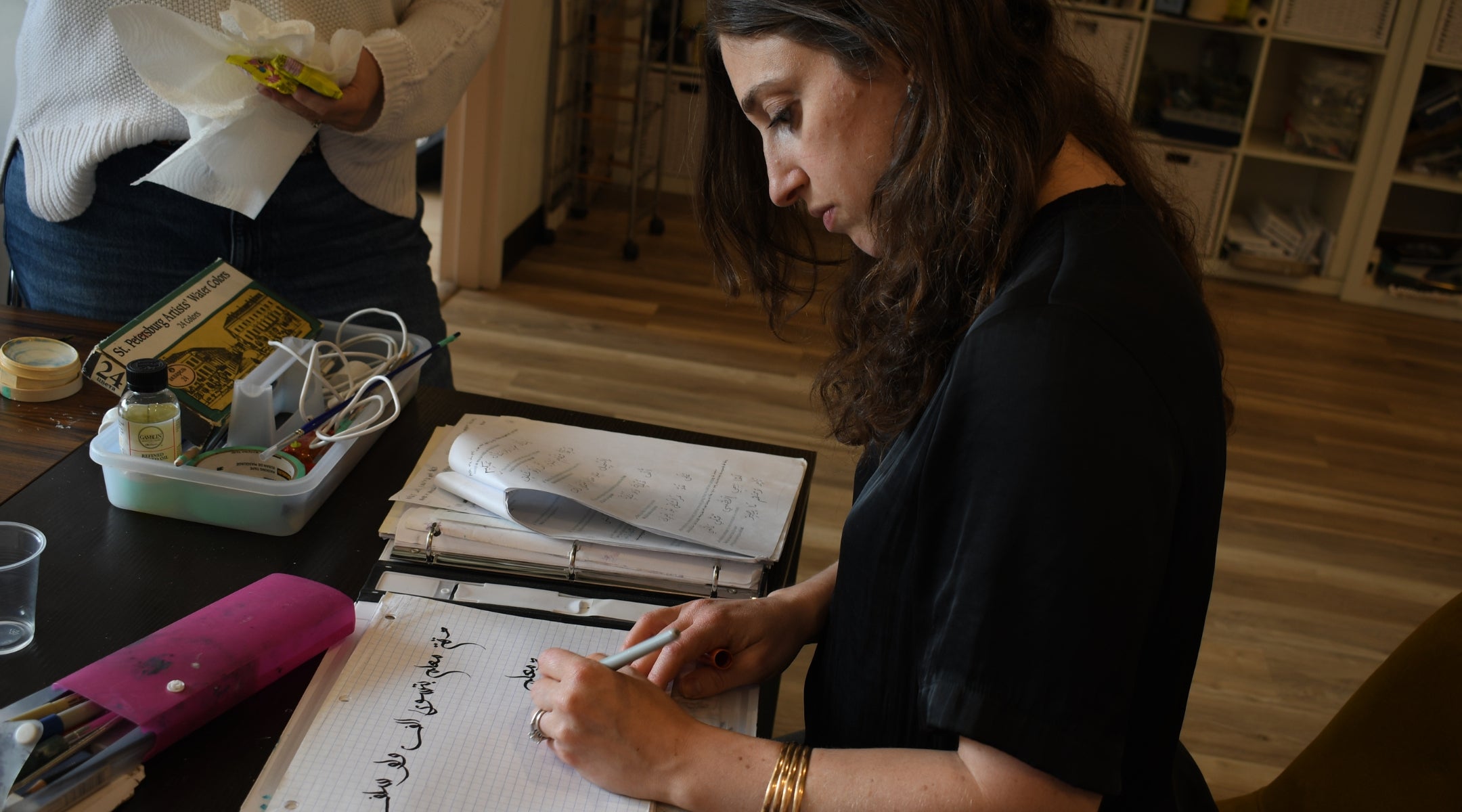
Lenore Mizrachi-Cohen, artist and founder of Muse artist studio in Brooklyn, drafts a calligraphy project. (Jackie Hajdenberg)
Previously a member at a shared studio in Red Hook, Brooklyn, Cohen said that she had felt singled out there as a Jew, recalling that she was once asked if she was comfortable with another artist donating money to a pro-Palestinian children’s charity.
“A, that’s weird that you think I would have a problem with that. B, it’s already somewhat of an issue that they’re creating: ‘Oh, you’re Jewish, but I’m a ‘free Palestine’ person,’” Cohen said.
Cohen began looking for a space to execute her vision in September 2023. Muse Brooklyn officially launched exactly a year later, when she found a space to rent within a larger complex currently used as a music coworking space by another member of the Syrian community.
Aimee Swed, a 32-year-old content and marketing professional and mother of two young boys, joined Muse when it opened last fall. Swed said that, as a Shabbat-observant Jew, she felt “very discouraged from entering the art world.” Many galleries held openings on Friday nights, she explained, and workshops and classes were often on Saturdays.
An artist who works in watercolor, acrylics and multimedia, she said her work has been “transformed” by the shared Jewish space.
“The camaraderie kind of reinitiated my own artistic practice,” said Swed, whose work focuses on the food found on her Syrian Jewish Shabbat table, like her watercolors of kibbeh meatballs with rice and meat. “It’s really something that became very important to me, because it felt so good to create with others, and finally find a space that was very friendly towards what you were creating.”

Much of artist Aimee Swed’s work focuses on the foods of her Syrian-Egyptian Jewish heritage. (Courtesy Aimee Swed)
Now that she works in a studio with other Mizrahi Jewish artists, Swed, whose family is Syrian via Egypt, finds inspiration all around her, including Cohen’s Arabic calligraphy. “One of the first things that I made was [a painting of] some phrases, like, ‘yom asal, yom basal,’ — ‘one day onion, one day honey’ [which] is what my grandma would say,” she said.
Not everyone who comes to Muse is necessarily working on Jewish art. For Shelley Shamah, a 22-year-old illustrator, graphic designer and photographer, Muse is simply a safe space for artists who happen to be Jewish.
Shamah, who also joined last fall, was drawn to Muse because she needed “to be in a space that fuels creativity,” she said.
Part of that, she explained, is simply being around likeminded people. “Jews are a microcosm of the world, but Syrians are a microcosm of Jews,” she said.

Shelley Shamah paints a canvas for her dining room. (Jackie Hajdenberg)
On a recent Tuesday, Shamah, a recent graduate of the Pratt Institute, was working on a canvas for her dining room, which she will soon be sharing with her fiancé, a musician.
Shamah and another young Muse member, Allie Saada, a recent graduate of the Fashion Institute of Technology, consider themselves part of the “younger bunch” of artists in the group.
Not yet married or mothers, they feel they can take full advantage of the space, coming in at all hours of the day and night, where they often run into each other.
For Swed, whose sons are 4 and 5, the space provides almost the opposite advantage.
“It was really hard, like any working mom, trying to step back into another world once she’s had children,” Swed said. “So as a mom coming into an all-women space, that felt really good, too.”
The studio also functions as a space for the neighborhood to engage in the arts. Several times a month, Muse holds events such as art classes, paint-and-sip nights and museum tours, taught and led by its members, and always with the Jewish holiday schedule in mind. Shelley Shamah even had her 22nd birthday party, a drink-and-draw night, in the space with a dozen of her friends.
Ultimately, Cohen hopes that Muse will grow into a robust network of Jewish women artists. “The more people you have in the space who generate opportunities like this, the better it is for everyone concerned,” Cohen, who’s shown work at the Jewish Museum in Vienna, the Museo Ebraico in Lecce, Ital,y and the Jewish Museum in Amsterdam, said. “All your best opportunities in your career as an artist, at least for me, come from other artists.”
She added: “Create the conditions to be successful. Show up and watch what happens.”
—
The post In Brooklyn, a shared studio empowers Mizrahi women artists appeared first on Jewish Telegraphic Agency.
Uncategorized
A synagogue and Jewish-owned shops damaged in French riots
(JTA) — PARIS – Jewish-owned shops in Marseille were set ablaze and a synagogue in Paris was vandalized as part of widespread property damage caused by riots across France Saturday and Sunday, according to the Jewish Community Protection Service.
It is too early to assess the full extent of the riots protesting the rising cost of living and the damage they’ve caused, but various elements in the media have described them as civil unrest and chaos.
From Lille in the north to Marseille in the south and in the major cities in between, media estimate that nearly 800,000 people took to the streets and some 2,000 shops were vandalized or looted. Public buildings were set on fire, and hundreds of people or more were injured, including 150 police officers, with thousands arrested.
The riots followed a student uprising that blocked entrances to high schools across the country in recent weeks. Palestinian flags and keffiyas have been a recurring motif in most of the violent protests, acts of vandalism and looting.
But according to SPCJ, known as the Service de Protection de la Communaute Juive in French, there was no evidence that Jewish institutions or businesses were deliberately targeted.
Vandals broke into the Ohalei Yaakov synagogue in Paris’ 19th district overnight between Saturday and Sunday. On Sunday morning, members of the Jewish community discovered that their temporary place of worship had been broken into. The permanent synagogue building is currently undergoing renovations.
Inside the sanctuary, prayer books, tefillin, and various objects — taken from boxes and cupboards — were found scattered on the floor. The rabbi’s office was also searched. Despite the mess, the Torah scrolls appeared to be unharmed.
According to a member of the synagogue committee, the incident primarily points to an attempted theft. The suspects may have been looking for money, but nothing was believed to be missing.
This article originally appeared on JTA.org.
The post A synagogue and Jewish-owned shops damaged in French riots appeared first on The Forward.
Uncategorized
How much will Trump’s endorsement help Netanyahu?
(JTA) — JERUSALEM – Within minutes of President Donald Trump endorsing Prime Minister Benjamin Netanyahu in a post on Truth Social Sunday, Netanyahu’s campaign team had released a 30-second clip showing all the times Trump has lavished praise on the Israeli leader over the past few years.
With polls showing that Netanyahu and his governing coalition are slipping in their struggle to retain power in the upcoming Oct. 27 election and lag behind the opposition bloc, an endorsement from the president of the United States is a powerful statement.
But is it enough to tip the scales?
“I don’t think it will change anything,” said Ilana Shpaizman, a senior lecturer in the Department of Political Studies at Bar-Ilan University.
Of course, she said, “Netanyahu will say this is the proof that I’m a leader and all that, and I can speak to Trump … But so what? His followers already know that and they believe in him. They don’t need the endorsement.”
Those who oppose him, Shpaizman continued, “know that Trump forced him (Netanyahu) to accept the ceasefire in Gaza and accept the hostage deal, and that Trump runs the show around Iran. So they also don’t need the endorsement either,” Shpaizman said.
Some pundits speaking on Israeli news outlets criticized Trump for “interfering” in Israel’s election, while others put it down to the fact that Trump does not want America to return to fighting Iran alone if Netanyahu, who is hawkish on Iran, is replaced by someone less willing to act militarily. If Netanyahu loses, that is a scenario that could play out.
“This is the first time ever that the president, at least publicly, endorses a candidate in Israel’s election,” Bushinsky, a political commentator and former adviser to Netanyahu, told the Jewish Telegraphic Agency.
Bushinsky said he remembered Netanyahu complaining about U.S. intervention in previous elections in 1999 and 2001, when presidents less enamored of him were in office. He even pushed for an initiative that would block foreign funding for election campaigns.
Now, Bushinsky said, “I guess he is not complaining,” adding that the endorsement serves Netanyahu in two ways.
First, it signals that Trump thinks that Netanyahu is the most suitable guy for the job. Second, it puts Netanyahu’s election campaign back on track, refocusing attention on an issue where Netanyahu is strong – Iran.
“It lets him say ‘I can now finish a job, and I can finish a job with Trump,’ and ‘without Trump or without me, the job will not be finished,’” said Bushinsky.
He said that in the last few days, the political debate had pivoted to other issues such as Ashkenazim vs Sephardim, the draft law and the contentious efforts by the outgoing government to overhaul the judiciary.
“This [endorsement] is the ultimate campaign boost for Netanyahu,” Bushinsky said.
But that boost might not be enough.
Most of the polls taken in recent days show the opposition bloc led by former IDF chief Gadi Eisenkot pulling ahead of Netanyahu’s ruling coalition, but give neither bloc enough seats to gain the necessary 61 of 120 seats in Israel’s parliament, the Knesset, to form the next government.
“I think this might give Netanyahu one more seat, one more mandate, but not more than that,” said Bushinsky.
Prof. Tamar Hermann, director of the Israel Democracy Institute’s Viterbi Center for Public Opinion and Policy Research, said that the timing of Trump’s support for Netanyahu in this election race had come both “too late and too early.”
“It’s too late because people have already decided electoral preferences. They may shift within each bloc, but will not move between the blocs because of this,” she said. “And it’s too early because there are nine days to go to the elections, and we can already see other American leaders spilling some cold water over what he said, even on the Republican side of the aisle.”
This criticism, Hermann continued, will be transmitted to Israeli voters, and they will see that Trump is facing a huge battle in the upcoming midterm elections.
“The image of President Trump has deteriorated significantly since April 26, when he started the negotiations with Iran,” she said, pointing to one of the IDI’s recent public opinion surveys that found the president’s popularity had plummeted after he stopped the war with Iran without totally removing the threats against the State of Israel.
According to that poll, the Israeli public’s confidence in Trump as someone dedicated to Israel’s security fell from around 70% to just 42%.
“In my view, the endorsement will not make a big change,” Hermann added. “It will just strengthen Netanyahu’s political supporters, who will see it as a sign that he is still the internationally known figure that even the president of the United States is endorsing.”
She concluded, “The meaning of endorsement in Israel is totally different than in the United States … we are not that used to this kind of move, and it will not make people change their minds.”
This article originally appeared on JTA.org.
The post How much will Trump’s endorsement help Netanyahu? appeared first on The Forward.
Uncategorized
Trump endorses Netanyahu for reelection, warning Israelis against choosing another leader
President Donald Trump endorsed Israeli Prime Minister Benjamin Netanyahu for reelection, giving his longtime ally a major boost just nine days before Israel’s Oct. 27 election, which polls indicate could end without a clear winner.
“Please let this letter serve to represent my complete and total endorsement of Bibi Netanyahu in his upcoming race for re-election as Prime Minister of Israel,” Trump wrote Sunday in a lengthy post on Truth Social, praising Netanyahu as a strong leader and trusted partner in confronting Iran.
Netanyahu, Israel’s longest-serving prime minister, is seeking a seventh term after surviving political crises that repeatedly appeared likely to end his career — most significantly after the Oct. 7, 2023, Hamas attack. Recent polls suggest neither Netanyahu’s right-wing coalition nor the opposition is sure to win the 61 seats needed to form a government in the 120-member Knesset.
In his endorsement, echoing the sentiment of Netanyahu’s campaign, Trump warned Israeli voters that choosing anyone else as prime minister could put more pressure on the United States to deal with threats in the Middle East alone. “If Israel has the wrong leader, which would be anyone other than Bibi, America will have to do this work ourselves, and I am not inclined to do so,” Trump wrote. “Bibi Netanyahu has been strong, brave, and brilliant in the face of tremendous opposition, including that coming from even Israel, itself.”
Gadi Eisenkot, a former IDF chief of staff whose son was killed in the Gaza war, has emerged as Netanyahu’s chief rival. Eisenkot has floated a path to a government that does not require a majority in the Knesset. However, one of his partners in the anti-Netanyahu bloc, Avigdor Lieberman, has said in recent days he would oppose such a move. Recent polling puts Lieberman’s party at an average of eight or nine seats — enough to give Lieberman leverage in who leads the government.
Trump’s endorsement came hours after Netanyahu appeared on another program, the Fox News show Life, Liberty & Levin hosted by journalist and commentator Mark Levin. Netanyahu spoke glowingly of Trump and the importance of his battle to destroy the Iranian threat, as the American public prepares to head to the polls for midterm elections on Nov. 3. In that race, Republicans are fighting to maintain control of the House and Senate.
The U.S. war with Iran, which has slowed the flow of oil through the Strait of Hormuz causing gasoline prices to rise, has been unpopular with American voters and is often cited as one of the reasons Republican politicians could lose their races to Democrats.
Netanyahu made the case on Fox that the defeat of the Islamic Republic and the elimination of its nuclear program was critical to ensuring a safe American future. In the U.S., some lawmakers have insisted that the war was unnecessary.
If Iran can destroy Israel, it will conquer the Middle East, control world waterways and oil supplies and proceed to Europe and proceed “to the next target, which is you,” Netanyahu said, addressing a U.S. audience in his Fox News appearance.
A boost for Netanyahu in the final stretch
Trump has taken a personal interest in Israel’s election, but he held off on endorsing Netanyahu for months, raising questions about whether he was keeping his options open in case the longtime Israeli leader lost. “I’m not involved in [Israeli] politics anymore,” Trump told Time magazine in September. In an interview with Newsmax on Thursday, when asked whether he trusted Netanyahu, Trump said he did not trust anybody.
Sunday’s endorsement comes as Netanyahu steps up his campaign to rally his base and convince undecided voters that his close relationship with Trump is essential to Israel’s security. Trump remains popular in Israel, though his approval has declined in recent months following the ceasefire agreement with Iran. But the move could also complicate the president’s ability to influence what happens after the election, if neither political bloc wins a majority.
Trump has previously shown a willingness to pressure Israeli political leaders, including his public campaign last year for President Isaac Herzog to pardon Netanyahu of corruption charges.
Nonetheless, by declaring that Netanyahu is the only acceptable leader for the U.S. administration, Trump may have made it harder to persuade opposition parties to join a unity government led by Netanyahu if the election produces a political stalemate. It also gives Netanyahu another reason to resist stepping aside in post-election negotiations, knowing that the American president has publicly declared him the only alternative.
Netanyahu has already begun sharpening that message, arguing that he and Trump have unfinished business and only two more years to accomplish their shared goals before Trump’s term ends in January 2029. The messaging carries an implicit warning about Israel’s relationship with Washington after Trump leaves office. Whether the next president is Republican or Democrat, any Israeli leader may find it harder to maintain the same level of personal access and cooperation.
The election also carries broader consequences for American Jewry. Netanyahu has become increasingly unpopular among American Jews and Democrats, many of whom oppose his alliance with far-right and religious parties. A change in leadership could allow Israel to rebuild ties with Democrats and reconnect with parts of the American Jewish community — even without bringing nearly as much change in Israeli policy as some might hope.
Rep. Dan Goldman, a Jewish Democrat from New York who was defeated earlier this year in a primary that focused on his support for Israel, posted on X that the U.S.-Israel alliance “will suffer permanent damage if this Israeli government continues to hold power after the election on October 27.”
Polls point to another deadlock
The latest polls show that Netanyahu faces a difficult path to reelection.
Surveys published over the weekend show Eisenkot’s Yashar party ahead of Netanyahu’s Likud, with the opposition parties holding a combined 55 seats. The two Arab lists — the United List, a coalition of three Arab Israeli parties, and Ra’am led by Mansour Abbas — are generally counted outside either bloc.
Those numbers help explain why Trump’s endorsement matters.
A few additional seats could change the balance of power and determine who gets the first opportunity to form a government. And even if Netanyahu fails to secure a majority, he could still benefit from a political deadlock if his bloc wins enough seats to prevent the opposition from forming a government.
In that scenario, Netanyahu would remain prime minister until a new government is sworn in, potentially setting the stage for another election.
JTA contributed to this report.
The post Trump endorses Netanyahu for reelection, warning Israelis against choosing another leader appeared first on The Forward.
