


Uncategorized
With hostages home, the filmmaker behind ‘Torn’ says his documentary about NYC’s poster wars remains sadly relevant
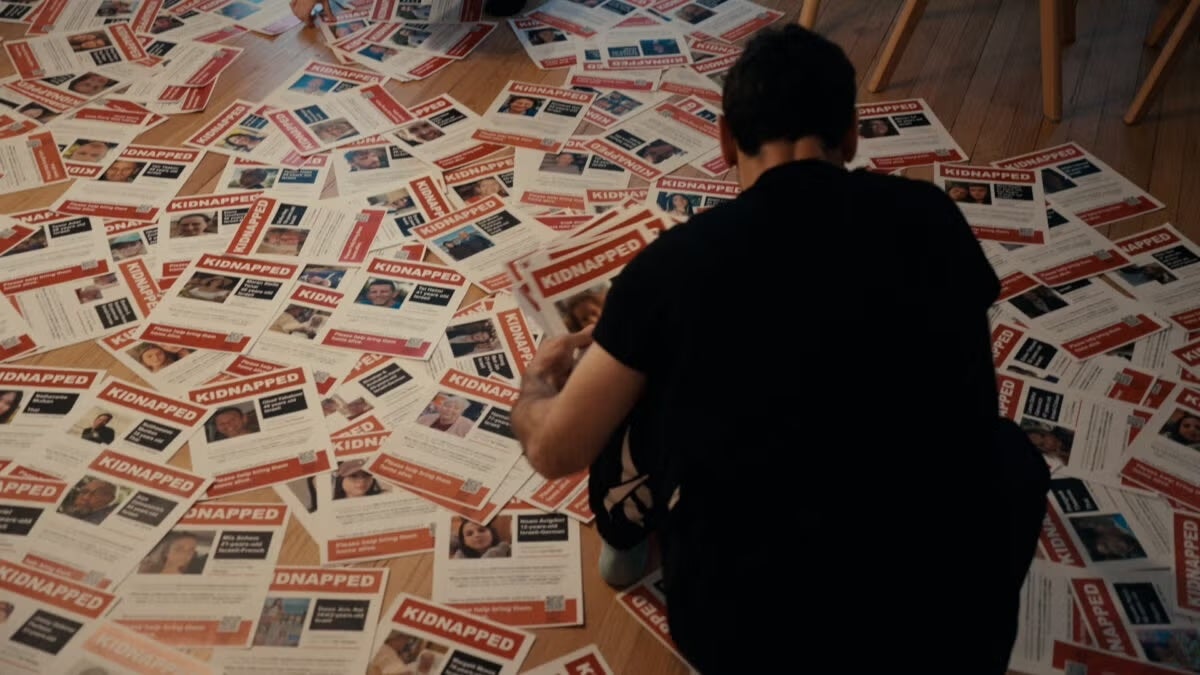
(JTA) — What caught Nim Shapira’s eye when videos of New Yorkers tearing down posters of Israeli hostages began circulating in October 2023 wasn’t just the stark affront. It was also the poles the posters had been attached to.
“I recognized every corner,” he said. “This was my neighborhood.”
The filmmaker had never before turned his craft to his identity as an Israeli living in New York. But Shapira immediately began gathering footage about the posters — and about those who felt compelled to put them up, and to tear them down.
His resulting documentary, “Torn,” was first released last year, when about 100 Israelis were still held hostage, out of roughly 250 taken on . Now, with all living hostages released and Hamas agreeing to free the bodies of 28 deceased hostages, too, Shapira — who is entering “Torn” into awards consideration — says its message remains deeply relevant.
We spoke to Shapira on Monday in the hours after 20 hostages were released about what he learned about the poster wars and why his film is still essential viewing.
Sign up here to attend a virtual screening of “Torn” on Thursday at 7 p.m., followed by a conversation with Shapira and others involved in the poster wars in New York City.
JTA: Before Oct. 7, your work did not focus on your Israeli identity. Why did you feel you had to make this movie?
Shapira: I’ve always been vocal for peace. But then, Oct. 7 happened, and the people that were my friends stopped speaking to me because I’m Israeli. It’s like the old saying of: You are the people you’ve been waiting for. I just had to do it. I didn’t want to do this film, and I had to do it.
What did you learn about the people who were tearing down the posters? Were there moments where you felt like you understood what they were thinking?
That’s what I wanted to explore in the film. I don’t justify what they did, and I don’t respect it, but this is a documentary. It’s asking questions. It’s not a film funded by this organization or that organization, or this country, or that country. I’m asking for empathy, and if I’m asking for empathy, I should also have empathy for the other side, and I should also understand their motives.
I would say that the people that tore down the posters live on a spectrum. These were people from in their teens to people that are retired, every ethnicity, every background and every age group. And that’s what strikes me the most. There were so many people without skin in the game that joined this cause of taking down these posters.
Some people that tore down the posters did lose family members in Gaza because of Israeli airstrikes. Some people that tore down the posters — they didn’t read what was on the signs. They were told that this is Israeli propaganda funded by the government, and they thought that it needs to be removed. Some of them are college students that thought it was the cool thing to do. And some are antisemites.
So I don’t want to put a label on the entire group of people that turned out the posters, because there are different scenarios in which posters were torn. In any case, this was an attack on freedom of speech, and this was anti-American. And there are enough lampposts in New York to share their suffering as well.
What do you hope viewers will take away from seeing “Torn”?
Empathy is all about putting yourself in someone else’s shoes. I honestly don’t think that people can put themselves in other people’s shoes, because you can never know what another person is going through, but you can step outside of your own shoes for a quick moment. So that’s all I’m asking.
I’m asking for the people who put on the posters to think about these victims and hostages that did nothing wrong. And I’m also asking for understanding from, let’s say, my side, to understand that the number-one reason why people read down the posters is that the death toll in Gaza kept rising throughout this war.
What has been most surprising about the reception?
I was able to have a film screened in Ivy League universities from Columbia to Harvard to Stanford to NYU. I’m very proud of that. I’m very proud that some of the screenings had people from the encampments. I spoke with American Muslims. I spoke with people from Jordan and from Egypt. I also spoke with Chinese and Venezuelans — I spoke to everyone who came to the screenings. I think maybe the most surprising thing was that there was a Q&A that I couldn’t come to — people just stayed in the theater and talked until the usher told them to leave.
Now there are good reasons to remove hostage posters — all of the living hostages are home. Why is your movie still worth seeing?
For two reasons. First, the hostage families with their loved ones still in Gaza — they are asking for us to stay in the fight. They still need us.
These hostages that were murdered, first kidnapped and then murdered — they are not just Israeli. They are American, and they are also from Nepal, Thailand and Tanzania. They are Christian and Muslim and Buddhists and Muslims and Jews. People from all religions are captive right now because their only sin was to be at the wrong place at the wrong time, and their families deserve to bring them home for a proper burial.
But also, my film is not about Israel or Palestine. My film is about New York and America. I’m dying for the day that the film will not be irrelevant, but we are more tribal and polarized than ever. We exist in different echo chambers and different silos. The poster war did not just tear down the posters, but also tore down the social fabric of the city. We are the most diverse city on the planet, so if we can’t sit down and talk to one another, what are we doing here? We have the biggest Jewish population. We have a huge Muslim population. Antisemitism is at a record high; there’s also Islamophobia that is rising.
But these are not just problems for the Jews or the Muslims. This is a societal problem and the film mostly asks questions. It asks: Can multiple things be true at the same time? Why is empathy a limited resource, and can we have disagreements without dehumanizations? So yes, the film is still much more relevant than ever.
The post With hostages home, the filmmaker behind ‘Torn’ says his documentary about NYC’s poster wars remains sadly relevant appeared first on The Forward.
Uncategorized
Netanyahu to meet Trump with Iran, Gaza and Saudi Arabia on the line
(JTA) — Prime Minister Benjamin Netanyahu is set to meet with U.S. President Donald Trump Tuesday, as the American leader is weighing whether to expand his bombing campaign against Iran or to find a diplomatic resolution regarding the Straits of Hormouz and the Islamic Republic’s nuclear program.
Israel fears that Trump is going to negotiate a premature end to the war without eliminating Iran’s capacity to develop nuclear weapons in the future. Trump has persistently insisted that Iran can’t possess nuclear weapons, but the war and the economic upheaval it has spurred has contributed to Trump’s approval rating hitting record lows in his second term. The poor marks are ringing alarm bells for Republicans ahead of midterm elections that could return Democrats to leadership in at least one chamber of Congress.
Netanyahu and Trump are also at odds over other issues, however, including the recent U.S.-Saudi nuclear deal, the pending sale of F-35 advance fighter jets to Turkey and the extent of Israel’s troop presence in Gaza, Lebanon and Syria.
Netanyahu is coming to the United States to attend the funeral for Republican Sen. Lindsey Graham of South Carolina, who remained one of Israel’s most unyielding advocates even as its popularity plummeted and was one of the most important Trump associates in pressing for the Iran war. Former Israeli Prime Minister Yair Lapid, now the opposition leader, will also be at the service at Washington’s National Cathedral on Tuesday.
But while in Washington, Netanyahu will seek to close the widening gaps between himself and Trump over Middle East strategy. In a video statement he released before Monday‘s departure, Netanyahu said, “I am embarking on this mission with one clear goal – to ensure the security, strength and future of our dear State of Israel.”
“We will discuss all the issues on the agenda, first and foremost, Iran,” he said. “Naturally, our goal is to safeguard our security and also to expand the circle of peace around us.”
During the trip, Netanyahu said he would also pay his final respect to Graham, “one of the greatest friends the State of Israel has ever known.”
Israelis are acutely aware of the emerging differences between the allies. “It will not be an easy visit,” former IDF intelligence chief Amos Yadlin told Israel Radio on Monday morning. “There is no doubt that Netanyahu wants the United States to return to war.”
Trump himself spoke on Monday of the discord between himself and Netanyahu, even as he lauded Netanyahu, while speaking to reporters aboard Air Force One, stating that Netanahu had been “great” and that “we did very well together.”
On the plane Trump was quizzed about U.S. plans to sell advanced F-35 fighter jets to Turkey, which Netanyahu has publicly opposed. “Turkey has been a great ally for me,” Trump told reporters, stressing, “No one tells me what we should be selling or not.” He acknowledged that Turkey “is not a big fan” of Israel and Netanyahu.
When it comes to the Saudi civilian nuclear power program that the Trump administration recently completed, Israel has been more circumspect. But it has deep concerns about an agreement that allows for plants with the capacity to enrich uranium. Assisting in the building of those plants had been one of the key incentives former President Joe Biden had used as a means to sway Saudi Arabia to normalize ties with Israel and join the Abraham Accords between Israel and several other Muslim countries.
Trump has since said that U.S. support for a Saudi civilian nuclear program would be contingent on normalization with Israel and that the plants would not be allowed to enrich uranium. But on Monday, he told reporters aboard Air Force One that he hadn’t spoken with Saudi Arabia about the Abraham Accords. Tuesday’s meeting is the first face-to-face encounter between Trump and Netanyahu since the announcement.
The closer Netanyahu appears to Trump and the center of U.S. decision making, the better it is for him domestically ahead of Israel’s Oct. 27 election. Trump has in his second term met with Netanyahu more than any other leader. This will be their eighth such conversation, and the fifth time he has hosted the Israeli leader in the White House.
Tight ties with Netanyahu also plays well for Trump with his evangelical base ahead of the U.S. mid-terms in November, but they run the risk of further alienating the larger American public that opposes the conflict.
Netanyahu’s influence in America had diminished, in part because of how unpopular the war has become in the United States and the role he played spurring it on.
“This is not the same Netanyahu of 2025 or even of February 2026. He is greeted with suspicion,” Yadlin said of the reception he expects for the prime minister in the United States.
Netanyahu last visited Washington in February, where he successfully advocated for the joint Israeli-U.S. military aerial bombing campaign against Iran launched on the 28th of that month.
Tehran retaliated by closing the Strait of Hormuz, the waterway through which 20% of the world’s oil supply is shipped. That step caused crude oil prices to spike in the first quarter of 2026 from $61 a barrel to $118, according to the U.S. Energy Information Administration.
Iran allowed the strait to reopen in a limited way after an April ceasefire that was followed by a Memorandum of Understanding with the U.S. in June. The agreement fell apart in early July, with the parties resuming attacks – but without any Israeli military involvement. The United States bombed Iran for 13 consecutive nights, ending on Thursday, even as talks with the Islamic Republic continued.
The United States and Israel in February were initially aligned around their joint goal of destroying Iran’s nuclear and ballistic missile program, with Netanyahu also focused on the collapse of the Islamic Republic.
Over the weekend, Trump stressed that the war was still about eliminating Iran’s nuclear program. Last week he spoke about specifically hitting the nuclear facility at Pickaxe mountain.
In an interview with NBC News’ “Meet the Press” on Sunday, U.S. Ambassador to the United Nations Mike Waltz said the United States was “keeping all options on the table,” but was giving space for talks.
He dismissed media reports that lack of military supplies was part of Trump’s motivation to pause its bombing campaign, stating that the United States had everything it needed militarily.
Waltz warned Iran not to ignore American military threats. Early Monday morning, Trump published a short AI video in which his likeness planted an American flag on an Iranian oil tanker, with a slogan that stated, “it’s our oil tanker now.”
Later in the day, the president told reporters on Air Force One that he was having “good talks” with the Iranians, “so we will see what happens. I think there is a good chance something could happen. If it does, good. If it doesn’t, we go back to doing what we were doing two days ago.”
Yadlin told Israel Radio that at the end of the day, “What interests President Trump is the reopening of the Strait of Hormuz.”
The war might have begun in February with a focus on the Iranian regime and its nuclear program, but it will end, Yadlin predicted, with the reopening of the strait and some kind of diplomatic achievement with regard to Iran’s nuclear weapons program.
Israel has watched the U.S.-Iran reengagement warily from the sidelines.
Sima Shine, an Iran expert at the Tel Aviv-based International Institute of Strategic Studies, said that until now, neither Washington nor Tehran had wanted Israel’s involvement in the resumed fighting, fearing that such a step would “widen the scope of the war.”
Maintaining its status as a bilateral conflict makes it easier to return to negotiations, she told the Jewish Telegraphic Agency.
The United States can better control the battlefield without Israel, which would have its own military agenda and objectives, Shine said. Israel can only enter the war if it is attacked by Iran or invited to do so by the United States, she added.
In an interview with Fox News on Sunday, Netanyahu warned of a forceful response should Iran attack Israel.
Iran has to end its nuclear program, he stressed, saying that the military strikes so far have set the program back but have not eliminated it.
A nuclear-armed Iran is a danger to Israel, the region, the United States and the world, he said, adding, “President Trump and I are both committed to prevent this danger.”
This article originally appeared on JTA.org.
The post Netanyahu to meet Trump with Iran, Gaza and Saudi Arabia on the line appeared first on The Forward.
Uncategorized
In Detroit, pro-Israel Senate candidate Haley Stevens meets a pro-Palestinan El-Sayed supporter
(JTA) — DETROIT — Hours before a big debate showdown with her primary rival, U.S. Rep. Haley Stevens began a routine campaign stop Monday seemingly comfortably in her element.
The Michigan candidate for U.S. Senate walked into The Roost, a cafe and wine shop in the Woodbridge neighborhood, chatting up her record on small businesses with the owner, Jeff Tatum. She gamely made herself a cappuccino, exclaiming with glee that the store used Dial soap like her father’s business had.
She also made a play for party unity. Asked by the Jewish Telegraphic Agency about Jewish Democratic donors who have indicated they would fundraise for Republican candidate Mike Rogers if Stevens lost the primary, she responded, “I’m on the Democratic team. I’m on the Beat Mike Rogers team.”
But things went off-script for Stevens when she sat down with Jai Singletary, director of a local neighborhood improvement association — who revealed, midway through their conversation, that he had already cast his early voting primary ballot for her opponent, former county health director Abdul El-Sayed.
What’s more, Singletary made it clear to Stevens that the candidates’ respective stances on aid to Israel were the deciding factor for him.
“Genocide isn’t a Palestinian issue. We’ve all got to care about this,” Singletary told Stevens, a pro-Israel centrist who has received nearly $30 million in outside spending from the American Israel Public Affairs Committee to date in her primary — the organization’s largest-ever investment in a single race, according to CBS News. He believes, he said, that “our country is directly responsible for peace not being achieved.”
The director of Woodbridge Neighborhood Development and local soccer coach added, “We’ve got to have the money stay here. I don’t think we should be giving any more aid to the State of Israel while they’re committing the atrocities they’re committing in widespread collective punishment.”
The interaction spotlighted two of the biggest questions hanging over Michigan’s closely watched and hard-fought Democratic Senate primary: To what degree are the state’s voters factoring Israel into their decisions, and does the pro-Palestinian sentiment driving El-Sayed’s campaign cross racial lines — including in the Black communities where Stevens has long maintained strong relationships?
Many of the Jews in Michigan who form a major base of support for Stevens have made clear their distrust of El-Sayed, who has questioned whether Israel should exist as a Jewish state. Meanwhile, the state has a large Arab and Muslim voting bloc, and voters here helped propel a 2024 Democratic revolt over Israel’s war in Gaza that helped lead to the party’s current civil war. But the situation is less clear with voters from other groups.
El-Sayed and the insurgent progressive movement he represents have sought to make Israel central to the race and have tried to turn Stevens’ AIPAC support into her biggest liability. But the Stevens campaign has made the calculation that most of the state’s voters — including Detroit’s majority-Black population, with whom she has enjoyed good relations in the past — would rather talk about other things.
Not so, according to Singletary, who is Black. In his own Detroit community, he told JTA, Israel was an important issue.
“It’s connected,” he said, comparing the Israeli-Palestinian state of affairs to Apartheid-era South Africa, adding, “$3.3 billion to the state of Israel, and that’s money that could be helping out here. I think people are now seeing the links.” He told reporters that, though he does not have Palestinian family himself, his own vote was “100% exclusive” based on Israel.
After the campaign left, Singletary told JTA that he had no affiliation with the El-Sayed campaign and had stopped by on an invitation from the store’s owner. He said he would not vote for Rogers in the general election even if Stevens wins and came because he hoped to develop a connection with her in the event she became the nominee.
The issue of whether backers of either candidate across the yawning policy divide would continue to vote for a Democrat in the general if their preferred choice loses has become an emerging question. Last week, Democratic U.S. Rep. Hillary Scholten of Michigan, a Stevens backer, refused to commit to voting for El-Sayed if he wins the primary. Scholten cited the candidate’s campaigning with left-wing streamer Hasan Piker, who has repeatedly said he would “vote” for Hamas over Israel. Her objection, she said, was to his comment that “America deserved 9/11.”
“Abdul El-Sayed is taking us in a direction we don’t want to go as a party,” Scholten told CNN host Jake Tapper.
Stevens’ campaign is also touting her backing from a growing number of establishment Democrats, including, on Friday, Michigan Gov. Gretchen Whitmer. She and El-Sayed face off Monday evening in their final televised debate before the Aug. 4 primary.
Speaking to Singletary, Stevens smiled and nodded. She name-dropped a Palestinian supporter of hers, and mentioned legislation targeting China that she’s worked on with “my colleague Ro Khanna” — the staunchly pro-Palestinian Democratic congressman from California, who has endorsed El-Sayed. She added that she believes in a two-state solution and has been attacked “by name” by Israeli Prime Minister Benjamin Netanyahu.
She also turned to her staff and excitedly indicated to Singletary: “He voted for Abdul in the primary, and he came here to talk to me.”
This article originally appeared on JTA.org.
The post In Detroit, pro-Israel Senate candidate Haley Stevens meets a pro-Palestinan El-Sayed supporter appeared first on The Forward.
Uncategorized
‘If you’re ever confused: I stand with the Jews’ Boy George sings in new pro-Israel song
(JTA) — The British pop icon Boy George has gone to bat for Israel and its supporters multiple times in recent months, rejecting boycott calls and expressing solidarity after antisemitic violence. Now, he has released a single in the same key.
“We Will Dance Again” defends Israel’s military response in Gaza, criticizes musicians and activists who have publicly supported the Palestinian cause and declares, “If you’re ever confused: I stand with the Jews.”
The song borrows its title from the slogan of survivors of the Nova music festival, where Hamas terrorists killed 378 young people and kidnapped dozens more as part of the Oct. 7, 2023, invasion of southern Israel. The slogan has become a symbol of resilience in the aftermath of Oct. 7.
The singer released the reggae-inspired track, titled “Od Nirkod” in Hebrew, on his social media accounts on Monday with a single hashtag: #Shalom.
“You say genocide, I say war / When you’re attacked, that’s what the army’s for,” the song opens. Later, Boy George sings, “You never mention Oct. 7,” in a criticism of those he sings have “selective memory” about atrocities deserving their reprobation. The song ends by repeating the opening lyrics in Hebrew.
Although Boy George is not Jewish, he has become increasingly vocal when it comes to supporting Jewish communities in the wake of Oct. 7.
#Shalom pic.twitter.com/0BfHIrThzO
— Boy George (@BoyGeorge) July 26, 2026
He rejected calls to boycott this year’s Eurovision Song Contest over Israel’s participation, saying he would not “turn my back” on his Jewish friends. The singer participated this year representing San Marino, in a counterpoint to artists and countries that pulled out rather than compete alongside Israel.
Boy George had a long relationship with Jon Moss, the Jewish drummer who with him launched Culture Club, the New Wave band that dominated much of the 1980s with its melodic soul infused music and its outlandish styles. Boy George then often wore a tunic with “Culture Club” in Hebrew translation.
Following an antisemitic stabbing in London’s heavily Orthodox Golders Green neighborhood earlier this year, where the singer happened to be at the time, he said Jewish people should know “we support them.”
Boy George’s new song has drawn appreciation from pro-Israel voices. Stop the Hate UK, a British Jewish anti-antisemitism campaign, called Boy George a supporter of “Jewish joy” and thanked him publicly for standing with the Jewish community.
And the official Nova Music Festival account on Instagram responded to Boy George’s post announcing the song with a simple comment: “We will dance again.”
This article originally appeared on JTA.org.
The post ‘If you’re ever confused: I stand with the Jews’ Boy George sings in new pro-Israel song appeared first on The Forward.
