


Local News
Jewish Heritage Centre of Western Canada’s Archivist and Curator Stan Carbone retires
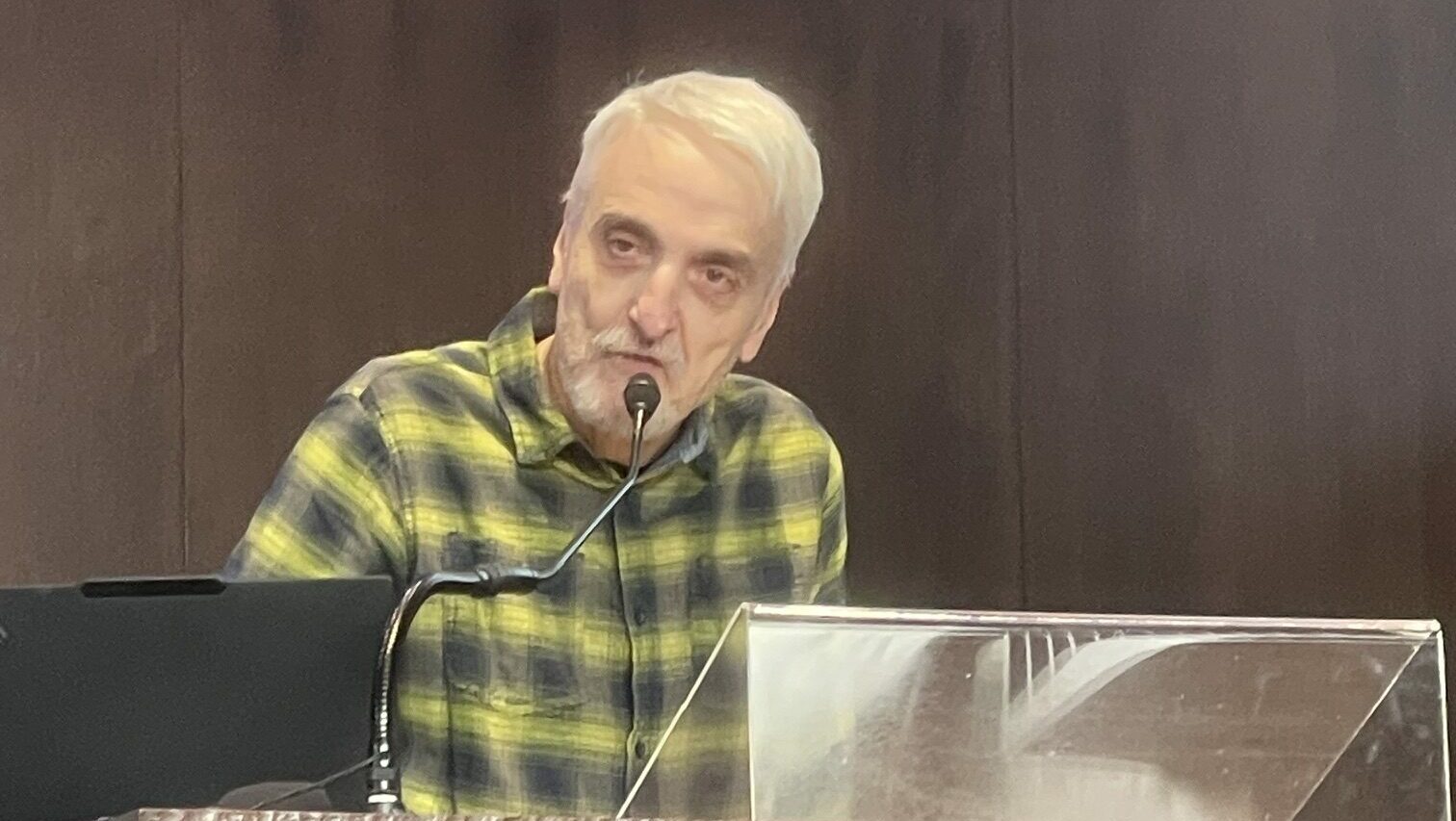
By MYRON LOVE Stan Carbone, a long-time friend of our Jewish community and fixture at the Jewish Heritage Centre of Western Canada (JHCWC) for the past 25 years, retired last week. His last day of work was May 13.
Most recently, he was the JHCWC’s Director of Programs and Exhibits.
“For the past 25 years, the Jewish Heritage Centre of Western Canada has been an integral part of my life,” Carbone said. “I have made a lot of friends in the Jewish community, and I hope to maintain those friendships.”
Carbone’s own history reflects the immigrant experience. He arrived in Canada in 1960 as a three-year-old with his mother and sister, from San Giovanni in Fiore, Calabria in southern Italy. His father had come a few months earlier. Initially, the family settled in Fort Rouge which, at that time, had a substantial Italian community. Within a couple of years, they had relocated to East Kildonan to be closer to where his father’s two sisters and their families lived.
He earned a BA Double Honours in History and Political Studies at the University of Winnipeg, followed by an MA in History at the University of Manitoba, from where he graduated in 1981.
In 1993, he was hired at the Manitoba Museum of Man and Nature (as it was then called) as Curator of Multicultural Studies.
“I always enjoyed doing research,” he said.
His first project for the JHCWC came in 2000, the year after the organization was formed through the amalgamation of the Jewish Historical Society, the Ed and Marion Vickar Jewish Museum of Western Canada and the Freeman Family Foundation Holocaust Education Centre.
Marim Zipursky had approached the Manitoba Museum of Man and Nature looking for a curator to organize a JHCWC exhibit featuring Jewish music and musicians in Winnipeg,” Carbone recalled. “I didn’t know much about Jewish music and musicians, but I was familiar with the Jewish Historical Society – which preceded the JHCWC. I was really impressed by its extensive archives, and I was intrigued by the Jewish community’s history and the wide range of subject materials in the archives.”
The next year, when a position opened at the JHCWC, Carbone applied.
“I have been here ever since,” he said.
Over the past quarter century, Carbone has been involved in bringing to fruition several interesting exhibits. He mentions the synagogues display, a history of the YMHA, and the current exhibit highlighting the important role of women’s organizations. The exhibit that was closest to his heart though was “A Stitch in Time,” a look at how Jews contributed to the development of the garment trade in Winnipeg. Both of his parents worked in the garment industry.
The exhibits though are just one facet of the JHCWC’s focus, Carbone noted. He mentioned how the organization contributed to the publication of Allan Levine’s “Coming of Age: A History of the Jewish People of Manitoba.”
There have also been several compilations over the years of talks that the JHCWC has organized. These are known as the “Jewish Life and Times,” consisting to date of ten volumes.
Carbone further pointed out the organization’s commitment to Holocaust education and the numerous initiatives that have brought that subject to greater public attention.
The organization’s genealogical component, he reported, draws numerous queries from people all over the world.
One particularly interesting project that Carbone spoke about is an ongoing cooperative partnership with Gray Academy. For the past 10 years, the JHCWC has been loaning photos from the archives to the school’s art program, allowing the students to make drawings based on the photos.
“It has been a wonderful program which has given the students a better understanding of local Jewish history,” he said.
“During my time here, we have worked with numerous Jewish and non-Jewish organizations,” Carbone added. “It helps to build bridges between the Jewish and other communities.”
In retirement, Carbone is looking forward to doing more travelling with Anna, his wife of 40 years. They were scheduled to leave for southern Italy on May 16.
He will also continue to be busy in his role as Italy’s vice-consul here, helping fellow Italians and others in Winnipeg.
And he is excited about having more time to spend on his own genealogical and historical research. He has already published two books: “Italians in Winnipeg: an Illustrated History,” and “The Streets Were Not Paved With Gold: A Social History of Italians in Winnipeg”.
A future project which he is seriously considering is a study of the history of Jewish life in Calabria.
He is also working on a family tree.
“I may be retired,” he said, “but I will still be available from time to time to help out if needed.”
Local News
Regan Katz manages not just one, but two different – and successful baseball teams in two different cities
By BERNIE BELLAN About three months ago I wrote a story about an up and coming local football star by the name of Gavin Katz – who, although only 14 years old, had already received widespread recognition for his defensive abilities on the football field. (You can read that story at “Gavin Katz: ‘The next great Jewish football player’.”)
Gavin had been both a linebacker and defensive lineman for his pee-wee Fort Garry Lions Bantam football team – and he was voted most outstanding defensive player on his team by his coach, John Makie.
One thing that stood Gavin in especially good stead as a football player was that, in his 14th year, he grew 4 inches to 5’8″ and added 35 pounds to weigh 170 pounds at the time I spoke to him in July.
With him graduating from Ecole River Heights last June and moving on to Kelvin High School this September, Gavin had hopes to make the Kelvin football team, but he was realistic about his chances, saying that he thought he would probably “end up on the practice roster” for the Clippers varsity team “where he will be fighting for a playing role,” because if he did make the team he’d be among the youngest players on the team (which is usually made up predominantly of players from Grades 11 & 12).
Well, as I noted in my introduction to my story about Gavin Katz, the idea for doing that story came from sportswriter Scott Taylor. Recently, Scott sent me another email about a story, but this time the idea he suggested was to do a story about Gavin’s father, Regan.
I had mentioned Gavin’s parents’ names in my story about Gavin – also that Regan is former Mayor Sam Katz’s nephew (His father is Sam’s older brother, David), but other than adding Gavin’s mother’s name (Mandy), I didn’t go into any detail about Regan Katz and his own very successful career.
Then I received another email from Scott Taylor, this time about Regan (with a photo attached):
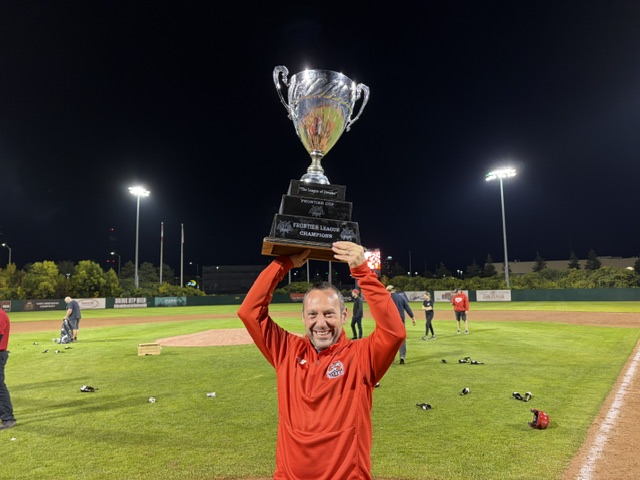
“Here’s a photo of the best baseball executive in Canada — Regan Katz.
“He runs both the Goldeyes and the Ottawa Titans. He helped get the Goldeyes to the playoffs, just won a championship with the Ottawa Titans and also set the affiliated minor league attendance record in Ottawa with more than 10,000 fans for the Frontier League opener and again for the Championship series.
“This guy has his shit together.”
And so, since my story about Gavin Katz was one of the most widely read stories on this website this past summer (It was also very widely read in the print Jewish Post newspaper.), I decided that, if Scott Taylor sends me a story idea, it’s an idea worth following up.
Which led me to contacting Regan Katz again. (The last time I contacted him it was to see whether he could wake Gavin up to talk to me. After all, like most teenagers, Gavin likes to sleep in when he can, but it was already 11 am on a Saturday morning when I was calling, so I figured: “Dad, go wake up your son. There’s a not-so-important journalist who wants to talk to him.”
Which is how I ended up having a very enjoyable interview with a very personable and unassuming young man – who did seem a little bit drowsy as I talked to him.
This time though, when I spoke with Gavin’s father, Regan was very much alert. Considering the hectic schedule he maintains though during baseball season, I could have forgiven him for sounding just a wee bit tired himself. But, at the time we did our phone interview, Regan’s baseball season had wound up. He sounded quite relaxed – still very much enjoying the accolades he had received for his work running not just one, but two different minor league baseball teams.
Before I began to ask Regan about his life in baseball, however, I wanted to touch base with him about Gavin’s football career. By now, the high school football season was in full tilt, and I was curious to know whether Gavin had made the Kelvin football team?
Regan told me that Gavin was one of only three “freshmen” to make the team and “Gavin’s the only one who started every game, and, yesterday got defensive player of the game” (which would have been played Thursday, Oct. 1, as our interview was conducted Friday, Oct. 2.)
I asked Regan whether Gavin was still playing linebacker (which, Gavin had told me, was his preferred position on defense)?
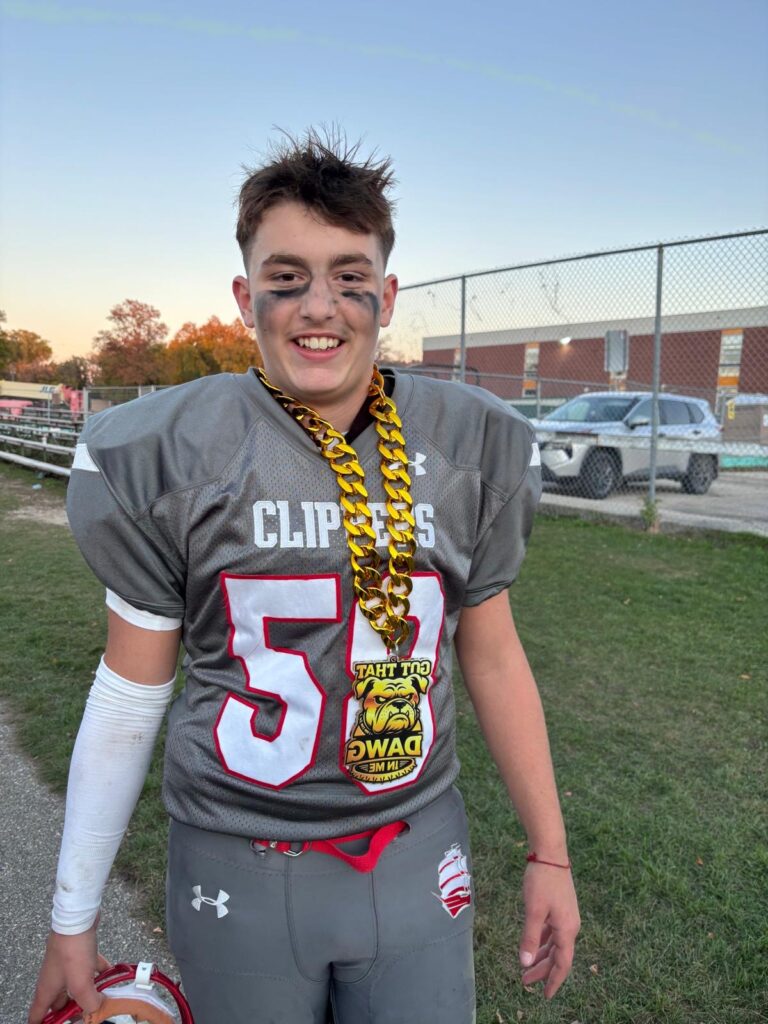
Regan responded that “they moved him to defensive tackle, so he’s right in the front line instead of at the back, but he’s breaking through the offense and helping the linebackers take down the tackles. He got two sacks yesterday and two running back tackles, which is not his job, but he’s breaking (through) kids larger than him and making his way through.”
At some point, as we follow Gavin’s football career, I hope to provide further updates as to his success on the “gridiron.” (By the way, the term “gridiron” – which refers to a football field and which used to be used quite often by sportswriters in the past “comes from the historical layout of the field, which was marked with intersecting lines every few yards that made it look like a metal cooking grate (or gridiron) used for broiling food over an open fire.”)
Enough about Gavin. Now, here’s the main point of why I wanted to do this story, which was to write about Regan.
I asked him how long he’s been involved with organized baseball?
He answered: “I’m in my 28th year.” As Regan observed, although he was born in Winnipeg, “when I was three, my dad decided he was allergic to snow and moved the family west (to Victoria). I came back in my late teens and joined up with the Winnipeg Goldeyes.”
Even before Regan moved back to Winnipeg, however, he had already embarked on a business career in his early teens, working for Westfair Foods (owners of Superstore and Wholesale Club) in British Columbia, helping to build grocery stores all over the province.
As he explained it, “So, when they would open up a new store, I would be the regional person who would go in and ensure that the setup and the staff was on plan.”
Regan was also responsible for training the staff and making “sure that everyone was ready” – traits that were to prove indispensable to what was to come during his current career in baseball. ”I was part of seven store openings in a two-year span, in that role” (with Westfair), Regan added.
He noted that when he left, he told them he was taking a “two-year sabbatical from the job.”
Regan added though, that “since I haven’t gone back, I assume they figured out I’m not returning.”
I asked: “Well, have they sent you a message saying, ‘Hey, the door’s still open?’ “
Regan answered: “No, but every year I get my superannuation for the time I served with them.”
He went on to note that he got married in 2010, “to a wonderful Manitoba woman, ” (Mandy, whose maiden name Gavin had told me, was Falk.)
Sam Katz actually revived the Winnipeg Goldeyes as a baseball franchise in 1994, when the team played out of the north end of what was then Winnipeg Stadium – in what was a very oddly shaped baseball field.
Regan, who came on board full-time with the Goldeyes in early 1999, says that he had spent some time with the team during a few previous summers spent in Winnipeg and had been able to see the Goldeyes play on that field which, he says, was affectionately known as “Deformity Field.”
(The left field fence was only 225 feet from home plate. It was a hitter’s dream – knocking easy home runs over that very short distance to the fence.)
Regan arrived in Winnipeg, however, just in time for what was to be the first season in what was to become the Goldeyes’ new home – what was then called CanwWest Park (now Blue Cross Park), in 1998.
His first title with the Goldeyes, he said, was “account executive, but I was truly a ‘gofer,” he observed.
“At the time construction was on full throttle at the new ballpark – downtown. And so, we were commuting from our offices on Maroons Road (where Winnipeg Stadium was located), and on McDermot – at Sam’s offices for Nite Out (Entertainment), as well as the ballpark trying to get things set up.
“So, when I wasn’t hauling or setting things up, I was making calls off a list to try and convince people to buy tickets.”
In those early years with the Goldeyes, as Regan noted, he was mostly involved in ticket sales, and in “2003, I moved to director of group sales and looked after all of our group sales, which are the outings where people are coming out (for things like) birthday parties, baseball teams, family gatherings, that kind of thing.”
In 2005, Regan moved up from director of group sales to assistant general manager, then in 2016 to vice president and chief operating officer – which are the positions he holds to this day.
In March 2020, however, Regan and his uncle Sam Katz took a trip to Ottawa – just as Covid was beginning to shut down things everywhere – including sporting venues.
There was a baseball park in Ottawa – called Ottawa Stadium, owned by the city, that was sitting empty.
As Regan explained, the city was “taking RFPs for an operator. (It had) sat empty for a year and a bit, and its previous occupant had left all kinds of turmoil and unpaid bills and whatnot.
“So they were looking for a team, trying to decide what to do with the venue. So we went out to tour – just as COVID shutdowns were starting in late March. We toured the venue, contemplated for a bit. And so, we went back and forth for a while, trying to decide if this was something we wanted to take on.
“In September of 2020, we agreed to terms with the city on a lease for the venue. We couldn’t travel across the border, so we started the team in 2022.”
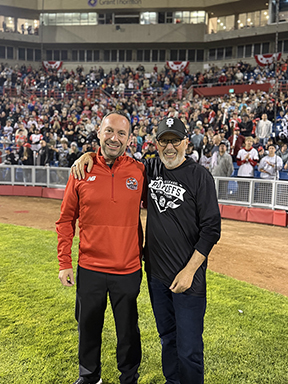
The Ottawa team, known at the Titans, play in what is called the “Frontier League (which will be rebranding in 2027 to become the “National Association.” The Goldeyes, by the way, are in a league known as the “American Association.”)
There is a difference in the calibre of baseball players in the two leagues, as Regan explained to me: Players in the Frontier League would move up to Single A baseball, while players in the American Association would move up either to Double A or Triple A. (The level of baseball in the American Association is at a level wherein you can often see former major leaguers playing on teams.)
As vice-president and chief operating officer for both the Winnipeg Goldeyes and the Ottawa Titans, Regan said that he oversees general operations for both teams, but is not involved with the day to day management of players or coaches of the teams. That is the responsibility of the teams’ general managers and field managers, he clarified.
While there is no specific award for executive of the year in either the Frontier League or the American Association, when Scott Taylor wrote to me that Regan Katz is “the best baseball executive in Canada,” he didn’t say that he was referring only to minor league baseball.
As Regan noted, the Goldeyes received an award for “Game Presentation of the Year” this year, while the “Ottawa Titans received the Commissioner’s Award of Excellence.”
“When we started the (Ottawa) team five years ago,” he observed, “we were averaging about 1,200 fans. This year we were in excess of 2,600. We set attendance records, both for the ballpark in Ottawa, as well as for the league. We also sold 10,278 tickets to our opener, which is a record that will probably stand true for the rest of time.”
As far as the Winnipeg Goldeyes’ season went, not only did the team perform well on the field, making it to the first round of the playoffs, average attendance was the highest it’s been since before Covid, with games averaging over 4,000 fans.
Not only that, but the Goldeyes received a number of accolades for how they produce their games.
“Our broadcaster got Broadcaster of the Year,” Regan noted. (The games are broadcast on Nostalgia Radio Station CJNU. The play by play announcer is Trevor Curl.)
“We (also) received Game Presentation of the Year, which, you know is a big one because that’s what we work so hard on. What we’re selling – it’s all about fan experience.”
Regan continued: “Obviously, we try to put together a winning team, but to us, it’s all about having fun at the ballpark, win or lose – even if you don’t like baseball. So that one meant the most to us.
“We also won Social Media Team of the Year – for Winnipeg. All three of (those awards) are big ones to us because they’re pieces that we choose and work hard on.
“The essence of what I do (is) we’re trying to put on family entertainment that happens to have a baseball game in the background. ..and that’s what we built in Winnipeg.”
I asked Regan whether “in terms of, of how you rate in in Minor League Baseball – without trying to blow your own horn, I know the Goldeyes have always been considered a top-notch operation. Have the Goldeyes received any particular awards from organizations that look at all of minor league baseball and compare all teams?”
“ ‘Baseball Digest’ has acknowledged us a number of times over our 33 years for various pieces of what we do,” Regan answered, “whether it be attendance or game experience or most creative promotion. We’ve certainly received many, many mentions in ‘Baseball Digest,’ which is probably the most well-known for all of Minor League Baseball and independent leagues for sharing what’s out there.”
I asked Regan – and it was based on everything he had told me to that point: “Has anyone in a much more senior league tried to recruit you?”
He responded: “Are there headhunters out there who have called me? Absolutely, yes. Many, many teams call me to consult all the time, but I do keep my advice and recommendations to those within our league because I want to see the leagues that we’re in succeed.”
Regan added: “I have a young family. (In addition to Gavin, the Katz’s have a daughter, Brynlee, who is nine). I like where I’m at. I don’t think any other team is going to come to Winnipeg, so I’m well-planted here.”
My final question was about how difficult it is to run two separate teams that are so far apart?
He answered: “Anybody else who has overlap between two teams has a much shorter commute than I do – with a three-hour flight each way. It’s incredibly challenging. Fortunately, technology’s made it a lot easier with virtual meetings and things like that. I speak with my staff in Ottawa every single day. I’m in constant contact with at least some of them, if not all of them. All of our meetings are virtual so that I can be part of them.”
Only 47 years old, Regan Katz has been working full time since he was a young teenager. I didn’t even mention that, while he was working for the Goldeyes here after he had just moved to Winnipeg, he managed to finish university, where he studied business administration. If anyone would be interested in learning about business administration, with everything he has accomplished so far, Regan Katz could be the perfect teacher.
Local News
Federation mission to Poland mix of heartbreak and celebration
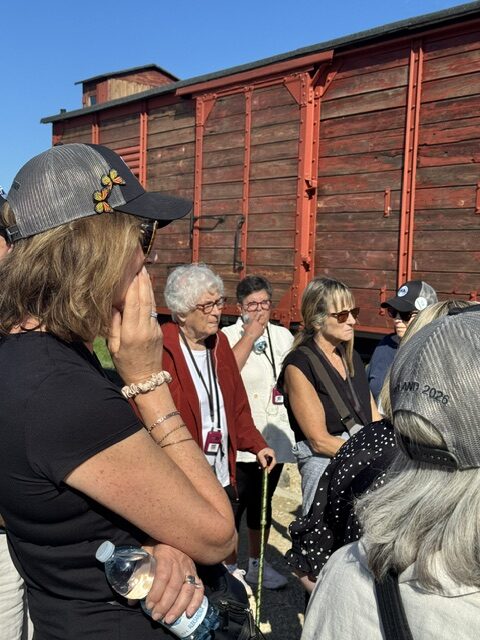
By MYRON LOVE For Sheila Rabb, her first visit to Poland was “both heartbreaking and heartwarming.”
The 90-year-old Rabb was one of 34 participants in the Jewish Federation of Winnipeg’s first ever organized Adult Mission to Poland. The group toured Poland from Wednesday August 26 – Monday August 31, with an entourage of Israel and Polish tour guides, a security guard ,and two bus drivers.
It was Jeff Lieberman, CEO of the Jewish Federation of Winnipeg (and whose late father, Aron Lieberman, was a Holocaust survivor who was originally from Poland) who initiated the trip. “In 2023,” he recounted, “shortly after I was appointed CEO, I learned we had never organized an adult mission to Poland. Given the passage of time since the Holocaust and the tragedy of October 7th, I thought there would be interest in offering this meaningful trip to our community.“
The six-day journey,” Lieberman continued, ”taught us about the 1,000 years of mostly good and impactful Jewish life in Poland before 1939, as well as what happened during the Holocaust. We visited several sites including the Warsaw Jewish Cemetery, the Polin Museum, synagogues, the Krakow Jewish Community Centre, the Lodz Ghetto, Majdanek and Auschwitz-Birkenau concentration camps, and the Chelmo death camp.
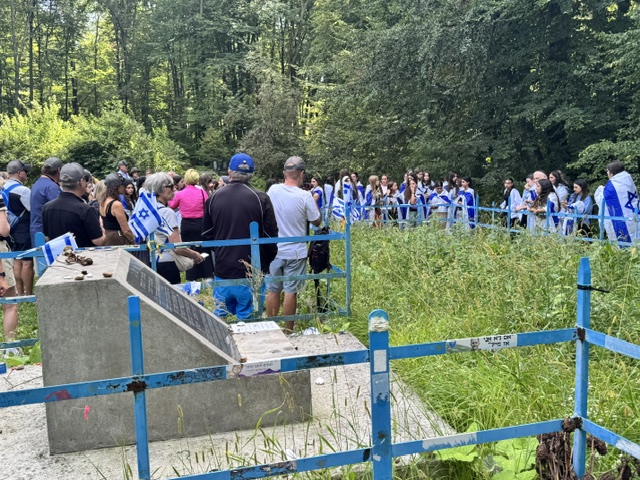
Lieberman noted that the group bonded very quickly. ”We learned so much,” he said. “We cried together and we celebrated together. Many of the people that went on this mission have said how life-changing this trip was for them.”
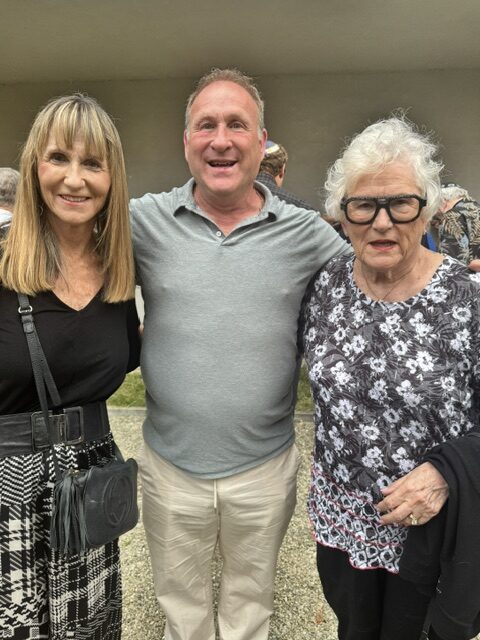
In particular, the Federation CEO singled out the presence of Sheila Rabb. He describes her as “incredible”. It was a difficult tour with much walking and standing at sites, he noted.
“She was a real trooper,” Lieberman said. “Sheila was able to able to experience this meaningful journey with her children. It was truly special for us to have Sheila and her children, Ian and Irene (Zimmer), join us.”
“There was a wheelchair available for me if I needed it,” said Rabb, who looks much younger than her years. “I must admit that the heavy schedule of 12-hour days and late dinners was a challenge. But everyone was so nice and helpful and protective of me.”
Sheila Rabb’s connection to Poland was through her mother, Molly (Horn) Pitch. Fortunately, she was able to emigrate in the early 1930s. (Sheila’s father, Willy, came here from Russia about the same time.) Molly was able to bring one brother over but sadly, all but one sister were subsequently murdered by the Nazis.
The group began their journey in Warsaw with a visit to the Polin Museum which – Rabb noted – was built by Ron Lauder, president of the Estee Lauder Foundation. The museum recounts over 1,000 years of Jewish life in Poland.
“We learned about Jewish life, how Jews contributed to Polish society and the rich communities that existed throughout the country,” Lieberman reported.. “You can’t talk about Poland without including the impact of what Jews did for Poland.”
Both Rabb and Lieberman have fond memories of a group of Israeli high school students that that they met at the museum, who were from Ulpanat Chorev High School in Jerusalem. “We joined them in singing Hatikvah and other songs and danced a hora with them,” Lieberman said. “We ran into them again at Mila 18 and Auschwitz, and their Head of School invited us to join them for Kabbalat Shabbat in Krakow.
“Our group had the amazing experience of celebrating Shabbat with them,” he continued. “The women were so joyous, and their enthusiasm helped us emotionally after what we had experienced during the first few days of the mission. Their presence and the sorrow they expressed at the sites we shared with them had a profound impact on all of us.”
The group’s time in Warsaw also included a visit to a Jewish cemetery with over 250,000 graves and a walking tour of the famed Warsaw Ghetto.
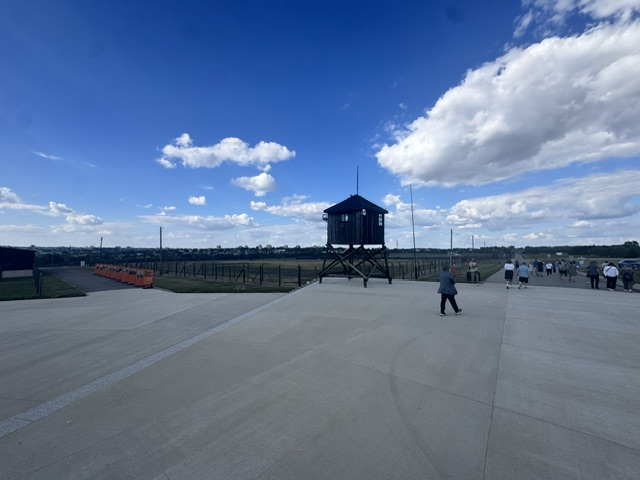
The next stop was Lublin and the Majdanek death camp.
“One can read the books, watch the films and visit the museums, but nothing prepares you for walking the grounds of the death camps and mass grave sites and the profound sadness and shock that accompany them,” observed Jewish Federation staffer Abby Flackman, who was also part of the mission. “Walking in Auschwitz, Majdanek and the forest graves of Chelmno, I felt, validated the lives that were taken. We take the memories of their experiences and assure that they will not be lost with time.
“But,” she added, “we also showed that we are still here. We are still laughing and feeling joy, supporting one another and proud of who we are.”
On the other side of the coin, the group witnessed the ongoing rebirth of Poland’s Jewish community. One site that Sheila Rabb recalled in particular was the reconstituted Lublin yeshiva. The yeshiva, which opened in 1930, was one of the largest in the world. The building was restored by the Jewish community in 2003 and reopened as a synagogue in 2007.
On the Friday of the tour, the group arrived in Krakow, where they toured the old Jewish quarter where, Ian Rabb noted, there are still many Jewish-owned businesses – also the Schindler factory museum. He reported that Krakow has a Jewish population of about 1,200, as well as home to the internationally known annual Krakow Jewish Festival.
Sheila Rabb spoke about a 97-year-old Holocaust survivor the group encountered, who told his story. Although he had lived in California most of his life, he felt the need to return to Poland two years ago.
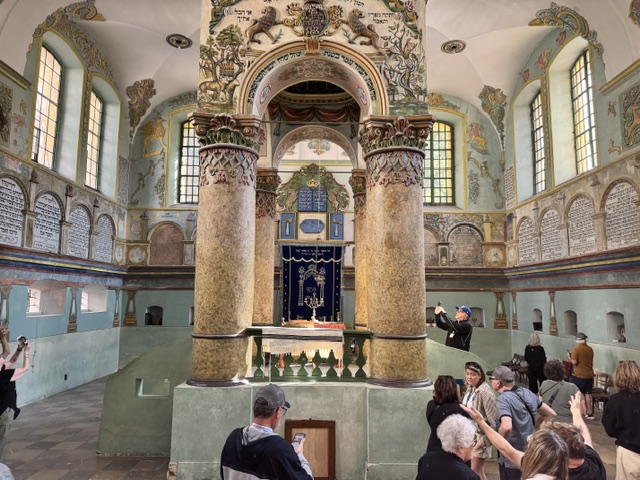
While in Krakow, the group made a day trip to nearby Lancut, formerly a Hasidic stronghold, where the members of the group toured the synagogue that was built in 1761 and has been well preserved.
“The synagogue was unreal,” Ian Rabb commented. “It has an art deco design that exudes spirituality and kabbalah.”
The Winnipeggers finished their tour with a visit to the Lodz ghetto. Lodz was an industrial city and the last Polish city to be made “Judenrein” because the Nazis needed the Jewish factory workers to build tanks and sew German soldiers’ uniforms.
For Sheila Rabb, one of the most difficult moments was standing on the site of the mass grave in the forest near the Chelmno death camp, not far from Lodz, where up to as many as 300,000 victims of the Chelmno gas chambers were buried.
“We recited kaddish over the site,” she said.
Sheila Rabb hac high praise for the Winnipeggers’ Polish and Israeli tour guides, Janush and Mordechai. ”They were outstanding,” she said. “They really brought history alive for us.”
Ian Rabb reports that his cousin (and Sheila’s nephew), Alan Pitch, who was also part of the group, is working on a documentary of the trip.
The last word goes to Abby Flackman. “My biggest takeaway,” she said, “is that we will control how our story ends. The Nazis tried to end our story of the Holocaust. They failed. We went elsewhere, built communities and institutions, grew again in numbers and continue to strive to become stronger, more resilient and thrive.”
Local News
Gray Academy enrolment continuing steady upward trend
By MYRON LOVE Next year, Gray Academy of Jewish Education will celebrate its 30th anniversary – and Western Canada’s only JK-Grade 12 Jewish day school has much to celebrate.
For starters, enrolment continues to grow. Lori Binder, Gray Academy’s Head of School and CEO of the Winnipeg Board of Jewish Education, is pleased to report that this year’s opening enrolment stands at 521 – the highest number for September in 13 years.
For the third year in a row, Gray Academy is running three kindergarten classes, and all three are nearly full, as are the Grade 1 and 2 classes. While Early Years remains the main entry point for new families, the school also welcomed 37 new students to its elementary and high school this year – a total of 88 new students.
Lisa Boroditsky, the school’s admissions coordinator, points out that many kindergarten children are coming from the Kaufman Child Care Centre at the Rady JCC and Chabad-Lubavitch of Winnipeg’s Torah Tots early childcare program. At the high school level, she notes, Grade seven enrolment is also rising, with more students coming to Gray Academy after completing Brock Corydon Elementary School’s Hebrew Bilingual Program.
“From our parent surveys, we can report that parents are choosing Gray Academy not out of fear, but rather because they value the sense of Jewish community that is only available at Gray Academy,” Binder says. “The fact that so many current Gray Academy students are children of alumni also tells us that parents believe in the high academic standards and the positive Jewish experiences we offer.”
New for the school’s elementary School this year, Lori Binder reports, is a musical theatre program. Over the years, our community has produced a significant number of young performers who have not only graced local stages but have also made their mark in theatre and film throughout North America. (Incidentally, this school year, Gray Academy will present its high school musical production, “Mary Poppins,” in March.)
In addition to the annual musical, Binder reports, Gray Academy this school year will be hosting the annual Canadian Accredited Independent Schools national varsity boys’ basketball tournament. Students and staff alike are looking forward to welcoming participating team from independent schools across the country.
Students are also looking forward to the school’s 50th Yom Ha’atzmaut Song Festival. “We are excited for our current students to continue our long tradition of celebrating Israel through music,” Binder says. “We are also hoping for a lot of participation from past performers from the first five decades.”
Among newer programs for Gray Academy high school students are internship opportunities. One is with Drs. Lorrie Kirshenbaum and Inna Rabinovich-Nikitin at the Institute of Cardiovascular Sciences at St. Boniface Hospital – a great opportunity for students in Grades 11 and 12 who have an interest in pursuing studies in health sciences. The other program, which was piloted last year, is run in conjunction with the Saul and Claribel Simkin Centre, and gives students in Grade 9 and up opportunities to connect weekly with Simkin residents for hands-on activities.
The corollary to that is a new program that focuses on the school’s relationships with grandparents. The Gray Academy Grandpals program encourages grandparents (and other special seniors in the lives of Gray students) to connect with and volunteer at the school. Since the program launched two years ago, Grandpals have attended special events and come into the school to volunteer for challah making, hamantaschen baking, and even with building projects such as at the new Hypedome by the ice rink, which will provide student skaters with shelter to warm up and change their skates in winter.
Lori Binder points out that, in addition to new programming, the school maintains a strong focus on affordability. “It is very important to us that no child is turned away because a family can’t afford to pay,” she says.
She notes that Manitoba is one of only a few Canadian provinces that fund independent schools such as Gray Academy, with the school receiving approximately 50% of the funding public schools receive per student. She adds that the school offers a robust Bursary Assistance program, strongly supported by funding from the Jewish Federation of Winnipeg’s Combined Jewish Appeal. “Over 60% of our families receive some level of bursary support,” she reports. “We work with every family to ensure that no child is ever turned away because of inability to cover the full parental contribution.”
The school also continues to play an integral role in helping families moving to Winnipeg from Israel, Argentina, Brazil and other countries to adapt to their new homes. Over the past few years, the school has expanded its EAL (English as an additional language) programming significantly to accommodate growing needs.
In an increasingly troubled world, Gray Academy remains a beacon of light, offering Jewish students and their families a warm, welcoming environment, along with a top notch Jewish and general education.
For more information about what Gray Academy has to offer and application dates, phone 204 477-7425 or email admissions@grayacademy.ca.
