


Uncategorized
How NYC mayoral candidates reacted to the release of the Israeli hostages, from Gematria to Gaza
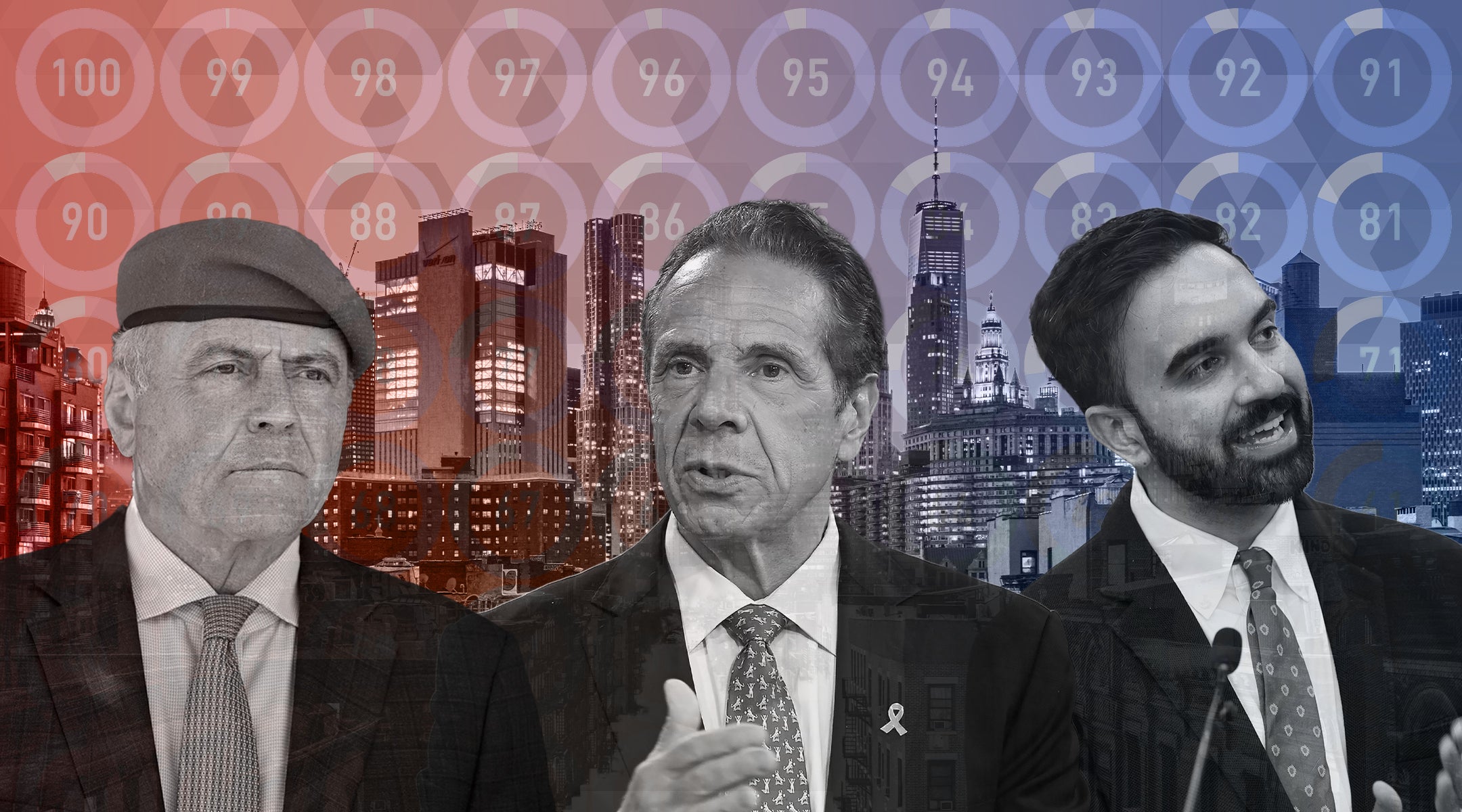
This piece first ran as part of The Countdown, our daily newsletter rounding up all the developments in the New York City mayor’s race. Sign up here to get it in your inbox. There are 21 days to the election.
From Gematria to Gaza
- Andrew Cuomo, Curtis Sliwa and Zohran Mamdani reacted Monday to the release of the last 20 living Israeli hostages in exchange for nearly 2,000 Palestinian prisoners.
- Cuomo called it a “moral moment” and invoked the Holocaust commemoration slogan “never again” to condemn the Hamas attacks. He also quoted writer and Holocaust survivor Elie Wiesel as saying, “The opposite of love is not hate, it’s indifference.”
- Sliwa introduced Jewish math into his statement. “The 20 surviving hostages are reunited by families and loved ones after 738 agonizing days in captivity. 7+3+8 = 18, which means Chai, which means ‘life’ in Judaism,” he said.
- Mamdani said the “scenes of Israelis and Palestinians are profoundly moving,” but focused much of his statement on holding the Israeli and U.S. governments accountable for the death and destruction in Gaza. He also repeated his stance that American tax dollars “funded a genocide” in Gaza and that the global community must work toward a future “without occupation and apartheid.”
- Mamdani posted his statement at 4:20 p.m. New York time, over 12 hours after the hostage release, leaving time for Cuomo to criticize him.
- “It shouldn’t go unnoticed that @ZohrankMamdani – who still refuses to condemn the phrase ‘globalize the intifada’ (widely understood to mean death to Jews) – has yet to comment on the release of the hostages. His silence speaks volumes,” Cuomo said on X.
- In a race where Cuomo and Mamdani have sparred over their ability to stand up to President Donald Trump, neither mentioned his name or role in brokering the ceasefire. Sliwa said he was “proud of President Trump and all involved.”
Mamdani’s charm offensive
- Mamdani is continuing his charm offensive with New York’s business elite, reported The New York Times. He has built relationships with some of his harshest skeptics, and many say they like him — even if they disagree with his stances and plan to vote for Cuomo.
- Mamdani has strongly pivoted his views on policing, one of the top concerns among critics who recall his “defund the police” calls in 2020. In addition to a private apology tour with police officers, he has reiterated his interest in keeping Police Commissioner Jessica Tisch in her role, according to The New York Times Magazine.
- But Mamdani isn’t budging on his Israel views, he told the magazine. He reaffirmed his commitment to ordering the arrest of Israeli Prime Minister Benjamin Netanyahu if he is elected mayor, though the pledge is unpopular even among some of his allies.
A Jewish comic stumps for Mamdani
- Jewish comedian Gianmarco Soresi, who recently told us about his Jewish background, which figures prominently in his act, was among the speakers at Mamdani’s rally in Washington Heights on Monday night, according to Politico.
- At the rally, which drew some 3,000 supporters, Mamdani said he saw “power of a movement that won the battle over the soul of the Democratic Party.”
-
“We all know Cuomo will kiss the ring” of Trump, Soresi joked. “He kisses everything.”
- Like Mamdani, Soresi is an outspoken critic of Israel and its actions in Gaza.
Coming up over the next three weeks
- Thursday is the first general election debate among Cuomo, Mamdani and Sliwa. The event will be held at 7 p.m. in Rockefeller Center, and you can watch live on WNBC-TV or across WNBC’s and WNJU-TV’s digital and streaming platforms.
-
Saturday, Oct. 25 is the last day to register to vote in person or by mail for the general election.
-
Saturday, Oct. 25 through Sunday, Nov. 2 are the dates for early voting.
- Tuesday, Nov. 4 is Election Day.
—
The post How NYC mayoral candidates reacted to the release of the Israeli hostages, from Gematria to Gaza appeared first on Jewish Telegraphic Agency.
Uncategorized
Antisemitic vitriol claims an unlikely new victim — a flamboyant and popular French DJ
The celebrated French DJ Barbara Butch, whose flamboyant performance at the 2024 Olympic Games in Paris was condemned by Catholics and conservatives, is proudly lesbian and unabashedly Jewish. Last week, the latter quality sparked yet another flare up of antisemitism in France.
On the evening of July 18, about 20 minutes after Butch began a concert in the city of Grenoble, about 150 protestors who had entered the hall with the rest of the audience unfurled pro-Palestinian banners denouncing the brutal destruction of Gaza. Many of them began to fling antisemitic insults and glass bottles at Butch. Stunned by the sudden explosion of violence, Butch soon left the stage. At that point, the municipal authorities intervened. “Confronted by threats aimed at the artist Barbara Butch, and to guarantee the safety of both the audience and performers,” they declared, “the city of Grenoble has taken the decision to cancel the performance.”
This eruption of antisemitism parading as anti-Zionism was as predictable — and as predictably ignored by the local government — as are the fires now consuming swathes of western France. In the weeks leading up to the concert, a petition was launched by the local section of La France insoumise (France Unbowed), the extreme-left political party founded and led by Jean-Luc Mélenchon, who has recently and plausibly been accused of flirting with antisemitism. The petition condemned Butch for supporting a proposed law in 2025 that penalized “new forms of antisemitism,” which potentially included expressions of anti-Zionism and even criticism of the Israeli government.
There were two problems, though, with the petition. First, there is the obvious issue of banning an artist from presenting or performing their work because one disagrees with their political statements. (Statements that do not, of course, inspire acts of racial hatred or violence.) Second, and no less obviously, Butch had almost immediately regretted and publicly retracted her initial support of the proposed law, one she realized could suppress legitimate criticism of Israel’s brazenly illegal and brutal actions in Gaza and the West Bank.
All this was for naught, though. The tract distributed in early May by the local office of Unbowed France demanded the cancellation of Butch’s concert by the city government, which had sponsored the music festival it was part of. Fair enough. Not so fair, though, was the tract’s lurid montage, which placed Butch against the background of an LGBTQ flag spattered in blood and stamped with the Star of David, accompanied by the claim that she was “complicit with the genocide” committed in Gaza.
Equally startling was the role played by Allan Brunon, a parliamentary member of Unbowed France who is also president of the party’s local chapter. Not only did he lead the protestors at the concert venue, but he also insisted that, as far as he could see, their behavior never degenerated into violence, even though videos of the ruckus confirm that bottles and other objects hit the stage, as does the eyewitness testimony of Laurence Ruffin, the mayor of Grenoble, who was also in attendance. Brunon’s faux naïve explanation for the expletives shouted at the concert was equally insulting; they were aimed, he insisted, at Butch’s “political position and not who she is.”
Leaders from across the political spectrum, from the extreme right to traditional left, have denounced the role played by Unbowed France at the concert. Marine Le Pen, the leader of the National Rally who never misses an opportunity to bash Unbowed France and bury her party’s own antisemitic origins, decried “the antisemitism, repeated appeals to violence, and totalitarian nature and project of the extreme left,” while the former prime minister and centrist politician Gabriel Attal, in a mocking allusion to an earlier claim made by Mélenchon, observed that the party’s “antisemitism is anything but residual.” As for the leadership of Unbowed France, Mélenchon has kept silent while the leader of the parliamentary group, Mathilde Panot, spoke in the conditional case, stating that “we would never support, if they occurred, either flung insults or bottles.” (my emphasis).
Wittingly or not, Attal’s remark reaches much further back than last week. Ever since the late 19th century, the extreme right in France has not had exclusive dibs on antisemitism. Édouard Drumont, the author of the virulent antisemitic 1886 bestseller La France juive and editor of the La Libre parole, the newspaper that sparked the Dreyfus Affair, thought of himself as an anti-capitalist and man of the left. It required the immense reserves of eloquence and decency of Jean Jaurès, the Socialist leader, to persuade the rank and file to rally to Dreyfus’ cause. As late as the 1950s, the French Communist Party unhesitatingly followed Moscow’s lead during the late stages of Stalin’s paranoia, featuring spectacles like the “Doctors’ Trial” of 1953, that targeted Jewish “counterrevolutionaries” intent on undermining the Soviet Union.
Of course, the French left has come a long way since then. But to paraphrase Mathilde Panot, if Unbowed France’s apparently uncowed leader, along with a large contingent of his party, are suffering from more than a dollop of residual antisemitism, the future of a democratic and liberal France is at risk.
The post Antisemitic vitriol claims an unlikely new victim — a flamboyant and popular French DJ appeared first on The Forward.
Uncategorized
Why I stand with Israel
I’m often asked why I take a public stand on behalf of Israel. Some have asked how I have the fortitude to do so. Others wonder about the “reputational risk.” Still others wonder about subjecting myself to the “awful” comments. To me, they’re like weather reports — a way to gauge the sentiments of those with whom I disagree.
“Just stop talking — if for no other reason than for saving yourself the embarrassment of being heard by anyone.”
“You Zionists are just mad that no one’s buying your narrative anymore”
“F— Israel”
“Hey Peter! When did you drop the second “n” in your last name? When your family eluded capture when Germany surrendered back in 1945?”
“You are so full of $hit! Mamdani condems a genocide unless you think as long a Santanyahu who happens to be a Jew should be able to kill innocent children day in and day out and get away with simply because he is a jew.”
“I have absolutely loved your music over the decades (my favourite artist) but I have difficulty in listening to it now. The meaning behind your lyrics resonates differently with me now — sorry.”
I support Israel, not because of any government, any particular policy, or anything having to do with geopolitics. I support Israel because half the world’s Jewish population lives there. This is about peoplehood — my people. I understand well how this kind of particularity is easy to criticize, how in an era where the ideology of oppressor versus oppressed has caught the imagination of many people, where thinking about one’s sense of belonging to an ancient nation is thought to be anachronistic, and where a vague notion of universalism has become the new moral imperative.
But as I’ve written many times in my column, all love and all concern begin with specificity. We only learn how to love and be concerned about others through the ways we have loved — and have been loved — by our own.
I see it this way. There are seven million Jews in Israel. They are people of many races and ethnicities, many talents, and many political affiliations. They and their supporters worldwide are now under siege. They have been fighting for their survival, surrounded by neighbors seeking their destruction since before the Jewish state came into existence in 1948— and they have continued to do so since the pogrom of Oct. 7, 2023.
Some have asked me, by way of accusation: do you now believe in genocide? Have you become a warmonger? (I assume my former fan, above, feels this way.) Do you support the murder of children? What happened to the man who wrote songs like “Been Set Free,” Impermanent Things,” and “Mission Of My Soul”? Have you suddenly become cruel, hard-hearted?
The questions are too absurd to warrant a response.
For me, support of Israel and the Jewish people more broadly doesn’t take special courage or insight.
If someone were attacking a close relative or friend, my reaction would be the same. It would be reflexive, instantaneous. What consequence could outweigh the idea of sitting back while your loved ones are imperiled? There are those who have argued that whatever cruelties have been meted out are “acts of resistance” and justified military actions by the oppressed against their oppressors. One wonders what logic brought Hamas and its supporters to conclude that K’fir (who was 10 months old at the time of his murder) and Ariel Bibas (who was 4 years old at the time of his murder) were oppressors deserving of death by strangulation.
Such is the strangeness of the current moment, when it feels as though much of the world has once again chosen to place a target on the backs of Jews. Justifications are conjured up and offered, just as they were during the pogroms in Europe, the forced conversions and auto-da-fés of Spain, the fabricated Protocols of the Elders of Zion in Russia, the institutionalized anti-Jewish and anti-Israel campaigns of the Soviet Union that found expression at the United Nations in 1975, and in the demonstrations that erupted immediately after Oct. 7 — before Israel had fired a shot.
Synagogues in America are more than three times as likely as other U.S. houses of worship to employ armed security guards. Jewish day schools too, like the ones my grandchildren attend, face extraordinary security costs. Today, the average Jewish institution spends more than $400,000 annually on security. That represents an average increase of roughly 125% since before Oct. 7.
Let’s pause here.
This means that after the largest massacre of Jews since the Shoah, synagogues and Jewish schools have to spend 125% percent more to protect themselves from another one. The idea should stun any normal thinking person. Though sadly, I believe it would stun very few people these days.
Most recently, in NYC, Mayor Zohran Mamdani employed the magic words that brought him more attention on social media than ever before. The last time I checked the video in which he said the following received upwards of 90 million views: “I will arrest Benjamin Netanyahu if he comes to New York City.”
Not long afterward, a brutal double stabbing occurred, amid shouts of the now all-too- familiar “Allahu Akbar. One of the victims was a man wearing a kippah as he left a synagogue service. The attack happened on the Jewish holiday of Tisha B’Av, no more than a two-minute walk from my daughter’s apartment.
I leave it to you to decide whether this kind of rhetoric helps create a more peaceful New York City.
So I ask: How could I not speak up? How could I not use my voice in support of my people at a time like this? Isn’t it obvious? And why shouldn’t anyone who cares about Jews and Israel use their own voice?
You don’t need a huge platform. You simply need to speak out in whatever sphere you find yourself. This is the moment your parents and grandparents hoped you’d never see.
How you choose to act matters. It matters a great deal.
The post Why I stand with Israel appeared first on The Forward.
Uncategorized
Over 12 Torah scrolls stolen from Paris suburb synagogue
(JTA) — Over a dozen Torah scrolls have been stolen from a French synagogue in an attack the local rabbi called “antisemitic.”
The burglary hit the Grand Synagogue of Levallois-Perret, a wealthy suburb of Paris, between Sunday night and Monday morning. Rabbi Chalom Lellouche said the Jewish community was “violated” by the theft.
“It is, of course, a criminal act, but it is also an antisemitic act that specifically targeted the Torah,” Lellouche said in a joint video statement on Monday with Philippe Cohen, the president of the local Jewish community association.
The des Hauts-de-Seine prefecture, which handles local state administration, said on X that the stolen scrolls represented not just a “simple theft,” but “an entire community of believers that was wounded to the depths of its soul.”
Prefect Alexandre Brugère and elected officials met with Jewish communal leaders in Levallois-Perret on Monday evening, promising to identify the thieves and secure the return of the scrolls. A police investigation is ongoing, according to Cohen.
Cohen said the burglary was the work of a “professional team” that bypassed security systems and said the synagogue’s security was being reassessed. He called the incident “a profound spiritual trauma for the entire Jewish community in France and around the world.”
“It was the Torah — and only the Torah — that was targeted,” said Cohen. “No property was damaged, and nothing else was stolen apart from Torah items of immeasurable value.”
France recorded 1,320 antisemitic incidents in 2025, accounting for 53% of anti-religious acts, according to the Ministry of the Interior. Jews make up less than 1% of the French population.
This article originally appeared on JTA.org.
The post Over 12 Torah scrolls stolen from Paris suburb synagogue appeared first on The Forward.
