


Uncategorized
The new Anne Frank musical wants you to laugh at ‘woke culture’ — but is it funny?
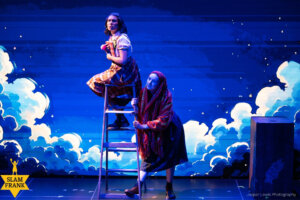
Reactions to Slam Frank, Andrew Fox’s musical satire in which Anne Frank is rewritten as a Latinx pansexual girl named “Anita,” have been mixed. Some have called it a timely, comedic takedown of cultural hypersensitivity while others see it as a shonda to the memories of Holocaust victims. In interviews, Fox has refused to break the character of a playwright obsessed with woke culture, so there is no insight from him to understand the musical. Somehow, the show resists fitting neatly into any understanding of humor, making it hard to know exactly who — or what — you’re supposed to be laughing at.
In his 1655 book The Element of Law Natural and Politic, Thomas Hobbes explains humor through what he calls “superiority theory,” which argues that “laughter is nothing but sudden glory arising from some sudden conception of eminency in ourselves, by comparison with the infirmity of others.”
There’s also self-deprecating ethnic humor, where one makes jokes about their own ethno-racial group, often highlighting historically demeaning stereotypes or characteristics. In his book Ethnic Humor in Multiethnic America, scholar David Gillota describes it as a “psychological defense mechanism” that takes the power of aggression away from the dominant group since jokes about a minority community are being made by its own members.
Then there’s “culturally intimate humor” which SUNY Farmingdale professor Evan S. Cooper defined in his dissertation “I don’t get It?: Culturally Intimate Humor and Its Audiences,” as a familiar use of culturally specific stereotypes in a positive manner. Contemporary scholars have argued that some ethno-racial humor is a way for minorities to create group solidarity and make fun of the dominant culture, a tactic which Cooper calls “protest humor.”
Because Slam Frank pokes fun at so many identities using a diverse cast and crew, it is impossible to put it neatly into any one category of humor.

Take the scene where the cast members, wearing black hats and plastic hook noses, rub their hands together under red lights as they sing about colonizing Palestine and being able to charge high rent. Is it self-deprecating humor — a Jewish writer making fun of those who have turned the search for a holy land into a capitalist cash grab? Is it protest humor, using a caricature of how some anti-Zionists might imagine a Jewish cabal making fun of the ridiculous fantasies of antisemites? Is it superiority humor that is painting religious, Zionist Jews as somehow morally inferior? It’s impossible to know — and that’s part of what makes it so hard to know how to react, making for an awkward viewing experience.
If you understand the jokes about neurodiversity and pronouns as a form of protest humor against “woke culture,” does that mean the playwright sees political correctness as the dominant narrative in our society right now? In an age where diversity, equity, and inclusion initiatives are being targeted by the federal government and political lobbyists have suggested trans people should be considered a terrorist group, the idea that fighting inclusive culture is punching up feels ignorant. But at the same time, even among the left and among those whose identities are under attack — people who make up the cast and crew of Slam Frank — there seems to be an exhaustion with identity politics’ overpolicing of who can say what.
The jokes take on a whole new life in some of the merchandise. Among the items available for purchase in the lobby are t-shirts featuring a photoshopped image of Anne Frank as a nightclub DJ, trucker hats that say “Problem Attic,” and kippot with the Slam Frank logo — a yellow Star of David where the top point has been replaced with a silhouette of Frank, a la Hamilton’s iconic symbol. Unless you confront a wearer on the street, it will be hard to know why the person feels the need to advertise the show. Did they love the musical so much because of its mockery of antisemitism? Or were they enthralled by the takedown of Zionism? Or are they just celebrating a show that made them laugh?
When it comes to Slam Frank, it seems that the only true conclusion is that there is no certain message, which is frustrating for audiences who want to understand what they’re watching. It is particularly hard when we’re living in a time where society seems to constantly demand we proclaim a socio-political opinion on everything.
As a musical, Slam Frank actually holds its own, with pretty catchy — if not politically correct — songs and good performances. But every time I was compelled to laugh with the audience, my amusement was mixed with apprehension and guilt. I knew why I thought the overdone Black American Accent and caricatured Jewish stereotypes were funny; but it’s hard to relax when you don’t know if the rest of the audience is laughing with you or at you.
The post The new Anne Frank musical wants you to laugh at ‘woke culture’ — but is it funny? appeared first on The Forward.
Uncategorized
Conservative and Christian movies are coming for Hollywood
A star-studded new movie set in a Soviet prison is coming out in November. James Franco and Rob Lowe anchor the cast of Confession, playing a brutal prison guard and an imprisoned dissident professor, and a disheveled Nick Nolte appears as a fellow prisoner.
These actors were once huge gets, and their names could convey legitimacy to a project. Nolte and Franco both have received Academy Award nominations. Lowe was a member of the Brat Pack, and was a regular on The West Wing.
Confession, written by Ben Shapiro and produced by the rightwing tabloid-esque news site The Daily Wire, is not the expected fare for actors with that kind of name recognition; Shapiro’s screenwriting aspirations have been the target of ridicule for years.
Nevertheless, this isn’t the only Daily Wire production getting big names; Danny Trejo signed onto a pro-ICE movie about Minneapolis in the aftermath of the Renee Good shooting, and Jonathan Majors led Run, Fight, Hide: Infidels earlier this year.
Each one of these actors has been, in some way, canceled or in career doldrums so may have been more open to working with The Daily Wire. And some have claimed that they did not know who Shapiro was, or what his politics were; Trejo’s son, Gilbert, said his 82-year-old father did not endorse ICE and was misled about the movie before he signed his contract.
Movie studios have struggled through the pandemic and the streaming era, both of which have tanked box office receipts, leaving the field open for movies from offbeat production studios. In addition to The Daily Wire, there has been a whole ream of Christian movies attempting to shift the stereotype of bible movies — that they’re preachy, low-budget straight-to-TV affairs with cardboard acting — to something more prestigious, or at least profitable.
The Christian company Angel Studios has been placing screenings of the half philo-semitic, half-antisemitic Jesus TV series The Chosen in movie theaters across the country, produced the right-wing hit The Sound of Freedom and is pumping out faith-based movies like the animated King of Kings Christmas story and David, a kiddie movie about the biblical king. Recently, Pinnacle Peak Pictures, another faith-based production company, premiered Daniel and the Fiery Furnace, another bible movie that was notable enough to merit a review in The New York Times. (Though admittedly it wasn’t a particularly positive one.)
For decades, Hollywood, and the media industry at large, has been associated with liberalism, progressive politics and diversity. (This is part of why conservative conspiracy theorists often insist that Jews control the media.) Even when conservatives are in power, satirical movies have poked fun at the ruling class — Team America: World Police spoofed George W. Bush’s foreign policy, while M*A*S*H critiqued Richard Nixon. During the current Trump administration, we’ve seen One Battle After Another lambasting immigration policies and rising white nationalism, Eddington on misinformation and populism, and The Apprentice depicting Trump directly.
But a rising number of higher-budget, bigger releases from the right wing, whether The Daily Wire’s conservative political parables or the Christian fables, are bringing a new kind of messaging — about the importance of God and country, about gender roles, about about the centrality of Jesus to the U.S. — to the American movie-going public.
This is no accident. A group of powerful conservative Christians, many of whom worked on Project 2025, are proponents of the Seven Mountains Mandate, a blueprint for Christian nationalism that instructs Christians to gain influence and control over the “seven mountains” of society — which include media, entertainment and the arts. The Mandate is part of the New Apostolic Reformation, a decentralized evangelical movement embraced by millions of Americans.
Jeremy Boreing, the director of many Daily Wire movies — though he has since left the company — said on a podcast hosted by businessman Patrick Bet-David that “It had always been part of our strategy to move into making culture, not just criticizing culture” as a way of proving that “there is a future where conservatives aren’t losing. There’s a future where we have political power and cultural power.”
Cultural power, of course, requires more than just a lot of movies; they have to be well-done, or at least appear to be. Previous Daily Wire productions, as well as other right-wing, MAGA movie ventures, have been hacky. Lady Ballers, about an unsuccessful men’s basketball team pretending to be women so they can dominate the league, was an unsubtle, unfunny and ultimately unwatchable spoof of transgender athletes. And even plenty of higher-budget attempts, like Daniel and the Fiery Furnace, can still fall victim to wooden acting and writing.
But now, with the financial success of movies like The Sound of Freedom and biblical parables like The Chosen, bigger stars are being drawn to projects like the Daily Wire’s lineup of pro-ICE, anti-immigration and anti-LGBTQ movies. With those bigger stars may come new audiences who might not have watched a Christian movie or Daily Wire project otherwise. And where there is money and viewers, mainstream Hollywood will go, too, no matter how progressive people expect the industry to be. We’ve already gotten a biblical epic from Amazon Prime, with The House of David, and there are likely to be many more to come.
After all, it wasn’t so long ago, after all, that Cecil DeMille’s The Ten Commandments was the biggest movie in town.
The post Conservative and Christian movies are coming for Hollywood appeared first on The Forward.
Uncategorized
‘Heil’ Mary? New Atlanta Falcons logo inspires Nazi comparisons
If there was something off about the logo the Atlanta Falcons unveiled on social media Wednesday, whoever runs their accounts did, uh, not see it.
Behind the black falcon graphic that began appearing on the football team’s helmets in the 1960s was a new background — a flag of red, tan, black and white vertical stripes. To thousands of people who responded to the logo, it looked distinctly German — in a 1930s kind of way.
“The Atlanta Falcons are preparing to invade Poland,” one fan wrote.
A day after its posting, the new profile picture had unleashed a deluge of Nazi memes in the 4,000-plus replies on X. One picture swapped in the logo for Nazi flags in the background of a historical photo of a Hitler rally. Another edited the Falcon claw to look like a Nazi salute.
Others depicted Hitler in a Falcons cap, references to Inglourious Basterds and the Battle of the Bulge and a World War II joke invoking a blown lead in Super Bowl LI.
“Falcons were up 28-3 at Dunkirk,” that tweet read.
The Falcons’ snafu enters a small but growing catalogue of Reich-coded brand mixups. Who can forget the German national soccer team’s ‘44’ soccer jerseys? There was also the swastika-emblazoned Hallmark gift wrap; the accidental Hitler mugs; and (for my money) the worst of the bunch, Zara’s concentration camp uniform shirt.
All of those have been addressed; so far, the Falcons’ has not. We’ve reached out to them for comment.
The post ‘Heil’ Mary? New Atlanta Falcons logo inspires Nazi comparisons appeared first on The Forward.
Uncategorized
Netanyahu’s Torah exemption pledge highlights election stakes
Sometimes a statement can contain multitudes, or at least provide a crystallizing moment in an election campaign. So it was when Benjamin Netanyahu, while criticizing the detention of about 40 Haredi draft evaders by military police at Ben-Gurion Airport this week, declared in a radio interview: “We need to protect the world of the Torah … But whoever doesn’t study must serve in the military.”
Netanyahu was effectively saying that yeshiva study should continue to be, as it has been under an informal arrangement, a free pass out of military service – and he went on to repeat a pledge to turn this into law. It is a position opposed by the overwhelming majority of Israelis.
The statement came amid such a calamitous two-week stretch for Netanyahu’s campaign leading up to the Oct. 27 election that it has some people joking that agents of the opposition might have infiltrated Likud headquarters and taken charge.
In a tragicomic episode, one of Netanyahu’s chief propagandists called leading opposition candidate Gadi Eisenkot – a former military chief who is of Moroccan Jewish background – a “monkey” who is under the control of Ashkenazi elites.
Yinon Magal, who has described himself as a vessel for Netanyahu’s messaging, made the comments on Channel 14, the pro-Netanyahu propaganda TV channel where he is the leading host. He later filmed himself explaining that the simian reference, in Israel’s mafia parlance, merely refers to a junior criminal who is a puppet of more heavyweight mafiosi. His clarification did little to stem the tide of criticism.
As Netanyahu awkwardly tried to distance himself, he also charged that opposition figures had used racist slurs, referring to a recent podcast interview with businesswoman Galia Albin in which she said his supporters are Mizrahis who plan to vote for him mindlessly.
Then came leaked comments (made last year) by Haredi Rabbi Dov Lando, leading spiritual leader of the Netanyahu-allied United Torah Judaism party – proclaiming that Zionism had brought disasters upon the Jewish people, that life under Arab rule would have been preferable and that religious Zionist soldiers were being killed because their rabbis taught them “distorted Torah.” Once again, outrage boiled over, and received mostly silence from the Likud.
Donald Trump’s enthusiastic endorsement of Netanyahu might have qualified as good news – but the U.S. president seemed to connect a Bibi reelection to a renewed assault against Iran. That rests on the dubious assumption that Israelis are eager for another few weeks (or more) in bomb shelters.
A punctuation mark arrived a few days later with reports, albeit unverified, that Netanyahu actually had planned to attack Iran earlier this month but was blocked by Trump. Many expected that scenario, which would have been interpreted as a gambit to delay, by dint of national emergency, an election in which he’s badly trailing in credible polls.
Polling is not available on every such twist and turn of the campaign, but decades of studying Israel and a nose to the ground tell me none of this is popular. And there is no question that most Israelis want to end the draft evasion by Haredim. Recent polls put support for that at 85 percent, which essentially means all non-Haredim.
The issue, as I have said before, is easily the most effective axe for the opposition to grind – because the current situation with the Haredim is utterly untenable.
Tens of thousands of Haredi men of military age remain outside the draft system, while soldiers and reservists from other communities carry an increasingly intolerable burden that has ,in many cases, reached hundreds of days a year.
Whether all those registered as yeshiva students genuinely study – a central question for some people – should be beside the point. Why should Torah study confer a privilege unavailable to Israelis studying physics, medicine, engineering or law? Why should one form of education exempt citizens from defending the country while every other form does not?
The consequences of the Haredi parties’ extortion extend far beyond the army. Israel has created an incentive system in which prolonged religious study preserves military exemptions, public subsidies and a way of life often characterized by economic dependence. Many Haredi educational institutions reject the core curriculum essential for participation in a modern workforce, even as the state helps finance them.
This is an extraordinary arrangement for a country whose security depends on its economic strength, and whose economic strength depends on scientific education, technological innovation and a highly skilled workforce.
Demography makes the issue existential. Haredim already account for roughly one-sixth of Israel’s population, and their exceptionally high birth rates – almost seven children per family on average – mean their share will continue to skyrocket. Unless patterns of education, employment and military participation change dramatically, Israel faces the prospect of an ever-smaller proportion of its citizens supporting and defending an ever-larger population.
The danger is compounded by the mobility of the people on whom Israel’s prosperity depends. Engineers, scientists, entrepreneurs and physicians have opportunities elsewhere. If enough conclude that the country’s trajectory has become irreversible, the resulting brain drain could be catastrophic.
Earlier this year, my friend Rabbi Hershel Grossman arranged for me to meet senior rabbis associated with the Mir and Hebron yeshivot. They were gracious and pleasant, but strikingly candid about their opposition to compulsory core education, military service and ordinary employment whenever these conflicted with Torah study. More troubling was their confidence that demographic change would eventually give their community decisive political power.
The necessary alternative is a comprehensive overhaul of the incentives governing Haredi education, military service and employment. Every child should receive a core curriculum. Young adults should perform military or meaningful national service, with appropriate accommodations for religious observance. Public funding should encourage economic participation rather than prolonged dependence.
Opposition parties promise various versions of such plans. None of this will be easy, and it will not be accomplished by dialogue alone. But the alternative is a version of national suicide. There is no question that – alongside accountability for Oct. 7 and the demand for an independent state commission of inquiry – the future of Haredi military service, education and economic participation belongs at the center of this election.
So why would Netanyahu effectively say that studying Torah should entitle an able-bodied young man to exemption from military service?
There are several possible explanations for this – and the rest of the parade of seeming political misjudgments.
One might be a calculated strategy of mobilizing the base through fear and resentment rather than persuading the center. This might be useful in various scenarios involving a messy outcome of the election.
The others might be overpowering hubris, a toxic contempt for the public or the myriad other pathologies that often accompany too long a time in power.
The post Netanyahu’s Torah exemption pledge highlights election stakes appeared first on The Forward.
