


Uncategorized
The Jewish Museum has just completed a major renovation. Here are 7 highlights.
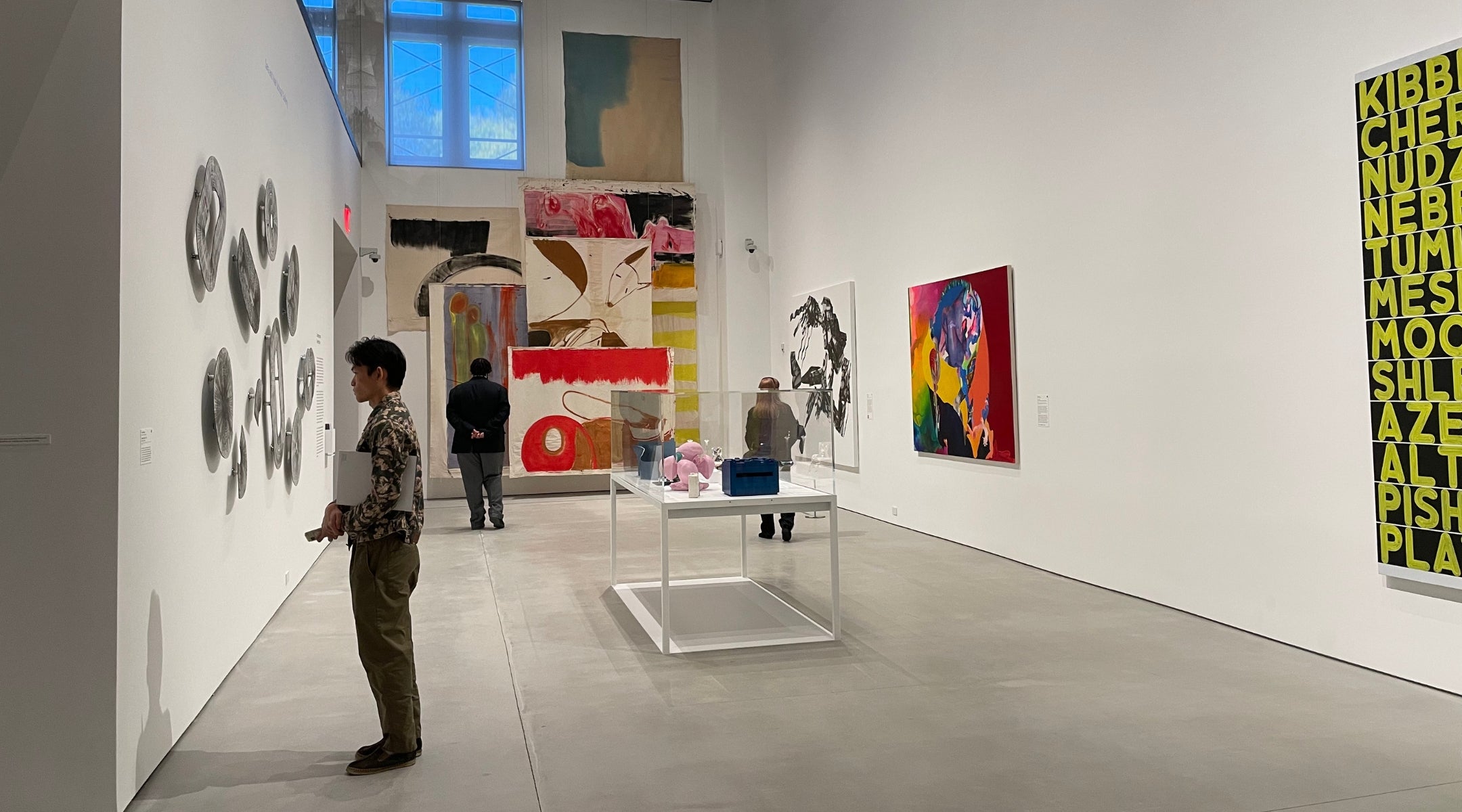
Following a yearlong, $14.5 million renovation, the Jewish Museum — which is housed a 1908 French Gothic mansion on Fifth Avenue — is opening two upgraded floors to the public.
Among the new features on the museum’s reimagined third and fourth floors: a new installation, “Identity, Culture and Community: Stories from the Collections of the Jewish Museum,” which spotlights 200 items from the museum’s permanent collection; four galleries for rotating exhibits and new acquisitions and the Pruzan Family Center for Learning, featuring art-making studios, a touch wall, and an interactive, simulated archaeological dig.
The renovation is the brainchild of the museum’s director, James Snyder, who assumed the helm of the 121-year-old institution in November 2023, following stints as the director of the Israel Museum and deputy director of the Museum of Modern Art in New York.
The renovation “gave us the opportunity to think through an entirely new narrative, an entirely new strategy for what we are all about,” Snyder said during a press event on Tuesday.
“These are complex times — they have been for a while. They’re getting more and more complex every day,” Snyder said. “Our job, particularly for culturally specific museums like this one, is to be the antidote to what’s really a pandemic today — to the xenophobia, the racism, the ignorance that is prevalent everywhere now.”
Here are seven things to see and do at the renovated Jewish Museum’s new galleries.
1. Marc Chagall’s “Self-Portrait with Palette” (1917)
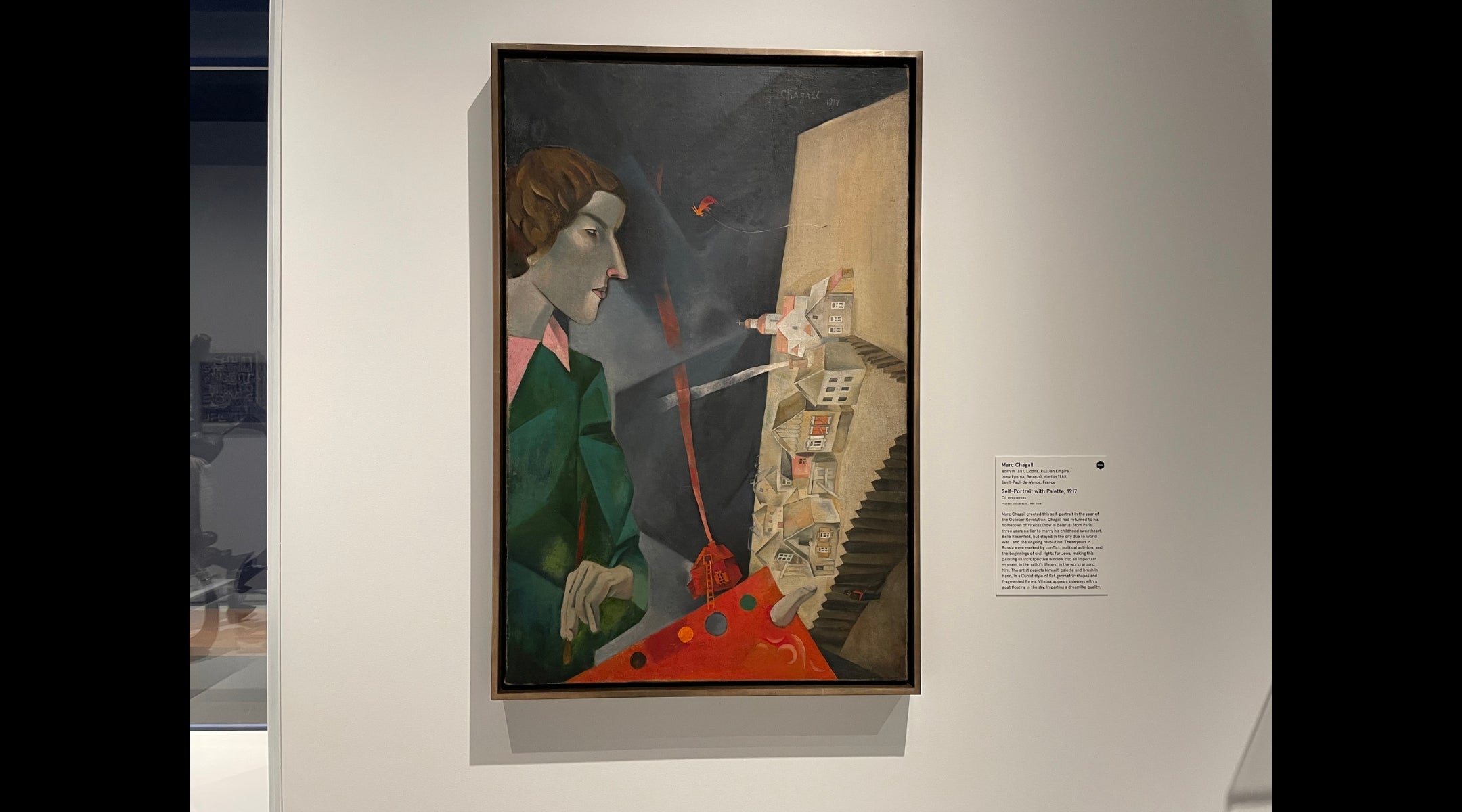
Marc Chagall’s “Self-Portrait with Palette” (1917) is among the new acquisitions at the Jewish Museum. (Jackie Hajdenberg)
This self-portrait by the lauded Jewish artist is in the Cubist style. An oil on canvas, the painting shows Chagall as a young man holding a brush and palette, with his hometown of Vitebsk (in today’s Belarus) in the background.
When the portrait was painted — during the Russian Revolution — Chagall had just returned home after three years at a Parisian art school in order to marry his childhood sweetheart, Bella Rosenfeld, who modeled for many of his works.
The painting, a new acquisition by the museum, was previously in a private collection. It was last publicly exhibited at the Tefaf New York art fair at the Park Avenue Armory in 2022. It hangs “in conversation” with a newly acquired piece by Alice Neel, titled “Nazis Murder Jews,” from 1936, an unusually non-abstract work by Mark Rothko that shows a deconstructed crucifix, and three paintings by Romanian-Israeli painter Reuven Rubin.
2. 130+ Hanukkah lamps, from ancient times to the present
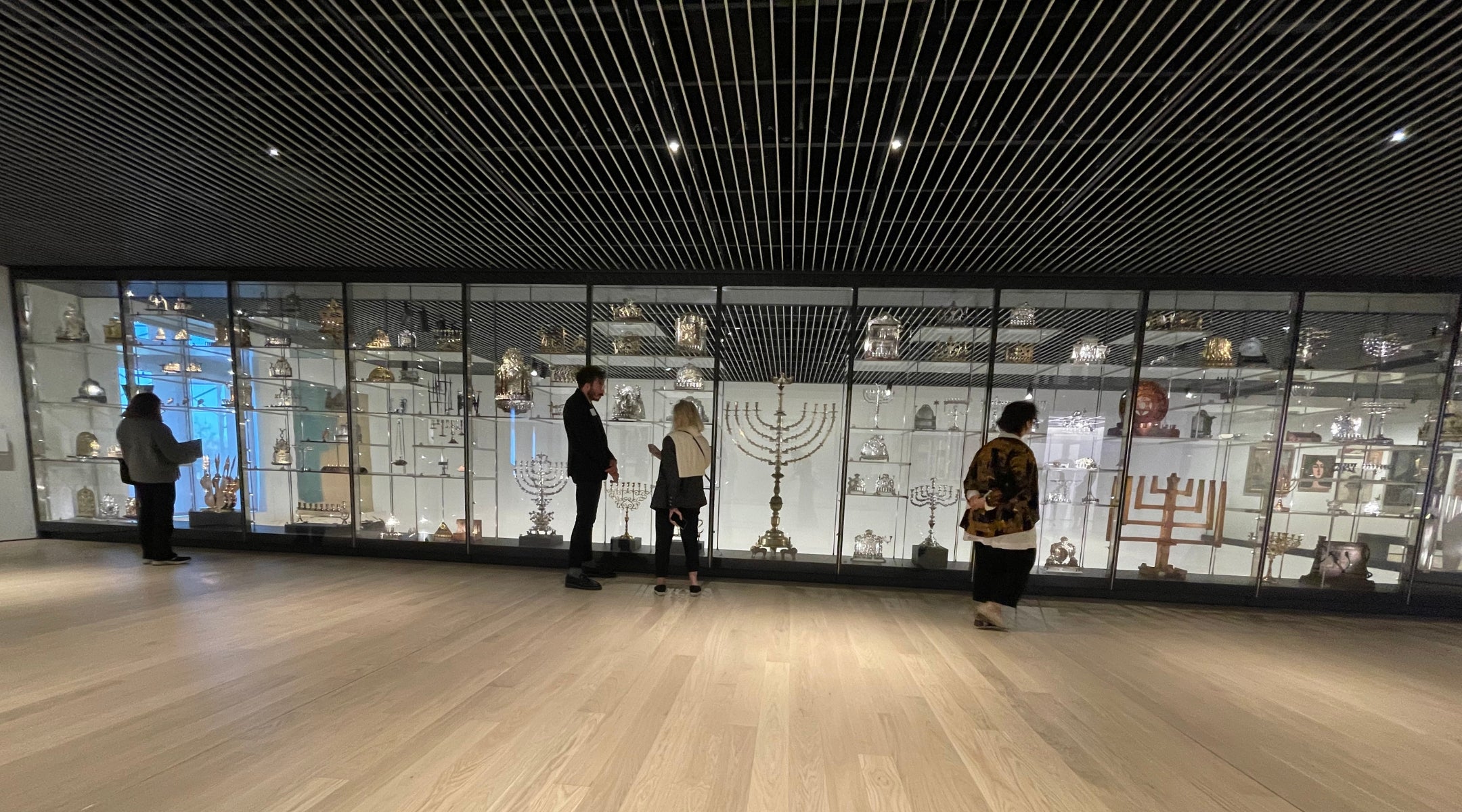
A glass case of more than 130 Hanukkah lamps is part of the Jewish Museum’s identity and culture exhibit, drawn from the museum’s collection. (Jackie Hajdenberg)
The Jewish Museum has more than 1,400 Hanukkah menorahs in its collection, and as part of its new, fourth-floor learning center, more than 130 are on display in a space that is open to a double-height gallery on the third floor.
The installation — featuring menorahs from across the globe, antiquity to the present day — is meant to accentuate “the central meaning of light as a symbol of enlightenment and hope across cultures,” per a press release.
Particular highlights include oil lamps from the 2nd to 1st century BCE, as well as a “Menurkey” — a turkey-shaped menorah, devised by 9-year-old Asher Weintraub in 2013, when Thanksgiving and Hanukkah overlapped for the first time since 1888.
3. “The Return of the Volunteer from the Wars of Liberation to His Family Still Living in Accordance with Old Customs” (1833–34) by Moritz Daniel Oppenheim
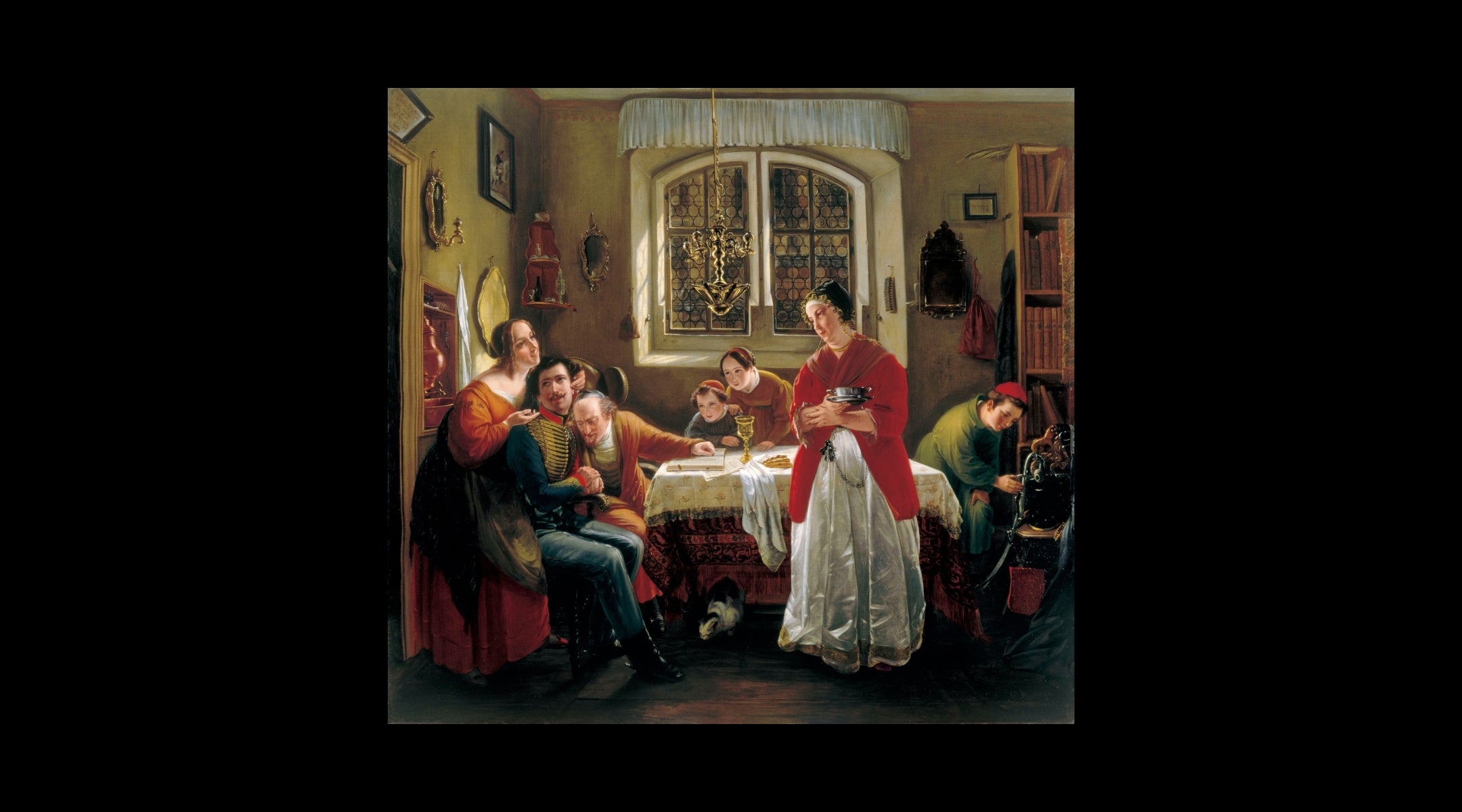
‘The Return of the Volunteer from the Wars of Liberation to His Family Still Living in Accordance with Old Customs” by Moritz Daniel Oppenheim. (Courtesy The Jewish Museum)
Considered to be the first Jewish painter in the modern era, Moritz Daniel Oppenheim — born in 1800 in Hanau, Germany — is known for being the first Jew to receive a formal arts education in Europe.
Many of Oppenheim’s works — which are on view at the museum as part of its permanent collection — showcase intimate portraits of Jewish life in Europe. Considered his masterpiece, “The Return of the Volunteer,” depicts a young German Jewish man returning home after helping defend Germany against the Napoleonic armies just as his family is welcoming Shabbat. (Note the challah and kiddush cup on the table.)
Oppenheim created the painting during a time of civil unrest following the 1830 revolutions in France, when some German states passed repressive legislation against the Jews. Per the Jewish Museum, “This painting has been interpreted as a reminder to Germans of the significant role played by Jews in the Wars of Liberation, and its political overtones are unusual in the generally apolitical nature of Biedermeier art.”
4. Letters between George Washington and Moses Seixas
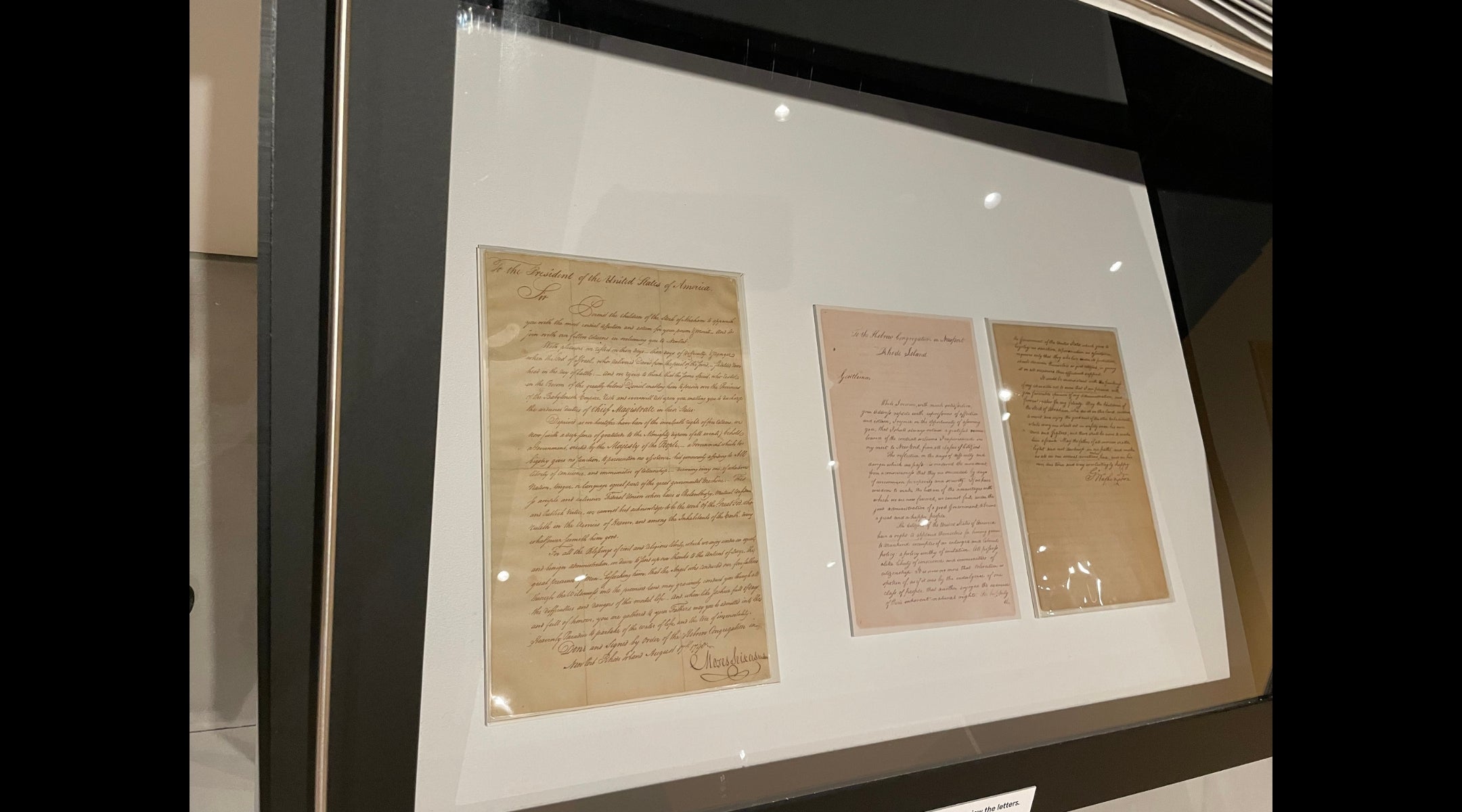
A letter exchange between Touro Synagogue president Moses Seixas and American President George Washington. (Jackie Hajdenberg)
Part of the new “Identity, Culture and Community” exhibit is a section on Jews in the Colonial Era. A highlight here are letters from 1790 between new American President George Washington and Moses Seixas, the president of Jeshuat Israel of Newport, Rhode Island, now known as the Touro Synagogue — the oldest synagogue in the United States.
Washington came to Rhode Island after the state ratified the United States Constitution in order to promote the passing of the Bill of Rights; upon Washington’s arrival in Newport, Seixas read a letter aloud to the president, in which he expressed optimism at the freedom of religion that Americans would see in this new country.
“May the children of the stock of Abraham who dwell in this land continue to merit and enjoy the good will of the other inhabitants —,” Washington wrote in response, adding a quotation from scripture, “while everyone shall sit in safety under his own vine and fig tree and there shall be none to make him afraid.”
The letters are so delicate they’re kept under a window blind that visitors manually pull up and down, to minimize exposure to light.
5. A child-friendly mock archaeology dig

Visitors of all ages can dig for replicas of real ancient artifacts in the Jewish Museum’s newly renovated dig room. (Jackie Hajdenberg)
As part of the Pruzan Family Center for Learning, the Jewish Museum’s new mock archeology dig is three times larger than the previous version. Here, as part of the visitors can dig through four pits, each centered around a different era in time, for replicas of real artifacts, such as an Ottoman-era copper alloy coffeepot from Jerusalem, an ancient Roman oil lamp and a calcite-alabaster jar from ancient Egypt circa 1550 BCE.
The real versions of those artifacts — most of them newly on display in the room — are also on display, accompanied by kid-friendly language. Families are provided with an “Archaeologist’s Notebook” to keep track of their finds.
6. “in full command of every plan you wrecked” (2024) by Zoë Buckman
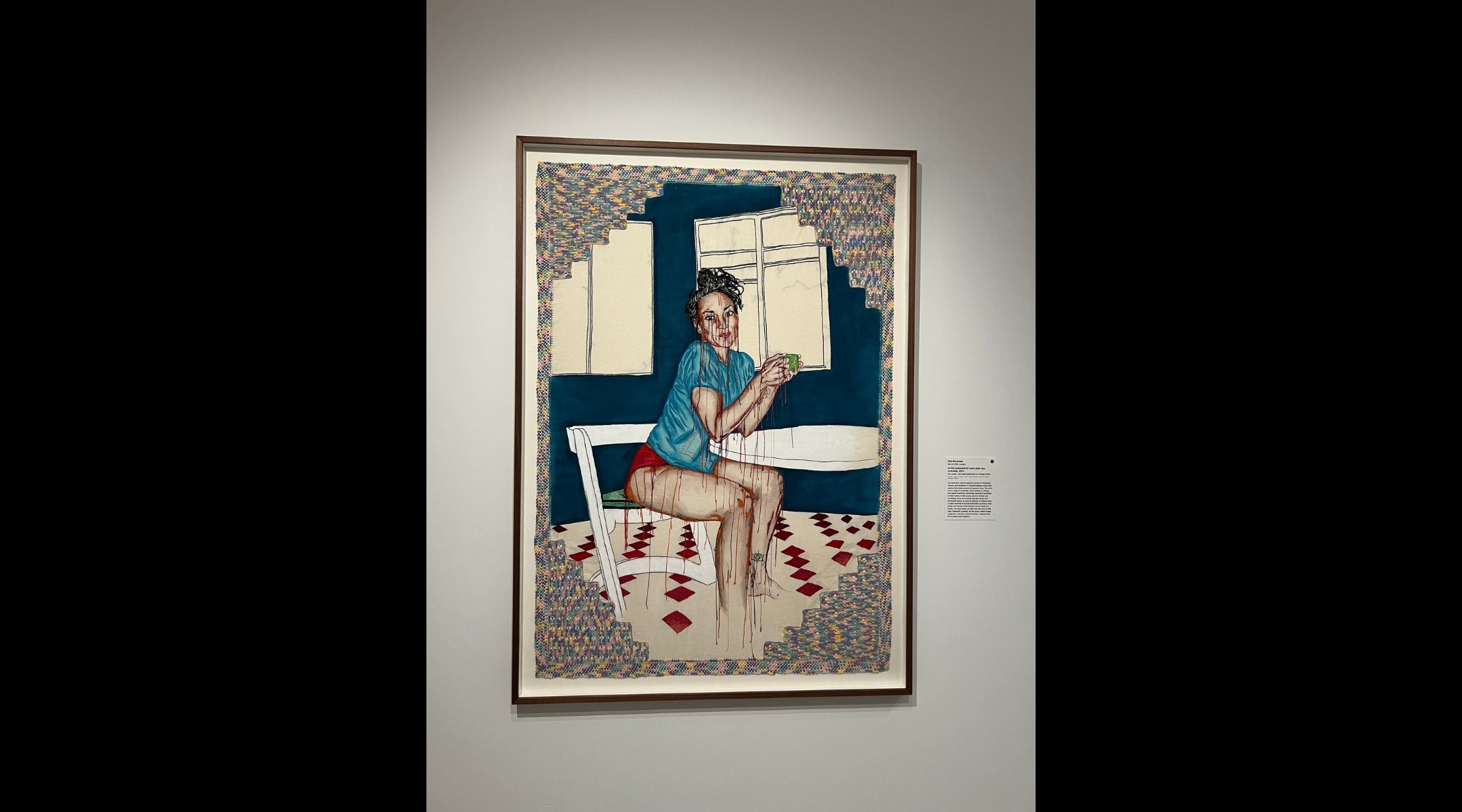
“in full command of every plan you wrecked” by Zoë Buckman is on view at the Jewish Museum as part of the third floor’s rotating exhibitions. (Jackie Hajdenberg)
Zoë Buckman, 40, is a British Jewish artist whose work has been featured in the UK’s National Portrait Gallery and who has emerged as a prominent voice among artists on antisemitism in the wake of the Gaza war. This ink, acrylic and hand-embroidered piece is Buckman’s debut at the Jewish Museum, which is part of her “Who by Fire” series exploring Jewish personhood.
Located on a third-floor gallery, Buckman’s work depicts a woman sitting on a chair; the piece’s name, “in full command of every plan you wrecked,” a reference to a Leonard Cohen lyric from “Alexandra Leaving.” The loose threads — typically found on the back of such woven pieces — subvert expectations of traditional feminine and domestic textile work.
7. A retrospective on the early works of Anish Kapoor
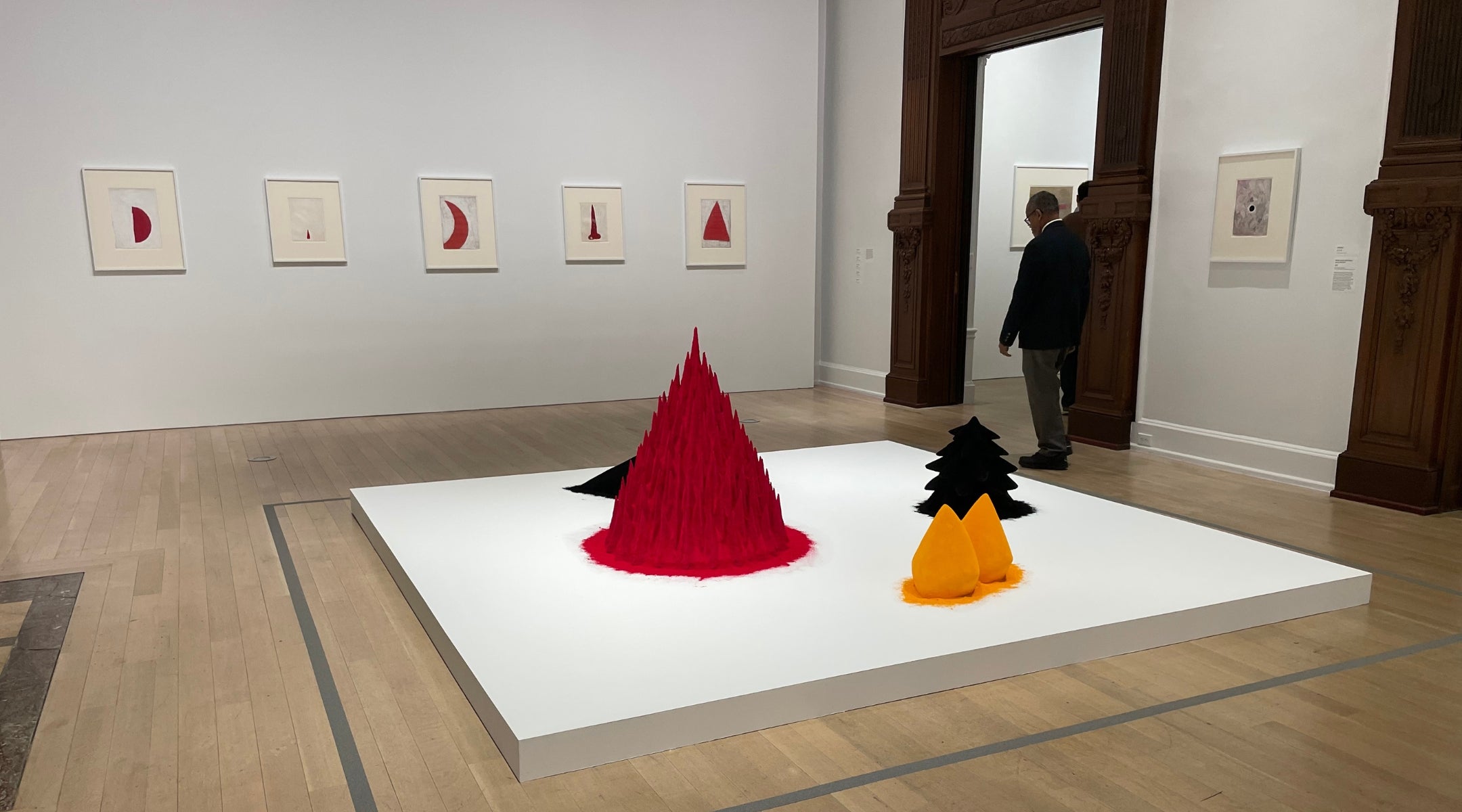
Some of the early sculptural pigment works of Anish Kapoor at the Jewish Museum. (Jackie Hajdenberg)
Born in India in 1954 to a Punjabi Hindu father and an Iraqi Jewish mother from Mumbai, Anish Kapoor rose to prominence as an artist exploring matter, non-matter, space and voids. “Anish Kapoor: Early Works,” on view until Feb. 26, 2026, is the first American museum presentation showcasing Kapoor’s works from the late 1970s and early 1980s, “when he was still the classic starving artist,” per the New York Times.
Snyder and Kapoor — a winner of the prestigious Genesis Prize — have previously collaborated on exhibits at MoMA and the Israel Museum; the Jewish Museum exhibit opens on Friday alongside the museum’s newly reimagined floors. “He is about this narrative of the experience of the Diaspora and what it does to artists,” Snyder said of Kapoor.
—
The post The Jewish Museum has just completed a major renovation. Here are 7 highlights. appeared first on Jewish Telegraphic Agency.
Uncategorized
American synagogues are spending more than ever on security. How much is enough?
At Temple Israel in Bloomfield, Michigan, which was attacked in March by a gunman, getting ready for the High Holidays this year means more than preparing for crowds of worshippers.
The synagogue is spending millions of dollars on security upgrades, including a new gatehouse, artificial intelligence technology and physical and ballistic hardening of its building.
“There are major changes coming,” Rabbi Josh Bennett of Temple Israel said in an interview. “I think that extends then to many of the other places of worship in town, and then, by extension, the entire Jewish community around the country.”
But as congregations install barriers, hire guards and tighten access to their buildings, Jewish leaders are struggling to balance budgets and keep their synagogues welcoming.
Bennett fears fortressing the Jewish community through ever-expanding security upgrades is “unsustainable at all levels,” from the emotional to the financial.
The Secure Community Network, a Jewish security organization that provides threat intelligence and safety training to Jewish institutions across the country, told the Forward that the American Jewish community now spends between $765 million and $1 billion annually on security and safety.
CEO Michael G. Masters said that figure is dramatically higher than it was several years ago, when it was the exception, rather than the rule, for a Jewish institution to have a security plan, let alone layers of cameras, guards, and coordination with law enforcement.
The spending reflects what Mitchell Silber, CEO of the Community Security Initiative, a New York-focused Jewish counterterrorism and security organization, described as “the most complicated threat picture that the Jewish community in the United States has ever faced.”
According to the FBI, Jews were the victims of nearly two-thirds of religion-based hate crimes in the United States in 2025. And these days, Silber’s analysts are tracking threats from white supremacists and neo-Nazis, Islamist extremists and actors inspired by or connected to Iran and Hezbollah, and left-wing violence connected to the Israeli-Palestinian conflict.
“That’s taking a tremendous toll just financially on our Jewish institutions,” Silber said.
The growing costs have pushed Temple Israel to lobby Congress in support of the bipartisan Jewish American Security Act, which would increase federal funding available to protect Jewish institutions. Last week, members of Congress, including the bill’s co-sponsor, Rep. John James of Michigan, visited the Temple to see the security updates.
When congregants help screen for danger
But as congregations pour money into keeping potential attackers out, another question looms: At what point does protecting a synagogue begin to change the experience for those coming in?
“The more you build, there’s, I think, an inverse proportion to how safe people will actually feel when they’re coming in,” said Bennett, whose congregants have been emotionally rattled since the March attack, during which a gunman rammed a truck loaded with gasoline and fireworks into the synagogue. “Nobody wants to walk into a building where you walk by loaded semi-automatic machine guns.”
A person arriving at a synagogue for the first time could have harmful intentions. They could also be new to town, exploring Judaism, or simply looking for a place to spend Shabbat. Distinguishing between those is an important challenge.
Unlike an outside guard, a longtime congregant may know who normally attends services, which unfamiliar face is expected for a wedding or bar mitzvah, and when someone’s behavior genuinely seems out of place. That’s why organizations like SCN and the Community Security Service train community members to serve as additional protection at their own institutions.
In 2026 alone, SCN has conducted close to 1,000 in-person safety trainings, reaching roughly 25,000 people. For the High Holidays, they are offering Zoom Webinars for Jewish institutions across the country, as synagogue-goers who ordinarily recognize most people walking through their doors may suddenly welcome hundreds of unfamiliar worshippers.
Preparation was put to the test at Central Synagogue in Manhattan last Friday, when a man stormed the temple, punched a congregant, and headbutted and spat on a security guard while directing a racial slur at him.
Silber described the response as a “tactical success.”
“Their security team had drilled. Their clergy and staff had drilled. And when the moment came, within less than 60 seconds, they had this individual moved outside of the sanctuary.”
At Temple Israel, the congregation has been fundraising specifically for security. After the March attack, Bennett said, some congregants would like to see “a moat and a full army around our buildings.”
He understands the impulse. But he worries there may be no end to what a synagogue can spend in pursuit of safety.
“How do you do this with the knowledge that it’s financially unsustainable?” Bennett said. “This is not the way we should be spending dollars.”
The post American synagogues are spending more than ever on security. How much is enough? appeared first on The Forward.
Uncategorized
The far right is more dangerous to Jews than the far left. A historian explains why.
When Jewish leaders speak out these days, it’s often to blast the anti-Israel actions of one Democratic Socialists of America politician or another. Given all the attention — and the millions of dollars raised within the Jewish community to help defeat these candidates — you’d think the greatest existential threat to American Jews was coming from the left.
But a new book by historian Steven Ross is here to tell you: You’d be mistaken.
“What you’ve seen seeping in on the far left is more anti-Israel and some antisemitism,” Ross told me in a phone interview. “But here’s the thing: the left has never called for death to people, the right has.”
Right-wing extremist groups have spent 80 years calling for the death and deportation of Jews and minorities — and sometimes acting upon those calls. The far left, whatever its failures on antisemitism, has not. And unlike in previous years, the far right today has found the two things it lacked: a single leader to unite behind, and a technology to reach millions.
In The Secret War Against Hate: American Resistance to Antisemitism and White Supremacy, Ross, a professor of history at University of Southern California, tracks the continuous, noxious activity of hate groups in the United States from the end of World War II to the present day — and the brave and secretive men and women who sought to thwart them.
The book reads like a great suspense novel, except, unfortunately, it’s nonfiction. And its conclusion — spoiler alert — is that the threat is only growing more dangerous.
Uncannily, in his research, Ross found that Jewish leaders predicted as much — in 1945.
Even before the Allies declared victory in Europe, leaders of the Anti-Defamation League, American Jewish Committee and the Anti-Nazi League, who had launched undercover operations to infiltrate and disrupt hate groups, had come to a disturbing conclusion. They could defeat any hate group, even the Ku Klux Klan, unless the disparate groups could one day “communicate on an instantaneous basis,” and unless the far right figured out a way to make it into one of the two mainstream political parties.
“Here we are,” Ross said. “Everything has come true.” Social media has enabled hate groups to communicate and organize at scale, and President Donald Trump’s pardon of the Jan. 6 rioters — direct ideological descendants of the postwar far right, Ross says — was but one example of the Republican flirtation with extremist and violent groups.
Descendants of the ‘Betrayed Generation’
In the early 1940s, Jewish leaders also predicted that when the war ended, antisemitism and racism would increase — despite Americans having just fought a savage battle against prejudice and fascism.
The Greatest Generation also birthed what Ross calls “the Betrayed Generation,” men and women who returned to a changed America in which liberals, Blacks and Jews were mobilizing and upwardly mobile.
“The Founding Fathers, they insisted, had created a nation based on white Christian rule and they would not allow traitors or people of color to change that,” Ross writes.
Groups like the American Nazi Party, the Columbians and the National States Rights Party warned that Jews were behind “race suicide,” plotting to replace white people with non-white immigrants. They accused Jews of being secret Communists and undermining the cause of “America First.”
“I will solve the Jewish problem once and for all,” James Madole, founder of the fascist National Renaissance Party, told a boisterous rally in Manhattan’s Yorkville neighborhood in February 1953. “I will finish the job that Hitler started.”
During this period, there were an estimated 3,114 right-wing organizations and periodicals that reached a combined membership of over 10 million Americans, says Ross.
The groups carried out a series of bombings against synagogues and Black churches that were, Ross writes, “unrelenting, unpredictable, and unnerving.”
How to fight back
J. Edgar Hoover’s FBI, which should have been tracking these groups, was far more concerned with persecuting potential communists. So the ADL, AJC and the ANL fielded undercover agents to infiltrate and disrupt these groups, often at the risk of their lives.
One of them, a 19-year-old Columbia University student named William Goring, rose to the head of the National Renaissance Party’s leadership. In a memo to his handlers, Goring described the far-right members he encountered as “the failures, the lonely,” who feel “abandoned by their government and gain a strong internal feeling of camaraderie” from the far-right parties.
“To ease their lack of self-respect they make up excuses and find scapegoats. Some fix upon the Jews, others on the Blacks,” Goring wrote.
By the 1970s, this spy network as well as internal strife had weakened these hate groups, their memberships dwindling to hundreds.
Jewish groups “thought they had won the battle against hate,” wrote Ross, and turned their attention to the causes of civil rights and Israel.
But the ideology and organizations festered and regrouped, manifesting in the anti-government militia movement, the white supremacist march in Charlottesville and the Jan. 6 riots. Between 2008 and 2016, the number of militia and anti-government groups rose to 1,400.
Media personalities with millions of followers, like Tucker Carlson and Candace Owens, push warnings against shadowy Jewish influence and the “great replacement theory,” the new term for “race suicide.”
The bombings that wracked Jewish communities in the postwar period have declined, Ross acknowledged. What’s replaced them is a constant stream of hate pushed into people’s social media feeds. Social media has made it harder to infiltrate and disrupt hate networks, while making it easier to constantly find new recruits.
“You don’t have to bodily harm someone,” he said. “Creating a life where they’re afraid, whether it’s Muslim, Jew, immigrant — that’s terrorism, that’s domestic terrorism.”
Meanwhile, Trump and others in his administration openly engage with Holocaust deniers and antisemites. In Florida’s Republican primary races earlier this month, two candidates, Dan Bilzerian and Jake Lang, spouted raw antisemitism. Bilzerian, who lost to a Jewish congressman, had asked his 30 million online followers if Hitler “was a good person.”
Ross, whose father survived the Warsaw Ghetto and Dachau and whose mother survived Auschwitz, said he believes the answer is better education, but that’s “long term.”
I asked him what the short-term solution is.
“Take two people to the polls,” he said. “Get two people in their young 20s who aren’t used to voting, and get them out to the polls. That will change things right now.”
Bilzerian lost badly, but he’s not going away, and neither is the ability to infect minds and harvest hate. The question isn’t whether the far right is more dangerous — Ross has answered that. It’s whether we’re paying attention.
The post The far right is more dangerous to Jews than the far left. A historian explains why. appeared first on The Forward.
Uncategorized
Italy is having a Yiddish moment. An unprecedented I.J. Singer translation is part of the boom.
(JTA) — In September 1932, Israel Joshua Singer boarded a ship bound for New York, where he had been invited to report on the United States for Yiddish-speaking Jews like himself.
“Americans are a difficult people to understand,” the famed novelist wrote in one of his first articles from the U.S. “They have tried at all costs to be, in every aspect, the opposite of Europeans.”
In a series of articles commissioned by Abraham Cahan, the famed editor of the Yiddish Forverts, Singer sought to help his readers understand this mirror world. On the eve of the Nazis’ rise in Europe, he marveled at the landscapes, the Jewish strivers and dreamers and the Christians who lent a sympathetic ear to the challenges facing Jews back home.
Nearly a century later, Singer’s astonished first encounters with America have appeared together in translation for the first time — not in English, but in Italian. “Viaggi in America” (Travels in America), published by the historic Italian Jewish publishing house Giuntina and translated from Yiddish by Enrico Benella, brings together I.J. Singer’s witty American dispatches for the Forverts.
The articles follow Singer from New York’s Jewish heart on the Lower East Side to Coney Island, the Catskill Mountains, the Warner Bros. studios in Hollywood and a General Motors factory in Michigan, among many other stops. Singer returned to Poland after his visit and moved permanently to the United States with his family in 1934, but he continued to observe the country with the distance of a European Jewish outsider. Most of the pieces in the new volume have never been translated, including into English.
The collection arrives amid an Italian revival of Singer and Yiddish literature in general, enabled by newly accessible digital archives, a new generation of translators and readers increasingly interested in Yiddish culture.
“Yiddish is alive and well — even in Italy,” said Shulim Vogelmann, the book’s publisher.
“I think the reason books like ‘The Family Carnovsky’ succeed [in Italy] is that they are books written in blood,” said Anna Linda Callow, who translated that Singer novel into Italian. Yiddish literature, she explained, emerged from a society being “violently confronted with modernity, the collapse of empires, and profound historical questions.”
Born in Poland in 1893, I.J. Singer was the elder brother of the future Nobel laureate Isaac Bashevis Singer. (Their sister Ester Kreytman also became a novelist and short story writer.) Within the Yiddish-speaking literary world, I.J. was once the better-known of the Singer brothers, but his work has long been eclipsed by Isaac Bashevis’.
When the Italian publisher Adelphi published the first Italian edition of his masterpiece “The Family Carnovsky” in 2013, the book became a major success, selling more than 120,000 copies. That was a watershed moment for Yiddish literature — and for I.J. Singer’s popularity — in Italy.
Before “Carnovsky,” Italian publishers had brought out a handful of Yiddish literary works, many of which were translated through English rather than directly from Yiddish (a practice that continues today). Since the success of “Carnovsky,” over 50 new editions of Yiddish books have appeared in Italy, from authors including Kreytman, Sholem Aleichem and Chaim Grade.
Interest in Yiddish culture has not been limited to books — and it does not appear to be closely entwined with surging anti-Israel sentiment in Italy, even as some Yiddishists report renewed interest from those who are embracing diasporic Jewish traditions.
Yiddish began reaching Italian audiences in the late 1980s, when director Mara Cantoni and performer Moni Ovadia staged a Yiddish-themed production at one of Milan’s most established theaters. Their work helped popularize Yiddish culture in the years that followed. (Ovadia later became one of Italy’s most prominent Jewish anti-Zionist public figures.)
But Miriam Camerini, an Italian artist and theater director who specializes in Yiddish culture, said presenting Yiddish material live has become more difficult during the Israel-Hamas war in Gaza. Speaking to JTA from Yiddish Summer Weimar, a festival in Germany that draws Yiddishists from around the world, she said theaters and cultural institutions increasingly told her it was “not the right time” for Jewish programming — even though her work focuses on diasporic and non-Zionist traditions.
“The fact that my work dealt with the history of the Bund,” Camerini said, referring to the Jewish socialist movement founded in the Russian Empire at the end of the 19th century, “did not lead people to say, ‘How interesting — let’s listen to Jews with different, non-Zionist ideas.’ No: anything Jewish was to be excluded.”
Instead, the Yiddish publishing boom can trace its roots in part to a practical matter: The copyrights for Singer’s work expired in Europe in 2015. While Elisabetta Zevi, an executive and Jewish literature editor at Adelphi, insisted on publishing “Carnovsky” just a couple of years before the copyrights expired, the financial barrier has been lifted for new titles.
Adelphi’s status as one of Italy’s most prestigious publishers also gave Singer a visibility in the country that earlier editions lacked and primed the pump for further interest.
“It was a masterful publishing coup,” Callow said, who recently began teaching a Yiddish course at the National Museum of Italian Judaism and the Shoah in Ferrara.
Another factor in the Yiddish boomlet was the emergence of new translators able to work directly from the language, a tiny but significant trend helped along by technology and the commitment of a passionate few.
“There are no university-level Yiddish courses in Italy, so you either have to go abroad to study or learn on your own,” said Enrico Benella, the translator of the new collection, in an interview. “It is therefore hardly surprising that so many major authors have been left behind.”
Within the remarkably narrow circle of Yiddish translators in Italy, Benella is an outlier — first and foremost, because he is not Jewish and did not start his career as a translator or a scholar of Jewish literature. Born near Padua in 1979, he only began learning Yiddish a few years ago, driven by a desire to read I.J. Singer’s work in the original.
Benella began studying through the Oxford School of Rare Jewish Languages, which offers free online courses on 18 Jewish vernacular languages, including various Judeo-Arabic dialects, Ladino and Judeo-Italian. Almost immediately, he began reading and practicing translating Singer’s work.
Digital access, also made possible by U.S. donors and research institutions, created another opening. Large collections of Yiddish books, magazines, and daily newspapers are now available online, including almost a century of the Forverts. The Steven Spielberg Digital Yiddish Library at the Yiddish Book Center in Massachusetts includes more than 11,000 Yiddish titles. YIVO, the Yiddish research center in New York, is digitizing its prewar library and archival collections.
“Yiddish literature will soon become the first modern literature to be completely digitalized,” Benella said.
Benella was inspired to pursue the translation of Singer’s American dispatches while reading “The Homeless Imagination in the Fiction of Israel Joshua Singer” by Anita Norich, one of the most prominent living scholars of I.J. Singer’s work. Benella worked through her bibliography of Singer’s Forverts journalism, much of it published under the pseudonym of G. Kuper. That’s where he first encountered the titles that “sounded American.”
He then approached Vogelmann, Giuntina’s publisher, and pitched the idea for the collection. Benella had already translated two other books from Yiddish for Giuntina. (Giuntina has also published a book by the author of this article.)
Anita Norich still remembers the painstaking work behind that bibliography, which she compiled in the 1980s while working on her first book on I.J. Singer.
“There was no index of the Forverts, and there was no search engine you could use,” she recalled. “I went to the YIVO library in New York, and turned the Forverts microfilm page by page, looking for his name.”
The desire to explain America to Yiddish-speaking American readers reflected a central part of the Forverts’ mission, Norich said.
Singer, who arrived speaking very little English, often looked beyond the stories and places familiar to Yiddish readers, and instead reported from Harlem and Chinatown, compared poverty in New York with poverty in Warsaw, and explored American commerce, culture, and religion.
“There is America to be described, there are American Jews, and then there is Singer, who is neither an American Jew nor an American,” Benella said. “Precisely for that reason, he has an additional point of view. His distance gives him a different perspective on an America that American Jews may be seeing from too close up.”
“You could define ‘Travels in America’ as the encounter between the Jews of Eastern Europe and true modernity in the United States.”
Singer encountered that modernity on his initial voyage. He marveled when the ship’s Christian passengers packed into a talk by a rabbi on the just-completed First Preparatory World Jewish Conference in Switzerland, Hitlerism and antisemitism.
“The large hall immediately filled with crowds of Christians,” Singer wrote. “They sat there listening … and applauded the speaker enthusiastically. It came as a surprise to me. Such a thing is completely incomprehensible to a Jew … and with what interest those genuine Americans listened to a Jewish man speak about Jewish problems!”
The dispatches also move from travelogue to comedy to political witness. One of the collection’s most notable pieces recounts a Nazi rally at Madison Square Garden — an article that Italian reviewers have highlighted in a country with its own Fascist past and wartime alliance with Nazi Germany.
“Whenever Jews were mentioned, the crowd roared like bloodthirsty beasts,” Singer wrote. “That hall reeked of a medieval hatred and bloodlust directed against everything honorable, just and humane.”
Norich said Singer’s journalism and fiction cannot be neatly separated. He reported what he saw, but he also turned the people he met into characters.
Benella described Singer’s humor as understated. “It never makes you burst out laughing; it’s closer to a form of analysis, a kind of sly teasing that shows you reality and laughs at it — but not in order to diminish it or belittle it.”
Norich, who has studied and translated Singer for decades, edited a recent three-volume English-language collection of his work for the Israeli publisher Koren. (The collection does not include the American dispatches.)
“I think readers are responding to something that’s going on now in our own world,” Norich said. “Antisemitism and the condition of Jews in Europe are an ongoing theme of his.”
Readers are responding to Singer’s “honest sense of uncertainty,” she said, about “all of these panaceas, all of these cures, all of these convictions that don’t listen to one another.” His work repeatedly returns to “Jewish arguments, political and religious messianism, and the fractiousness of communal life. As Singer put it, ‘I have the diagnosis, but not the cure.’”
Nearly a century after Singer used his European perspective to interpret America for Yiddish-speaking immigrants, the Italian translation adds another layer of distance: American Jewish life returns to contemporary readers through Yiddish and Italian.
“The sign of a great writer is that he’s steeped in his own world but speaks to other worlds and other times,” Norich said.
This article originally appeared on JTA.org.
The post Italy is having a Yiddish moment. An unprecedented I.J. Singer translation is part of the boom. appeared first on The Forward.
