


Uncategorized
As 1000+ rabbis sign anti-Mamdani letter, others decry mounting ‘red lines’ in Jewish communities
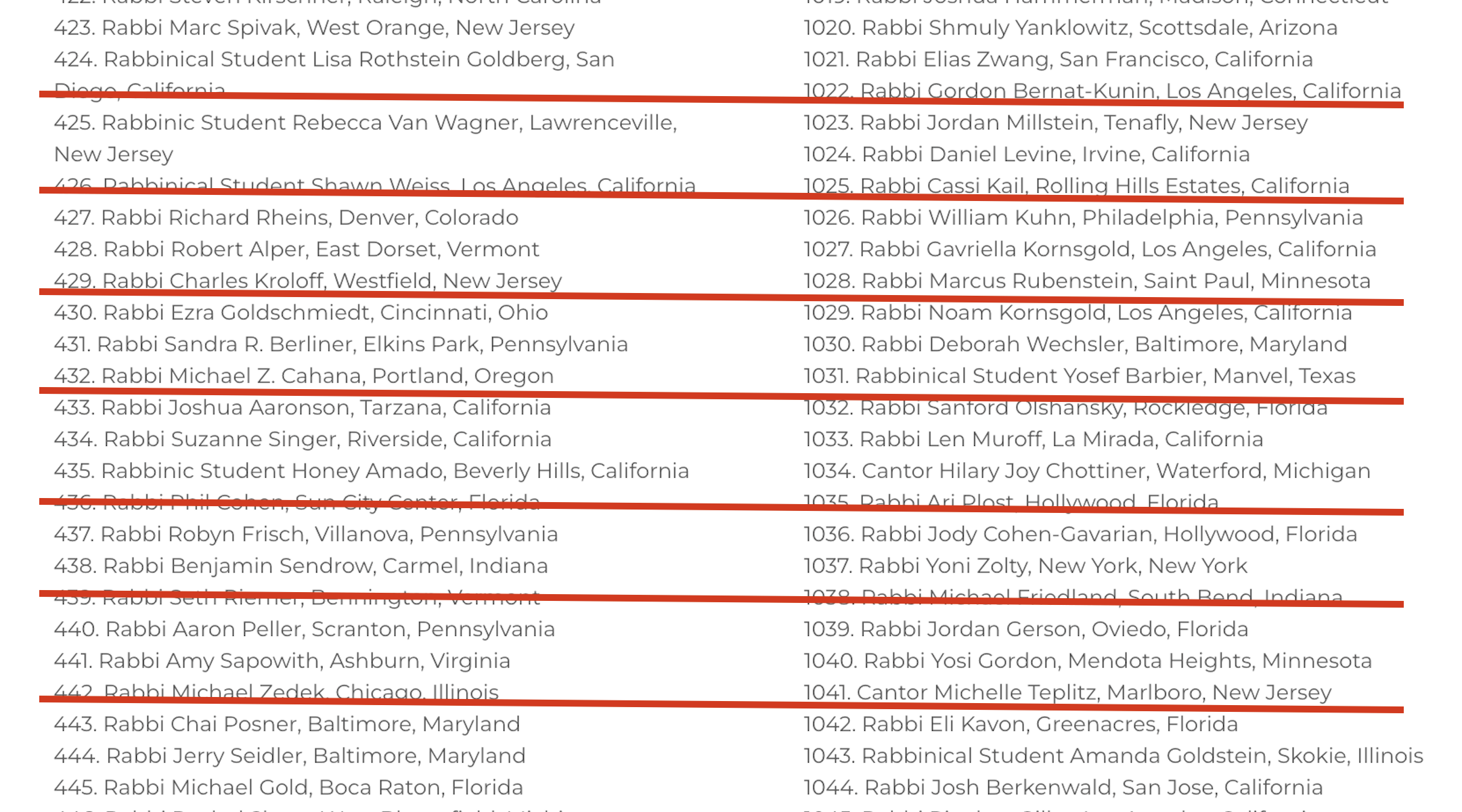
Two days after Rabbi Elliot Cosgrove delivered a sermon urging congregants to vote against Zohran Mamdani, rabbis across the country were asked to sign a letter quoting him.
By the time it was published Wednesday, 650 rabbis and cantors had done so, adding their names calling out the “political normalization” of anti-Zionism among figures like Mamdani, the New York City mayoral frontrunner.
By Friday, the letter had more than 1,000 signatories, making it one of the most-signed rabbinic letters in U.S. history.
But Cosgrove, the senior rabbi of Park Avenue Synagogue on the Upper East Side, was not one of them.
“As a policy, I do not sign group letters,” he said in an interview.
“My fear of such letters is they can flatten subjects and reduce complex issues to ‘Who’s on a letter and who’s not on a letter?’” he added. “There are other platforms that rabbis can give expression to their leadership.”
As the letter has ricocheted across the country and escaped from rabbis’ inboxes to their congregants’ social media feeds, it has ignited a wave of scrutiny, plaudits and recriminations. Some people have voiced relief or disappointment in seeing their rabbi’s name on the list — or on not seeing it.
“Jewish communities are circulating spreadsheets of who signed and who didn’t,” wrote Rabbi Shira Koch Epstein in an essay describing what she said was “a painful public reckoning” taking place both publicly and privately.
“I am not sleeping. These red lines are so dangerous,” responded Rabbi Lauren Grabelle Hermann, of Manhattan’s Society for the Advancement of Judaism, in one of dozens of comments representing a wide range of views. Hermann devoted her Yom Kippur sermon earlier this month to calling on her community to “become an antidote to the polarization and fragmentation in our broader Jewish community and society.”
Now, facing renewed pressure from their congregants over the letter, some New York City rabbis are articulating alternative strategies for responding to a political moment that many Jews are experiencing as fraught and high-stakes.
Rabbi Angela Buchdahl wrote to all members of Central Synagogue, the Manhattan Reform congregation where she is senior rabbi, to explain why they would not find her among the letter’s signatories.
“As a Central clergy team, we have spoken from the pulpit in multiple past sermons and will continue to take a clear, unambiguous position on antisemitism, on anti-Zionist rhetoric, and on sharing our deep support for Israel,” she wrote.
But, citing the importance of “separation of church and state,” Buchdahl wrote that “it is up to each of us to vote our conscience.”
“There are political organizations, including Jewish ones, where electoral politics is the core mission. Get involved,” she wrote. “Central Synagogue, however, is a Jewish spiritual home and we want to keep it that way. It remains our conviction that political endorsements of candidates are not in the best interest of our congregation, community, or country.”
Rabbi Jeremy Kalmanofsky of the Conservative synagogue Congregation Ansche Chesed on the Upper West Side sent out a letter of his own to congregants. He said he would not be voting for Mamdani but did not believe it was his role to tell them how to vote. And he raised concerns about what he said was the “shearing off of liberal from conservative liberal communities,” saying that Jews of all political outlooks should be able to pray and act together.
“The Torah commands lo titgodedu, traditionally interpreted to mean, don’t fragment yourselves into factions,” Kalmanofsky wrote. “I fear this happening to Jews. Frankly, I fear it more than I fear an anti-Zionist mayor.”
Rabbi Adam Mintz, who leads the recently rebranded Modern Orthodox congregation Shtiebel @ JCC, said he’d signed a smaller letter from Manhattan Orthodox rabbis urging the importance of voting. But Mintz felt this letter was outside his role.
“I’m a rabbi. I don’t want to take a political stand,” he said. “I understand that some people feel strongly and they want to take a political stand. I think that’s OK, but that’s not my role.”
Rabbi Michelle Dardashti of Kane Street Synagogue, an egalitarian Conservative synagogue in Brooklyn, did not sign the letter, either. She instead took a different approach to addressing her congregants in the lead-up to the election, hosting about 80 of them Tuesday night for an evening of dialogue.
Members representing a spectrum of views took turns sharing questions and concerns ahead of the election. Dardashti said congregants, despite conflicting views, were “deeply engaged and passionate, and spoke beautifully and respectfully.”
“I understand my rabbinic role to be one that creates space for people to learn from each other’s different experiences, and therefore perspectives,” she said.
Some Jewish leaders and groups outright opposed the letter and its message, rather than considering it an ill-advised strategy. Bend the Arc, a progressive Jewish organization that endorsed Mamdani, released a statement excoriating the letter and its signatories for distracting from what it said was the real issue: Donald Trump.
“These Jewish leaders are doing Trump and the MAGA movement’s work for them: dividing our pro-democracy movement at a time when we need to be united to beat back fascism,” the statement read.
Josh Whinston, a rabbi in Ann Arbor, Michigan, expressed skepticism on social media about the letter’s origin and intentions, and noted that he did not sign it.
“This was not a call for moral clarity; it was a political move aimed at influencing a local race in New York City,” he wrote.
Upon first reading it, Whinston wrote that he “agreed with parts of what it said,” and that he “considered signing.” But, hoping to learn more about the Jewish Majority, the group behind the letter, Whinston wrote, “The site offered no substance. There was no mission, no vision, no leadership, no staff.”
The Jewish Majority’s goal, as stated on its website, is to counterbalance left-wing “fringe groups” like Jewish Voice for Peace and Jews for Racial and Economic Justice, which they say “weaponize the Jewish identity of some of their members to call for policy recommendations that are rejected by the overwhelming majority of the Jewish community.”
The executive director of the Jewish Majority, Jonathan Schulman, is a former longtime AIPAC staffer. In an interview, Schulman said he wrote the letter’s first draft before it underwent rounds of edits from about 40 rabbis of different denominations.
The inspiration came when “Rabbi Cosgrove’s sermon started making the rounds,” he said, adding, “By Sunday morning, rabbis were reaching out to me saying, ‘This is the kind of sentiment we’re feeling all over the country.’”
Unlike Cosgrove’s sermon, which included an endorsement of Andrew Cuomo, the letter does not mention either of Mamdani’s opponents. It does, however, say that political figures like “Zohran Mamdani refuse to condemn violent slogans, deny Israel’s legitimacy, and accuse the Jewish state of genocide,” and calls on Americans to “stand up for candidates who reject antisemitic and anti-Zionist rhetoric, and who affirm Israel’s right to exist in peace and security.”
Schulman recalled being told, “‘There’s the issue of Zohran Mamdani and calls to globalize the intifada and all this, but there’s anti-Zionist candidates running for mayor in Somerville, Massachusetts, in Minneapolis, Seattle — this is becoming normalized, this is becoming mainstream.’”
Rabbi Mark Miller of Temple Beth El in Bloomfield Hills, Michigan, is one of the rabbis who helped edit the letter. He said part of his goal was to help clarify its nature as being national rather than local.
“This was not an attempt for the rest of us to get involved in New York politics,” Miller said. “It’s highlighting it, but the issue is that everywhere we are, this is a concern.”
Signatories on the letter include rabbis from across the United States, and even outside the country.
Rabbi Brigitte Rosenberg, the senior rabbi of a Reform congregation in St. Louis, signed the letter, and said the message about anti-Zionism resonated with her on a national level.
“Mamdani was the big race that was talked about in this, but it’s come up in other races, right?” Rosenberg said, pointing to the comeback bid of “Squad” member Cori Bush to represent St. Louis in Congress.
Rabbi Jeremy Barras from Miami said a number of his congregants have residences in New York, and “they’re just terrified.”
“But I would’ve signed it if it was the same issue in any city in America,” Barras said. “It just happens to be true that we’re a little more sensitive because so many of our families have connections in New York.”
Both Barras and Rosenberg said they couldn’t remember an open letter signed by this many rabbis. There have in fact been examples of open letters being signed by 1,000-plus rabbis, including an appeal to open Palestine to Jews in 1945; a 2017 letter calling on Trump to support refugees and a letter from earlier this year demanding Israel stop “using starvation as a weapon of war.”
Yehuda Kurtzer, co-president of the Shalom Hartman Institute, affirmed that open letters like the one distributed by the Jewish Majority are nothing new, and said there is “definitely a tension that emerges” for those expected to sign. Endorsements from the pulpit, on the other hand, are “new terrain,” he said, noting the Trump administration’s decision to stop enforcement of an IRS rule barring political endorsements from religious institutions.
“We felt pretty strongly that rabbis should not generally do this, and there’s a whole variety of reasons,” Kurtzer said. “It’s a plausible scenario that politicians will start doing quid pro quos with religious leaders around their needs. Once you do it once there’s an expectation that you’ll do it all the time.”
Some of the rabbis who signed say they weren’t making a partisan political statement. Ammiel Hirsch, senior rabbi of Stephen Wise Free Synagogue on the Upper West Side and the leader of a Zionist organization within the Reform movement, acknowledged “worries” about alienating some congregants. But, like others who’ve come out against Mamdani, Hirsch said it was non-partisan to speak out against someone whose rhetoric could compromise Jewish safety.
“There’s always the risk that people will understand you in a partisan way, especially since we’re living in such a hyper-partisan atmosphere now,” Hirsch said. “But it’s a risk that we have to take because the stakes are so high.”
Rabbi Joshua Davidson of Manhattan’s Temple Emanu-El made a similar point. “I’m not going to tell people who they ought to vote for. But I do think it’s important for me to let them know what I think they ought to be thinking about when they vote,” he said, pointing to issues like “the well-being of the State of Israel and the safety of the Jewish community.”
For Cosgrove, whose synagogue is located 20 blocks from Davidson’s, the division that’s arisen since his sermon is something to grieve.
“It deeply saddens me that, in a moment where the Jewish community should be thinking about the external threats that our community faces, that we should be spending an iota of energy on that which exacerbates any fault lines,” Cosgrove said.
—
The post As 1000+ rabbis sign anti-Mamdani letter, others decry mounting ‘red lines’ in Jewish communities appeared first on Jewish Telegraphic Agency.
Uncategorized
Eva Marie Saint was born Quaker, but found her ‘Exodus’ in Jewish stories
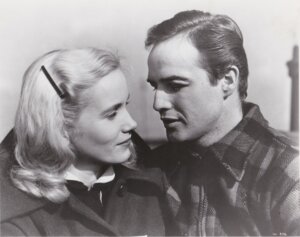
Oscar-winning actress Eva Marie Saint, who has died at age 102, preferred mishpocheh to political posturing.
Her stance was akin to that of author Albert Camus, who during a press conference in 1957 after winning the Nobel Prize in Literature, commented on strife in his native Algeria by opining of the terrorism used to liberate the nation from French colonialism, endangering his family still in his homeland: “If that is justice, I prefer my mother.”
Born to a Quaker family in Newark, Saint likely followed that religion’s wartime and immediate postwar concern for the fate of Europe’s Jews. Yet by 1951, when she married the American Jewish television director and producer Jeffrey Hayden (born Raphael Levine), to whom she would remain wed for 65 years, Saint apparently diverged from the official Quaker line.
By that year, previous collaborations between Quakers (officially the Religious Society of Friends) and Jewish communities during the Holocaust were halted by conflicts ensuing from the 1948 Arab-Israeli War. Traditional Quaker pacifism and historical Christian theology which downplayed Jewish presence in the Middle East opposed Israeli nationalist aims.

Instead, a policy purporting to favor balanced partiality claimed Quaker neutrality between Israeli authorities and Arab populations. Later, intense Quaker advocacy would make observers such as the historian Nancy Gallagher consider that the historic alliance with Jewish organizations was compromised.
Not so with Eva Marie Saint, who won acclaim in such early career explorations of Yiddishkeit as Paddy Chayefsky’s 1954 television production, Middle of the Night, which centered on a romance between Jerry Kingsley, a 53-year-old widowed Jewish garment manufacturer, who falls in love with Betty Prieser, his 24-year-old receptionist.
Nominated for an Emmy for her turn as Betty, Saint played opposite E.G. Marshall, but when the play transferred to Broadway two years later, the veteran of the shmatta trade was played by Edward G. Robinson (born Emanuel Goldenberg) with such heart-wrenching emotion that some theater mavens considered his work to be the single finest performance seen on the modern New York stage.
By then, Saint, replaced on Broadway by Gena Rowlands, had already conquered cinemagoers in Budd Schulberg’s 1954 film On the Waterfront, widely seen as an onscreen argument for betraying fellow Jews by naming names to political authorities. Screenwriter Budd Schulberg and director Elia Kazan had given friendly testimony to the House Un-American Activities Committee (HUAC) during the McCarthy era, decimating the lives and careers of many creative Jews in Hollywood. Among those cited in 1951 by Schulberg as dangerous Communist Party associates were the writer-director Herbert Biberman and screenwriter Albert Maltz. Meanwhile, in speaking to HUAC in 1952, Kazan singled out the writer Clifford Odets; actors Morris Carnovsky and J. Edward Bromberg; and actress Paula Strasberg.
In On the Waterfront, the protagonist played by Marlon Brando was shown breaking a code of silence to testify against mob-controlled union bosses. The result incensed Arthur Miller, who had originally written an unproduced screenplay about corruption on the Brooklyn docks, which Kazan had agreed to direct. At this point, Columbia Pictures head Harry Cohn demanded that the villains be altered from corrupt union bosses to Communists. Miller demurred, left the project, and was replaced by Schulberg. In 1955, Miller’s play A View from the Bridge was considered a response to Schulberg, in which informing was shown to be a destructive betrayal driven by jealousy, rather than noble whistleblowing.
Saint transcended this tzimmes pitting Jew against Jew by delivering an Oscar- winning performance in her first screen role. As the younger sister of a murdered dockworker, Saint demanded justice for her brother’s death and challenged the conscience of the character played by Brando.
Saint was later cast in Otto Preminger’s Exodus, whose overblown and boring nature is best summarized by a legendary historical burn: At a preview of the film in 1960, the Canadian Jewish comedian Mort Sahl rose from his seat and supposedly pleaded, “Otto, let my people go!”

The film was based on Leon Uris’ melodramatic novel about the founding of the State of Israel, which historians Matthew Silver and Deborah Dash Moore diagnosed as more redolent of shoot-em-up cowboy films than Jewish history. Nevertheless, once again Saint surpassed the limitations of a script given her, as a widowed American nurse toiling in Cyprus with Jewish refugees who becomes enamored of a Palestine-born Haganah leader, Ari Ben Canaan (played by Paul Newman).
Newman’s character tells Saint’s nurse, “I just wanted you to know that I’m a Jew. This is my country,” as Brandeis professor Stephen J. Whitfield notes in American Space, Jewish Time. Shortly afterward, she is seen wearing a khaki uniform and holding a gun, joining her betrothed and other Jews to resist an Arab attack. Film maven Tony Shaw asserted that, during the movie’s production, Saint made it a personal mission to recount to the international press “stories of Israel’s steadfastness” and “democratic spirit.” She also lauded the Jewish State’s “stoicism in the face of constant Arab invasion threats” and, further, spoke of the “opportunities Israeli women had” compared to “their Arab counterparts.”
In less fraught contexts, Saint continually proved that she was a mensch, as recalled by Brooklyn-born actor Bernie Kopell, a mainstay as Dr. Adam Bricker on TV’s The Love Boat. When the cast of one 1983 episode was temporarily outside the Parthenon in Athens, Kopell stated, Saint saw him studying his lines for a forthcoming stage role and offered her partnership to help him memorize the words. This solidarity from an Oscar-winning actress to a humble Love Boat actor impressed Kopell, but Saint told him with egalitarian zest that she did the same for all her friends.
On a more somber note, Saint’s personal steadfastness and Camus-like preference of family to debates on current events extended to portraying Marilyn Klinghoffer, the widow of Leon Klinghoffer who was murdered by Palestinian terrorists during the sea-jacking of the Italian cruise ship in a 1990 two-part miniseries, Voyage of Terror: The Achille Lauro Affair.
Saint incarnated the resolve of Marilyn Klinghoffer, who although fatally ill, had the fortitude to travel to Italy to testify against the four terrorists after her wheelchair-bound husband was separated from other passengers as a Jew during the 1985 Achille Lauro hijacking, murdered, and thrown overboard. It was a noble and compelling performance, like all of her work during a long acting career inspired by Yiddishkeit.
The post Eva Marie Saint was born Quaker, but found her ‘Exodus’ in Jewish stories appeared first on The Forward.
Uncategorized
Three years after Oct. 7, survey says Jewish engagement has reached an elevated ‘new normal’
(JTA) — Levels of engagement in Jewish life have risen overall, establishing a “new normal” three years after the Oct. 7, 2023, attacks, according to a survey released Thursday by the Jewish Federations of North America.
Thirty-eight percent of Jewish respondents surveyed by the federation umbrella group in May and June said they had increased their Jewish engagement in some way in the last three years, an increase of 7 percentage points over rates in 2025 yet down from the 43% rate in March 2024, in the months after the attacks. The survey had a margin of error of 1.8 percent.
JFNA researchers say the results demonstrate that this initial spike in engagement — which the organization dubbed “the Surge” — has had a lasting effect, prompting people to deepen their involvement in Jewish life even three years on.
“I think the fact that people are continuing to engage with community during a difficult time is a good thing, and it’s an opportunity for us to meet people’s needs in this moment,” Mimi Kravetz, JFNA’s chief impact and growth officer, told the Jewish Telegraphic Agency ahead of the release of the findings Thursday morning.
The number of “Surgers,” she said, includes Jews who were already engaged but have found ways to become more engaged since the attacks.
Many in the Jewish community feared that Jewish engagement “would continue to decline as we got further out from the events of Oct. 7, and that likely people would return to something like their behavior prior to Oct. 7,” Kravetz said. “That is usually what happens after a major incident.”
JFNA surveyed more than 2,800 Jews by text message in May and June of this year. Follow-up questions were generated by AI, which Kravetz said allowed researchers to ask open-ended questions about respondents’ relationship to Jewish community and quickly sort the answers by category.
This approach unlocked new insights. A top motivator for Jewish engagement was “social or interpersonal” connections in informal settings, such as Shabbat dinners or personal invitations to Jewish events. And in what seems like an encouraging sign for congregational Jewish life, 65% of Jews who “Surged” were turning to synagogues — though Kravetz noted that not every shul’s membership has grown as a result.
The Chabad-Lubavitch movement, whose adherents place a premium on interpersonal connections and often operate in environments lacking in other Jewish communal infrastructure, was the second-most-popular engagement option.
Jews who had increased their levels of engagement were also more likely to voice support for Israel, the findings said. Ninety-three percent of “Surging” Jews said they were “emotionally attached to Israel,” compared to 51% of Jews whose level of engagement did not change. Additionally, 75% of Jews who grew their engagement agreed that “in general, Israel makes me proud to be Jewish,” compared to 36% who did not “Surge.”
Overall, respondents’ most frequently cited barrier to participation in Jewish life was Israeli politics. Large numbers of Jews said they struggled to connect with Jewish community spaces because they felt misaligned on Israel in one direction or another — data that JFNA said it did not quantify because it came out of the open-ended section of the survey.
The most common complaint, Kravetz said, was that Jews were seeking spaces they thought of as “apolitical.”
Kravetz said that many of those Jews, instead of dropping out of Jewish life, indicated they eventually found communities that aligned better with their values.
“These aren’t people who are walking away,” Kravetz said. “These are people who are leaning into Jewish community and are experiencing this tension. And usually, what we see is people are interested in finding Jewish spaces that meet their needs.”
The challenge for Jewish leaders, Kravetz said, is “to make sure that we have and support that diversity of spaces for people, so that they can find the right space that meets their needs.”
But that diversity has limits, as many prominent Jewish leaders — including heads of JFNA — have also urged Jewish communal spaces to reaffirm a commitment to Zionism at a moment when more and more Jews feel divided on Israel. Some Jewish leaders have explicitly called to reject anti- and non-Zionist Jews.
Kravetz doesn’t see those values as contradictory or damaging to the “Surge.” She pointed to another recent JFNA survey, released earlier this year, querying Jews about their relationship to Zionism.
While that survey found that only a third of American Jews identify as Zionist, it also found that 88% of the same population agree with what has historically been a basic tenet of Zionism: that “Israel has the right to exist as a Jewish, Democratic state.”
“I think being supportive of the premise of Zionism, and in how we define Zionism, is very much aligned with engaging the majority of the Jewish community,” she said.
The post Three years after Oct. 7, survey says Jewish engagement has reached an elevated ‘new normal’ appeared first on The Forward.
Uncategorized
On Oct. 7, Mamdani spoke in support of Palestinians. A father from Gaza did it better.
On Wednesday in New York City, on the third anniversary of Oct. 7, two people spoke up for Palestinians. One of them was New York City Mayor Zohran Mamdani. The other person actually said something helpful.
In a statement from the mayor’s office, Mamdani expressed sorrow at the loss of over 1,100 Israeli lives and Hamas’ “horrific war crimes,” then pivoted to condemn Israel for its war against Hamas in Gaza, accusing Israel of ongoing genocide, war crimes, apartheid and occupation.
Then came the Hallmark-ian ending, “To honor the dead, we must fight for a world in which every person can live with freedom, safety, and dignity.”
It was four paragraphs of blame with a coda of pablum: no vision for a way forward and no idea of how to improve Palestinian lives, much less Israeli ones.
Vision and healing — that is, leadership — came not from the mayor, but from a Palestinian and an Israeli who spoke later that day at a forum uptown.
“It’s my choice to give the children the anger and the pain or to give them a chance” at a future, said Jaser AbuMoussa, a Gazan who suffered unfathomable loss during the recent conflict. “And I will choose the chance every day.”
“Our neighborhood, from Nir Oz to the sea, can be a paradise because of the human factor on both sides of the border, and not because we necessarily love each other,” said Jonathan Dekel-Chen, a member of the ravaged Kibbutz Nir Oz. “You don’t have to agree on everything to get there.”
AbuMoussa and Dekel-Chen appeared on stage together at the 92nd Street Y, speaking across chasms of grief. From the West Coast, I tuned into a livestream of the event, because if Israelis and Palestinians want a secure and just future, it starts not with pain-inducing pronouncements like Mamdani’s, but with painful conversations like this one.
On Oct. 15, 2023, an Israeli airstrike hit AbuMoussa’s home in Khan Younis in Gaza, killing his wife and two of his children, as well as a nephew, sister-in-law and a cousin. A second airstrike killed his mother, sister, uncle, aunt, a niece and a nephew. AbuMoussa, a senior fellow at the Middle East Institute, managed to evacuate with his two surviving children to the United Arab Emirates, where they underwent lifesaving surgeries.
“She was an architect,” he said of his wife, Heba. “She was a novelist. She was a poet, and above all, she was a wife and a mother.”
Hamas terrorists took Dekel-Chen’s son Sagui into Gaza, where he was held for 498 days before his release. Terrorists killed 47 out of 420 kibbutz members and took 76 people hostage, including the Bibas family.
Hamas and Islamic Jihad gunmen “rampaged for nine hours through the kibbutz, destroying everything in their path,” said Dekel-Chen, a historian at Hebrew University and visiting professor at Columbia’s School of International and Public Affairs, which co-sponsored the event. He said he is only alive because he and his wife were on a work trip to the United States at the time.
So many arguments over Oct. 7 turn into comparative victimhood — Mamdani’s statement was an example of that, making sure to emphasize Palestinian loss.
But the Palestinian at the 92nd Street Y didn’t do that.
“To me, suffering is like an absolute value, and we are not here for a competition,” AbuMoussa said.
While on the same day in the same city, the mayor’s statement used the words “genocide,” “apartheid” and “war crimes,” the Gazan father who lost his wife and two of his four children used none of those words.
Both men made it clear that the pain and anger of Oct. 7 and the years that followed are ever-present, a fact of life. But so is the choice of how to channel that anger.
“I will not point it at people,” said AbuMoussa. “I will not point it at Jonathan because he is an Israeli. But I will point it at policies, at leaders, at systems that were invented to kill people.”
While he held Israel responsible for helping to create the catastrophe in Gaza — he pointed out that Israeli attacks have killed 1,400 Palestinians since the ceasefire — AbuMoussa — again, in contrast to Mamdani — excoriated Hamas. The group corrupted Gaza’s political, economic, social and above all religious life. It cast itself as the only legitimate interpretation of Islam, though AbuMoussa said Oct. 7 itself contravened Islamic law.
Hamas never treated protecting civilians as its job, AbuMoussa said, pointing out that Oct. 7 mastermind Yahya Sinwar’s family went into the tunnels while ordinary Gazans were left out, unprepared.
The Westerners who took to the streets and college campuses in support of resistance hurt Palestinians more than helped them, AbuMoussa said, because they blur Palestinians together with Hamas and the Iranian axis.
These were the very people Mamdani seemed to be pandering to in his statement — who turn Gaza, in AbuMoussa’s words, “into a flag or a pin.”
Dekel-Chen said his harshest critics are often Diaspora Jews who fail to separate what’s good for Israel from the government of Israel.
Because they spent no time trading accusations and blame, both men had plenty of time to discuss their vision for a better future.
Gazans aren’t leaving, despite the Israeli far right’s fantasies, and Israelis aren’t leaving, despite the Islamists’ fantasies, Dekel-Chen said.
It’s the simplest truth, but it carries extra weight when an Israeli Jew who lives a mile from Gaza says it: there are roughly seven million Jews and seven million Arabs between the river and the sea, and no one is going anywhere.
AbuMoussa said he is open to a confederation between Israelis and Palestinians, two states or “whatever.” But Oct. 7 proved the folly of believing the status quo, or just managing the conflict, will bring stability.
The way forward for now, both men said, is to push leaders to carry out the 20-point plan President Donald Trump put forward to help Gaza recover. They agreed that Washington still has the most leverage.
If Gazans had some sort of hope, AbuMoussa said, “I don’t think they will choose Hamas ever.”
Dekel-Chen said the insistence that Hamas fully disarm before any rebuilding “hurts us all.”
“Nothing positive will happen on our side of the border,” Dekel-Chen said, until most Gazans have hope in a post-Hamas future.
That is ultimately why both men decided to speak together — because they recognize what continuing the hatred costs.
“It’s the only way that I know how to honor those that I grieve, and the loss of life on both sides,” Dekel-Chen said.
It was a message, and a conversation that I wish Mamdani had heard in person. Instead, he spent the evening in Union Square, where anti-Israel protesters booed him for appearing with a group called Israelis for Peace.
To his credit, he showed up. But the same constituency the mayor seemed to court that morning turned on him that night, for standing beside actual Israelis calling for peace.
AbuMoussa and Dekel-Chen could have told him: You can stoke division or you can build a future. Choose the future.
The post On Oct. 7, Mamdani spoke in support of Palestinians. A father from Gaza did it better. appeared first on The Forward.
