


Uncategorized
Rabbi Alvin Kass, longest-serving NYPD chaplain famed for 9/11 response, dies at 89
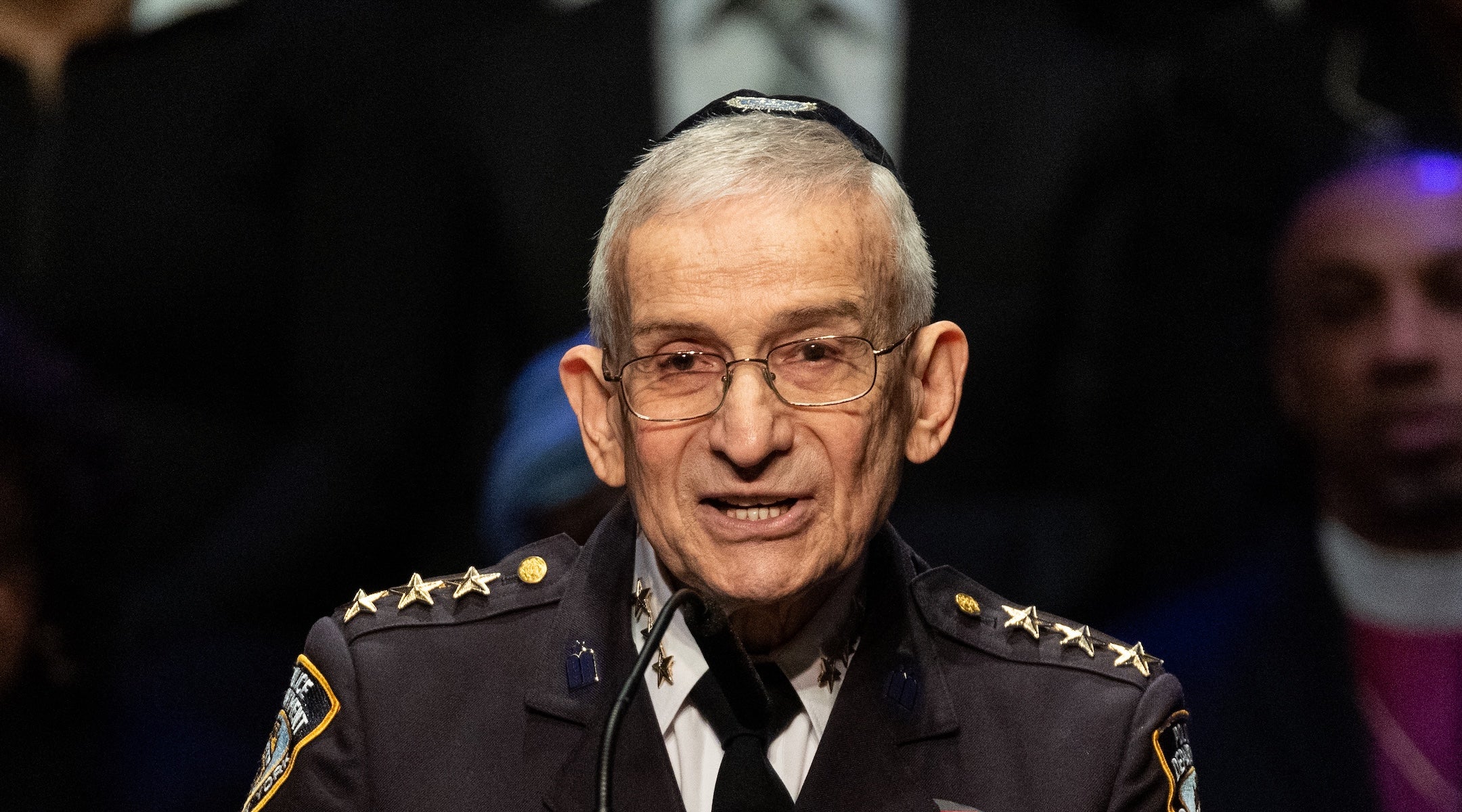
(JTA) — Less than a week after rushing to Ground Zero as a police chaplain on 9/11, Rabbi Alvin Kass led Rosh Hashanah services — not only for his Brooklyn congregation but at a makeshift synagogue at LaGuardia Airport for emergency responders who had flooded into New York City after the terrorist attacks.
“It was,” he would later say, “the most meaningful religious service in my career.”
Kass died Tuesday at 89 as the longest-serving chaplain in the New York Police Department, with a career that included responses to global terrorism, local violence and the intimate needs of police officers — as well as a hostage crisis that he famously resolved with a non-kosher pastrami sandwich.
Born and raised in New Jersey, Kass attended Camp Ramah before enrolling at Columbia University in 1953. His freshman-year roommates there were Robert Alter, who would become a preeminent translator of the Bible, and Shalom Schwartz, later a leading psychologist in Israel.
After graduating from college, he earned both a doctorate from New York University and ordination as a Conservative rabbi from the Jewish Theological Seminary of America before joining the U.S. Air Force as a chaplain. Returning stateside, he took a pulpit in Queens before being urged to join the city’s police department as a chaplain.
At the time, he was only the third Jewish chaplain to work for the NYPD. He would become its longest-serving and the first three-star chaplain, working under eight mayors and 21 police chiefs, while also helming the East Midwood Jewish Center, a Conservative synagogue in Brooklyn, for 36 years until 2014.
The NYC Benevolent Association called Kass “a true pillar of the NYPD” in a Facebook post mourning him. “Every time we bowed our heads for one of his prayers, we appreciated his deep faith, his old-school wit and his unshakable devotion to the men and women who protect NYC,” the group said. “He was a champion of all that is good and noble about our profession. May his memory be a blessing.”
NYPD Police Commissioner Jessica Tisch, who is Jewish, mourned Kass in a statement following his death. She noted that he was the youngest chaplain in the department’s history when he came on at age 30.
“Nearly six decades later, he remained its spiritual heart — a source of strength, guidance, and faith for generations of police officers and their families,” Tisch said, adding, “His loss is immeasurable. His example is everlasting.”
Within the NYPD, Kass was responsible for the spiritual care of all officers but especially the thousands who are Jewish. Kass successfully advocated for the right of Jewish police officers not to work on Shabbat and major Jewish holidays while also serving as the primary Jewish figure for Jewish officers who were otherwise unaffiliated with Jewish communities. He also served as spiritual director of the Shomrim Society, a fraternal organization for Jewish police officers.
“The main responsibility for a spiritual leader is to bring all people closer together, including those of your own faith,” he told the New York Jewish Week when he was honored as one of “36 to Watch” in 2024. “I feel particularly proud that the Shomrim Society embraces Jews of all backgrounds and points of view. The organization is a paragon of the unity that ought to bind all Jews together.”
After the terrorist attacks in Lower Manhattan on Sept. 11, 2001, Kass reported to Ground Zero, where he encountered a police officer he described as “crying like a baby” as well as the families of officers who were unaccounted for. Later, he attended the funerals of ever police officer who was killed that day, including two who were Jewish.
“I told their families that you’re supposed to say ‘Baruch atah Adonai, eloheinu melech ha’olam, dayan ha emet’: Blessed is the Lord our God, ruler of the universe, who is a judge of truth, or truthful judge. This means, essentially, that He knows what He’s doing. We don’t,” Kass wrote in an essay for The Forward on the 20th anniversary of the attack.
“We can’t comprehend what He’s doing very often, but presumably He knows what he is doing, and we submit. We bow our head to what is often inscrutable and incomprehensible, and we accept it with a measure of faith and hope,” he continued. “That really is the essential message of Judaism, in the face of evil.”
Kass would later say that 9/11 marked a transition in the role of the chaplain within the NYPD, peeling back some of the stigma that had been associated with seeking spiritual care in a department where machismo was long the currency.
Kass’ own encounters on the job ranged from lofty to the low-brow. He was pulled away from his son’s bar mitzvah celebration to tend to an officer who had been shot, according to a 2006 profile in the Columbia alumni magazine. On another occasion he flew upstate between Friday night services and Shabbat morning services to inform a family that their officer son had been murdered.
One of Kass’s more famous escapades came in 1981 when he was called in to negotiate with a Jewish man who had taken a woman hostage.
“I talked to him all night to give up his gun,” Kass recalled in a 2012 interview with the Wall Street Journal, neither the first nor last time he would recount the incident. “I was an utter failure. But by morning he was hungry.”
The hostage team ordered pastrami sandwiches from the (nonkosher) Carnegie Deli for the hostage-taker and for Kass. Kass traded one overstuffed sandwich for the man’s gun — but it turned out he had another. Kass, who ate only kosher meat, had not touched his sandwich and persuaded the man to accept it in exchange for the other gun. The police swooped in and ended the crisis.
The NYPD commissioner noted the incident when promoting Kass to three-star chief in 2016, saying, “In a feat that has become legendary, you were able to trade two pastrami sandwiches for the man’s two guns.”
But for Kass, whose small stature added to a widespread impression of modesty, the real feat came not in his ability to disarm the hostage-taker but in the man’s appetite. “Have you seen the sandwiches from the Carnegie Deli?” he recalled. “They’re huge.”
Kass is survived by his three children and three grandchildren. He was married for 54 years to Miryom Kass, an educator, until her death in 2017. Speaking at the 2016 ceremony marking 50 years with the NYPD, Kass said about Miryom, “She has been by confidant, my partner, my co-worker, she’s been my inspiration, she’s been my chaplain.”
The post Rabbi Alvin Kass, longest-serving NYPD chaplain famed for 9/11 response, dies at 89 appeared first on The Forward.
Uncategorized
Troy Jackson wins Maine Democratic Senate nomination, keeps mum on Israel, AIPAC
(JTA) — BANGOR, Maine – Troy Jackson accepted the Democratic nomination for Maine’s U.S. Senate race on Saturday with no mention of Israel, sidestepping an issue that has become a focal point for many Maine Jews as they assess the party’s new standard-bearer.
Jackson secured the nomination in a landslide 566 to 5 vote by delegates at the nominating convention. Saundra Pelletier, the only remaining challenger after the rest of the field dropped out in the days leading up to the gathering, picked up the handful of votes that didn’t go to the winner.
While Jackson took several shots during his acceptance address at Sen. Susan Collins, the incumbent Republican he will now face in the general election, it was Pelletier who used her remarks to specifically malign Collins’ voting record on Israel.
“She voted to increase federal funding in defensive arms for Iran, and did not vote to take moderate measures to hold Netanyahu accountable,” Pelletier said, receiving a chorus from the crowd.
The victory for Jackson came after the state’s former Democratic nominee, Graham Platner, a staunch Israel critic, left the race earlier this month amid a sexual assault allegation, which he has denied. The resulting scramble to replace him upended the Democratic primary and prompted fresh scrutiny from Jewish Mainers of Jackson’s recent evolution on Israel.
Jackson, a former state lawmaker and union advocate, had previously said little publicly about the Israeli-Palestinian conflict during his two-decade career in state legislature. However, during the race to replace Platner, he has embraced the term “genocide” to describe Israel’s war in Gaza and called for an end to U.S. military aid to Israel on his campaign website, both positions championed by Platner before his exit. Jackson also has said he wouldn’t accept any funding from AIPAC.
But on Saturday, as a sea of supporters sporting his campaign’s blue and yellow “Troy Jackson” t-shirts cheered their new nominee, Jackson omitted any mention of Israel from his remarks. Instead, Jackson reaffirmed his commitments to passing Medicare for all, supporting union rights and restoring abortion rights nationwide, among other issues.
During his address following the decisive victory, Jackson also offered a message to Maine voters who remain on the fence:
“Whether you supported me from the beginning, supported another candidate, or are still deciding what you think of this fifth-generation logger from Allagash,” Jackson said. “I’ve always known this, that your trust has to be earned, and so I want you to hear this directly from me. There is a place in this campaign for all of you. There is work for you in this movement, and I will spend every day, now through November, earning that trust because today we turn the page.”
Amy Fried, a professor emerita of political science at the University of Maine who attended Saturday’s conference as an alternate delegate but did not cast a ballot, said that while she believed Jackson had addressed Israel in the lead-up to Saturday because “a lot of people are interested in the topic,” his speech reflected the issues he had been “concerned about his whole political career.”
“Obviously, he’d have to take votes on foreign policy and funding when he’s in the Senate,” Fried said. “But I think that his main interest is always in issues that have to do with housing and healthcare, you know, all of the matters that are sort of more day-to-day kitchen table issues.”
While Jackson avoided revisiting his recent stances on Israel, which have raised concern among some Jewish voters in Maine, about a dozen pro-Palestinian protesters rallied outside the convention hall in support of his candidacy.
“It’s a really positive step that you have nominated Troy Jackson,” one protester shouted through a megaphone. “I think he’s going to be a strong voice for the kind of values that I believe in and the people of Palestine, the children of Iran, and all the other places the U.S. bombed.”
Ronna Lugosch, a 71-year-old Jewish grandmother and delegate from Round Pond, Maine, said that she was “more excited now than I was before” about Jackson’s candidacy.
Lugosch, who supports Jackson’s stances on Israel, said she hadn’t noticed he had left the topic out of his remarks. “Unfortunately, it’s a sensitive topic, so that’s my guess that maybe he didn’t bring that up because it was just too much,” Lugosch said. “You know, he was being careful.”
Still, Lugosch said that she was “really impressed with all his comments about working people and organizing.”
“I’m going to campaign for him because we need to get rid of Susan Collins,” Lugosch said. “Before it was more of a sort of a defensive stance, but now I’m supportive, and so I feel better about going out into the community.”
This article originally appeared on JTA.org.
The post Troy Jackson wins Maine Democratic Senate nomination, keeps mum on Israel, AIPAC appeared first on The Forward.
Uncategorized
Maine Democratic Senate nominee Troy Jackson raises eyebrows in the Jewish community
(JTA) — BANGOR, Maine – Throughout his two-decade-long career as a state lawmaker in Maine, Troy Jackson built his political brand around labor and economic issues.
But as the former logger and state Senate president now seeks a seat in the U.S. Senate, Jackson has begun staking out positions on something new — Israel.
Facing one of the Democratic Party’s most divisive issues, Jackson has embraced the label “genocide” to describe Israel’s war in Gaza and called for an end to U.S. military aid to Israel.
“This is unconscionable. Anybody with eyes and a heart knows the Israeli government is committing genocide in Gaza. It has to end, and we as Americans have the power to end it,” Jackson wrote in a post on X on July 9, responding to reports of a Palestinian aid worker killed by Israeli strikes. “When I’m in the U.S. Senate, I’ll never vote in favor of US taxpayer-funded military aid to Israel.”
A week later, Jackson also inveighed against AIPAC, the pro-Israel lobby that has become a frequent target of progressives.
“I pledge to lead for Maine voters by rejecting attempts to buy influence through unlimited personal wealth and dark money,” Jackson wrote in a post on X. “That means rejecting all money from corporate PACs, AIPAC, and lobbyists from Big Oil and Big Pharma.”
For some Jews in Maine, Jackson’s emergence has prompted unease. Some worry that his embrace of the term “genocide” reflects a troubling shift in Democratic primaries across the country that many Jews have found alienating. Other Maine Jews, while somewhat hesitant, see the longtime Democrat as a pragmatic choice to represent the state and say they prefer him over Platner.
Jackson’s newfound efforts to speak out forcefully on Israel comes as he is likely to secure the Democratic nomination Saturday to take on Republican Sen. Susan Collins in a high-profile race that could determine control of the Senate.
His policy statements and comments about Israel have mirrored the broader evolution of the race since the collapse of Graham Platner’s campaign earlier this month. Platner, a staunch critic of Israel, bowed out of the race earlier this month following a sexual assault allegation that he has since denied. In the days that followed, some of the Democratic candidates who emerged to replace Platner but then dropped out, including Shenna Bellows and Jordan Wood, also began using the term “genocide” for the first time.
Jackson’s campaign did not respond to a Jewish Telegraphic Agency request for comment about his views on Israel.
For some Jews in Maine, Jackson’s sudden emphasis on Israel has raised questions about whether his positions reflect a deeply held conviction or an effort to win over Platner’s supporters.
“I do think that his rhetoric on Israel has been kind of like a ‘pick me’ appeal to the perception of what the Platner base is feeling about the whole thing,” said Brian Kresge, president of Congregation Beth Israel in Bangor, who said he largely votes for Democrats. “I don’t know whether it’s a closely held position because it’s not something he said much about during the gubernatorial race (Jackson came in third place in the governor’s race). It’s not something I’ve ever heard him talk about in his other forays in politics.”
Rabbi Bill Siemers, the leader of Beth Israel, Maine’s oldest active synagogue, said that he had found “no evidence” in Jackson’s “social media or in his talks that this was an issue for him before very recently, and it’s clear to me and to others that he brought this up so he could be the Senate nominee.”
“Now we know where we are. We know where we stand, that this, at least in the upper levels of the Maine Democratic Party, this is a requirement, and that’s not good,” Siemers said, referring to the label of genocide.
“I don’t think Jews want to have to go to the polls and vote on the basis of that, but they will,” he added.
Jackson’s rhetoric on Gaza earned praise from Our Revolution, the group formed by Vermont Sen. Bernie Sanders to advance the progressive movement. Jackson has won endorsements from both Sanders and Our Revolution, as well as left-wing streamer Hasan Piker, California Rep. Ro Khanna and Maine’s Democratic Socialists of America chapter.
“Troy Jackson doesn’t do word salad. He calls a genocide a genocide and says he’ll never vote for taxpayer-funded military aid to fund it,” the group wrote in a Facebook post earlier this month. “That’s what Maine voters delivered a historic win for on June 9, what other contender in Maine will actually say it?”
Jackson, 58, is a fifth-generation logger from northern Maine and first entered politics in 1998 by leading a logging blockade along the Maine-Canada border to protest corporations hiring low-wage foreign workers. In 2000, he launched an unsuccessful Republican bid for the state House before later winning a seat two years later as an independent.
He ran again for re-election in 2004 as a Democrat and won, kicking off a two-decade long career in state politics where he maintained strong union ties and progressive views. Jackson also once voiced opposition to same-sex marriage and abortion, both positions he has since reversed.
In 2024, at the Maine State Democratic Convention, Jackson, who served as convention chairman, reportedly attempted to quiet down a small group of pro-Palestinian protesters who called Maine Rep. Jared Golden a “war criminal” during a video celebrating the Jewish congressman.
“I believe in the ability of people to demonstrate and protest,” Jackson said amid the outburst. “There is a time for that.”
Earlier this year, Jackson came in third place in the state’s Democratic primary for governor. During his campaign, he pledged not to take “dark money,” but did not specifically reject AIPAC, which typically spends in federal races.
During Platner’s campaign, Jackson campaigned alongside him and endorsed his candidacy until Platner was accused of sexual assault. Following the allegation, he joined other progressive leaders in calling for Platner to drop out.
Going into Saturday’s nominating convention, Kresge said that there was still a “palpable sense of relief” among the local Jewish community that Platner, whose Nazi-linked tattoo had sparked outcry among Jewish Mainers, was out of the race.
“Troy Jackson may sound alike on a lot of these issues, but he’s not burdened by – well, he is burdened by some accusations and stuff —but he’s not burdened by a Reddit history,” Kresge said. “He has an actual political resume to run on.”
While some Jewish Mainers questioned Jackson’s recent rhetoric on Israel, others said his long record in local government offered some assurances.
“I don’t know Troy Jackson, but I think having a resume to fall back on, and having been in the position where he’s had to make compromises and understand the difference between spouting a popular slogan versus getting things done, I think is a small measure of comfort,” said Matt Tzuker, a Jewish resident of Portland.
Maine State Rep. Laurie Osher, who is Jewish and said she was ready to vote for Jackson, said that she hoped that Jackson would be able to “keep up the momentum” that Platner had gained during his campaign.
“He’s got my vote because I have worked with him,” Osher said. “For every moment that I found him doing something I didn’t think was great, he was also open to me telling him why I didn’t think it was great, and I saw him do better.”
This article originally appeared on JTA.org.
The post Maine Democratic Senate nominee Troy Jackson raises eyebrows in the Jewish community appeared first on The Forward.
Uncategorized
MAGA influencer Laura Loomer mounts Jewish apology tour in Ukraine, meeting with Zelensky and rabbi
(JTA) — MAGA firebrand Laura Loomer, who is warring with anti-Israel figures on the right, is invoking her Judaism as she pulls an about-face on a former hobbyhorse of hers: Ukraine.
Loomer interviewed Ukrainian President Volodymyr Zelensky on a visit to the country this week, asking him about his Jewish identity and the country’s antisemitism policies. She also sat down with influential rabbi Moshe Azman as Ukraine’s punishing war with Russia drags into its fourth year.
In a series of tweets, she apologized for her past assertions that Ukraine is “full of Nazi sympathizers,” and that Zelensky was “a self-hating Nazi Jew.”
“I admit it, I fell for Russian propaganda,” Loomer, who wields considerable influence with President Donald Trump, wrote Friday after sharing “a lovely Kosher dinner” with Azman’s family. She also visited a historic Kyiv monastery recently shelled by Russian drones and invited Zelensky to make his case for why supporting Ukraine was “America First.”
Loomer’s Jewish Ukraine tour comes as the American right is splintering, largely between pro- and anti-Israel factions — pitting the likes of Loomer and Jewish pundit Ben Shapiro against those aligned with pundit Tucker Carlson.
Military aid to Ukraine has served as a tension point between the hawks and isolationists since Russia’s invasion in 2022. The two issues have become increasingly intertwined, with the right’s loudest anti-Israel voices opposing the U.S.-Israel war against Iran and also projecting weariness around supporting Ukraine.
Vice President JD Vance, whose language on Israel and Jewish issues has alarmed some Jewish leaders, took credit for halting U.S. aid to Ukraine earlier this year. Vance’s associate Carlson, who has recently turned on Trump and broken with the Republican Party, conducted a softball interview with Russian President Vladimir Putin in 2024. The U.S. Senate will vote on a new joint Russia-Iran sanctions bill next week.
Trump himself exhibited closeness with Putin during his first term and, together with Vance, chastised Zelensky during a White House meeting last year. But his administration has indicated a recent willingness to try to end the war on terms sympathetic to Ukraine, and the two leaders are scheduled to meet in the White House next week.
Loomer, too, formerly exhibited pro-Russia tendencies, including writing for the Russian-owned English-language outlet RT. More recently, she has feuded with other right-wing media figures, including Carlson, Candace Owens and Joe Rogan, often citing her pro-Israel views as the reason for the falling-out. Unlike a growing number of pundits on the right, she has also continued to cheer on the war with Iran even as its support has sunk across party lines and other commentators have sought to cast blame onto Israel.
Loomer has also used inflammatory rhetoric toward Muslims, calling on Trump to pass “a Muslim Ban as it was intended to be” after New York City Mayor Zohran Mamdani called Israeli Prime Minister Benjamin Netanyahu a “war criminal” earlier this week.
In her Zelensky interview, filmed at the Ukrainian presidential palace and released in full on Friday, Loomer tried to play partisan politics. She unsuccessfully urged him to call Trump the best president in history and told him that his 2024 visit to a Pennsylvania munitions factory alongside Democratic Gov. Josh Shapiro was “one of the reasons why a lot of Americans came to dislike you.” (Shapiro, who is also Jewish, was at the time a prominent campaign surrogate for then-Vice President Kamala Harris, who was running for president.)
Loomer sought a Jewish connection with the president, telling him, “I’m Jewish, you’re Jewish. We share that in common.” Zelensky, who rarely publicly comments on his Jewish heritage, highlighted that Ukraine earlier this year passed a law criminalizing antisemitism.
“It’s illegal, antisemitism. We did it during my presidency,” he said. The new law, a strengthening of a 2021 law, institutes fines and possible prison terms for those found guilty of hatred or discrimination on the basis of Jewish identity.
Zelensky, who has long enjoyed largely unqualified support among Democrats and liberal Americans, praised Loomer’s visit and change of heart. He, Azman and other Ukrainian figures who met with Loomer have sought to cultivate increased favor with Trump during a particularly uncertain phase of the war.
Loomer told the president her main goal was to counter “Russian propaganda” she believed was prominent among American podcasters, including allegations of links between Ukraine’s military and Naziism.
“I really opposed sending my taxpayer dollars to Ukraine because I really believed that you had an army, the Azov Battalion, full of Nazis,” she told Zelensky, referencing an infamous Ukrainian military wing that has continued to attract scrutiny, both before and after the 2022 invasion, for its links to neo-Nazis and other extremists.
“We are not Nazis,” Zelensky told her, later urging her to visit Babyn Yar, the memorial to the “Holocaust by bullets” perpetrated by Nazis on Ukrainian soil with the help of local collaborators in 1941. In 2022, shortly after the invasion, a Russian bombing near the memorial prompted Zelensky to make an appeal to the global Jewish community for support.
Loomer, who is notorious for credulously reporting explosive allegations against her political enemies, said she accepted Ukraine’s claims to now be Nazi-free. One of the deciding factors, she said, was meeting with Azman, the Chabad-affiliated rabbi who holds the disputed title of chief rabbi of Ukraine and whose son was killed in battle with Russia in 2024.
“The Rabbi told me his dead Jewish son didn’t fight alongside Nazis,” Loomer tweeted, adding, “I can assure Amercians [sic] that Jews are safer in Ukraine than they are in Mamdani’s New York City!” (Azman has also praised the Jan. 6, 2021, U.S. Capitol riots by Trump supporters, celebrating them for “protesting mass election fraud” and comparing them to the Maidan, the 2014 Ukrainian protest movement that ousted a pro-Russia president.)
Most diaspora Jews and Jewish organizations have backed Ukraine since the invasion and have decried Putin’s initial assertion that his invasion was intended to “denazify” the country. Loomer has now joined their ranks, hoping to marry that support to her own ideological identity as a Jewish right-winger in an era where the president she has long championed is losing some influence.
“We won’t have Trump forever,” she wrote Tuesday, “and the axis of evil is moving fast.”
This article originally appeared on JTA.org.
The post MAGA influencer Laura Loomer mounts Jewish apology tour in Ukraine, meeting with Zelensky and rabbi appeared first on The Forward.
