


Uncategorized
Why Those Fighting for the Jews Should Concede that Anti-Zionism Is Not Antisemitism

Rutgers University students holding an anti-Zionist demonstration on March 19, 2024. Photo: USA Today Network via Reuters Connect
Anti-Zionism is not antisemitism, as the latter is typically conceived.
Anti-Zionism is its own libel-spewing hate movement targeting the Jews, and it’s time the Jewish people and their allies recognize this and change our tactics.
We have lost the battle over anti-Zionism on campuses and elsewhere because we have been fighting too hard to identify it with antisemitism. It is time to join the battle against anti-Zionism itself.
A new organization called the Movement Against Anti-Zionism has the mission to make all this clear. Here is just one example that illustrates the need to change tactics.
The widely-made claim that Federal investigations into campus Jew-hatred are “misusing civil rights law to squash political dissent,” as Jessica Corbett recently expressed it, rests on a deep misunderstanding of what that hatred looks like today. It assumes that Jew-hatred still wears its old “antisemitic” uniform: swastikas, slurs, caricatures, and conspiracy theories.
But Jew-hatred manifests differently in different times, and mutates and adapts. The operative Jew-hatred of our era is neither the anti-Judaism of Christian yore nor the antisemitism of late modern race science (though that is on the rise today as well). It is anti-Zionism, a moralized, intellectualized, and socially acceptable hatred of the Jewish collective that masks itself in the language of justice.
Whereas antisemitism treats the Jew as an alien within society, anti-Zionism treats the Jewish state as an alien among nations. The vocabulary has changed, but the underlying impulse remains constant: to mark the Jewish identity of the era as uniquely illegitimate. Anti-Zionism allows (on paper) that Jews may exist as individuals — but not as a people with collective rights, casting their sovereignty not as self-determination but as mortal sin. The hatred that was once expressed through the language of race and religion is now expressed through that of rights and resistance.
The AAUP (American Association of University Professors) and MESA (Middle East Studies Association) report cited by Corbett frames campus antisemitism probes as an effort to silence “criticism of Israel.” Yet its own rhetoric reveals a deeper prejudice. It begins by asserting that Israel is waging a “genocidal war” in Gaza, presented not as argument but as premise. This is not critique; it is anti-Zionist libel, the moral inversion by which Jewish survival is reframed as moral crime. The purpose is not to critique Israel but to isolate it, not to debate policy but to deny legitimacy. Anti-Zionism is not “critique of Israel” any more than antisemitism is “critique of Jews.”
To describe anti-Zionist accusations as “mere criticism” is to misunderstand how modern bigotry operates. Hatred no longer announces itself openly; it hides beneath the cloak of virtue. On university campuses, this takes the form of polite exclusion: the Israeli scholar uninvited from a panel, the Jewish student told that solidarity requires renouncing Zionism, the cultural institution that celebrates diversity except when it includes Jews who refuse to disavow their people’s homeland. Each act seems minor, even principled. Taken together, they constitute the moral architecture of contemporary discrimination.
Anti-Zionism is not identical to antisemitism, but is its direct descendant, a mutation adapted to the moral grammar of the 21st century.
The ongoing Federal civil rights investigations are not an assault on liberty, but an attempt to recognize how hate has changed its form. They do not criminalize dissent, but acknowledge that the boundary between political speech and ethnic animus has blurred — primarily, or only — with respect to the world’s one Jewish state.
To challenge anti-Zionism is not to silence dissent. It is to insist that equality includes Israelis and their supporters too. The refusal to grant Israel what every other nation takes for granted — the right to self-definition and security — is discrimination, whether clothed in theology, theory, race, or virtue. The tragedy of the AAUP and MESA report, and of the article that amplifies it, is that they mistake the exposure of prejudice for its creation. By defending exclusion as conscience, they do not protect freedom — they excuse its perversion.
Anti-Zionism is the hate that learned to pass as justice. To recognize it as such is not censorship. It is moral clarity — the refusal to let an old hatred hide under the banner of a fashionable cause.
If you agree then check out the Movement Against Anti-Zionism–and join the battle.
Andrew Pessin is Professor of Philosophy at Connecticut College and founder of the Institute for the Critical Study of Antizionism.
Uncategorized
Netanyahu wants his far-right allies to unite. One of them is betting on a bigger prize: replacing Netanyahu himself.
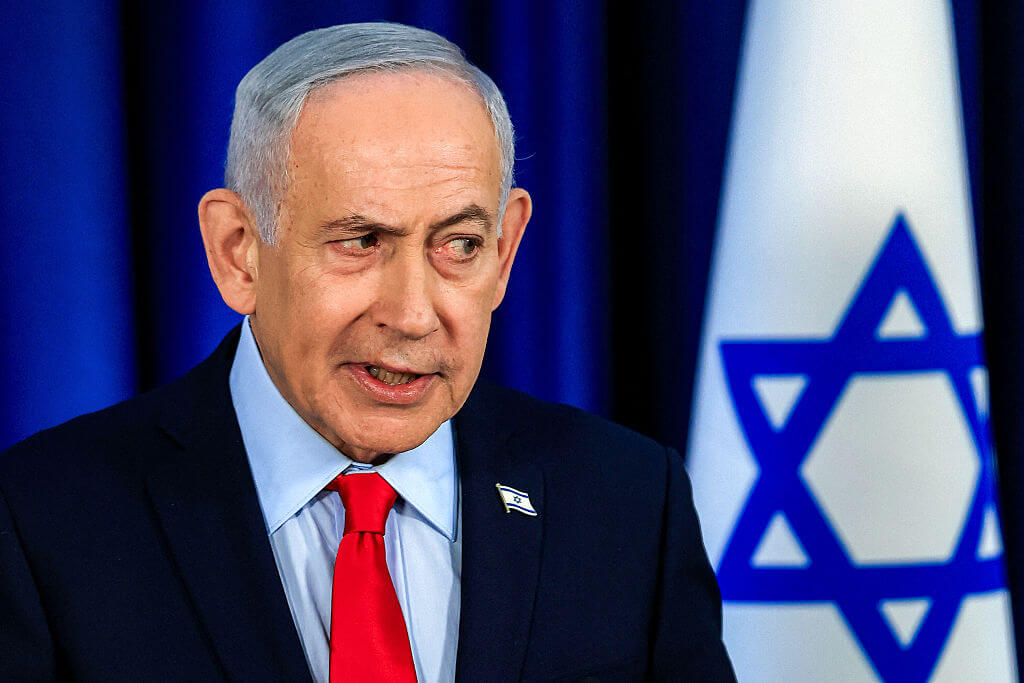
Israel’s right-wing firebrand Itamar Ben-Gvir, the minister of national security, has spent the past several days under intense pressure from Prime Minister Benjamin Netanyahu to do something he plainly does not want to do: join forces in the coming election with his far-right rival, finance minister Bezalel Smotrich.
Netanyahu has good reason to be worried. Israel elects its 120-member parliament through nationwide proportional representation, but a party must win at least 3.25% of the vote to enter the Knesset. If it falls short, its votes are effectively wasted.
That is precisely the danger facing Smotrich. Recent polls ahead of the Oct. 27 election have repeatedly placed his Religious Zionism party near or below the threshold. Ben-Gvir’s Jewish Power party, by contrast, is comfortably above it. Netanyahu has therefore been pressing the two men to run together, ensuring that neither party’s votes are lost. Over the weekend, Ben-Gvir’s party issued a statement saying it would not run with Smotrich.
On its face, this looks extraordinarily irresponsible.
Israel has seen what happens when parties gamble with the threshold. In 2022, the left-wing Meretz and Arab nationalist Balad parties together won roughly 6% of the vote, but because each fell below the threshold, neither entered parliament. The result helped Netanyahu secure a comfortable Knesset majority. In 1992, wasted votes for small right-wing parties similarly contributed to Yitzhak Rabin’s narrow victory.
So why would Ben-Gvir risk helping defeat his own political camp?
The obvious explanation is ego. Ben-Gvir and Smotrich dislike each other and compete for many of the same voters.
But there is another possibility: Perhaps Ben-Gvir has already concluded that Netanyahu is going to lose. If so, what looks like recklessness may be perfectly rational.
The parties opposed to Netanyahu currently lead his bloc by roughly 20 seats or more in most serious polling. And it would be naive to assume they would refuse to rely, directly or indirectly, on Israel’s Arab parties if the alternative were another Netanyahu government, an outcome they regard as catastrophic.
If Ben-Gvir believes defeat is coming anyway, preserving every possible seat for Netanyahu’s current bloc becomes a secondary concern. His real contest begins the morning after Netanyahu loses: Who inherits the Israeli right?
Running separately allows Ben-Gvir to preserve his identity, weaken Smotrich and emerge as the undisputed leader of Israel’s radical right, even if the entire Netanyahu camp ends up in opposition.
That possibility would have sounded absurd only a few years ago.
From pariah to power broker
In 2019, Ben-Gvir could not even get elected to the Knesset. For years he inhabited the outer fringes of Israeli politics, a disciple of the racist extremist Rabbi Meir Kahane whose political tradition was considered so toxic that even Netanyahu once treated him as an embarrassment.
By 2022, Ben-Gvir had become one of the most prominent figures on the Israeli right. Netanyahu made him national security minister. The question is no longer whether Ben-Gvir belongs to mainstream Israeli politics. It is whether he might someday lead a substantial part of it.
Imagine Likud going into opposition with 19 seats and Ben-Gvir emerging with 13 – roughly the current polling. Suddenly the distance between them does not look enormous, especially after Likud has spent decades becoming almost inseparable from Netanyahu. Ben-Gvir would possess a substantial parliamentary faction, a fiercely motivated base, enormous public visibility and a powerful argument to right-wing voters: I represent what comes next. Likud represents an exhausted past.
There is no law saying Likud must remain the dominant party of the Israeli right forever. Political parties survive as dominant institutions only as long as voters believe they represent something they want. Once that bond breaks, decades of accumulated political capital can disappear remarkably quickly.
Which raises the question: What exactly is Likud without Netanyahu? The party machinery will remain, along with more than 100,000 members and a formidable institutional legacy. But after three decades of Netanyahu’s dominance, separating Likud’s identity from his own has become increasingly difficult.
Many of its most independent and impressive figures have left or been pushed aside over those decades, among them Tzipi Livni, Dan Meridor, Ariel Sharon, Ehud Olmert and Benny Begin. The cumulative exodus says something about the transformation of a once broader political movement.
The cost of Netanyahu’s compromises
Netanyahu’s dependence on Israel’s Haredi parties has surely done further damage. For decades, Likud could present itself as the natural home of Israel’s secular and traditional right: nationalist voters with strong Jewish identities who nevertheless expected the basic obligations of citizenship to be shared.
That compact is under enormous strain over military service. Most Haredi men have historically been exempted from Israel’s compulsory military service while studying full-time in religious seminaries. The arrangement has become vastly more problematic explosive since Oct. 7 and the wars that followed, which have imposed extraordinary burdens on soldiers and reservists.
The Haredim want their exemptions codified into law, and Netanyahu has attempted to comply. The issue is one of the main ones in the election. A party asking non-Haredi Israelis and their children to shoulder an ever-heavier military burden while protecting broad exemptions for the rapidly growing Haredi population should expect to pay a political price.

Here lies one of the ironies of Ben-Gvir’s rise. He represents an even more extreme version of the religious nationalism that has alienated some traditional Likud voters. Yet precisely because he is more extreme, his claim to the future right may become stronger.
Likud’s concessions to the Haredi parties can be understood as transactional politics — bargains Netanyahu needs to remain in power. Ben-Gvir’s religious radicalism is more authentic. He offers a coherent worldview in which Jewish nationalism, religious authority, territorial maximalism and hostility toward the institutions and restraints of liberal democracy reinforce one another. What Likud has adopted gradually, sometimes for reasons of political survival, Ben-Gvir offers as a complete ideological package. In that sense, he offers the product in its purest form.
Consider the Palestinian question. Much of the Israeli right wants permanent Israeli control of the West Bank. But millions of Palestinians live there, and permanent Israeli sovereignty ultimately requires an answer to their political status. If Israel permanently governs millions of Palestinians without equal political rights, its claim to liberal democracy becomes impossible to sustain. Grant them equal rights, and maintaining a decisive Jewish majority is impossible.
The mainstream right has never produced a convincing answer to this dilemma. Its effective policy has largely been to manage the contradiction indefinitely. It looks foolish in this regard. Meanwhile, the extreme right does have an answer: Palestinian submission and, ultimately, though this is whispered and not shouted, expulsion.
That answer is immoral and would carry enormous strategic consequences. It has never represented the clear majority position in Israeli society. But politically it possesses one advantage: clarity. Part of Ben-Gvir’s appeal comes from his willingness to say openly what much of the right prefers to leave unresolved.
Where the numbers are headed
Demography may strengthen him further. Israel’s secular population has lower birth rates than its Haredi and religious-Zionist populations. For decades, Likud was broad enough to accommodate secular nationalists, traditional Jews, religious voters and conservatives who wanted a strongly Jewish state while retaining some attachment to liberal democratic norms. As the right becomes more religious and culturally radical, that coalition becomes harder to maintain. Increasingly, the right will become the religious bloc, and its former secular adherents will move across the aisle.
The nationalist-religious Ben-Gvir consequently begins to look less like an aberration from the Israeli right and more like one possible expression of where it is heading.
That is why his refusal to reunite with Smotrich may be more consequential than another round of ego and rivalry. It may reflect a cold calculation: Netanyahu’s era is approaching its end, his camp may be headed for opposition, and the real prize is no longer merely a place in the next government.
It is the inheritance of the Israeli right.
Ben-Gvir has traveled an extraordinary distance already. Prior to being elected, he was convicted of offenses including supporting a terrorist organization and incitement to racism. As a young Kahanist activist in 1995, he brandished an emblem torn from Yitzhak Rabin’s Cadillac and declared, weeks before Rabin’s assassination: “We got to his car, and we’ll get to him too.”
That man is now Israel’s national security minister.
He may not be wrong about the calculation he appears to be making.
And if Ben-Gvir is positioning himself not merely to survive Netanyahu but to inherit a large part of the movement Netanyahu leaves behind, it is worth understanding that possibility now. Disasters should at least be approached with eyes wide open.
The post Netanyahu wants his far-right allies to unite. One of them is betting on a bigger prize: replacing Netanyahu himself. appeared first on The Forward.
Uncategorized
As Nepal’s flood toll climbs, Jewish aid groups mobilize to help survivors recover

Two Jewish humanitarian groups — IsraAID and the American Jewish Joint Distribution Committee, widely known as “the Joint” — have sent emergency aid to Nepal’s border with Tibet where flash floods and landslides have killed at least 800 people and more than 3,000 are still missing.
Triggered by a landslide that tore through the mountainous Rasuwa and Nuwakot districts on Aug. 26, the flooding has destroyed roads, bridges and entire villages and displaced tens of thousands of people.
IsraAID’s four-person emergency team landed in Kathmandu Friday evening. Mai Leshem, who is currently serving as head of mission for the Nepal response, said most of the team are the same people who worked in Nepal between 2015 and 2019, when IsraAID ran a long-term recovery program there after an earthquake killed nearly 9,000 people and injured 22,000.
“It’s a place that’s very deeply connected to us,” she said. A fifth team member, a health specialist, is expected within days.
While the Nepali government and local responders handle search and rescue efforts, Leshem said, IsraAID’s team is focused on supporting communities and first responders once the immediate danger passes — handing out hygiene and dignity kits, running stress-relief programs for kids, and working with overwhelmed hospitals to offer burnout-prevention support to staff. Those hospital workers, Leshem said, are dealing with more than the injured; families of the missing keep showing up looking for loved ones.

One moment from the team’s first days stuck with her. At a shelter in Kathmandu housing displaced residents from a hard-hit community near the Tibet-Nepal border, hand-lettered signs read “no photos, no journalists.” Leshem spoke there with a man in his mid-30s who said he wasn’t as worried about himself as he was about the teenagers and young adults around him — kids, he told her, who’d lost everything and were starting to grow angry.
“I don’t think I’ve ever been on a mission where I heard someone focus so intently on this age group,” Leshem said. “It really moved me to hear him speak with such empathy.”
A mission rooted in memory
The Joint is also coordinating its response through the local Nepali organizations it trained in disaster preparedness after the 2015 earthquake — a strategy Avital Sandler-Loeff, executive director of JDC’s Disaster Relief and Development Unit, described as central to how the organization operates. The Joint reached out to its Nepali partners within hours of the flood because those relationships were already in place.
The organization’s immediate focus is preventing a public health crisis, she said. Standing water and damaged sanitation systems have left officials worried about waterborne disease outbreaks, on top of a housing crisis for the tens of thousands who have no shelter. Some families were swept as far as 25 miles from home, she said, and can’t get back because roads and bridges are still buried in mud.
The Joint is funding hygiene kits, tents, blankets and clothing, buying locally where possible. It expects its focus to shift toward helping people rebuild their livelihoods, many of whom depend on farm fields that were destroyed. Sandler-Loeff and Mickey Noam-Alon, the unit’s director of disaster response, said they hope to travel to Nepal themselves within days, though they’re watching the same renewed flood risk that has kept rescue crews on alert.
Both Sandler-Loeff and Noam-Alon said the organization is in direct contact with other Jewish groups responding to the floods, including IsraAID and World Jewish Relief, to avoid duplicating efforts. The Joint leads the Jewish Coalition for Disaster Relief (JCDR), comprising 49 mostly North American Jewish organizations that address disasters and development challenges worldwide, but Sandler-Loeff said coordination often comes down to something simpler: “We pick up the phone and talk to our friends.”
Asked why this work matters, Sandler-Loeff pointed to her ancestors who lived through the Holocaust.“I wish more organizations had been there for them,” she said.
Noam-Alon said assisting communities in crisis carries extra weight now, at a moment of rising antisemitism worldwide. “Today,” he said, “it’s even more important to show up.”
Both IsraAID and the Joint say they expect to be in Nepal for weeks, if not longer, as the scale of what’s needed becomes clearer.
The post As Nepal’s flood toll climbs, Jewish aid groups mobilize to help survivors recover appeared first on The Forward.
Uncategorized
‘I made a mistake’: Abdul El-Sayed apologizes to Michigan Jews for past comments about synagogue attack
(JTA) — LANSING — Michigan U.S. Senate candidate Abdul El-Sayed apologized for his past comments regarding the March attack on Temple Israel in suburban Detroit during a meeting with the state Democratic party’s Jewish caucus at the party convention on Saturday.
The Democratic nominee told the room that his remarks following the attempted targeting of the West Bloomfield synagogue preschool, in which he had said, in part, “Hurt people hurt people,” were intended to provide “context.”
Reflecting on them, he said on Saturday, “I made a mistake.”
“If my statement caused pain, I’m sorry. It was not what I intended to do,” El-Sayed continued. Referencing the first of two statements he had made about the attack, he added, “We issued a statement, of course, condemning it, and that just should have been it, full stop.”
El-Sayed’s initial Temple Israel comments, which many Jews interpreted as justifying the attack, have alienated Jewish voters in the state. After an initial statement condemning the attack, El-Sayed then followed up with one referencing Israel’s war in Lebanon, where the attacker had lost family in an Israel airstrike.
On Saturday, El-Sayed, a former county health director, insisted that his push for “context” to the attack was broadly appropriate, but not at that moment, explaining that such “conversations” could happen “in the fullness of time.”
“Sometimes you can’t really see context in the moment of acuity or pain,” he said. “The intention for me was not to trample that pain. It was not to discount it. It was not at all to justify any sort of domestic terrorism. That’s wrong, full stop.”
El-Sayed’s apology, which was in response to a question posed to him by a Jewish Democrat in attendance, came amid a new round of outreach efforts he has been making with Jewish voters since he won Michigan’s Democratic senate primary earlier this month. He also plans to attend a Sunday Jewish caucus gathering honoring state Attorney General Dana Nessel with congressional nominee Jeremy Moss in attendance, both of whom the candidate has publicly been at ideological odds with over Jewish issues.
In recent days El-Sayed has also minimized some of his harsh critiques of Israel in his stump speeches and issued a statement distancing himself from onetime campaign ally Hasan Piker, the left-wing anti-Israel streamer.
His nomination acceptance speech later that day made only one, oblique, reference to American support for Israel: “It shouldn’t be this hard to pay your taxes and know that that money’s going to be spent on you, and your kids, and your schools, instead of being dropped in the form of a bomb on somebody else, and their kids, and their school.”
But skepticism was still palpable among the 30 or so Jewish Democrats in the room, a crowd that included one delegate who said his daughter and grandson had been inside Temple Israel when it was attacked.
“Our safety as Jews in America relies on, I think, what’s said by public figures, and how they present themselves in public, and how they advocate for Jews in public,” he said just prior to El-Sayed’s apology.
Not all of El-Sayed’s answers pleased the room. Fielding another question about whether he would support the longstanding Democratic platform of a two-state solution in the Middle East if elected senator, the candidate pivoted.
“It’s incoherent to start with a solution and say, ‘Figure out how to work here,’” El-Sayed said. “To me, it’s about starting with a process and saying, ‘How do we dignify equal rights to peace, dignity, and self-determination for Palestinian people and Jewish Israelis alike?’”
He added, as he has in other interviews, that he was open to the possibility of a two-state solution “if that’s what a free Palestinian and free Jewish Israeli people decide.” But, he qualified, “Our country, under the guise of a two-state solution, has been aiding, arming, and abetting a government that wants to foreclose on the possibility of a second state.”
That didn’t sit well with some in attendance, even as El-Sayed’s apology for his other comments was broadly appreciated.
“I really liked him apologizing for misspeaking. We’ve all made comments that we regret later on,” Rebecca Kasen, a Lansing-area Michigan Jewish Democrat in attendance, told the Jewish Telegraphic Agency. “I was less comfortable with what he said about not supporting a two-state solution.”
Overall, Kasen said, her opinion of El-Sayed had improved after the Jewish caucus meeting as a result of his apology.
“I was probably a more reluctant voter for him” beforehand, she said. That had changed: “Instead of just going to vote now, I am going to be enthusiastically voting for him.”

As the senate race is shaping up to be the potential tipping point to decide control of the chamber in a crucial midterm year seen as a referendum on President Donald Trump, the views of the state’s Jewish Democrats regarding their party have been placed under a microscope for more reasons than just El-Sayed. That has led some longtime Jewish Democratic voters to defect to the Republican opponent, former U.S. Rep. Mike Rogers, and also led to some awkward moments at the convention.
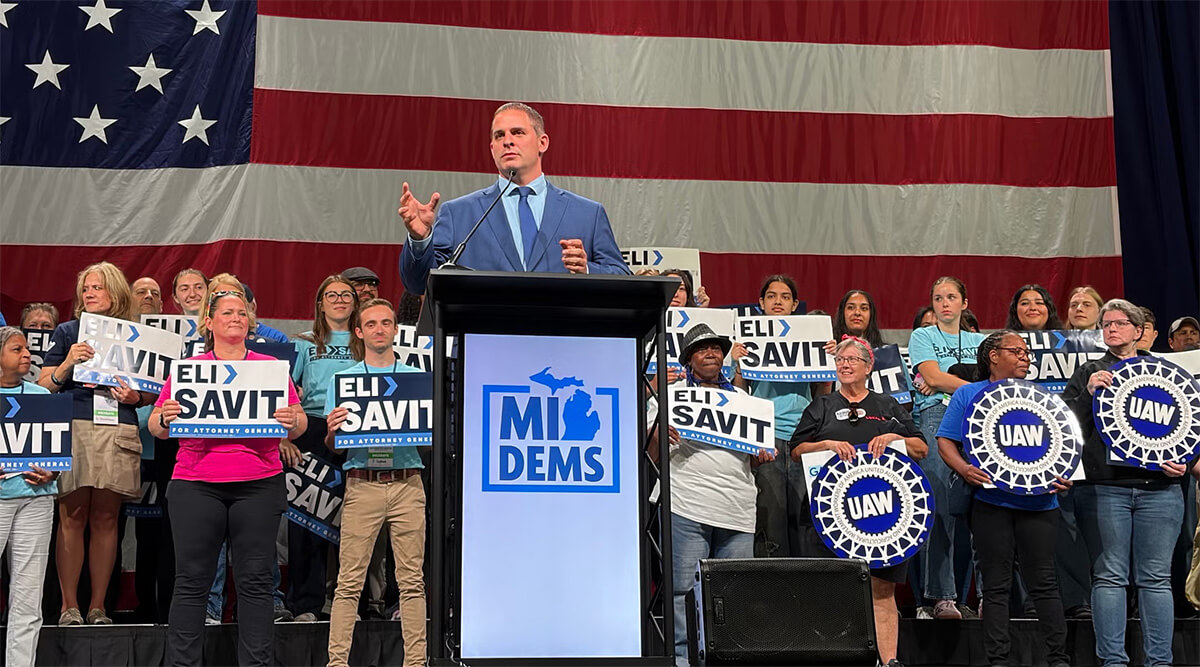
In one example, Washtenaw County Prosecutor Eli Savit, the party’s progressive Jewish nominee for state attorney general, addressed the Jewish caucus by declaring, “We’re going to win and keep the attorney general’s office in the hands of a Michigan Jewish Democrat.” Conspicuously absent from the day’s events was Nessel, the Jewish Democrat currently holding the seat.
Prior to the Saturday convention, Nessel, the state’s highest ranking Jewish official, had announced she would not be attending for fear she would be targeted by antisemitic harassment. Earlier this week, in a podcast interview with The Atlantic, Nessel had reiterated her issues with El-Sayed’s comments about Temple Israel and expressed hope he would walk them back soon.
Nessel’s son Zach Nessel, secretary of the state Jewish Democratic caucus, told the caucus that his mother’s absence stemmed from “agitators” who had targeted her at the party endorsement convention in the spring. Attendance at Saturday’s event was less than one-third of what the Jewish caucus had drawn at the spring convention, organizers said.
Zach Nessel criticized the state Democratic Party for failing to take prompt action to remove the agitators from the earlier convention. He told JTA that Jews in the party “have a right to be concerned.”
“I think the Democratic Party needs to put more work into addressing their concerns,” Zach Nessel said. “But I think that can’t happen without showing up.”
Moss, the Michigan state senator who has recently been at the center of another El-Sayed-related controversy, was spotted at the convention on Saturday but did not attend the Jewish caucus events.
One ally of El-Sayed’s who also addressed the caucus is University of Michigan Board of Regents nominee Amir Makled. He is an attorney for members of the school’s pro-Palestinian encampment movement who had pushed out a Jewish pro-Israel incumbent at the previous convention. During his own address to Jewish delegates, Makled did not mention his history of social media posts including retweeting far-right antisemitic conspiracy theorist Candace Owens and sharing praise for Hezbollah leaders.
Makled’s speech later that day at the nominating convention alluded to his work with the encampments as he declared that Michigan “will never have a university where students are punished simply because their speech makes the powerful uncomfortable.”
In-between candidate meet-and-greets, Jewish caucus members shared their anxieties about their closely scrutinized role in the midterm elections. They were gravely concerned about protecting democracy and election security from Republican threats, and felt that flipping the Senate was crucial.
Yet it was hard, they said, to get much of the Jewish community onboard this time, given the positions of El-Sayed and some other members of the Democratic slate. Michigan is home to an estimated 100,000 Jews, and the senate race is currently polling in a dead heat, making their votes potentially pivotal.
“How do we unify our community to put the country first?” one attendee asked the group. “I have a hard time doing that.”
This article originally appeared on JTA.org.
The post ‘I made a mistake’: Abdul El-Sayed apologizes to Michigan Jews for past comments about synagogue attack appeared first on The Forward.
