


Uncategorized
This Jewish family is betting the farm on Thanksgiving turkeys like bubbe cooked

NARVON, PA – A thick, rolling gobble fills the barn in Lancaster County, Pennsylvania as several hundred turkeys stand shoulder to shoulder, shifting in waves like a loud, feathered mob.
They don’t know it, but they’re part of a gamble — one that could reshape the kosher poultry business in America. The question is: Will enough people want a Thanksgiving turkey, at a price between $140 and $400, that tastes like bubbe’s did?
Supermarket poultry has become a fixture of the Jewish kitchen — easy to find, easy to cook, easy to forget. As organic and ethically raised meats gain traction across the country, many kosher families are still left with factory-farmed options that claim tradition but taste like compromise.
This flock belongs to Chosen Farms, a kosher heritage poultry startup run by Yadidya and Miriam Greenberg, a husband-and-wife team who split their work between two states: turkeys here in Lancaster County with help from an Amish farmer, and chickens on 30 acres in Pemberton, New Jersey.
Once the turkeys reach market weight, they begin a Thanksgiving relay — first to a kosher processor in upstate New York, then to Pemberton to be frozen and packed. Labels come off the printer like boarding passes, rattling out destinations: California. Colorado. Florida. Nevada. New York. Orders pile up like suitcases in an airport the day before the holiday.
These are heritage birds — the kind that existed before industrial farming redesigned poultry around speed and uniformity. They come from older bloodlines that could walk, flap their wings and develop muscle over time. Today’s supermarket birds are bred to grow fat fast, their skin stretched thin over rapidly expanding bodies. They arrive like something delivered by algorithm. Heritage birds arrive with history.

The turkeys live twice as long as their grocery store counterparts. They keep the genetics, and much of the flavor, of the past. If you want your chicken soup to taste like your bubbe’s version, you start with one of these.
As a teenager, Miriam volunteered on farms in Maryland and later trained as a classical chef in New York. She speaks about modern poultry with the bluntness of someone who has tasted too much of it. “They neutered all the flavors. It just tastes like mush,” she said.
Heritage birds, she insists, give you something more flavorful. “It’s like tasting butter after a lifetime of margarine.”
Heritage breeds and Hanukkah goose
Miriam isn’t the only one making the case for flavor. Gidon van Emden, CEO of Kol Foods, which specializes in kosher grass-fed beef, lamb and pasture-raised chicken, has seen growing curiosity about heritage breeds in the kosher market. Consumers tell him the difference is noticeable immediately.
Van Emden believes the kosher market is hungry — not just for cleaner food, but for food that feels intentional. “If you mistreat the animal — bad feed, bad genetics — it’ll taste more watery,” he said.
He and Yadidya go back years. Greenberg taught him how to be a shochet, a butcher. Now, Kol Foods and Chosen Farms are among the few companies trying to expand what kosher poultry can be.
Yadidya bought the Pemberton property in 2022, and soon after married Miriam. The pasture is in the same swath of South Jersey where Holocaust survivors resettled and rebuilt their lives running chicken farms.
These day, in the kitchen, Yadidya boxes frozen turkeys — lining cardboard with insulated wrap, dropping in ice packs and sealing each shipment with a strip of tape. Their sukkah from last month’s holiday still stands in the yard, a reminder that the Jewish calendar doesn’t always make room for farm schedules. Their two-year-old brown herding dog, Peanut Butter, zigzagged between the chickens, nipping at their heels.

Chosen Farms sold its first batch of kosher heritage turkeys last year. It was a modest 20 birds. This year, they tripled that to 60. There’s no marketing budget, no social media campaign. Orders came in online by word of mouth, passed between butchers, rabbis, chefs and families looking for something better than the standard frozen brick with a pop-up timer.
Not all of their orders are for November. Yadidya pried open a freezer and revealed rows of heritage geese. The traditional Ashkenazi “Hanukkah goose” was once a staple dish in Eastern Europe, especially for Jews who couldn’t afford beef. Its rendered fat, known as schmaltz, became the secret weapon for frying latkes.
“We’re one of the only places in the country raising and selling kosher geese,” Yadidya said. Goose requires specialized equipment to pluck, and at $30 a pound, it’s not exactly an impulse buy. But Greenberg said demand returns every winter, a culinary echo of an older Jewish kitchen.
Farm life, Jewish life
Living on a farm doesn’t mean leaving Jewish life behind. The Greenbergs chose Pemberton precisely because it keeps them connected. They’re 30 minutes from Cherry Hill and Lakewood, both home to large Orthodox communities and kosher restaurants. There’s a mikvah nearby, and a daily minyan within a 20-minute drive. “There are farmers who move two hours away from Jewish life and then struggle,” he said. “I didn’t want that life. We paid more to be close.”
Friends drive in to spend Shabbat with them. In the summer, Jewish camping groups pitch tents by the trees. “We’re far enough to have space,” Yadidya said, “but close enough to still feel part of something.”
Chosen Farms isn’t an anomaly. It’s part of a small but growing movement of Jews choosing to make their living in agriculture. The Jewish Farmers Network, which began in 2017, now counts 1,800 farmers across 46 states. Some run educational farms for school trips, but others simply farm. No workshops. No signage. Just soil, livestock and spreadsheets.
“When Jewish people enter agriculture, it often feels like they’re departing from Judaism,” said Shani Mink, the group’s co-founder and executive director. “But we try to show that it can actually be a deeper encounter with it — because at its core, Judaism is agrarian.”
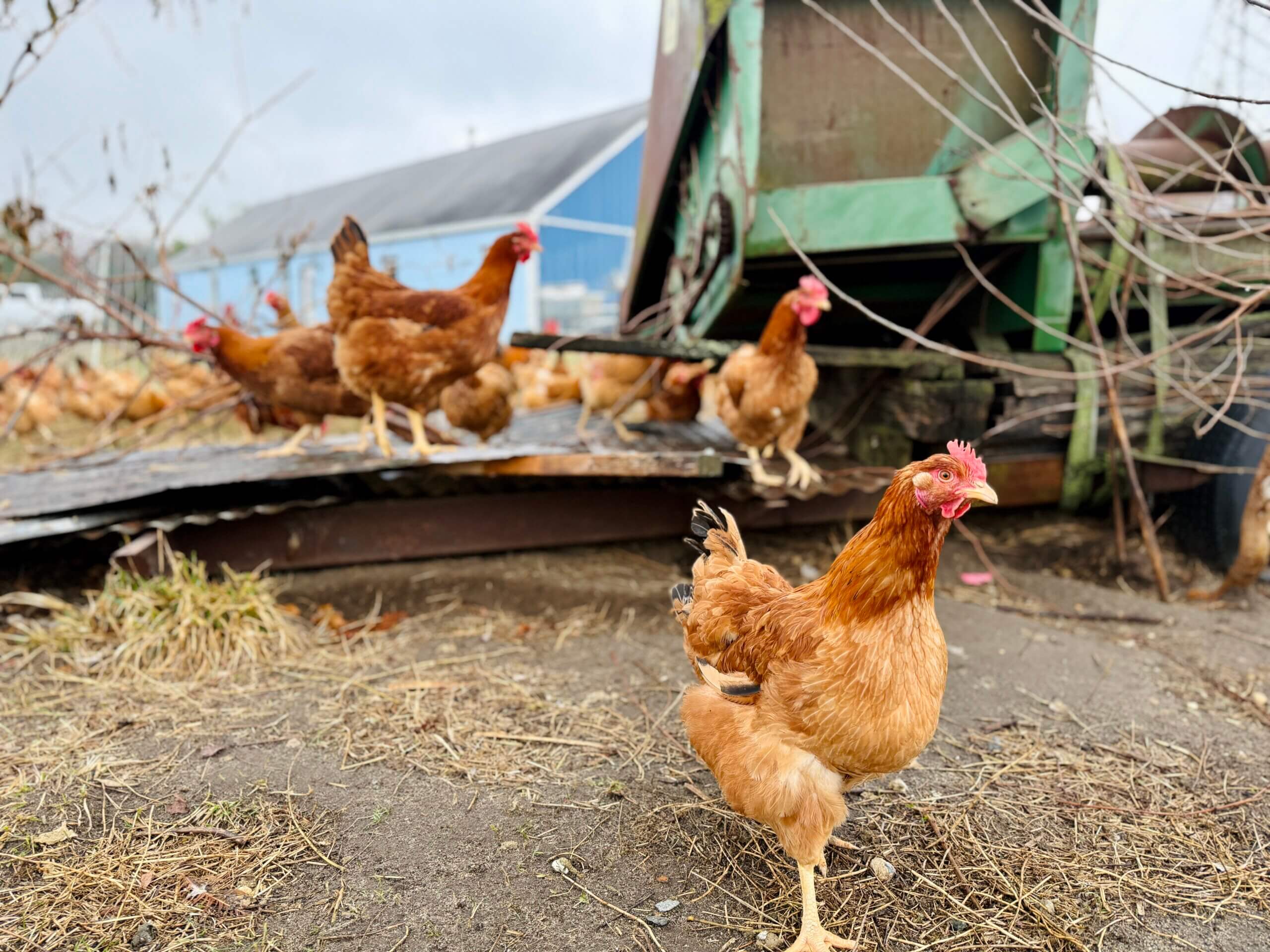
The Greenbergs’ farm still feels young — part vision, part construction site. They’re hoping to add heritage ducks next year, starting with the Silver Appleyard breed, which currently has no kosher supplier. A small curbside farm stand is in the works, where they could sell eggs, meat and Miriam’s sourdough bread.
The Greenbergs, as is their tradition, are hosting Thanksgiving on the farm with visiting family and friends. The turkeys will be their own, of course. Peanut Butter will make his rounds.
In a few days, ovens will preheat. Football games will hum in the background. Parade balloons will float past Macy’s like oversized guests. And somewhere between the gobbling and the grace after meals, one Jewish farm will find out whether a taste from the past still belongs to the future.
The post This Jewish family is betting the farm on Thanksgiving turkeys like bubbe cooked appeared first on The Forward.
Uncategorized
After New York stabbing, Netanyahu says Mamdani is making Jews less safe
Israeli Prime Minister Benjamin Netanyahu accused New York City Mayor Zohran Mamdani of “fomenting” hate and making Jews less safe through his fierce criticism of Israel. Netanyahu suggested the mayor’s rhetoric on the Gaza war contributed to the climate that led to Thursday’s stabbing of an Orthodox man outside a Manhattan synagogue.
“I don’t think it’s accidental that after he made this hate speech against Israel and against me, the next day a Jew is stabbed coming out of a synagogue,” Netanyahu said Sunday morning on Fox News.
Authorities said the suspect, Jose Morales, 51, allegedly yelled “Allahu Akbar” as he stabbed an Asian man in the back with a knife and an Orthodox man in the torso with a screwdriver before being subdued and arrested. Morales was arraigned Friday on several hate crime charges and was held without bail. Both victims were hospitalized and are expected to recover.
Investigators have not publicly linked the suspect’s motives to the mayor’s comments in a video address last week conceding he did not have the authority to arrest Netanyahu when he visits the city for the United Nations General Assembly in September, while also calling Netanyahu a war criminal and accusing him of orchestrating a genocide. Mamdani encouraged New Yorkers to protest instead.
The controversy has also been fueled by reports that members of Mamdani’s inner circle believed long before the legal review was completed that the city lacked the authority to arrest Netanyahu. Despite that, Mamdani proceeded with the review and used a mayoral address to announce the legal conclusion while renewing his criticism of the war in Gaza. Critics say the episode was a calculated political move aimed at energizing the pro-Palestinian and progressive base that helped elect him. The speech drew more than 200 million views across social media.
Speaking outside the Manhattan synagogue on Friday, Jewish leaders and some prominent rabbis expressed concern that the comments risked endangering Jewish New Yorkers, the largest concentration of Jews in the United States.
Netanyahu escalated his feud with Mamdani by directly linking the mayor’s embrace of the International Criminal Court’s case against him to the rise in antisemitism. “I speak to Jewish Americans in New York, and they’re afraid right now,” Netanyahu said. “I speak to quite a lot of my friends, and they say, ‘Look, it’s like a different world. We’re afraid to go into the streets. We certainly do not want to wear yarmulkes or any clothing that would give away that we’re Jews.’”
The Israeli leader further accused Mamdani of “basically supporting” Hamas, despite the mayor describing the Oct. 7, 2023, attack on Israel as a “horrific war crime” that should be opposed “with every single fiber of our being.” Asked on Thursday whether he considers the Hamas massacre a genocide, Mamdani stopped short of using that term.
“The genocide charge belongs to our enemies,” Netanyahu said in the Sunday interview. “What we are doing is try to fight this genocidal terrorist organization that embeds itself among civilians.”
Netanyahu (6 minutes ⬇️) accuses Mamdani of fueling antisemitism by embracing ICC case:
“He’s fomenting hate… I speak to Jewish Americans in New York, and they’re afraid right now. And I don’t think it’s accidental that after he made this hate speech against Israel and against… pic.twitter.com/qjb5uj4xNM
— Jacob N. Kornbluh (@jacobkornbluh) July 26, 2026
The latest clash shows how the war in Gaza has become one of the biggest political issues of Mamdani’s administration. His outspoken criticism of Israel has won support from progressives but has also deepened tensions with many Jewish leaders, who say his rhetoric has made an already difficult climate even worse. In an interview on Thursday, Mamdani suggested that New Yorkers “have been aghast at this genocide over the last few years, and not only the continued denial of that genocide but also the fact that it continues itself.”
A recent Associated Press survey conducted before Mamdani’s recent comments found that Mamdani, who won just 26% of the Jewish vote in last year’s mayoral election, is viewed more favorably by American Jews than Netanyahu, who is facing a tough reelection in October.
Netanyahu is expected to visit Washington, D.C., on Monday for a meeting with President Donald Trump and attend the funeral of Sen. Lindsey Graham, a close political ally.
Despite acknowledging he cannot arrest Netanyahu, Mamdani has vowed to continue speaking out against the Israeli leader ahead of his expected appearance at the United Nations this fall. Netanyahu said Sunday that he still intends to travel to New York “to speak the truth” and defend Israel before the international body.
The post After New York stabbing, Netanyahu says Mamdani is making Jews less safe appeared first on The Forward.
Uncategorized
Israel’s shameful West Bank front
Two mosques burned in the West Bank on Sunday.
One, in the village of Qusra south of Nablus, was torched and defaced with graffiti reading “Revenge for Benayahu,” referring to Benayahu Mellet, who was killed in the deadly clashes near the village of Tel two days earlier. Another mosque, in the village of Kur, was also set ablaze. Cars were burned. Fields were set on fire. Elsewhere, according to witnesses, extremist settlers blocked a major road, attacked Palestinian motorists, and allegedly did so in full view of Israeli security forces. No arrests were reported.
In the incident on Friday, villagers had confronted armed settlers who had entered the village in a provocation, triggering a gun battle that left two Israelis and four Palestinians dead. The clash was the latest in an escalating wave of settler-Palestinian violence that has killed dozens of Palestinians and wounded hundreds this year, according to the United Nations and the Palestinian Authority — and not denied by Israel.
The images should horrify every Israeli and Jew. Not because they will generate another round of hostile headlines abroad, though they certainly will. Not because Hamas or Iran will exploit them for propaganda, though they will. They should horrify Israelis because they reveal a sickness that has been growing inside the Jewish state for years — one that the Netanyahu government has failed to confront, and some would say abetted.
For all the disasters that have befallen Israel in recent years, few have been as shameful as the tolerance of violent Jewish extremism in the West Bank. This is no longer a matter of isolated “price tag” attacks or a handful of hooligans. It has become a persistent phenomenon that includes the burning of places of worship, attacks on civilians, destruction of homes and farmland, vigilante raids into Palestinian villages, and organized acts of intimidation designed to terrorize entire communities. Sometimes it results in deaths, almost always in material damage, and without exception in reputational damage. Whatever political cause its perpetrators imagine they are serving, they are inflicting immense damage on Israel itself.
Two arrests were reported by Israeli police for the latest widespread mayhem – far from a crackdown; if past is prologue, those detained will soon be released. There have been no known convictions for the murder of Palestinians by radical settlers; a security apparatus that knew the exact location of Iranian leaders could not, apparently, find the perpetrators.
This is a moral failure and a national security disaster. At the very moment Israel is preparing for the possibility of renewed confrontation with Iran, remains engaged against Hamas, and continues to try to deter Hezbollah, it is simultaneously forced to contend with Jewish extremists opening yet another front. Every burned mosque, every unauthorized raid into a Palestinian village, every revenge attack requires soldiers, commanders, intelligence assets, and police resources. Every incident inflames the West Bank precisely when Israel can least afford another arena of instability.
The latest violence illustrates the pattern. And every burned mosque and vigilante actions helps Hamas and strengthens Iranian propaganda. Every assault on innocent Palestinians makes Israel’s diplomatic task immeasurably harder. Israel’s enemies could scarcely invent a more effective narrative than the one Jewish extremists hand them themselves.
Israel’s security establishment understands this better than anyone.
Reserve Major General Gadi Shamni, who commanded the IDF’s Central Command and served as the army’s top officer in the West Bank, warned on Israel Radio that the military has too often looked the other way while influential members of the government have effectively encouraged the radical fringe.
Shamni also described what he sees as the strategic vision animating the most extreme elements of the settler movement: gradually forcing Palestinians into disconnected islands of “Area A” autonomous zones while emptying much of the rest of the West Bank in preparation for eventual annexation.
If that assessment is correct, it represents one of the most cynical political projects imaginable.
Apart from its profound moral implications, it would guarantee perpetual conflict. It would invite international isolation, deepen Israel’s demographic and diplomatic dilemmas, and condemn another generation of Israelis to policing an endless insurgency. It is a blueprint for permanent instability.
Defenders of the government cry foul when settlers are criticized, claiming that the vast majority of them reject violence and are not responsible for the crimes committed by a handful of extremists. This is a misleading presentation.
Sure, most of the half million “settlers” are living in communities close to the pre-1967 border which Israel expects to receive in border swaps as part of any future two-state deal. But the 20% or so living well beyond the “security fence” line, deep inside the West Bank, are another matter.
Many of them are deeply committed ideologues who, in the best-case scenario, envision a future of permanent subjugation of the Palestinians. Moreover, those who dream of the Palestinians leaving altogether, one way or another, are not a handful, as I know very well from countless off-the-record conversations. And the radicals who commit actual crimes are quietly backed by a massive infrastructure that is run by radical Cabinet ministers with real political power. So the violent fringe has acquired influence wildly disproportionate to its numbers — and is serving a vile cause with real support.
That influence is visible not only in the attacks themselves but also in the willingness of prominent politicians to minimize them, excuse them, or rally publicly behind individuals accused of serious violence against Palestinians. Such gestures send a devastating message: that political loyalty may matter more than the rule of law.
It is a tragic indication of the foresight of the late Israeli philosopher Yishayahu Leibowitz, who warned over a half century ago that the occupation will eat away at Israel’s decency and democratic character.
The ideological ancestry of much of this movement leads back to Rabbi Meir Kahane, whose Kach movement was eventually banned from the Knesset because of its openly racist platform. Even former Prime Minister Yitzhak Shamir — a career Likud politician, former underground fighter, and hardly a man of the political left — refused to remain in the Knesset chamber while Kahane spoke.
How far Israel has fallen that ideas once considered beyond the pale increasingly receive sympathy, protection or political indulgence.
The irony is, of course, that those who proclaim themselves the fiercest defenders of Israel are among those inflicting some of its deepest wounds. They weaken Israel’s international standing, strengthen its enemies, undermine society’s resolve, force young Israeli soldiers into impossible situations and stain Judaism itself.
The burned mosques of Qusra and Kur are another indication of what is at stake in the Oct. 27 election. If the opposition comes to power, this will not be tolerated any more.
The post Israel’s shameful West Bank front appeared first on The Forward.
Uncategorized
Troy Jackson wins Maine Democratic Senate nomination, keeps mum on Israel, AIPAC
(JTA) — BANGOR, Maine – Troy Jackson accepted the Democratic nomination for Maine’s U.S. Senate race on Saturday with no mention of Israel, sidestepping an issue that has become a focal point for many Maine Jews as they assess the party’s new standard-bearer.
Jackson secured the nomination in a landslide 566 to 5 vote by delegates at the nominating convention. Saundra Pelletier, the only remaining challenger after the rest of the field dropped out in the days leading up to the gathering, picked up the handful of votes that didn’t go to the winner.
While Jackson took several shots during his acceptance address at Sen. Susan Collins, the incumbent Republican he will now face in the general election, it was Pelletier who used her remarks to specifically malign Collins’ voting record on Israel.
“She voted to increase federal funding in defensive arms for Iran, and did not vote to take moderate measures to hold Netanyahu accountable,” Pelletier said, receiving a chorus from the crowd.
The victory for Jackson came after the state’s former Democratic nominee, Graham Platner, a staunch Israel critic, left the race earlier this month amid a sexual assault allegation, which he has denied. The resulting scramble to replace him upended the Democratic primary and prompted fresh scrutiny from Jewish Mainers of Jackson’s recent evolution on Israel.
Jackson, a former state lawmaker and union advocate, had previously said little publicly about the Israeli-Palestinian conflict during his two-decade career in state legislature. However, during the race to replace Platner, he has embraced the term “genocide” to describe Israel’s war in Gaza and called for an end to U.S. military aid to Israel on his campaign website, both positions championed by Platner before his exit. Jackson also has said he wouldn’t accept any funding from AIPAC.
But on Saturday, as a sea of supporters sporting his campaign’s blue and yellow “Troy Jackson” t-shirts cheered their new nominee, Jackson omitted any mention of Israel from his remarks. Instead, Jackson reaffirmed his commitments to passing Medicare for all, supporting union rights and restoring abortion rights nationwide, among other issues.
During his address following the decisive victory, Jackson also offered a message to Maine voters who remain on the fence:
“Whether you supported me from the beginning, supported another candidate, or are still deciding what you think of this fifth-generation logger from Allagash,” Jackson said. “I’ve always known this, that your trust has to be earned, and so I want you to hear this directly from me. There is a place in this campaign for all of you. There is work for you in this movement, and I will spend every day, now through November, earning that trust because today we turn the page.”
Amy Fried, a professor emerita of political science at the University of Maine who attended Saturday’s conference as an alternate delegate but did not cast a ballot, said that while she believed Jackson had addressed Israel in the lead-up to Saturday because “a lot of people are interested in the topic,” his speech reflected the issues he had been “concerned about his whole political career.”
“Obviously, he’d have to take votes on foreign policy and funding when he’s in the Senate,” Fried said. “But I think that his main interest is always in issues that have to do with housing and healthcare, you know, all of the matters that are sort of more day-to-day kitchen table issues.”
While Jackson avoided revisiting his recent stances on Israel, which have raised concern among some Jewish voters in Maine, about a dozen pro-Palestinian protesters rallied outside the convention hall in support of his candidacy.
“It’s a really positive step that you have nominated Troy Jackson,” one protester shouted through a megaphone. “I think he’s going to be a strong voice for the kind of values that I believe in and the people of Palestine, the children of Iran, and all the other places the U.S. bombed.”
Ronna Lugosch, a 71-year-old Jewish grandmother and delegate from Round Pond, Maine, said that she was “more excited now than I was before” about Jackson’s candidacy.
Lugosch, who supports Jackson’s stances on Israel, said she hadn’t noticed he had left the topic out of his remarks. “Unfortunately, it’s a sensitive topic, so that’s my guess that maybe he didn’t bring that up because it was just too much,” Lugosch said. “You know, he was being careful.”
Still, Lugosch said that she was “really impressed with all his comments about working people and organizing.”
“I’m going to campaign for him because we need to get rid of Susan Collins,” Lugosch said. “Before it was more of a sort of a defensive stance, but now I’m supportive, and so I feel better about going out into the community.”
This article originally appeared on JTA.org.
The post Troy Jackson wins Maine Democratic Senate nomination, keeps mum on Israel, AIPAC appeared first on The Forward.
