



Uncategorized
Tucker Carlson’s Latest Attack on Jews Is His Worst Yet

Tucker Carlson speaks on July 18, 2024, during the final day of the Republican National Convention at the Fiserv Forum in Milwaukee, Wisconsin. Photo: Jasper Colt-USA TODAY via Reuters Connect
Tucker Carlson has said some ugly things over the years, but even by his standards, last week was a new low.
In a monologue framed as a warning — because demagogues often pretend they’re just “warning” — Carlson delivered one of the most explicit and chilling mainstream threats toward American Jews in decades.
Speaking about people like Ben Shapiro and Mark Levin, Tucker said:
Give us the money for our preferred little country, or else we’re going to denounce you … Man, those attitudes are incompatible with leadership and in fact with democracy itself. You can’t have a country of 350 million people governed by boutique goals concerns … It doesn’t work. It’s illegitimate. If you keep it up, you’re flirting with real backlash. Like a real one … Not Nick Fuentes. Like a real one. So cool it. Don’t treat people like cattle.”
“Preferred little country.”
“Boutique goals.”
“Backlash.”
“Cool it.”
This was not analysis.
This was menace.
And it came wrapped in projection so brazen it would be funny — if the history behind it weren’t so deadly.
Because while Carlson accuses American Jews of disloyalty, coercion, and anti-democratic behavior, he has spent years whitewashing, rationalizing, or outright promoting the most openly anti-American movements operating on US soil: the anti-Israel campus mobs, the “resistance” celebrations of Hamas and Hezbollah, and the organizations openly seeking the dismantling of the American “empire” itself.
Carlson has nothing to say about movements that literally burn American flags
Let’s start with what Carlson ignores — because the silence is the tell.
Over the past two-plus years, anti-Israel protesters across the country have:
- burned American flags on college campuses and in major US cities,
- praised terrorists who murdered American citizens on Oct. 7,
- chanted “Death to America,” “Glory to our martyrs,” and “Resistance is justified from Gaza to New York,”
- waved Hezbollah, Hamas, IRGC, and even Houthi flags,
- shut down airports, highways, and Federal buildings,
- declared their goal is to “dismantle the US settler colony” (SJP),
- and demanded that America “collapse so a new world can be born.”
Not once — not even once — has Tucker Carlson accused any of these groups of “dual loyalty,” “treason,” “boutique goals,” or “corrupting democracy.”
Not once has he warned them of a coming “backlash.”
Not once has he urged them to “cool it.”
It turns out his concern for “American democracy” applies only to one group: Jews who support America’s democratic ally, Israel.
Meanwhile, the pro-Israel demonstrators Carlson smears wave American flags
Attend any pro-Israel rally in America and you’ll see a sea of US flags.
Mainstream Jewish Americans — whom Carlson now accuses of “treating other Americans like cattle” — regularly:
- thank US soldiers,
- praise America’s democratic traditions,
- and celebrate the shared values between the US and Israel.
The people Carlson calls “disloyal” attend rallies that look like Fourth of July parades.
The people he ignores are waving terror flags and chanting for America’s destruction.
Is this “America First”?
Of course not.
It is not patriotism driving Carlson.
It is obsession.
And obsession of this type always has a name.
What Carlson calls “boutique interests” are simply American Jews participating in American democracy
Carlson’s rant targeting Jewish media figures like Shapiro and Levin — two men whose “crime” is advocating policies Tucker himself embraced until he discovered the profitability of being the chief podcaster of the woke-right — is as familiar as it is poisonous:
- Jews advocating for a strong US–Israel alliance = anti-democratic “boutique interests.”
- Jews engaging in politics = “corrupting democracy.”
- Jews influencing policy (like everyone else) = “flirting with backlash.”
This is indistinguishable from Charles Lindbergh’s 1941 warning that Jews were steering America toward disaster and would deserve the “backlash” that followed.
The “America First” movement Carlson imagines has always carried this rot.
He’s just comfortable saying it out loud.
Carlson accuses Jews of:
- political coercion,
- ideological dominance,
- and treating opponents like “cattle.”
But his movement features:
- Nick Fuentes, the neo-Nazi Carlson now rehabilitates as a kind of misunderstood populist, who openly calls for stripping Jews of civil rights.
- Marjorie Taylor Greene, whose Christian nationalism rejects pluralistic democracy.
- Pedro Gonzalez, a figure Carlson helped mainstream, was caught pushing overt antisemitic tropes about Jewish “control,” the very rhetoric his movement now feeds on.
- Influencers in Carlson’s orbit who praise Putin, the IRGC, and the Houthis — America’s enemies.
This is the camp lecturing American Jews about “loyalty”?
Carlson’s rant wasn’t just hypocritical.
It was textbook projection.
And then there’s his selective outrage about “foreign influence”
Carlson says American Jews undermine America because they support Israel — America’s only reliable democratic ally in the Middle East.
But here’s what he never mentions:
- Anti-Israel campus groups receive support from networks tied to Qatar and the Muslim Brotherhood.
- Iran’s propaganda arms amplify the same talking points as the woke-right.
- Anti-Israel leaders openly praise the IRGC and Hezbollah.
- Many anti-Israel protesters literally call for America’s collapse.
Yet the only “foreign subversion” he sees … is Jews?
He sees “treason” in pro-Israel Americans.
He sees “populism” in pro-Iran activists.
Carlson himself went to Moscow to interview Vladimir Putin and give him a puff piece — and then offered the same courtesy to Iran’s “death to America” president.
Again: the silence is the tell.
Why Carlson targets Jews and not America’s real enemies
Because his movement needs a villain — one the far-right and far-left can share. And that villain — once again, as always — is the Jew.
There is no principle behind Carlson’s position. Only narrative:
- When Jews oppose Hamas → they are warmongers.
- When Jews support a strong America and strong US–Israel alliance → they are disloyal.
- When Jews engage politically → they corrupt democracy.
- When Jews defend themselves → they threaten national stability.
It’s the longest-running script in history.
Carlson just updated it for 2025 and put it on primetime.
At a time when genuine anti-American extremism is flourishing — in campus encampments, online propaganda networks, and foreign-backed organizations — Tucker Carlson has chosen to threaten the Americans waving US flags.
He has chosen to smear: Americans committed to democratic values.
He has chosen to accuse of treason: Americans whose “foreign cause” is a US ally under attack by terrorists who also kill Americans. Perhaps Tucker has forgotten how Iran’s proxies have killed literally hundreds of American service members — as they are enemies of both Israel and America.
And he has chosen to threaten a “real backlash” against: the one minority that history shows gets blamed whenever demagogues need a villain.
This is not patriotism.
It is not conservatism.
It is not “America First.”
It is the oldest hatred wearing a new mask.
And the mask isn’t slipping.
It’s off.
Micha Danzig is an attorney, former IDF soldier, and former NYPD officer. He writes widely on Israel, antisemitism, and Jewish history and serves on the board of Herut North America.
Uncategorized
This David Schwimmer sweater ad is playing on ‘Friends’ nostalgia. So why are commenters talking about Israel?
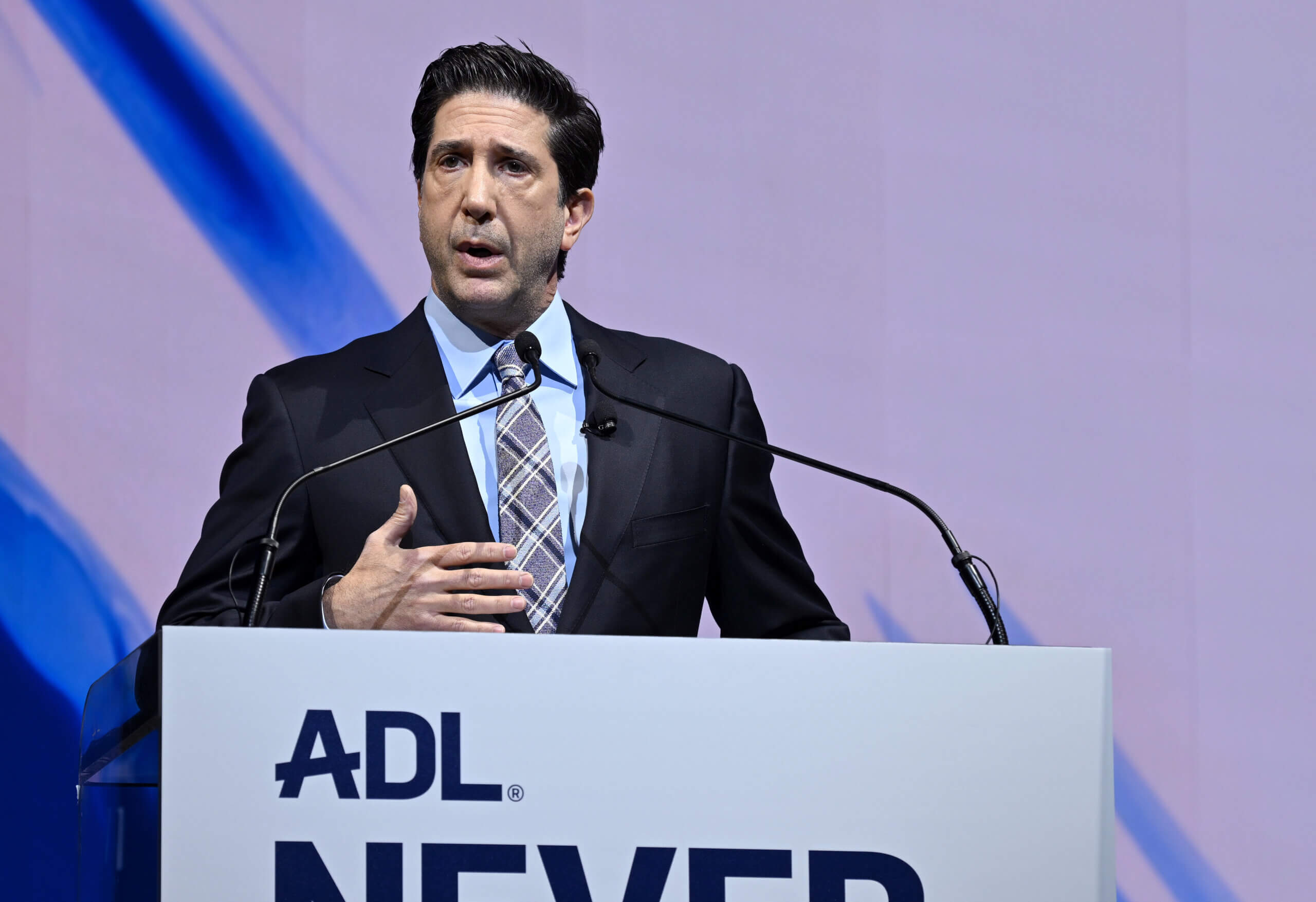
David Schwimmer, who played Ross on Friends, is tapping into some late ’90s and early 2000s nostalgia as the star in an ad this week marketing his “dream sweater” for Quince, a clothing and home goods store.
In the ad, Schwimmer, who is Jewish, sketches the perfect red sweater in a notebook while he sits in Central Park and then begins to see it on everyone: a man riding an electric scooter, an angry taxi driver who almost runs into him, a beautiful woman riding in the back of the taxi, even a dog.
The gag is a reference to the Friends episode “The One with the Red Sweater,” where Ross’ on-again-off-again girlfriend Rachel is pregnant and has not told the father, whose identity is a mystery to the group; Joey, Monica and Phoebe know that the father left a red sweater at the apartment, so when Ross stops by and is relieved to find his sweater, they figure out he’s the dad-to-be.
“I’ve been looking for this for like a month,” he says, just after making a reference to the Yiddish-named snack, Mashuga Nuts.
The episode and the ad are apolitical. So why then are some people planning to cancel their Quince orders and boycott the company?
Schwimmer, many of the commenters on the ad are saying, is a Zionist.
“I don’t approve of you featuring a Zio in your ad,” one Instagram user commented. “Please do better.”
Schwimmer on Israel, antisemitism
Schwimmer has been outspoken about antisemitism since long before the Oct. 7 Hamas attacks on Israel and the ensuing war in Gaza. Over the course of his career, he’s spoken at multiple Anti-Defamation League events and called for other people to stand against hate, routinely saying, “Silence is complicity.”
The actor appears to have never explicitly identified as a Zionist, and his statements have focused more on galvanizing support for Jews and Israelis — rather than on the Jewish state. But this is of little importance to his critics.

His relationship with the ADL, a staunchly pro-Israel organization, is damning enough for some. Schwimmer also starred in an Israeli commercial for Meitav, an investment management company. The move puts him at odds with the growing Boycott, Divestment and Sanctions campaign, which stands against any financial relationship with Israel or Israeli companies.
After Oct. 7, Schwimmer put out a statement calling the Hamas attack an “atrocity” and a “genocide,” adding that any attempt to justify what happened is “indefensible and antisemitic.” In the same statement, he also touched on Palestinian suffering:
“One can condemn Hamas and still object to the Israeli government’s policies regarding the occupation (as many Israelis do), still believe in the Palestinian people’s right to self-determination, and still mourn the loss of Palestinian civilians and the current destruction of their homes, schools, hospitals and places of worship.”
He’s also been vocal about sexual violence that occurred on Oct. 7, sharing the controversial New York Times piece headlined “Screams Without Words,” that investigated allegations of sexual assault committed by Hamas during the attack. Critics of the piece have questioned the validity of the reporting and argued that one of its reporters is biased toward Israel. The Times has stood by the piece.
Additionally, Schwimmer has criticized universities’ responses to pro-Palestinian protests on campuses that he said have veered into antisemitism.
Schwimmer spoke at a 2025 ADL summit about the backlash he’s gotten for his advocacy, noting that while he’s been “attacked” and “abandoned,” he’s found deep meaning in speaking out and has no plans to stop. He concluded his speech calling on fellow celebrities to do the same.
“You don’t have to say anything political,” Schwimmer said. “No one is asking you to solve the conflict in the Middle East. Just say that you stand with your Jewish friends, colleagues and neighbors against hatred and discrimination.”
The controversy isn’t bothering Quince.
“We’ve seen more than 8 million views across our social channels in the first 48 hours, alongside international press coverage and recognition from the marketing community for the creative,” said Dakota Isaacs, head of brand strategy and narrative, in an email to the Forward. “It’s been especially rewarding to see fans connect with the humor and nostalgia while discovering Quince.”
The post This David Schwimmer sweater ad is playing on ‘Friends’ nostalgia. So why are commenters talking about Israel? appeared first on The Forward.
Uncategorized
Why I urged my parents to avoid the counterprotest in Philadelphia
Parents usually tell their children whether they can go out, but last week, on a phone call with my parents, our roles reversed, and I urged them not to join a Philadelphia food crawl with their friends. The event was organized in response to a bicycle rally calling for the boycott of six restaurants, all Jewish-owned, to “show these zionist business owners that we see them for the disgusting humans they are.”
The counterprotest intended to show solidarity with these businesses by patronizing and protecting them on the day of the protest, given the hostile framing of the boycott against the restaurants and their Jewish owners. However, I was concerned that it would be co-opted by pro-Israel partisans, who not only would instrumentalize it for their own agenda — one which, in my view, is actively detrimental to the fight against antisemitism — but would also stoke chaos and violence. It’s a film that’s played out time and again, including when I was an undergraduate at UCLA: A call is put out that Jews are under attack, counterprotesters mobilize in response, and anger quickly morphs into belligerence, hostility, and violence.
Fortunately, it appears that no one was seriously hurt during Sunday’s bike rally and counterprotest. As I had feared, though, some demonstrators became aggressive as verbal confrontations and scuffles broke out across Rittenhouse Square. While it’s likely that some of the pro-Israel demonstrators were there for the sole purpose of displaying that they are not “Jews with trembling knees,” others ostensibly were there because, as the names of two of the organizations behind it would suggest, they want to StopAntisemitism and EndJewHatred.
If those were the goals, the demonstration was an unmitigated disaster. And much of the discourse surrounding the boycott laid the groundwork for failure.
To many Jews, it may seem self-evident that the boycott was illegitimate and antisemitic. For the protesters, though, there seems to be a genuine inability to understand how it could be. They also seem unable or unwilling to condemn antisemitism.
Anger at the protesters is understandable, but if the goal is to stop antisemitism and end Jew hatred, it is important to address the root of the problem, which starts with understanding why the protesters might have such a profound misunderstanding of antisemitism.
For several decades, following the Six-Day War of 1967 and the Cold War period, pro-Israelism has been a core, essential feature of hegemonic anti-antisemitism advocacy. Groups like the ADL have made the phenomenon of so-called “new antisemitism” – a term that explains hostility toward Israel by claiming that the nation is maligned out of bigotry, as the proverbial Jew among the nations – a central focus of their work, especially in times of increased Israeli-Palestinian conflict.
Though this is hardly “new,” the stakes and intensity of attacks against the “new antisemitism” have been raised in a post–Oct. 7, post–destruction of Gaza reality. In effect, this approach has been successful in as much as it has led to a public perception that the fight against antisemitism and the fight in defense of Israel are the same fight, and cannot be separated.
As a result, when anti-Zionist, pro-Palestinian activists are accused of antisemitism or expected to condemn it, they view it as purely cynical — an attempt to delegitimize their movement rather than a true objection to how they have treated or spoken about Jews. This very refusal to condemn antisemitism is often read as itself antisemitic by many Jews. This “acrimonious circle,” as philosopher Brian Klug described it 13 years ago, could go on forever.
As the acrimonious circle spins and spins, there are a few options that groups fighting antisemitism can consider:
- They can continue pushing pro-Palestinian activists to see both condemning antisemitism and supporting Israel as intertwined moral duties.
- They can insist on that interconnection, but tell pro-Palestinian activists to choose combatting antisemitism no matter what their beliefs about Israel are.
- They can accept that pro-Palestinian activists will rarely condemn antisemitism at their own initiative, and deploy tactics of intimidation, bullying, harassment, and/or violence against them.
- They can accept that pro-Palestinian activists will rarely condemn antisemitism at their own initiative, and present condemning antisemitism as a human-rights oriented stance, in line with standing up for all marginalized people, including Palestinians.
The first option is the one that organizations like the ADL have often chosen. In its statement about the bike rally and boycott, the group said that criticism of Israeli government policies are acceptable, but discrimination is not. Criticisms that the ADL considers ipso facto discriminatory, however, include claims that Israel has committed the crimes of genocide and apartheid. As a result, activists lend the ADL and groups like it no credibility and will dismiss any of their condemnations out of hand.
The third option is what the protest on Sunday became. Any Philadelphian can tell you that a brawl in the middle of Rittenhouse Square during an Eagles game is far from unusual. But the fighting in this instance broke out because of the boycott — one side driven by a fervor that they needed to defend Jews facing an existential threat from anti-Zionists, the other driven by a fervor that they needed to bring justice to a city ravaged by what protesters believe are business-owning war criminals.
The second option is a sensible demand from a moral perspective. However, it is not a strategic one. The hard truth is that for many, though certainly not all, pro-Palestinian activists, the cause comes before all else, including standing up against antisemitism.
Therefore, the only way forward for Jews is the fourth option: to frame the fight against antisemitism as a fight for the rights of all people. This is not a perfect solution — no solution could be. There will always be some unwilling to oppose antisemitism no matter what tactic is deployed. However, it will make plain that there is no contradiction between condemning antisemitism and supporting Palestinian rights, that in fact the task is to support human rights universally and to condemn all who violate these rights. That necessarily includes standing against Israeli war crimes and its regime of inequality, and that includes condemning those who hold Jews as Jews complicit for Israel’s actions and condemning those who harass, intimidate, and scrutinize Jewish business owners for their presumed political stances.
My parents, fortunately, decided to remove themselves from the chaos of this day and went to support the targeted businesses as regular patrons on other days throughout the week. I was pleased to see that our rabbi, who leads one of the largest synagogues in Center City, made a point of trying to de-escalate tensions and confrontations from within the Philadelphia Jewish community, as well as highlighting the strength and vibrancy of Philly’s Jewish life on its own terms.
These are important, positive things we can do in the short term. That said, if we want long-term change to come from the pro-Palestinian movement – and I think this moment requires it – anti-antisemitism groups that cannot meet the moment must step aside and make room for those that are capable and prepared to frame the fight against antisemitism as a fight for, not against, fairness, justice, and equality for all.
The post Why I urged my parents to avoid the counterprotest in Philadelphia appeared first on The Forward.
Uncategorized
Israel approves $31.5 million plan to strengthen Jewish education in North America
(JTA) — JERUSALEM – Israel’s government has approved a NIS 100 million ($31.5 million) plan, initiated by Prime Minister Benjamin Netanyahu, to strengthen Jewish education in North America, a statement from his office said Wednesday.
Based on a partnership and joint investment with North American Jewish communities, the goal of the plan is to strengthen Jewish identity and ties to Israel among the next generation of Diaspora Jews in the United States.
The approval of the plan, which was developed with representatives of the Jewish Federations of North America (JFNA), follows a government decision made in June.
It comes a day after Israel’s parliament, the Knesset, was sworn in and two weeks after a national election left Netanyahu facing a battle to stay in power as his rival, Gadi Eisenkot, received the mandate to form the next government.
It also comes amid signs of growing disaffection among Diaspora Jews, particularly younger generations, toward Israel and the Netanyahu-led government. Recent polls suggest that support for Israel among Diaspora Jews, especially in response to its policies in Gaza and on matters of democracy, is slipping.
A February survey of American Jews by the Jewish Federations of North America found that only one-third of American Jews aged 18-34 identify as Zionist, even as nearly nine in 10 say they support Israel’s right to exist as a Jewish and democratic state.
A separate Pew poll in May examining American views of Israel found that Jewish attitudes have shifted since 2024. The survey found that 83% of Jews view the Israeli people favorably, down from 89% in 2024, while 47% view the Israeli government favorably, compared with 54% in 2024.
“The plan we approved today, in partnership with Jewish communities in North America, is an investment in the future generation of Diaspora Jews. Together, we will strengthen Jewish identity, deepen the connection to Israel and ensure that our heritage and values are passed proudly from generation to generation,” Netanyahu said in the statement.
“The future of the Jewish people depends on our ability to ensure that future generations know their heritage, connect to their Jewish identity and maintain their deep ties to the State of Israel,” he said, adding that Israel would not “stand idly by in the face of challenges,” such as antisemitism.
Under the framework of the plan, which will focus on increasing the number of students enrolled in Jewish educational frameworks, the Israeli government allocation will be matched 50% with funding from Jewish Federations and other non-governmental sources.
JFNA said in a statement that it welcomed the Israeli cabinet’s decision to invest in Jewish education across the U.S. and Canada, calling it an “unprecedented partnership between the Government of Israel and North American Jewish communities to strengthen Jewish identity and ensure a vibrant future for the Jewish people.”
“We are proud to launch this historic partnership with the Government of Israel to expand access and grow enrollment in Jewish day schools across North America,” said Gary Torgow, chair of the Board of Jewish Federations of North America.
Eric D. Fingerhut, JFNA’s president and CEO, said the partnership “reflected the shared commitment of Israel and North American Jewry to strengthening Jewish identity and expanding educational opportunities for more families.”
This article originally appeared on JTA.org.
The post Israel approves $31.5 million plan to strengthen Jewish education in North America appeared first on The Forward.
