


Uncategorized
Campus Frontlines: Professors and Students Continue to Fuel Antisemitism

A pro-Hamas group splattered red paint, symbolizing spilled blood, on an administrative building at Princeton University. Photo: Screenshot
There may be a ceasefire between Israel and Hamas, but on university campuses globally, antisemitism has yet to end. The encampments that took up space both on the lawns of universities and on the front pages of newspapers may be gone, but the new form of antisemitism, one that student leaders and professors are driving, is not.
The top global universities are expected to train students to become the next leaders in society. That requires complex courses to be taught with accuracy and objectivity.
This is not the case at Princeton, however. One course, entitled Gender, Reproduction, and Genocide, is scheduled for the spring 2025-2026 semester.
Taught by Nadera Shalhoub-Kevorkian, the course is said to explore “genocide through the analytic of gender” and specifically will focus on the “ongoing genocide in Gaza.”
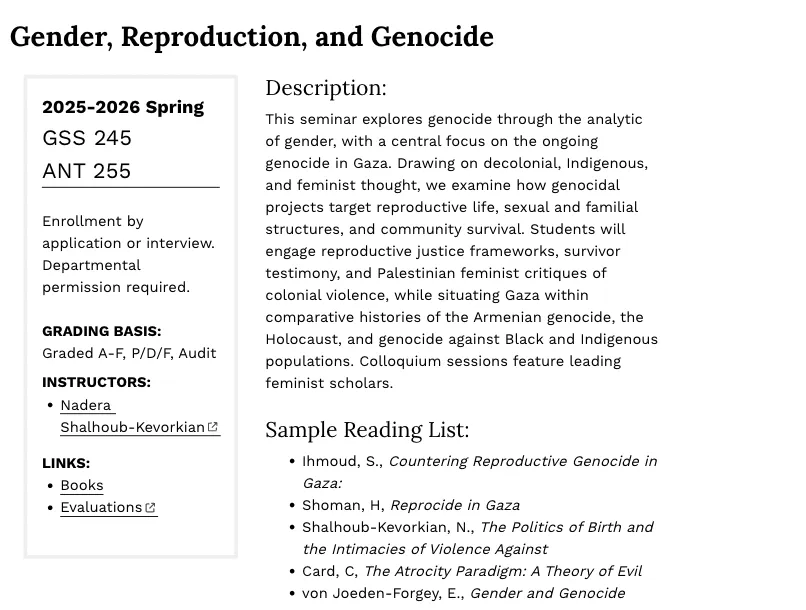
In the course, students will “engage reproductive justice frameworks,” suggesting that Israel is committing genocide by deliberately targeting institutions that would prevent women from becoming pregnant. However, this claim, spread by the UN, has no factual basis.
UN’s fake “genocide report” accuses Israel of intentionally striking Gaza Al-Basma IVF clinic to destroy embryos to “prevent births” and “destroy future of Palestinians.” This claimed attack is a key aspect of the claim. But there is ZERO evidence for any of it. Analysis: 1/ pic.twitter.com/t6n855r5an
— Aizenberg (@Aizenberg55) September 17, 2025
The UN report relies on a 2024 ABC News story that claimed an IDF shell was deliberately fired at an IVF clinic in December 2023, allegedly destroying more than 4,000 embryos with the intention to “prevent births.”
But even ABC News and its sole source, who was not present at the time, could not verify that an IDF shell caused the damage. In fact, a wide-angle photo of the scene shows a nearby high-rise building visibly damaged, while the IVF clinic itself appears fully intact.
If the course’s entire framework being held up by falsified information wasn’t enough, it also seeks to compare the history of the “genocide” in Gaza to other genocides, including the Holocaust. There is no lack of moral clarity more evident than flattening the Holocaust into a political talking point. No comparison can be made between a war of defense and the industrialization of murder that the Nazis waged against the Jewish people.
Yet, this vile comparison does not come as much of a surprise, considering the professor herself has, in the past, denied the murder and assault of Jews.
Antisemitism from faculty is not limited to academic courses. A Students for Justice in Palestine (SJP) chapter at University College London hosted Samar Maqusi as part of a series titled “Palestine: From Existence to Resistance.” Although the lecture was advertised as a discussion on the origins of Zionism, Maqusi instead promoted classic antisemitic tropes, including that Jews require the blood of gentiles for making their “special pancakes,” referring to a medieval blood libel in which Jews use the blood of gentiles for making matzah.
Antisemitism at UCL Event With University Research Fellow
A StandWithUs UK student shared this recording with us, exposing awful comments made by a UCL academic during a lecture at University College London.
During a lecture titled “The Birth of Zionism”, delivered by Dr… pic.twitter.com/0RF9Ooz3d6
— StandWithUsUK (@StandWithUsUK) November 13, 2025
Unfortunately, many discussions of Zionism on university campuses come from those with hostile and thus inaccurate beliefs on what it truly means to be a Zionist.
Even in an interfaith discussion at the City College of New York, a Hillel director was told he was “responsible for the murder” of Gazans and caused “disgust” in other participants because he was a Zionist. Activist and student groups further condemned the interfaith discussion. Not in favor of defending the Hillel director whose sole wrongdoing was being a Jew, but because interfaith efforts were causing the “normalization of Zionism.”
In warping the definitions to fit the narrative of the speaker or lecturer, lectures and campus spaces have become breeding grounds for bias and thinly veiled antisemitism.
Antisemitic Student Voices
Student leaders and activists have also frequently isolated their Jewish peers.
At The Harvard Crimson, one column suggests that there are some “visions of Zionism more morally objectionable” and therefore one might “feel wary of staying friends with Zionists.” It should then be no wonder to the author why Jewish students feel isolated on campuses.
This becomes all the more problematic when the students elected to represent the entire student union are not neutral nor representative on complex issues, particularly regarding the Israeli-Palestinian conflict at large.
At the University of Oxford, the Oxford Student Union elected Arwa Elrayess as the incoming president. She has been part of a no-budget documentary on the pro-Palestine protests that erupted after October 7. In one post promoting the film, Elrayess makes the moral equivalence between the Holocaust and the war against Hamas in Gaza by comparing the deaths of Anne Frank and Hind Rajab, a Gazan civilian.
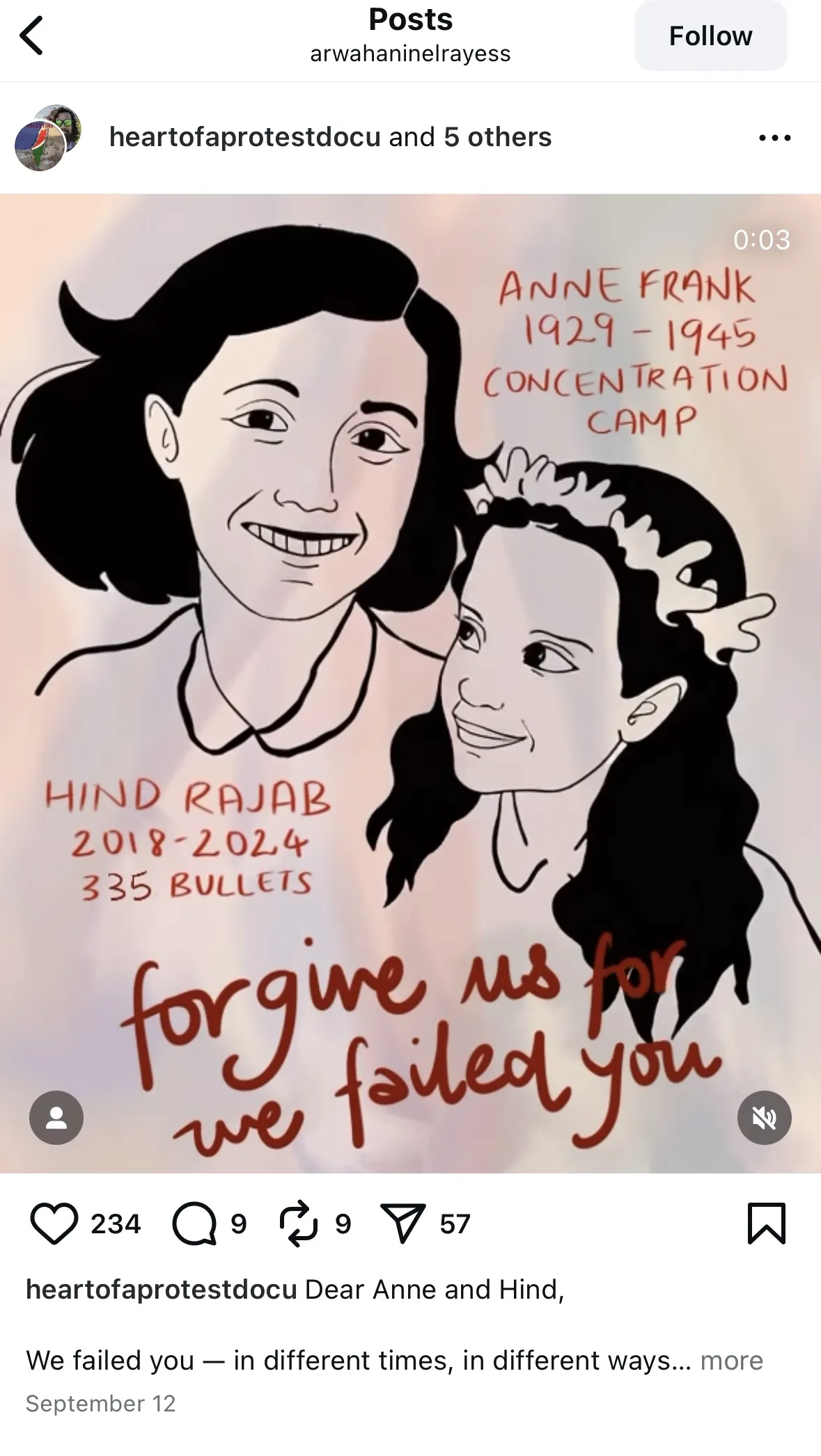
Elrayess is meant to represent all students equally. Still, her posts suggest otherwise and are part of a worrying trend of using Jewish trauma to uncritically discuss Israel’s war.
As the current academic year continues, it remains clear that the issue of antisemitism on campus has not gone away, nor can it be afforded to be swept aside and ignored. When courses are built on debunked claims and student leaders use Holocaust inversion to further their anti-Israel narratives, it becomes evident that this issue is not isolated but rather is systemic, requiring urgent and sustained action.
Jewish students on campuses worldwide deserve the same safety and respect as any other student, and all students deserve an education grounded in truth and accuracy. The moral and intellectual integrity of higher education depends on confronting antisemitism directly, rather than allowing it to fester under the guise of activism or academic freedom.
The author is a contributor to HonestReporting, a Jerusalem-based media watchdog with a focus on antisemitism and anti-Israel bias — where a version of this article first appeared.
Uncategorized
Feds say Cisco likely failed to protect pro-Palestinian workers from harassment
(JTA) — Cisco Systems likely violated the civil rights of Palestinian, Arab and Muslim employees, a federal agency has found, after employees were subjected to harassing messages — some of them posted by employees in an internal forum called the Connected Jewish Network.
The U.S. Equal Employment Opportunity Commission determined in June that there was “reasonable cause to believe” Cisco subjected the employees to a hostile work environment based on their national origin, religion or association in violation of Title VII of the Civil Rights Act of 1964.
The determination follows on media reports and an EEOC probe into an ugly climate at the tech company following the Oct. 7, 2023, deadly attacks by Hamas on southern Israel. Pro-Palestinian employees called on the company to end its business dealings with Israel, while Jewish employees said the company had failed to protect them from harassment by pro-Palestinian employees.
The EEOC case, however, turned in part on messages shared in the internal Connected Jewish Network forum. A complaint filed by Legal Aid at Work, which represented the Muslim and pro-Palestinian employees, said employees on the Jewish forum had “repeatedly glorified violence, joked about sending people to their deaths” and “labeled Palestinians, Arabs, and Muslims as murderous, violent, terrorists.”
“This is a massive multinational corporation with all the resources in the world and they couldn’t get it right,” Christopher Ho, a director at Legal Aid at Work, told the Guardian, which reported on the EEOC finding last month. “Thankfully the EEOC did.”
Ho said Cisco had “at best failed to take their harassment seriously” and through its inaction had sent “the implicit message that its pro-Palestinian employees were unworthy of protection.”
The letter is not a binding ruling, and both sides said the EEOC has indicated it will not sue. The finding could nonetheless strengthen employees’ cases if they pursue their own lawsuits. The employees are considering collective and individual litigation, according to media reports.
The case examines the period after a group of mostly Palestinian, Arab and Muslim employees called Bridge to Humanity circulated an open letter urging Cisco to end its business dealings with the Israeli military. More than 1,700 employees signed the letter. The employees said they were subsequently subjected to racist and Islamophobic harassment.
In August 2024, employees — including some concerned Jewish employees — filed a 76-page ethics complaint accusing more than a dozen colleagues of creating a hostile work environment through posts on the Connected Jewish Network, which was visible to all company employees, according to the Guardian.
The episode was not one-sided. Wired magazine, in a 2024 investigation into the dispute, reported that some Jewish Cisco employees also believed the company had failed to protect them from harassment by pro-Palestinian employees. One former employee told the magazine that Cisco leadership could have done more to “reduce the mess across the board.”
Legal Aid at Work believes this is the first EEOC finding against a major tech company involving discrimination against workers engaged in pro-Palestinian advocacy. Since the Oct. 7 attacks, the EEOC has made combating workplace antisemitism a major policy and enforcement priority, with scrutiny on academia and the private sector increasing under the Trump administration.
Cisco has disputed the EEOC’s determination, saying it had “thoroughly investigated all concerns and took appropriate action.” The company previously said it had removed some comments, issued discipline warnings and provided coaching to multiple employees.
The post Feds say Cisco likely failed to protect pro-Palestinian workers from harassment appeared first on The Forward.
Uncategorized
Mahmoud Khalil sues Columbia University citing ‘hostile environment’ for pro-Palestinian students
Mahmoud Khalil, the Palestinian Columbia University alum who was detained by the Trump administration last year, is suing his alma mater along with an Israeli dean of the school he attended for facilitating a “hostile environment” for pro-Palestinian students.
Khalil became a national symbol of the campus pro-Palestinian protest movement when he was detained in March 2025 after the government accused him of being aligned with terrorists. On Monday, he filed a civil rights lawsuit in federal court accusing the school of engaging in months-long “deliberate indifference” toward the harassment of pro-Palestinian students on campus, including at the hands of right-wing pro-Israel groups.
He contends that Columbia’s alleged indifference ultimately helped to lead to his 104-day detention by federal immigration authorities, during which he missed the birth of his first child, before being released after a federal judge ruled his detainment was likely unconstitutional. He is joined in the suit by members of the School of International and Public Affairs Palestine Working Group, a pro-Palestinian student group on campus.
“Columbia laid the groundwork for my targeting by the Trump administration through its deliberate indifference and discrimination aimed at intimidating Palestinian students,” Khalil told reporters at a press conference in New York on Monday.
SIPA’s Dean Keren Yarhi-Milo speaks during a book talk for Fareed Zakaria’s new book, “Age of Revolutions: Progress and Backlash from 1600 to the Present” at Columbia University’s School of International and Public Affairs on April 3, 2024 in New York City. (Shahar Azran/Getty Images)
In addition to the university, the suit also names Keren Yarhi-Milo, the dean of the Columbia School of International and Public Affairs, who is Israeli-American, as a defendant. The complaint says that Yahi-Milo had unfairly accused Khalil, while a student in the school, of antisemitism and harassment.
In a statement to the Jewish Telegraphic Agency, Columbia representatives defended Yarhi-Milo in general terms.
“Throughout her time at Columbia and during her service as dean, Dean Yarhi-Milo has worked with and supported students of all backgrounds, including our Palestinian, Arab, and Muslim students,” the statement reads. “The University is grateful for her tireless efforts on behalf of our students and her commitment to a campus free of discrimination and harassment.”
Columbia representatives declined to comment further on the lawsuit but said that “creating a campus environment where every member of our community feels welcome, supported, and safe is fundamental to who we are as a university. It is also a responsibility we take seriously.”
A leading figure of the encampment movement that began at Columbia before spreading to schools across the country, Khalil was the first pro-Palestinian student protest leader to be detained by the Trump administration and spent months in an immigrant detention center despite holding a green card.
In the months since a federal judge ordered his release, Khalil has filed a number of lawsuits, including against pro-Israel groups that he said “conspired” with the government to target him. He has also sued Columbia before, for disclosing student records as part of a congressional investigation.
Khalil’s latest lawsuit against Columbia claims the school violated Title VI protections for him and his fellow plaintiffs based on their ethnic identity, national origin or “affiliation with Palestine.” The lawsuit invokes the same federal civil rights law that Jewish and Israeli students have used in discrimination claims against universities, some of which have resulted in settlements.
Columbia itself signed a controversial agreement with the Trump administration last year to resolve federal civil rights investigations, paying $221 million and agreeing to a number of concessions in order to free up hundreds of millions in federal funding. During his press conference Monday, Khalil called such settlements “disgraceful.”
The suit notes that, as a student, Khalil called Yarhi-Milo “genocidal” in a message to fellow students. The suit then describes a subsequent internal university investigation into Khalil as “unfounded and retaliatory,” and claims the school “repeatedly launched meritless allegations of antisemitism against Mr. Khalil” prior to his federal detention.
During the press conference, Khalil accused Yahi-Milo of being someone who “weaponizes her identity to shield herself from legitimate concerns and criticism.” Khalil added, “Her priority has never been her students, me and my fellow students here. Her priority has always been Israel.”
The lawsuit’s examples of indifference include a claim that Columbia failed to intervene when a right-wing group, Accuracy in Media, labeled some of the members of Palestine Working Group as “Columbia’s Leading Antisemites” in messages on the side of trucks driven near campus for months after the Oct. 7, 2023, Hamas attacks. The group had targeted pro-Palestinian students in a similar fashion at several campuses.
Joseph Howley, a classics professor at Columbia who is Jewish, spoke at the press conference in support of Khalil, whom he called a friend. “We all see how the university’s anti-Palestinian racism has directly endangered its students,” said Howley, who wore a Jews for Racial and Economic Justice hat and a “Not In Our Name” shirt. “I won’t be wasting any more time on town halls or listening sessions or imagining anything.”
In a statement to JTA, Accuracy in Media president Adam Guillette said his group “uses publicly available information, and we are steadfastly opposed to doxxing. We pledge to continue delivering accountability to pro-Hamas radicals across the country.”
The post Mahmoud Khalil sues Columbia University citing ‘hostile environment’ for pro-Palestinian students appeared first on The Forward.
Uncategorized
Ed Sheeran says it wasn’t his call to drop Macklemore over ‘Free Palestine’ remarks
(JTA) —
Pop superstar Ed Sheeran said he wasn’t behind his tour’s recent decision to drop opening act Macklemore following the rapper’s recent pro-Palestinian remarks at a stadium show.
“I am not complicit,” Sheeran wrote in a statement on Instagram Tuesday, saying that Macklemore leaving the tour “was the promoter’s decision, it was not mine.” These were his first public words on the controversy that has gathered steam over the last 24 hours.
Hours after Sheeran’s comments, three of his other supporting acts announced they would be leaving his tour. All three acts — Aaron Rowe, Beoga and Finneas — posted pro-Palestinian solidarity statements to Instagram in their announcements.
Sheeran’s own note added, “I am appalled by the conflict between Israel and Palestine.” The British singer-songwriter wrote that he had been “involved in direct talks” between Robert Kraft and various promoters “to try and find a mutual resolution for all.”
Kraft, the Jewish and pro-Israel billionaire who owns one of the stadiums where Sheeran and Macklemore had been scheduled to play, said on Monday that he had told Sheeran’s team that Macklemore wouldn’t be allowed to perform there.
In his own statement to JTA, Kraft had said that Macklemore’s recent performance at New Jersey’s MetLife stadium, at which the rapper accused Israel of genocide and broadcast images from Gaza, “has been deeply offensive and hurtful to the Jewish community.” Pop star Pink, who is Jewish, also criticized Macklemore following the performance.
Sheeran didn’t mention Jews in his statement, but noted, “I have always used my platform and music to bring people from all backgrounds and cultures together and this won’t ever change.”
US rapper, singer, dancer and DJ, Benjamin Haggerty, known as Macklemore, performs at the Goldencoast Rap Festival in Corcelles-les-Monts, near Dijon, central-eastern France, on August 30, 2026. (Arnaud Finistre / AFP via Getty Images)
He also had some veiled criticism of his tourmate’s methods. “Those who come to my shows do not expect a political forum,” Sheeran wrote. “I respect Macklemore’s strength of purpose to stand up for what he believes. However, there is room for multiple approaches to the same end: peace… If we only focus on shouting the loudest, nothing will ever change.”
The other acts who announced they were leaving Sheeran’s tour didn’t agree. Some had strong words for Kraft and Zionism.
“As Irish people we know all too well about genocide, forced famine and violent occupation,” Rowe wrote in his own statement. “I cannot stand by and allow billionaires to use their position of power to silence the rightful voices of those who speak up against Israeli genocide and who highlight the savage murder of children.”
“It’s important that everyone knows that the real enemy is the zionist lobby,” Beoga, also an Irish act, wrote in the band’s own statement. “Research how much Robert Kraft has done to fight the BDS movement. That will give you a sense of what we’ve all been up against.”
In a shorter statement, Finneas said, “Artists must not be silenced when they speak up for the oppressed.” He added, “I stand with Palestine and its people.”
The Israeli-American Council, which organized a boycott against Macklemore following his New Jersey show, criticized Sheeran from the other direction in a new statement to the Jewish Telegraphic Agency.
“It’s time to take responsibility for giving a stage to antisemitic messaging,” the IAC said, of Sheeran. “This isn’t just ‘criticism of Israel.’ It’s a message that crosses the line between legitimate political criticism and antisemitism. This is Ed Sheeran’s stage, it’s the tour that carries his name — and so the responsibility for what happens on it is his too.”
The post Ed Sheeran says it wasn’t his call to drop Macklemore over ‘Free Palestine’ remarks appeared first on The Forward.
