


Uncategorized
The Jewish ‘Bubble’ — and Why It Still Matters for Our Future

Muhlenberg College students leaving for a Birthright Israel trip.
Photo: Facebook via Hillel: Taglit-Birthright Israel.
One of the most revealing questions you can ask a Jewish college student today is not what they think about Israel or how they view campus politics. It is whether they ever lived inside a real Jewish world before arriving at school.
Dan Senor‘s three touchstones — Jewish day school, Jewish summer camp, and a meaningful trip to Israel — turn out to be less about nostalgia than about survival. As antisemitism continues to erupt across America’s elite campuses, the students who remain confident, anchored, and unafraid are almost always those who experienced these “Jewish bubbles” long before anyone tried to tell them what being Jewish should mean.
I saw this long before I became a professor embedded in the world of higher education.
In my essay “High School Should Be Upsetting,” I wrote about attending Akiba Hebrew Academy — a pluralistic Jewish day school outside of Philadelphia — where nothing was uniform and everything required thinking. Some classmates kept kosher; others grabbed pizza and burgers freely. Some welcomed Shabbat with reverence; others barely thought about it. These were not superficial differences. They forced us into the daily work of argument, interpretation, and meaning-making. We learned that Jewish identity can withstand disagreement — that disagreement is itself a generative part of Jewish life. That formation did not insulate me from the world. It prepared me for it.
It also gave me something deeper. As I argued recently in “The Lessons We Were Taught and the Ones Being Forgotten,” Jewish classrooms once fused the study of prophets with photographs of Auschwitz, maps of Israel, and the trembling voices of survivors.
We learned early that justice without memory collapses into performance, that Jewish survival is not just historical but moral, and that being a Jew means carrying responsibility, not merely sentiment. These lessons were not designed to make us comfortable. They were designed to make us serious. That seriousness — an identity rooted in obligation rather than performance — is exactly what steadies young Jews today when campus climates turn hostile or morally confused.
Senor’s intuition about the “bubble” is more than anecdotal. It is empirically true. Jewish day school graduates consistently exhibit higher levels of Jewish literacy, deeper ritual practice, and stronger communal commitment, according to decades of Avi Chai Foundation research.
Jewish summer camps extend that formation into adolescence; the Foundation for Jewish Camp has repeatedly shown that alumni maintain Jewish friendships at dramatically higher rates and build Jewish homes of their own with greater confidence and intention. These friendships become ballast — the quiet, steadying presence of peers who share memory and meaning.
Rabbi Jonathan Sacks captured the heart of this when he wrote, “Moses and Aaron epitomize the two great roles in Jewish continuity — horim and morim — parents and teachers. A parent hands on the Jewish heritage to their children; a teacher does likewise to their disciples.” That investment — of presence, attention, and seriousness — is exactly what day schools, camps, youth groups, and Israel programs offer when they are at their best. They do not simply transmit heritage; they cultivate character. They shape conscience. They give young Jews a framework sturdy enough to meet the world without losing themselves.
Israel trips add something irreplaceable: narrative consciousness. Research on Birthright and other immersive Israel programs shows that participants return with a firmer sense of peoplehood, greater historical awareness, and a deeper understanding that being Jewish is a source of responsibility rather than defensiveness. Students who have walked the streets of Jerusalem or listened to the wind on the Golan Heights are not easily undone by slogans or distortions. They have seen complexity — and beauty — for themselves.
These experiences form a pipeline. Day schools cultivate literacy. Camps cultivate community. Israel cultivates memory. Together, they produce adults who are not bewildered by the demands of identity but strengthened by them. When students have studied texts, lived in Jewish community, and seen Jewish history with their own eyes, they carry an inner architecture that does not collapse when external pressure rises.
That was the theme running through the 2025 Tikvah Jewish Leadership Conference, where Senor spoke to a standing-room crowd. Again and again, speakers returned to the same truth: Jewish continuity will not be secured through slogans or reactive outrage. It will be secured through communities and institutions that form Jews — thickly, relationally, substantively. The future belongs to those who build Jewish life with depth, not performance.
And yet we find ourselves in a moment when the very infrastructure that sustains Jewish identity is thinning. Too many families treat day school as a luxury, camp as optional, Israel trips as politically fraught, and synagogue life as intermittent. Young Jews arrive on campus with warm feelings but thin foundations — a Judaism made of nostalgia rather than knowledge. Then the pressure comes, from peers and professors alike, and the identity that once felt easy suddenly feels fragile.
The greatest threat to young Jews today is not a lack of passion. It is a lack of preparation. Jewish identity cannot be episodic. It cannot survive on aesthetic appreciation or occasional observance. It flourishes when it is lived — daily, joyfully, rigorously, and in the company of others. If we want Jewish students to stand tall under pressure, then we must give them foundations deep enough to bear the weight.
Senor’s questions are diagnostic. They reveal whether a young Jew has ever inhabited a Jewish world strong enough to carry them through a hostile one. They show whether a student possesses not just ancestry but anchoring, not just identity but backbone.
The “bubble” is not a retreat from reality. It is preparation for reality. It is where young Jews learn who they are before others attempt to define them. And at a moment when antisemitism is rising, institutions are wobbling, and confusion is spreading, we should not apologize for strengthening these bubbles. We should expand them — boldly.
If we want confident, resilient, morally serious Jewish adults, we must give them confident, resilient, morally serious Jewish childhoods. Identity does not appear out of thin air. It is formed — deliberately, lovingly, and over time.
The bubble, it turns out, is not the weakness our critics imagine.
It is the most important thing we still know how to build.
Samuel J. Abrams is a professor of politics at Sarah Lawrence College and a senior fellow at the American Enterprise Institute.
Uncategorized
‘Long overdue’: Henry Ford home to confront his antisemitism
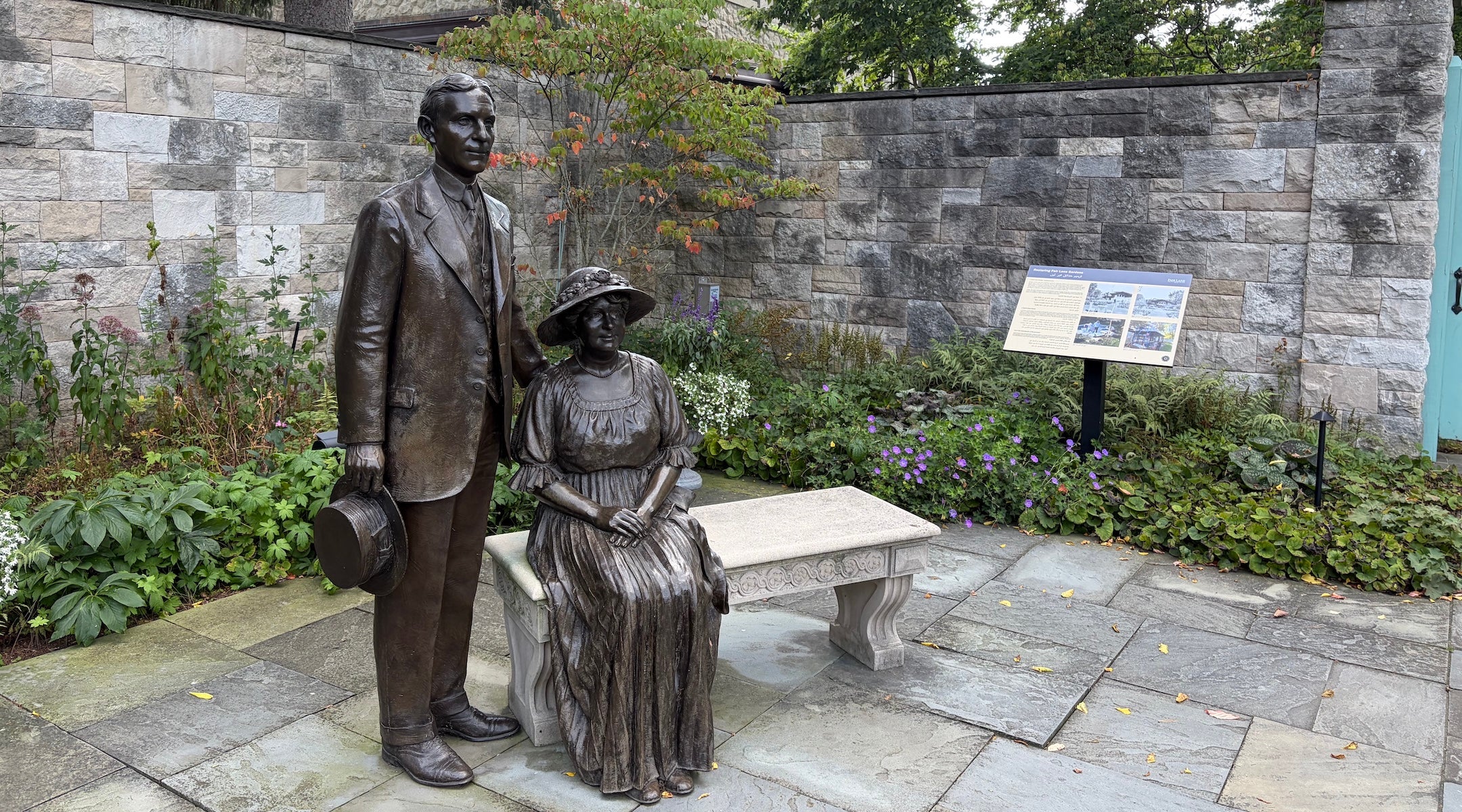
(JTA) — DEARBORN – The bust of Henry Ford looked on sternly as hundreds of Jewish professionals flooded his pool room.
The visiting Jews admired the views of the Rouge River from Ford’s windows and strolled through his immaculately maintained garden. They studied a mock-up for a Navajo rug in his basement woven with a particular pattern — one that appeared to resemble a Nazi swastika.
The staff at Fair Lane, the historic Dearborn home of Henry and his wife Clara, welcomed the Jewish educators, historians and museum staff. Why they did soon became clear during a panel discussion in that pool room. When the home reopens to the public in June 2027, after a 17-year closure for restoration, staff will teach visitors about Ford’s antisemitism.
This facet of the pioneering industrialist’s life was hardly incidental. The onetime richest man in America published venomous conspiracy theories in his newspaper, The Dearborn Independent, for years. Hitler was a professed admirer, and Nazi Germany awarded him a medal.
Leaders of Jewish groups greeted the news that the home would address Ford’s antisemitism with optimism.
“We applaud Fair Lane’s commitment to addressing Henry Ford’s antisemitism publicly,” Catherine Cangany, CEO of the Jewish Historical Society of Michigan, told the Jewish Telegraphic Agency in a statement. “This history happened, it caused harm, and it continues to have consequences we all must confront.”
Cangany, who has research expertise on the Dearborn Independent, sat on the June panel with Fair Lane’s curators but is not involved in the antisemitism initiative itself. Local Jewish groups including hers have been pushing for Ford’s enterprises to acknowledge his antisemitism for years.
“The reckoning is long overdue, and we all will be better for it,” she said.

The curators did not broach specifics of their plan with their Jewish audience in June. For the rest of the summer, as Fair Lane proceeded with its renovations, most of the Detroit area’s Jewish leaders were kept in the dark.
More than two months after the conference, top staffers Austin Eighmey and Hannah McCready sat down with JTA in Ford’s library to outline their educational plans in more detail.
Surrounded by replicas of books on German race science that helped to inform Ford’s attitude toward Jews, they explained that they viewed discussions of antisemitism as core to the revitalized Fair Lane’s statement of purpose. Such information would sit, they said, alongside other unflattering aspects of Ford’s character, such as his union-busting activities.
“Our mission is to illuminate the lives and legacy of Henry and Clara Ford,” Eighmey, senior director of historic resources, said. Part of that legacy, he said, was noting that “he was an ignorant man, fed a lot of poor information that he himself sought out.”
“It’s our job to tell a more full picture and give people a lens with which to view history,” added McCready, the site’s director of interpretation and education.

In the Detroit area, where Ford’s name still looms large nearly 80 years after his death, such a commitment is notable. In 2023 the former president of the Ford Foundation, the family’s charitable arm, acknowledged and condemned its namesake’s antisemitism. Other local institutions devoted to historic purveyors of antisemitism have reckoned with their own legacies in recent years, including the church founded by demagogic “radio priest” Father Charles Coughlin.
But as Ford the man continues to be heavily mythologized today, by new generations of entrepreneurs and gearheads — and white supremacists — the physical museums and educational institutions in the region that bear Ford’s name and have connections to his family largely have not broached his antisemitism.
Those include The Henry Ford, a museum built around his personal collections; Greenfield Village, a historic reenactment village that includes a restoration of the mogul’s childhood home; and the Ford Piquette Avenue Plant, a Detroit heritage site where Ford’s Model Ts were built.
For a long time Fair Lane, too, didn’t touch the subject. After Ford’s widow Clara died in 1950, the property was turned over to the Ford Motor Company, which brokered a deal with the University of Michigan to build a Dearborn satellite campus on the site.
For decades the university offered tours of the grounds on a largely volunteer basis, also using it as an events space. The house has been closed to visitors since 2010, as the team undertook an extensive restoration project with an eye toward reopening for the public.
Eighmey said the plan to teach about antisemitism had been the goal since the restoration’s early days. The staff met with representatives from the Zekelman Holocaust Center, the state’s flagship Holocaust museum, to discuss how such a project would look.

“They were straightforward about Henry Ford’s antisemitism and hope that it will be incorporated into the interpretive narrative where appropriate but, at the same time, they respectfully acknowledged many of Henry Ford’s strengths and expressed a deep regard for Fair Lane’s stories, physical spaces, and current restoration work,” reads one executive summary of the focus group that a consultant shared with JTA.
A spokesperson for the Zekelman declined to comment to JTA for this article.
Local controversies in the interim called such educational commitments into question. In 2019 the city of Dearborn — where the Ford Motor Company is the largest employer — quashed a planned historical magazine that would have discussed Ford’s antisemitism, tied to the 100th anniversary of his acquisition of the Dearborn Independent.
In what Eighmey today refers to as “the whole fiasco here in Dearborn,” the city’s then-mayor, John “Jack” O’Reilly, fired the magazine’s editor, prompting outcry. O’Reilly died last year. His son, Devon O’Reilly, now serves as Fair Lane’s CEO.
Despite this history, the younger O’Reilly is supportive of the plan to teach Ford’s antisemitism on the site, the curators said. “We have not talked about his personal life, really, and his familial connections at all,” Eighmey said of O’Reilly.
The team has developed talking points about Ford’s antisemitism as part of their “non-negotiables,” museum terminology for facets of history that every visitor will encounter. Donna Braden, a museums consultant who formerly worked with The Henry Ford and who is Jewish herself, was hired to give her feedback on the plan and drafted her own proposed “non-negotiables” for the subject.
“Explaining the true story of Henry Ford’s antisemitism to non-Jewish people will help them understand why it is so important to the Jewish community,” Braden told the Fair Lane team in a report on their efforts.

In a summary she shared with JTA, Braden also advised the team to “be aware of many people who are unaware of Henry Ford’s antisemitism, and it will surprise them.”
Braden drew from “The People’s Tycoon: Henry Ford and the American Century,” an acclaimed 2006 biography by Steven Watts. Unlike other Ford biographers before him, Watts tackled his subject’s antisemitism head-on. His approach would later find surprising admirers within the Ford dynasty, leading to him presenting on the subject in 2018 to a room full of The Henry Ford staff and Ford family members.
“It was, I must say, quite an experience, because I spoke pretty frankly about all of this,” Watts, an emeritus history professor at the University of Missouri, recalled to JTA about his 2018 talk. “Most of the staff that talked to me about it actually indicated that they were a little relieved, I think, to have this brought out into the open in a fairly frank way.”
The talk, co-presented with the Jewish Historical Society of Michigan, did not lead to change — at least not at The Henry Ford, which has a separate ownership structure from Fair Lane. Today, no mention of Ford’s antisemitism can be found in The Henry Ford’s physical museum space, despite efforts from Braden and others to add such material. Some pages of its website now include some brief words on the subject.
Amid new efforts to push Ford’s family on the subject, Watts returned to Dearborn in 2024, partially to address Fair Lane at Braden’s invitation.
“I hope that they will move forward to bring Henry Ford’s antisemitism to the public,” he said, of both Fair Lane and The Henry Ford. “I got the idea when I was there that they were thinking strongly about a more frank and open approach to all of this, and I guess I would hope that is the approach that they take, and not the ‘sweep it under the rug’ maneuver.”
He told JTA that Ford’s antisemitism became most pronounced in the 1920s, shortly after the height of his business success.

Watts traces Ford’s antisemitism not to any one specific root cause, but rather to a confluence of factors, including the mogul’s economic populism; his failed efforts to send a “Peace Ship” of dignitaries to Europe during World War I, which he came to blame on a “Jewish financial interest in Europe”; and his embrace of conservative cultural signifiers, including square dancing.
“He basically begins to argue that Jews lay behind the corruption of that old-fashioned kind of rural, WASP cultural virtue, that Jews were behind jazz music, Jews were behind Hollywood movies, and that there was a kind of moral degradation that was at work,” Watts said.
Fair Lane has a separate ownership structure from The Henry Ford and Greenfield Village, both of which are largely built around other subjects Ford was passionate about, such as American innovation, rather than the mogul himself. Fair Lane, its curators say, is the natural place for visitors to learn about the Fords’ personal lives and beliefs.
Ford descendants still weigh heavily on Fair Lane’s board — including chair Edsel Ford II, Henry’s great-grandson, whom Eighmey refers to as “the Deuce.”
The family was onboard for this reappraisal, the curators said. Fair Lane’s models in the museum space include Monticello, Thomas Jefferson’s plantation in Virginia that has taught visitors about his slaveholding; and the Frick museum in Pittsburgh, where industrialist Henry Clay Frick comes under scrutiny for his fierce anti-union stance.
Visitors to Fair Lane, Eighmey promised, will “never leave here thinking, ‘Oh, it wasn’t that big of a deal.’”
The Fair Lane team chose to restore the house to its condition in 1919 — in part because the home was photographed for an architectural magazine that year, allowing the curators to use it as a visual reference.

The date is significant for another reason. 1919 was also the year that Ford acquired the Dearborn Independent, which he would soon use to publish a series of antisemitic conspiracies called “The International Jew” as well as the Russian forgery “The Protocols of the Elders of Zion,” which purported to outline secret Jewish plans for world domination.
Ford would require his dealerships to distribute copies of the paper with every automobile purchase, making the Independent, for a brief time, one of the country’s highest-circulated newspapers. Ford’s role as newspaper publisher was, in Watts’ estimation, the most notorious and seismic way the mogul’s antisemitism manifested in his lifetime.
The choice to reset his home to the year he launched the paper “is further bringing all of this together as a narrative throughline,” McCready said.
After the paper shut down in 1927, owing in part to a libel suit brought against Ford by Jewish attorney and labor activist Aaron Sapiro, Ford — with the help of Jewish community figures — publicly apologized for spreading antisemitism. Around the same time, the celebrated Jewish architect Albert Kahn helped renovate Fair Lane.

The planned 90-minute Fair Lane tour, which is currently being workshopped, touches on the Peace Ship and Ford’s wielding of the Dearborn Independent. McCready described the tour’s intended arc: “He fails with the Peace Ship. He decides that there is a hostile press that’s controlled by financiers that’s against him. He purchases this failing local newspaper and starts getting really obsessed with his image in the media, and we kind of take it from there.”
It does not get into the Sapiro trial, though tour guides will discuss the topic if visitors bring it up. They also don’t plan to discuss the medal Ford received from Nazi Germany in the late 1930s when Hitler publicly expressed admiration for him, noting that it falls nearly two decades after the time period represented by the house’s restoration.
Watts, the Ford historian, told JTA that Ford had suffered two strokes at the time he received the medal, and “was in very bad shape” — possibly impairing his judgment.
“I think Ford’s got a lot to answer for, but I don’t think he was a Nazi,” Watts said. “I think things kind of went off the rails there.” By 1942, Ford was again publicly renouncing antisemitism, calling it “a distinct disservice to our country.”
At the Jewish museums conference, Cangany, the Jewish Historical Society of Michigan CEO, suggested the Fair Lane team should display copies of the Dearborn Independent around the house to demonstrate the effects of Ford’s worldview. That’s not part of the plan, Eighmey said: “It’s not on the site, and it never was.”
But the house does have other eye-catching artifacts. A room in the basement, in keeping with historic specifications, will be outfitted with a Navajo rug stitched with the ancient “whirling logs” symbol, which the Nazis later co-opted as the swastika. Ford had acquired the rug and displayed it in his home beginning in the 1910s, well before the Nazi swastika was popularized.
Maintaining an honest assessment of its founder’s troubling history is a tall order for any museum in modern times. Even Monticello, which Fair Lane held up as a model, has faced right-wing backlash from figures who want the site to minimize discussions of slavery.

Meanwhile, Ford’s legacy continues to shape the modern era as new conservative cultural figures from the business world push similar brands of populism.
In 2022, amid a dispute with the tech mogul Elon Musk over the prevalence of antisemitism on his social network X, the Anti-Defamation League’s CEO, Jonathan Greenblatt, called Musk “the Henry Ford of our time.”
Greenblatt later apologized for the comparison -– but some commentators noted that it was even more apt than he may have meant. “Twitter is to Musk as The Dearborn Independent was to Ford,” the writer Parker Molloy wrote at the time.

Last month in Dearborn, which today has a large Arab/Muslim community, neo-Nazi activists wearing swastika armbands staged an anti-Muslim rally. Their choice of venue carried historical echoes: They organized outside the Henry Ford Centennial Library.
The Fair Lane team is aware of the modern significance of Ford’s antisemitism, they said.
“Populist movements, they always end up using antisemitism as some sort of way to recruit people to their cause,” Eighmey told JTA. “And it’s a reality that I hope, after people leave their experience here, they do reflect on it and see, ‘Wow, wait a minute. Is this happening right now around me?’”
This article originally appeared on JTA.org.
The post ‘Long overdue’: Henry Ford home to confront his antisemitism appeared first on The Forward.
Uncategorized
Jewish artists face a relentless culture war over Israel. Some are building a way around it.
The pop star P!nk went into Rosh Hashanah explaining herself.
After sharing a post calling for rapper Macklemore to be dropped from Ed Sheeran’s tour over his pro-Palestinian performances, the Jewish singer faced a backlash of her own. On Friday, she clarified that she supported Palestinian humanity, opposed silencing artists and wanted room to express Jewish fear without being accused of endorsing Israel’s war.
Macklemore, meanwhile, said his criticism of Israel was not directed at Jews. Their exchange captured how quickly an argument about a performance can become a fight over identity — and who gets to define someone else’s.
Nearly three years after the Oct. 7 Hamas attacks, those fights are becoming part of the ordinary business of culture: promoting a movie, booking a concert, selling a manuscript. And some Jewish artists and executives are responding by building new places to take their work.
Consider Gal Gadot. While promoting her new Prime Video thriller, The Runner, the Israeli actress and former IDF soldier appeared on Jimmy Kimmel Live! last week, where she and Kimmel blew shofars for Rosh Hashanah. “Why platform her?” read a typical comment under the video on social media. Even sharing an episode became a point of contention: A member of MUNA, the musical guest, subsequently said the band’s performance had been prerecorded and that it hadn’t known who else would appear, adding a message supporting Palestinian freedom.
Artists critical of Israel face their own confrontations. Last month, Paramount accused Mark Ruffalo of invoking antisemitic tropes after he attacked the Ellison family’s corporate interests and Oracle’s work with the Israeli military. Ruffalo rejected the accusation, saying he was criticizing executives and government policy. The disputes involve different conduct and different stakes, but they keep returning to the same contested boundary between political criticism and prejudice.
In publishing, the consequences can be harder to see. Jewish and Israeli authors told The Wall Street Journal that agents had dropped them, editors had sought to remove Jewish or Israeli elements from manuscripts, and overseas publishers had become unwilling to buy their work. Some agents explicitly reject submissions from Zionists.
The picture is uneven: Jewish writers across the political spectrum continue to produce bestsellers, and a rejected manuscript alone cannot establish discrimination. But the accounts have helped spur new businesses.
A wave of new publishers has emerged to give Jewish and Israeli writers a home after agents and editors say mainstream houses have quietly frozen them out since Oct. 7: Neil Blair, best known as J.K. Rowling’s literary agent, launched High Line Publishing Studio last week to publish authors he says have been shut out elsewhere; Canary Publishing opened this month with the same mission; and Meg Keene Books, a new fiction imprint, will publish the American edition of Howard Jacobson’s Howl, which struggled to find a U.S. publisher despite its Booker Prize-winning author.
A similar response is taking shape in Hollywood. Former NBC co-chairman Ben Silverman is among the backers of SHOOQ, a new platform connecting Jewish filmmakers with investors and philanthropists. Its founders say talented storytellers need help finding the funding to get their projects made.
These ventures offer something practical to people exhausted by defending their right to participate: a publisher, a financial introduction, a way to keep working. They also raise a question that will outlast the latest celebrity argument: Can new Jewish cultural institutions help artists reach a wider public, or will an increasingly divided industry leave them speaking mainly to their own?
This essay first appeared in our Forwarding the News morning newsletter. Subscribe here.
The post Jewish artists face a relentless culture war over Israel. Some are building a way around it. appeared first on The Forward.
Uncategorized
‘We return changed’: Michigan synagogue reopens for Rosh Hashanah six months after a gunman forced them out
Six months after he was injured protecting his synagogue, Danny Phillips helped carry a Torah back into its sanctuary. The security director was still recovering. So was the congregation.
On Friday evening, the Jews of Temple Israel in West Bloomfield, Michigan, returned to celebrate Rosh Hashanah in the sanctuary they had been forced to leave after a gunman attacked their synagogue in March. The Torah scrolls came home to their ark. Familiar prayers filled the room again. And the High Holidays’ ancient invitation to return took on a meaning no one there could have anticipated a year earlier.
“This room holds more than our services; it holds our memories,” Cantor Neil Michaels said in his welcome, recalling the weddings, coming-of-age ceremonies and farewells that had taken place there.
Throughout the service, clergy and congregational leaders spoke openly about what it meant to enter a sacred space where their sense of safety had been shattered. They described gratitude alongside grief, and the effort of caring for others while still struggling themselves. Returning to the building was one step toward learning to feel at home again.
The congregation’s co-presidents, Debra Gordon and Jodi Neff, gave that work a plainspoken expression: “How do you lead others when you are trying to steady yourself?” Gordon asked.
The answer, in the stories shared from the bimah, was that others helped carry the weight.
The prayer books came from other congregations. Temple Israel’s machzors had been destroyed in the attack, and the edition it used was out of print. Synagogues around the country sent replacements. Rabbi Harold Loss told worshippers that the book he picked up bore another congregation’s initials — a small reminder, held in his hands, of the community that had sustained them.
The children had already made their own return. Earlier that week, students came back to the early childhood center and received teddy bears marking the occasion with the Shehecheyanu, the blessing of gratitude for reaching a significant moment. An educator recalled a parent saying that, after six months in which nothing had felt normal, the first day back finally did.
Their neighbors had helped make the journey possible. On the day of the attack, the Chaldean Christian community’s Shenandoah Country Club across the street sheltered children and teachers. The following evening, it hosted the congregation for Shabbat. At the holiday service, Temple Israel’s leaders again thanked those neighbors, along with the staff, first responders and restoration workers who helped sustain and rebuild their community.
Coming home still required protection. The March 12 attacker drove a truck into the synagogue and exchanged gunfire with security personnel while preschoolers were inside. The reopening included additional security measures. Temple Israel’s Rabbi Josh Bennett has also spoken about the emotional and financial difficulty of making a synagogue secure while preserving its welcome — a challenge facing Jewish congregations far beyond Michigan.
Near the end of their remarks, the co-presidents described teshuvah, the season’s work of return, as something that allowed room for everything the congregation had endured.
“We return changed,” Neff said, “but still rooted.”
This essay first appeared in our Forwarding the News morning newsletter. Subscribe here.
The post ‘We return changed’: Michigan synagogue reopens for Rosh Hashanah six months after a gunman forced them out appeared first on The Forward.
