


Uncategorized
Mamdani’s Father Blasts Columbia University Over Antisemitism Policies, Says Anti-Israel Students ‘Terrorized’

Pro-Hamas demonstrators at Columbia University in New York City, US, April 29, 2024. Photo: REUTERS/Caitlin Ochs
New York City Mayor-elect Zohran Mamdani’s father — Mahmood Mamdani — denounced Columbia University’s efforts to combat antisemitism on Friday, exacerbating concerns that the incoming Mamdani administration will be an anti-Zionist coterie bent on fostering a hostile climate for Jews and supporters of Israel.
“Well, students are terrified; they are terrorized,” Mamdani said on the Substack of Peter Beinart, a prominent anti-Israel writer who earlier this year refused to classify Hamas as a terrorist organization, arguing that the designation carries racial undertones.
“In the smallest move they make, they are targeted,” Mamdani continued. “They are expelled. They are suspended. They are warned. Which means we have less and less of an idea of what they think and how they might respond to their situation.”
He added, “The university is in a vindictive mood.”
As previously reported by The Algemeiner, Columbia University was, until the enactment of recent reforms, the face of anti-Jewish hatred in higher education in the aftermath of the Hamas-led Oct. 7, 2023, massacre across southern Israel. Dozens of reported antisemitic incidents transpired on its grounds, including a student’s proclaiming that Zionist Jews deserve to be murdered and are lucky he is not doing so himself and the participation of administrative officials, outraged at the notion that Jews organized to resist anti-Zionism, in a group chat in which each member took turns sharing antisemitic tropes which described Jews as privileged and grafting.
The shocking acts of hatred alone did not militate the university’s adopting a new posture to confront antisemitism on its campus. A slew of civil rights complaints, lawsuits, and the federal government’s impounding $400 million in taxpayer funds did. In July, it agreed to pay over $200 million to settle the cases, which alleged that school officials allowed Jewish students, faculty, and staff to suffer antisemitic discrimination and harassment.
Additionally, Columbia pledged to hire new coordinators to oversee complaints alleging civil rights violations; facilitate “deeper education on antisemitism” by creating new training programs for students, faculty, and staff; and adopt the International Holocaust Remembrance Alliance (IHRA) definition of antisemitism — a tool that advocates say is necessary for identifying what constitutes antisemitic conduct and speech. Columbia also announced new partnerships with the Anti-Defamation League (ADL) and vowed never to “recognize or meet with” the self-titled “Columbia University Apartheid Divest” (CUAD), a notorious pro-Hamas campus group which has serially disrupted academic life with unauthorized, surprise demonstrations attended by non-students.
Last week, Columbia University’s Antisemitism Task Force implored the school to foster “intellectual diversity” with respect to the subjects of Zionism and the Israeli-Palestinian conflict, concluding its fourth and final report on the origins of antisemitism on the campus. The task force found several instances of Jewish and Israeli students being harassed on campus as well as an overwhelming anti-Israel bias among faculty.
Mamdani took issue with the establishment of the task force in the first place.
“As you know, they created a task force on antisemitism. And then they followed suggestions that … why don’t we have a task force on Islamophobia? Why don’t we have a task force on XYZ? Student experiences cover lots of, you know, grievances,” he said.
Mamdani’s reversing the roles of victim and perpetrator is a staple of anti-Israel activism in the West, which thrives on misrepresenting the power dynamic between Israelis and Palestinians while insisting that antisemitic expression, conduct, and even terrorism are legitimate means of advocating Palestinian statehood.
Earlier this year, the Council on American-Islamic Relations (CAIR) sued Northwestern University to cancel a course on antisemitism prevention. The group argued that the course, which aims to discourage discrimination, violated Title VI of the Civil Rights Act of 1964, an anti-discrimination law. CAIR added that the antisemitism Northwestern University strives to prevent manifest as legitimate “expressions of Palestinian identity, culture, and advocacy for self-determination.”
Weeks earlier, the American-Arab Anti-Discrimination Committee (ADC) sued California to stop the enactment of a law to combat K-12 antisemitism. ADC said that Arabs are victims of discrimination and that fighting antisemitic harassment in accordance with the new law undermines First Amendment protections of speech unfettered by governmental interference. Furthermore, the ADC argued that the law amounts to a hijacking of American policy by Israel, an argument advanced by neo-Nazis, including Nicholas Fuentes, and commentators who promote their views such as Tucker Carlson and Candace Owens.
Such notions appear to have convinced many anti-Israel activists that escalating their conduct is acceptable.
In November, for example, hundreds of people amassed outside a prominent New York City synagogue and clamored for violence against Jews.
Mamdani’s son, Zohran, received widespread backlash from Jewish leaders and pro-Israel advocates after issuing a statement that appeared to legitimize the gathering. The younger Mamdani, who was elected the city’s next mayor last month, issued a statement that “discouraged” the extreme rhetoric used by the protesters but did not unequivocally condemn the harassment of Jews outside their own house of worship. Mamdani’s office notably also criticized the synagogue, with his team describing the event inside as a “violation of international law.” The protesters were harassing those attending an event being held by Nefesh B’nefesh, a Zionist organization that helps Jews immigrate to Israel, at Park East Synagogue in Manhattan.
Mamdani, a far-left democratic socialist and anti-Zionist, is an avid supporter of boycotting all Israeli-tied entities who has been widely accused of promoting antisemitic rhetoric. He has repeatedly accused Israel of “apartheid” and “genocide”; refused to recognize the country’s right to exist as a Jewish state; and refused to explicitly condemn the phrase “globalize the intifada,” which has been associated with calls for violence against Jews and Israelis worldwide.
Leading members of the Jewish community in New York have expressed alarm about Mamdani’s victory, fearing what may come in a city already experiencing a surge in antisemitic hate crimes.
Follow Dion J. Pierre @DionJPierre.
Uncategorized
Britain’s Green Party adopts ‘Zionism is racism’ motion
(JTA) — Britain’s Green Party on Sunday adopted a policy equating Zionism with racism, a move that immediately drew condemnation from the Israeli government and sparked concerns among some Jewish party members and the broader Jewish community.
The motion has also caused divisions within the party itself, with leader Zack Polanski, who is Jewish, skipping the vote and the party’s five sitting members of parliament issuing a statement on the policy.
Passing with 1,022 votes to 813 votes at the left-wing party’s annual conference, the motion argues that Zionism as an ideology is racist as it promotes “ethnonationalism,” and “privileges one ethnic group on the basis of the subjugation of others.”
It also declares the Greens to be an “anti-Zionist party” and that Zionism, the movement to develop and protect a Jewish state in Israel, will be “treated as any other form of racism.”
The motion also supports the establishment of a “single democratic Palestinian State in all of historic Palestine with Jerusalem as its capital.”
Israel’s Ministry of Foreign Affairs said in a press statement, “Today, the Green Party in Britain ceased to act as a political party and became a body that gives legitimacy to terrorism. The Greens have adopted not only the green of Hamas, but also its ideology: the elimination of the State of Israel through armed struggle.”
“The shocking resolution adopted today legitimizes armed struggle, calls for a Palestinian state ‘from the river to the sea’ – meaning the destruction of the State of Israel – and labels as ‘racist’ the aspiration of the Jewish people for self-determination,” the ministry statement said, adding that it “goes far beyond the boundaries of legitimate political debate.”
The ministry called on other political parties in Britain, particularly the ruling Labour Party, to reject the resolution.
In a letter to Polanski ahead of the vote, the Board of Deputies of British Jewry, Jewish Leadership Council and Community Security Trust said they had “acute concerns” about the motion and called on the party leaders to oppose it. They wrote that urgent action was needed to address growing antisemitism within the Green Party. Such a motion, they wrote, “fuels hatred of Jews.”
The five representatives of the Greens who sit in Parliament – MPs Ellie Chowns, Adrian Ramsay, Siân Berry, Carla Denyer and Hannah Spencer – issued a joint statement condemning the actions of the current Israeli government led by Prime Minister Benjamin Netanyahu but emphasizing, “We know there is no conflict between supporting the rights of Palestinians and the rights of Jewish people.”
A clause was proposed to protect Jewish Greens by clarifying that the motion should not be used to “pressure, proscribe or discipline” those affiliated with synagogues or other Jewish groups that describe themselves as Zionist. The clause was voted down.
This article originally appeared on JTA.org.
The post Britain’s Green Party adopts ‘Zionism is racism’ motion appeared first on The Forward.
Uncategorized
As The New York Times turns 175, the fight over its Israel coverage heats up again
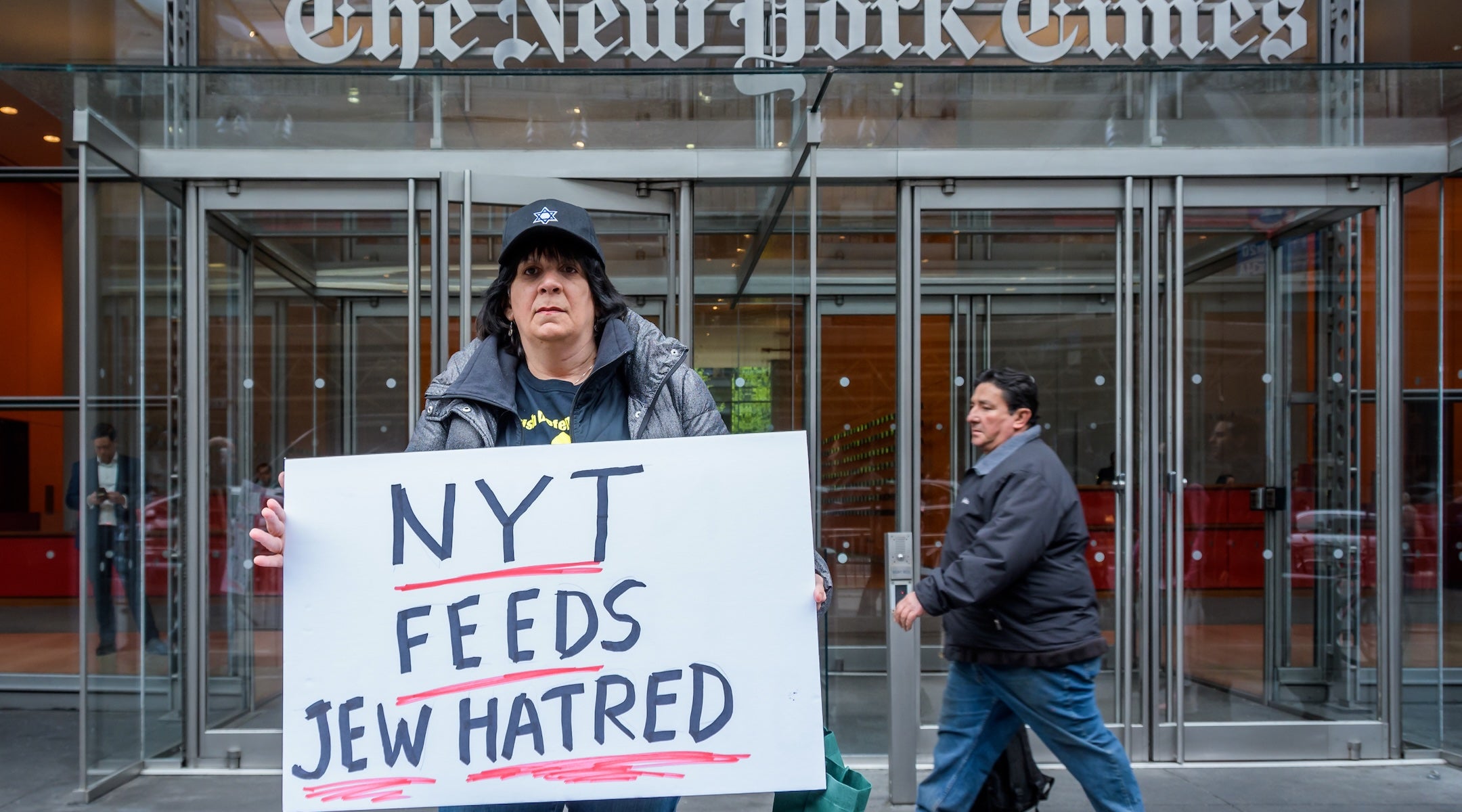
(JTA) — For generations of American Jews, The New York Times has been more than a newspaper.
It has been the hometown paper of the largest Jewish community outside Israel, a daily guide to the city that became the cultural center of American Jewish life and, more broadly, a reflection of the aspirations of Jews who saw themselves as educated, cosmopolitan, culturally engaged and interested in the wider world.
And in the 175 years since the paper’s founding on Sept. 18, 1851, no issue has inflamed its Jewish readers like its coverage of Israel. This month, as the Times celebrities its 175th birthday with a series of special features, that argument has gotten new fuel.
On Sept. 23, the Florida state pension fund and a conservative think tank that includes shareholders in the Times sued the company, seeking internal records that they say could show whether its board has adequately overseen the newspaper’s coverage of Israel. The plaintiffs allege that repeated errors and other evidence point to a failure to enforce the paper’s own journalistic standards and reflect an anti-Israel bias in its coverage.
The Times called the suit meritless and politically motivated, saying it amounted to an attempt to pressure an independent news organization.
The lawsuit came days after the publication of a study by Edieal Pinker, a professor at Yale’s School of Management, which is also cited in the lawsuit. Pinker’s study attempts to put numbers behind a complaint made by supporters of Israel: that the Times’ coverage of the war that began with Hamas’ Oct. 7, 2023, attacks has minimized Israeli suffering and Hamas’ role in the conflict.
Pinker examined 1,559 Times articles published between Oct. 7, 2023, and June 7, 2024. He found what he described as a dominant narrative in which Israel was assigned “near-exclusive agency and responsibility” after the Hamas attack. Meanwhile, Israeli casualties after Oct. 7, Hamas fighter casualties and Palestinian violence received much less attention, he asserted. Personal accounts of Palestinian suffering, he assessed, appeared far more frequently than comparable accounts of Israeli trauma.
Pinker told me that he understands the enormous disparity in the number of Palestinians and Israelis killed in the war. But that, he argues, does not absolve the newspaper for a framing of the war that focuses on Palestinian suffering and downplays Israeli motivations for carrying on the fight.
The Times has rejected Pinker’s conclusions. In response to the study, a spokesperson said the newspaper had covered the war “with more rigor than virtually any other U.S. news organization” and that editors make “careful and deliberate choices” about language, framing, prominence and tone in pursuit of independent journalism.
The discourse around Pinker’s study and the lawsuit reflects the American Jewish community’s longtime obsession with the Times’ Israel coverage, as well as splits within American Jewry itself. A cottage industry of media watchdog groups, including CAMERA and HonestReporting, seeks to expose errors in Israel coverage by the Times and other outlets. They focus on stories or headlines that show Israel in a bad light — press criticism mixed with pro-Israel advocacy.
Left-leaning academics and journalists often accuse the critics of having their own biases and dismiss their methodology, suggesting they seek to hold Israel above scrutiny and fail to understand the role of an independent press.
Eric Alterman, an author and historian who has written extensively about the American media, wrote in his 2022 history of American Jews and Israel, “We Are Not One,” that if anything, the Times has taken a “consistent, if sometimes, subtle, pro-Israel slant.”
He cited frequent protests by pro-Palestinian media critics, who think the Times is biased toward Israel, as well as a series of Jewish editors and Jerusalem bureau chiefs who, while often critical of Israel, used terminology and framing that reflect Israel’s perspective. (The word “nakba,” the Palestinian term for Israel’s creation meaning “catastrophe,” did not appear in the paper until 1998.)
But Alterman makes a larger point that is about the audience as much as the newspaper. He believes many American Jews have grown up on the “myth” of Israeli infallibility and see criticism or bad news about Israel as inherently suspect and evidence of hostility toward Israel or Jews.

“People who grow up on this myth and who define their Jewish identities by their fealty to this myth … find it very painful, very hard to deal with negative coverage of Israel,” Alterman, a professor of English and journalism at Brooklyn College, said in an interview. “And so, as I report in my book, attacking the media for its coverage of Israel became a manifestation of many a Jewish identity.”
For the petitioners in the recent lawsuit — the National Center for Public Policy Research think tank and the State Board of Administration of Florida, who as Times shareholders say they are entitled to inspect company books and records — the question isn’t the Jewish identity of the critics, but what they see as the Times’ board’s failure to enforce the newspaper’s own journalistic standards.
The suit includes numerous examples. They point to the Times’ initial coverage of the October 2023 explosion at Gaza’s Al-Ahli Hospital, which attributed the blast to an Israeli airstrike before the paper acknowledged that it had relied too heavily on claims by Hamas. The suit also cites an October 2023 account of a Hamas attack on the Israeli city of Ofakim in which, according to the plaintiffs, editors twice changed references to the attackers from “terrorists” to “men,” which they say reflected a reluctance to use language that cast Hamas negatively.
And in one of the highest-profile accusations of media bias during the war, the plaintiffs point to a July 2025 story about a severely malnourished Palestinian boy. While the paper said the subject was “born a healthy child,” the suit argues that Times staff had access before publication to information indicating that the boy had a pre-existing medical condition. (The Times later issued a correction.)
“In the absence of any Board-level oversight,” according to the filing, “journalistic standards have been weaponized within the Company to serve the personal agendas of unchecked editors.”
At the center of this debate is not only what may be the most important single news source in the world, but one with complicated Jewish roots. Adolph Ochs, a Jewish newspaper publisher from Tennessee who was born to German immigrants, bought the struggling paper in 1896. His descendants have controlled it ever since. Och’s father-in-law was Rabbi Isaac Mayer Wise, a founder of Reform Judaism in America, and for decades the newspaper’s editorial line reflected Reform’s vocal anti-Zionism.
Ochs’ son-in-law, Arthur Hays Sulzberger, would become the paper’s publisher from 1935 to 1961. Any discussion of the Times’ relationship with the Jewish community is haunted by the paper’s failure, under Sulzberger’s watch, to rigorously cover the Holocaust as it happened.
When the paper did publish reports on the annihilation of the Jews, former Executive Editor Max Frankel wrote in an extraordinary, overdue mea culpa on the Times’ 150th anniversary, “they were mostly buried inside its gray and stolid pages, never featured, analyzed or rendered truly comprehensible.”
While Alterman describes Sulzberger as “an antisemite in his hiring practices and an anti-Zionist in his politics,” Laurel Leff, who wrote about the Times’ Holocaust history in her 2005 book “Buried by the Times,” is slightly more measured.

While the Times reported extensively on Nazi persecution and mass murder, it often failed to make clear that Jews were the principal targets of the Nazi genocide. Leff, professor emeritus of journalism at Northeastern University, believes Sulzberger was worried about accusations that the Times would engage in special pleading on behalf of the Jews.
“He had a particular sensitivity about the Jewish issue because of his background,” Leff said in an interview. “Because he so much wanted the Times to not be viewed as a Jewish newspaper, and his editors and reporters knew that.”
That sensitivity didn’t only manifest in what stories were and weren’t put on the front page. When Abraham Rosenthal joined the paper as a cub reporter in 1941, his bosses assigned him the byline “A.M. Rosenthal” because the paper’s management felt his first name sounded too Jewish.
Still, whether chastened by the extent of the Holocaust or just swept up by the prevailing narrative of the day, the Times for many years treated the new state of Israel “as a struggling nation trying to thrive while surrounded by implacably hostile Arab Neighbors,” as former Times reporter Neil A. Lewis wrote in a 2012 paper for the Shorenstein Center on the Press, Politics and Public Policy.
“But, over various points beginning in the late 1960’s through the next dozen years, the narrative began to change to a second, more equivocal phase,” Lewis continues. “The template of the small nation as a David battling a Goliath composed of its enemies no longer fit after Israel prevailed handily in the 1967 War. And gradually, the situation of the Palestinian refugees began to emerge.”
After Rosenthal rose to executive editor in 1977, the first of five Jews to hold the post over the next four decades, he aligned the paper more closely with the majority of its Jewish readers: still secular, although more open to Jewish stories and Jewish hires. Rosenthal himself, after his mandatory retirement in 1986, transitioned to the opinion pages and wrote pugnacious columns defending Israel’s right-wing Likud Party leaders.
“Rosenthal had done more than any one individual to reconcile the Times to its Jewish identity,” Times alum Samuel Freedman wrote in an appreciation when Rosenthal died in 2006. Among other things, Rosenthal ended an “unspoken” policy blocking Jews from reporting on Israel.
Not that that shielded the Times from criticism: Thomas L. Friedman, who served as Jerusalem bureau chief from 1984 to 1988, would earn three Pulitzer Prizes for his Mideast coverage but still remained (and remains) a lightning rod for criticism of the paper’s coverage of Israel. (In 1989, a panel discussion featuring Friedman at the 92nd Street Y was interrupted by pro-Israel hecklers who scuffled with security guards. “I spent five years in Beirut. Who thought I’d meet my end at the 92nd Street Y?” Friedman, now a columnist, said from the stage.)
Coverage of the controversial first Lebanon War, by Friedman and others, kickstarted efforts by pro-Israel groups to monitor and criticize the media’s coverage of the region. CAMERA, the Committee for Accuracy in Middle East Reporting and Analysis, was founded in 1982 by Winifred Meyer in response to what she and other founders perceived as highly distorted, anti-Israel reporting on Israel’s military incursion. In his 1989 book, “From Beirut to Jerusalem,” Friedman himself criticized the foreign press corps in Lebanon for treating the Palestine Liberation Organization more charitably than it did Israel, the United States or their Lebanese allies.
At the same time, the newspaper increasingly came to embody another kind of American Jewish identity: intellectual, urbane, secular-minded, prosperous and engaged with the broader American and international culture. And as the rise of the internet took its toll on other daily newspapers, the Times’ influence only grew.

Daniel Okrent, who refereed readers’ complaints as the Times’ public editor from December 2003 to May 2005, said coverage of Israel and the Palestinians is perhaps the most scrutinized topic in the newspaper, with both sides convinced the Times favors the other side. He and his colleagues would brace for a flood of letters after every mention of Israel, however benign.
“I think that the feelings on that issue are so intense that people can’t see beyond their own feelings,” Okrent said in an interview.
Ari Goldman, a religion reporter who spent 20 years at The New York Times starting in 1975, often bore the brunt of those feelings. An observant Jew, he said he was frequently approached in synagogue by someone asking, “How can you work for that antisemitic newspaper?”
“They’d come to shul and wave a piece of paper in my face, and I’d say, ‘where’s the rest of the paper?’” Goldman, a professor emeritus at the Columbia Journalism School, said in an interview. “If you look at the coverage in general, yes, you’ll find mistakes, and stories that seem like they have a negative bent. But there are many stories that balance that, and many stories that are favorable toward Israel and tell the story more sympathetically.”
Goldman insists that Times journalists work hard to get a story right, and that the paper will offer corrections when they don’t. He also sees the recent hire of Yair Rosenberg to a new religion beat focused on Jewish American life as a sign that management recognized a “gap in their coverage.”
Critics and defenders agree that the Times often sets the agenda for other news outlets — and for its readers. In her 2005 book “Stars of David,” journalist Abigail Pogrebin asked the Broadway composer Stephen Sondheim about his feelings for Israel. “My attitude toward Israel is the New York Times’ attitude toward Israel,” he replied. “Whatever they tell me is what I believe.”
It is this sort of influence that motivates the Times’ critics. While Pinker does not accuse the Times of bias, his study does raise the specter of an “agenda” on the paper’s part to sway public opinion. “I document several imbalances in the reporting of the war that could plausibly influence the opinions of a reader in a direction that is at odds with reality,” he writes in the study.
In an interview, Pinker said he sought to move the argument away from individual headlines and toward patterns.
“What I find is that there is very little coverage of what you might call suffering or the cost of war on the Israeli side, whereas there is an enormous amount of coverage of that on the Palestinian side,” he said.
Those newsroom choices, he said, diminish Hamas’ responsibility for the extent and continuation of the war. Although he didn’t compare the Times’ coverage of the war to that of other news outlets, he did suggest what an alternative “framing” of the conflict might be: “Oct. 7 demonstrated to the Israelis that they have an unacceptable threat in Gaza, and they cannot rest until they’ve eliminated this threat.”
Alterman rejects Pinker’s analysis as “almost comical,” saying it didn’t take into account the disparity between the 1,200 Israelis killed on Oct. 7 and the tens of thousands Palestinians killed in Gaza in the subsequent war. No news outlet, he said, is obliged to note the persistent trauma and anger felt by Israelis amid the near daily bombardment of Gaza and critical food shortages seen during the height of a war.
“There’s been an enormous amount of reporting on the emotional cost to Israelis and the financial cost to Israelis of the reaction to Oct. 7, but it’s just ridiculous to say that there should be as much reporting on the incident of one day as there have been” of daily military operations during a war that lasted for two years, said Alterman.
Alterman also said that the newspaper’s critics fail to account for the separation between the Times’ news departments and its opinion pages.
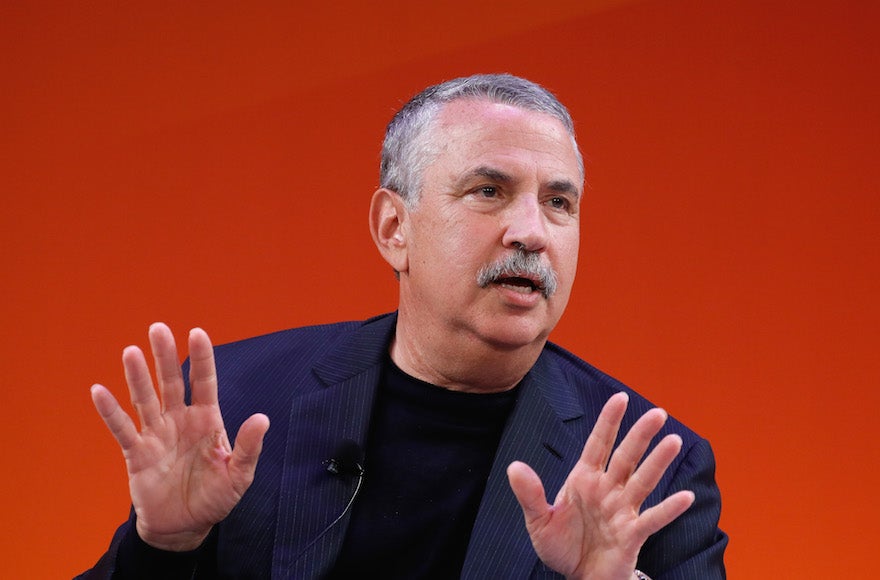
On the opinion side, regular critics of Israel far outnumber its consistent defenders. The former include Friedman, Ezra Klein and Michelle Goldberg, whose criticism often appears to be written from a place of sympathy with a former, more liberal Israel, and contributing opinion writers M. Gessen and Peter Beinart, who have both accused Israel of genocide. All five are Jews.
Meanwhile, Bret Stephens follows in a tradition of right-leaning columnists, also Jewish, who consistently defended Israel, including Rosenthal, William Safire and David Brooks. David French and Russ Douthat, two conservative columnists, also tend to defend Israel when they write about the conflict.
Earlier this year, when Nicholas Kristof wrote a column alleging sexual abuse of Palestinian detainees by Israeli security forces, critics suggested it hadn’t been put to the same journalistic scrutiny as a news story. Nonetheless, the Times defended the reporting, saying that details were fact-checked and corroborated where possible with witnesses and confidants.
Stephens, who rarely criticizes his employer in public, didn’t respond to Kristof’s column. But just nine days later, in a column cataloguing 25 years of what he described as inflammatory or unverified media narratives targeting Israel, he wrote what could be a manifesto for American Jewish critics of Israel coverage.
“The common thread in these and many other stories is that they all involve strenuous, if ultimately embarrassed, efforts to prove that Israelis deliberately seek to kill the innocent and maim the vulnerable, apparently for no other reason than gratuitous cruelty,” wrote Stephens. “This isn’t a matter of reporters’ impartially trying to expose wrongdoing wherever they find it — if that were the case, the errors wouldn’t invariably lean in the same ideological direction. It isn’t speaking truth to power. It’s feeding narratives to the credulous.”
For some Jews, the Times’ coverage of Israel, negative or not, is evidence of the newspaper doing precisely what a great journalism outlet ought to do: scrutinizing the powerful, including a government supported by the United States and deeply connected to American Jewish life.
For others, the same coverage is evidence that the paper has once again failed to understand the Jewish historical experience — particularly the experience of Jews who see Israel’s security as inseparable from their own.
What both sides share is a relationship with The New York Times that can feel both familial and obsessive.
“I think it’s a sense of ownership,” said Goldman, imagining the perception of so many of its Jewish readers: ”’I’m a New York Jew. This is my newspaper, and it should reflect me and my ideas.’”
This article originally appeared on JTA.org.
The post As The New York Times turns 175, the fight over its Israel coverage heats up again appeared first on The Forward.
Uncategorized
Texas wins case forcing Galveston school district to display Ten Commandments posters in classrooms
(JTA) — A Texas judge has ordered a Gulf Coast school district to display posters of the Ten Commandments in all classrooms, marking a victory for the state in a protracted series of legal battles over religious freedom in public education systems.
District Judge Jeth Jones ruled on Thursday that the Galveston Independent School District must comply within 10 days, while also scheduling a non-jury trial to resolve the case next June.
Texas Attorney General Ken Paxton, a Republican, had sued the school district last November after the school board voted against exhibiting the Protestant version of the Ten Commandments. Paxton’s petition argued that the board violated a June 2025 state law, SB10, which required the “conspicuous” display of Ten Commandment posters in all public school classrooms.
That law is at the heart of multiple lawsuits across the state, including one effort led by two rabbis who are seeking to bring a case to the U.S. Supreme Court. Along with non-Jewish clergy and parents, they are arguing that the mandatory inclusion of these texts in classrooms is unconstitutional and infringes upon religious freedom. Their case is separate from the Galveston case.
“These are religious documents,” Mara Nathan, the lead petitioner and senior rabbi at Temple Beth-El in San Antonio, told the Jewish Telegraphic Agency.
“They do not belong in a secular public school space,” she continued. “If people want to be in a school space where religious instruction is part of that, then they can choose to send their kids to parochial school.”
In their case, Nathan and more than two dozen parties are asking the U.S. Supreme Court to weigh in on the controversial Ten Commandments law. Their petition, filed in August, asks the court to protect the religious freedom of students by ensuring that families, rather than politicians, are able to determine what role religion plays in their children’s lives.
Joining Nathan in the case is Joshua Fixler, associate rabbi at Congregation Emanu El in Houston, as well as Jewish, Christian, Hindu, Baha’i, Unitarian Universalist and nonreligious families statewide. The defendants include a long list of school districts, such as the Alamo Heights Independent School District and the Houston Independent School District, where Nathan and Fixler send their children, respectively.
Their decision to petition the Supreme Court is the culmination of a lengthy legal process that began after Gov. Greg Abbott, a Republican, signed the SB10 bill into law in June 2025.
“When I heard about this law, I was really uncomfortable and outraged,” Nathan said. “When I found out there was an opportunity to speak up and be part of litigation to oppose it, I was like, ‘Please sign me up.’”
Fixler echoed these sentiments, with hopes of protecting children from “seeing this Protestant Christian text every day in every classroom, and having it shape their understanding of what religious freedom should look like in America.”
The Jewish and Protestant versions of the commandments differ in wording, order and emphasis, with the Jewish commandments beginning with God’s declaration that he brought the Israelites out of Egypt.
Nathan, Fixler and the other plaintiffs filed a federal lawsuit in July 2025 seeking to block the display at their children’s schools. The next month, they secured a brief victory in district court, when they won a preliminary injunction to block the displays.
Last October, Paxton issued a formal legal advisory to all Texas school districts, reiterating their obligation to exhibit the display. He warned that Texas would vigorously enforce the law, while acknowledging temporary exceptions for 11 school districts that were party to the litigation at the time.
The attorney general described the commandments as “a cornerstone of America’s moral and legal heritage,” stressing a need for “these timeless principles” in schools “now more than ever.”
The pendulum swung in Paxton’s favor in April 2026, when the U.S. Court of Appeals for the 5th District reversed the district court’s ruling. The judges, who sit on one of the most conservative federal appellate courts nationwide, determined that the law does not violate the First Amendment’s free exercise clause, which prohibits government from regulating religious beliefs.
They maintained that the SB 10 law “looks nothing like a historical religious establishment,” a bar that the judges said was set in a 2022 lawsuit. The Texas legislation, they wrote in the ruling, doesn’t “tell churches or synagogues or mosques what to believe or how to worship or whom to employ as priests, rabbis, or imams.”
“It punishes no one who rejects the Ten Commandments, no matter the reason,” they added.
Unwilling to concede defeat, Nathan and her colleagues in August asked the high court to review the case. Whether the Supreme Court will decide to take on the case is still uncertain, as four of its nine justices must agree to do so.
Fixler noted that the law requires posters of the commandments to be big enough to be read anywhere in the classroom and contain no other texts or context.
“I’m hearing from parents all over the state that their kids know that the state is elevating literally one religious tradition over all others,” he said, relating that although he prepared his kids for the displays, they “expressed a lot of anxiety” about needing “to see these words posted on the wall of their classroom.”
Fixler also expressed concern that the prominence of these posters could lead kids to ask “questions that some teachers aren’t going to want to answer,” such as, “What is adultery, and what does it mean to covet your neighbor’s wife?”
The families are represented by the American Civil Liberties Union of Texas, the national ACLU, Americans United for Separation of Church and State and the Freedom From Religion Foundation, with pro bono counsel from the Simpson Thacher & Bartlett law firm.
In their Supreme Court petition, the families accused the appeals court of defying a 1980 Supreme Court decision, Stone v. Graham, which they said “struck down a nearly identical Kentucky statute almost 50 years ago.” While the Texas appellate court had claimed that precedents set in a later case had superseded the Stone ruling, the families argued that the core principles of the Stone judgment were untouched by that later suit.
The forced display of the Protestant Ten Commandments in public school classrooms is not unique to Texas, although the Lone Star State case has emerged as one of the most prominent battlefields for the issue in recent months.
Other states that have required public schools to exhibit the Ten Commandments include Arkansas, Louisiana and Alabama, while Tennessee and North Dakota allow optional displays.
A group of complainants in Arkansas, including one Jewish family, is urging the U.S. Court of Appeals for the Eighth Circuit to block school districts from implementing a state law on the subject. Meanwhile, in Tennessee, the ACLU and other groups have sent letters seeking records relating to school district plans to begin displaying the Ten Commandments.
In Galveston, the school board president told local media on Thursday that the school district would comply with the order, as demanded in the November lawsuit. Alongside the filing, Paxton had declared that “there is no valid legal basis” to prevent schools from complying with the law, claiming that their refusal was rooted in “the misconception that a ‘separation of church and state’ phrase appears in the Constitution.”
“It does not,” Paxton stated.
While Galveston is not party to Fixler and Nathan’s Supreme Court petition, the plaintiffs cited the year-long saga as evidence. The situation in Galveston, the petition argues, demonstrates that “injuries” to families who oppose the Ten Commandments displays “are actual or imminent,” a requirement to hear a case in federal courts.
The attorney general accused Galveston’s school board of voting “to flout SB 10” in its refusal “to display the Ten Commandments in accordance with State law.” At the time, he alleged that Galveston decided to “blatantly ignore the legislature,” while emphasizing that “America is a Christian nation.”
Notably, Fixler and Nathan’s Supreme Court petition flags the Galveston case in its appendix, even though the district is not party to the case. The situation in Galveston, the petition argues, shows that “injuries” to families “are actual or imminent.”
“I hope that the Supreme Court will take our case and rule in our favor,” Nathan said, affirming that any decision made here could set a precedent for similar cases nationwide.
“It would be really exciting to be written into history in a positive way, as part of a movement to really protect our religious freedom and separation between public school spaces and the private religious lives of people,” she added.
This article originally appeared on JTA.org.
The post Texas wins case forcing Galveston school district to display Ten Commandments posters in classrooms appeared first on The Forward.
