


Uncategorized
Israel, Leading Jewish Groups Blast Mamdani for Scrapping Executive Orders Created to Fight Antisemitism

New York City mayor-elect Zohran Mamdani holds a press conference at the Unisphere in the Queens borough of New York City, US, Nov. 5, 2025. Photo: REUTERS/Kylie Cooper
The Israeli government and leading US Jewish groups sharply criticized newly inaugurated New York City Mayor Zohran Mamdani after he used his first day in office on Thursday to revoke a series of executive orders enacted by his predecessor to combat antisemitism, arguing the moves have weakened protections for Jews.
Among the most controversial actions was Mamdani’s decision to revoke New York City’s adoption of the International Holocaust Remembrance Alliance’s (IHRA) working definition of antisemitism, a framework widely used by governments and law enforcement to identify contemporary antisemitic behavior, including some forms of anti-Zionist rhetoric.
Israel’s Foreign Ministry lambasted the move as an invitation for intensified bigotry against Jewish New Yorkers.
“On his very first day as New York City mayor, Mamdani shows his true face: He scraps the IHRA definition of antisemitism and lifts restrictions on boycotting Israel. This isn’t leadership. It’s antisemitic gasoline on an open fire,” the ministry posted on social media on Friday.
IHRA — an intergovernmental organization comprising dozens of countries including the US and Israel — adopted the “working definition” of antisemitism in 2016. Since then, the definition has been widely accepted by Jewish groups and lawmakers across the political spectrum, and it is now used by hundreds of governing institutions, including the US State Department, European Union, and United Nations,
According to the definition, antisemitism “is a certain perception of Jews, which may be expressed as hatred toward Jews. Rhetorical and physical manifestations of antisemitism are directed toward Jewish or non-Jewish individuals and/or their property, toward Jewish community institutions and religious facilities.” It provides 11 specific, contemporary examples of antisemitism in public life, the media, schools, the workplace, and in the religious sphere. Beyond classic antisemitic behavior associated with the likes of the medieval period and Nazi Germany, the examples include denial of the Holocaust and newer forms of antisemitism targeting Israel such as demonizing the Jewish state, denying its right to exist, and holding it to standards not expected of any other democratic state.
The definition could have been problematic for Mamdani, a far-left democratic socialist and avowed anti-Zionist who has made anti-Israel activism a cornerstone of his political career and been widely accused of promoting antisemitic rhetoric. A supporter of boycotting all entities tied to Israel, he has repeatedly refused to recognize Israel’s right to exist as a Jewish state; routinely accused Israel of “apartheid” and “genocide”; and refused to clearly condemn the phrase “globalize the intifada,” which has been used to call for violence against Jews and Israelis worldwide.
Leading members of the Jewish community in New York have expressed alarm about Mamdani’s electoral victory, fearing what may come in a city already experiencing a surge in antisemitic hate crimes.
Beyond the IHRA definition, Mamdani also nullified an order that opposed the campaign to boycott Israel. The boycott, divestment, and sanctions (BDS) movement, which Mamdani openly supports, seeks to isolate Israel from the international community as a step toward its eventual elimination. Leaders of the movement have repeatedly stated their goal is to destroy the world’s only Jewish state.
Mamdani further revoked a directive for the New York City Police Department (NYPD) to review protests near synagogues following contentious demonstrations outside Jewish institutions last year. However, a subsequent executive order from Mamdani included similar instructions to police. The new mayor also committed to continuing the work of the Mayor’s Office to Combat Antisemitism, which was established last year.
In November, hundreds of people amassed outside a prominent New York City synagogue and clamored for violence against Jews. Mamdani issued a statement which “discouraged” the extreme rhetoric used by the protesters but did not unequivocally condemn the harassment of Jews outside their own house of worship. Mamdani’s office notably also criticized the synagogue, with his team describing the event inside as a “violation of international law.” The protesters were harassing those attending an event being held by Nefesh B’Nefesh, a Zionist organization that helps Jews immigrate to Israel, at Park East Synagogue in Manhattan.
The rollbacks were part of a broader action by Mamdani to revoke all executive orders issued by his predecessor, former Mayor Eric Adams, since Sept. 26, 2024, when Adams was indicted for corruption, charges of which have since been dismissed. Mamdani’s office has framed the move as an administrative reset rather than a targeted policy shift, saying the new mayor sought to begin his term with a clean slate.
Leading Jewish groups, including the two main community organizations in New York, rebuked Mamdani for his first steps as mayor.
“Mayor Mamdani pledged to build an inclusive New York and combat all forms of hate, including antisemitism. But when the new administration hit reset on many of Mayor Adams’ executive orders, it reversed two significant protections against antisemitism: the city’s adoption of IHRA and critical protections against the [BDS] movement against the State of Israel,” the statement read.
“While we welcome Mayor Mamdani’s executive order seeking to better protect houses of worship, and his continuation of the Mayor’s Office to Combat Antisemitism, our community will be looking for clear and sustained leadership that demonstrates a serious commitment to confronting antisemitism and ensures that the powers of the mayor’s office are used to promote safety and unity, not to advance divisive efforts such as BDS,” the statement continued. “Singling out Israel for sanctions is not the way to make Jewish New Yorkers feel included and safe, and will undermine any words to that effect. Bringing New Yorkers together and building broad coalitions will be foundational to the mayor’s ability to advance a more inclusive New York. ”
The statement was signed by the UJA-Federation of New York, the Jewish Community Relations Council of New York, the Anti-Defamation League’s office covering New York and New Jersey, the American Jewish Committee’s New York office, the New York Board of Rabbis, Agudath Israel of America, and the Orthodox Union.
Adams also criticized Mamdani’s reversals, saying they dismantle safeguards put in place following a surge in antisemitic incidents.
“@NYCMayor promised a New Era and unity today. This isn’t new. And it isn’t unity,” Adams posted on social media. “I’ve been clear: I will be vocal in defending our Jewish brothers and sisters, just as they stood up for African Americans during the civil rights era.”
New York City is home to the world’s largest Jewish population outside Israel, and its mayor traditionally plays an influential role in US–Israel relations and global Jewish affairs.
Mamdani assumed office amid an alarming surge in antisemitic hate crimes across New York City over the last two years, following the Palestinian terrorist group Hamas’s Oct. 7, 2023, massacre across southern Israel.
Jews were targeted in the majority (54 percent) of all hate crimes perpetrated in New York City in 2024, according to data issued by the NYPD. A new report released on Wednesday by the Mayor’s Office to Combat Antisemitism noted that figure rose to a staggering 62 percent in the first quarter of this year, despite Jewish New Yorkers comprising just 11 percent of the city’s population.
A Sienna Research Institute poll released in early November revealed that a whopping 72 percent of Jewish New Yorkers believe that Mamdani will be “bad” for the city. A mere 18 percent hold a favorable view of Mamdani. Conversely, 67 percent view him unfavorably.
Uncategorized
Why is this chef opening a kosher Israeli restaurant in LA right now?
How do you explain Malka, the new kosher Israeli restaurant in Beverly Hills?
I’m not talking about the food — I haven’t eaten there yet — I’m talking about the fact that it’s opening at all. Why would Eyal Shani — many of whose restaurants worldwide have faced protests, vandalism and physical attacks — dare to open another restaurant at this particularly fraught time?
“The whole situation is leading me to open more, more, more,” Shani told me when we met last week. “That is my reaction as a Jewish man. If they are trying to kill you, you should make a lot of children. And these are my children.”
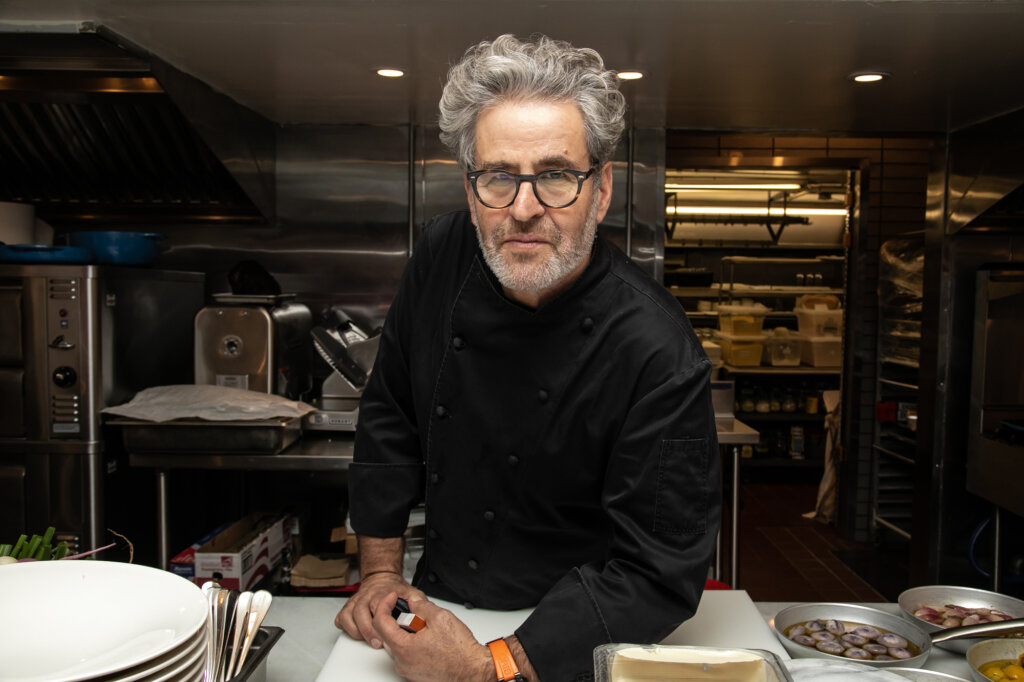
We were sitting in the empty restaurant on the ground floor of the boutique SIXTY Hotel. Shani, who is 67, wore a T-shirt and dark khakis. With his stubbly beard and unruly gray hair, he could pass for an intense, very post-grad philosophy major. He put a plate of farmers market green grapes between us.
The night before, at a pre-opening event for journalists, influencers and, it seemed, models, the same space was packed. Piles of fresh raw vegetables — a Shani signature — filled the long bar counter along with perfect rectangles of toasted focaccia topped with either steak tartare or smoky eggplant caviar. The crowd swelled, the music blared, trays of mojitos and palomas disappeared. It was signature Shani — a frolic of nature, noise and Israeli food.
Now, the large, modern space — a rare high-end restaurant in Los Angeles’ ever-struggling kosher restaurant scene — was quiet. Shani leaned back into an earth-toned banquette and reflected for a moment on how those two words, “Israeli food,” have become so toxic, especially following Oct. 7.
Demonstrators accuse Israeli chefs of passing Palestinian food off as Israeli and of being complicit in their government’s actions. Shani’s business partner, Shahar Segal, did engage in marketing work with the Gaza Humanitarian Foundation, the controversial U.S.-Israeli organization established to feed Gazans. But Israeli restaurants around the world with no such involvements have faced similar protests, as have Jewish-owned restaurants with no ties to Israel.
Malka’s opening follows the closure of Shani’s restaurants Miznon in Melbourne and Gila & Nancy in Berlin, both targeted by mobs chanting anti-Israel slogans.
The rioters in Melbourne entered MIznon, threw chairs, chanted “Death to the IDF!” and only stopped when the two owners of a nearby pizza place — both Lebanese — confronted them.
“In the end, they succeeded to kill the restaurant,” Shani said. “They almost killed our staff there.”
Shani happened to be at the restaurant in Berlin when dozens of protesters surrounded it, shouting, “Stop feeding genocide!”
He raced into the kitchen, put together some food platters and went outside to offer the demonstrators the opportunity to eat and talk.
“They didn’t want to eat,” he said. To them, he added, “Eating from an Israeli is like eating from Satan.”
Shani rejected the charge commonly leveled at Israeli chefs — that they have stolen Palestinian foods and recast them as Israeli.

“I always declare that I took a lot of inspiration from the Palestinians,” he said.
In 1989, Shani opened his first restaurant, Oceanus in Jerusalem. He was 29 and, he said, he knew nothing about food except that he loved bringing people together around it. He wanted to make something like the fresh focaccia an Italian Jewish neighbor once served him. The closest thing to it was the Arabic laffa Shani would buy from a closet-sized bakery in West Jerusalem.
“I had a cook, a Palestinian man from Hebron, a very talented man,” Shani said. “I loved him. He said, ‘Eyal, no problem, my grandmother makes it every day.’ He showed me.”
Shani brushed the finished bread with olive oil and showered it with fresh rosemary.
I told Shani that I ate at the now-closed Oceanus at the tim and to this day remember being served, when we sat down, fragrant sheets of his focaccia-laffa.
“It was a hybrid,” Shani said, “Palestinian, Italian and new Israeli. Each one is getting influenced by the other. You can’t do it with just one brain.”
Malka, a strictly kosher restaurant, presents a different kind of challenge to Shani, who is not an observant Jew. His Michelin-starred Manhattan restaurant Shmone offers, for instance, “A mountain of grilled calamari, okra, tomatoes and yogurt.”
But the chef who turned flour, yeast and water into a hybrid Palestinian-Israeli-Italian flatbread revels in facing constraints like kashrut.
“Each culture leads with its limitations,” he said. “These limitations are a blessing — they’re shaping your creation.”
The kosher stricture against cooking meat together with dairy products didn’t faze him.
“Take me off dairy, put a beautiful bottle of olive oil in front of me — what are the limitations?” he said. “And if there would be no olive oil anymore in the world, I would quit, I would not cook.”
Beyond the kitchen, Shani said he wanted to reach more Israelis with his food. About 70% of Israelis are strictly kosher or prefer it.
“So how can it be that we’re only cooking for the hipsters in Tel Aviv?” Shani said. “It’s unfair.”
The marketplace has rewarded Shani’s ability to combine local ingredients and techniques with creativity and showmanship. The chef has around 70 restaurants — neither he nor his publicist knew the exact number — including Malka’s in Tel Aviv, Miami and New York.
And the backlash isn’t close to stopping him. Shani just announced a new restaurant project in, yes, Melbourne.
“It doesn’t make me frightened,” he said. “It’s the way my personality reacts. I think it’s the instinct of survival. You just keep going.”
The post Why is this chef opening a kosher Israeli restaurant in LA right now? appeared first on The Forward.
Uncategorized
An unvarnished look at Polish Hasidic life before the Holocaust
In the decades before the Holocaust, Warsaw still teemed with Hasidim. Muranowska Street was virtually lined with shtiblekh (prayer and study houses), each with its own dynastic affiliation. But one day, a young man established a new shop on the street and brazenly kept it open on the Sabbath. Modernity had arrived.
Some Hasidim didn’t seem too concerned. As we read in the new English translation of Yechiel Hofer’s Hasidic Warsaw: Reb Zalmen and the Aleksander Shtibl, the protagonist, Reb Zalman, dismissed the whole scandal. The Sabbath, he shrugged, was simply too holy to be violated by people so unworthy. And in truth, Warsaw’s Hasidic enclaves continued to thrive, albeit in a more concentrated form.
Most Yiddish authors assumed the inevitable demise of Jewish tradition. In story after story, we read about pious, aging parents watching helplessly as their sons and daughters reject their ancestors’ ways to become Zionists, revolutionaries, assimilationists and, of course, Yiddish writers. Nobody, it seemed, could hold back the tide of progress.
But many interwar Polish Hasidic leaders were actually galvanized by the challenge of secularization. They launched ambitious, transnational fundraising initiatives, refurbished thousands of heders [traditional primary schools], and built hundreds of Hasidic yeshivas and Bais Yaakov girls’ schools. And as Hofer’s book shows, their shtiblekh recovered and proliferated down to the bitter end.
Hasidic Warsaw is one of the few works of modern Yiddish literature to present Hasidism as something other than moribund. Reminiscent of I.B. Singer’s In My Father’s Court, but more gracious, Hofer’s stories bring us into one corner of this impossibly thriving world: a Warsaw shtibl attended by followers of the Aleksander Rebbe. Reb Zalman, an irritable luftmensch (unemployed dreamer), is the shtibl’s most zealous member and the Hofer family’s most frequent Sabbath guest.
Reb Zalman’s pauper’s arrogance exasperates even his fellow Hasidim, who cannot resist pranking him. They appoint him “Purim Rabbi,” ply him with liquor, and get him to accept bribes. They lure him out of his Hasidic enclave to experience Gentile taunts and glares. Some try to help him gain a livelihood, but he proudly self-sabotages. Their most lucrative scheme, a tavern in the shtibl, fails because Reb Zalman decides to give all the liquor away.
Then there is Reb Zalman’s misogyny. He disdains his kind host, Hofer’s mother, who is “strictly observant, pious and indeed a Hasid in her own right.” She tactfully challenges his prejudices by recounting stories of her Grandmother Brayndl, a passionate follower of a Hasidic group called the Porisover Hasidim, who used to travel regularly to see the Rebbe, Reb Yankev Hersh [and] was deeply respected at the Rebbe’s court.” Yet Reb Zalman scoffs at even the most revered Hasidic women.
Hofer, in short, doesn’t romanticize interwar Hasidism. But he doesn’t dismiss it either. His family’s Sabbath table, he writes, provided even the ungrateful poor with a slice of Heaven. In the Aleksander shtibl, “deep seriousness combined with high-minded joy reigned.” Reb Zalman’s gift for quirky storytelling almost redeemed him in Hofer’s eyes.
Jonathan Boyarin is among the few scholars able to grasp not only the external, quantitative significance of the Polish Hasidic shtibl but its inner life: imperfect men swaying in prayer, chants, and study, occasionally halting to make a toast with vodka and herring or recount another edifying story. Yet Boyarin remains deeply attuned to Hofer’s gentle irony.
Hasidic Warsaw, with its multitude of stories-within-stories, is in a sense a work of collective authorship. We behold a community of storytellers constantly striving to make each other better by means of humorous, cautionary tales. Secularist Yiddish writers drew liberally from such stories, stylizing and serializing them to great acclaim while assuming the demise of the very movement that sustained them. But only physical annihilation could do that.
The reader of Hasidic Warsaw is left with a deep sense of loss. Without storytelling, how can we hope to regain that kind of connectedness? How can future Jewish literature emerge as easily and naturally? In honoring the art of storytelling, Hasidic Warsaw reminds us of yet another world that was lost in the Holocaust.
The post An unvarnished look at Polish Hasidic life before the Holocaust appeared first on The Forward.
Uncategorized
Peter Lorre, decades after ‘Casablanca,’ is the breakout star of ‘Coyote Vs. Acme’
The character actor Peter Lorre died in 1964. The doctor Peter Lorre is alive, quite possibly immortal and has never looked better.
In Coyote Vs. Acme, the long-awaited legal comedy in which Wile E. Coyote sues the mega-corporation behind all his contraption needs for decades of grievous injury, the Good Doctor is seen smuggling evidence outside of Acme labs. Soon thereafter, the company’s security forces him to step into a black hole in the ground that is then rolled up like an old carpet.
As a man who knows too much, he’s a threat to the business.
If it seems strange that the Hungarian-born Jewish performer known for his turn as a child murderer in M and black market peddler Ugarte in Casablanca should be revived as a whistleblower, you may be forgetting his earlier appearances in the Looney canon.
The first was as himself, voiced by Mel Blanc, sitting with a crowd of celebs in Ciro’s nightclub and admiring an oversized bubble covering up a burlesque performer. That short from 1941 scans as uncomfortably close to the house style of the Der Stürmer cartoonists. In subsequent episodes, Lorre was caricatured as a mad scientist, though shrunk down considerably even as his role grew.
In Hair-Raising Hare, Dr. Lorre lures Bugs Bunny into his castle in the hopes of feeding him to the gargantuan red monster Gossamer. (A flashing neon sign on his lair indicates that he is an “Evil Scientist.”) Bugs gets the upper hand by providing a manicure to the tennis-shoed behemoth, jousting him into a tin can and ultimately spooking him by drawing his attention to the fourth wall.
When Daffy Duck tricks his way into Lorre’s suburban home in Birth of a Notion, the diminutive doc tries through a series of booby traps to recover his wishbone for a science experiment. (Stan Freberg voices Lorre in this one.) When Daffy manages his escape, Lorre’s eyes turn toward his dog, Leopold, prompting the pooch to make his exit.
In these treatments Lorre is a lonely, depressive psychopath of the sort Lorre excelled at playing. His revival for 2003’s Looney Tunes: Back in Action reimagined him as a different sort of villain: an underling for the Acme Corporation.
What Coyote Vs. Acme does is revolutionary not just for exploring the liability implications of cartoon case law, but for the redemption it offers Lorre, a kind of fitting tribute to a Hollywood legend whose life and career was cut tragically short by chronic pain and addiction.
This Lorre, who’s had a bit of a glow-up, sacrifices himself to sound the alarm for Acme’s evil R&D methods. It’s an apt arc for a refugee from Nazi Germany, among whose most recognizable work is his role in perhaps the greatest anti-fascist film of all time. While Ugarte takes advantage of refugees desperate for exit visas in Casablanca, the real Lorre helped many flee Europe ahead of World War II, just as cartoon Lorre works on behalf of his fellow toons. (His role as a complicit scientist also recalls his lone directorial effort, The Lost One, in which he plays a Nazi chemist haunted by the war.)
Coyote Vs. Acme’s Lorre also plays piano — not with a disembodied hand — and is revealed to be in a long-lasting — 80-plus years! — marriage with Tweety’s doting owner Granny.
With the film marking the largest-ever opening for Ketchup Entertainment, which snagged the distribution rights after Warner Bros opted to ditch the flick for a tax write-off, it’s too soon to tell if it will herald a Looney Tunes renaissance. However it shakes out, it has singlehandedly upped Peter Lorre representation in the films of 2026.
For those who don’t despise him — or who give him any thought — that’s victory enough.
The post Peter Lorre, decades after ‘Casablanca,’ is the breakout star of ‘Coyote Vs. Acme’ appeared first on The Forward.
