


Uncategorized
She helped rescue the Torahs from their burning synagogue. A year later, Pasadena’s mishkan is thriving.
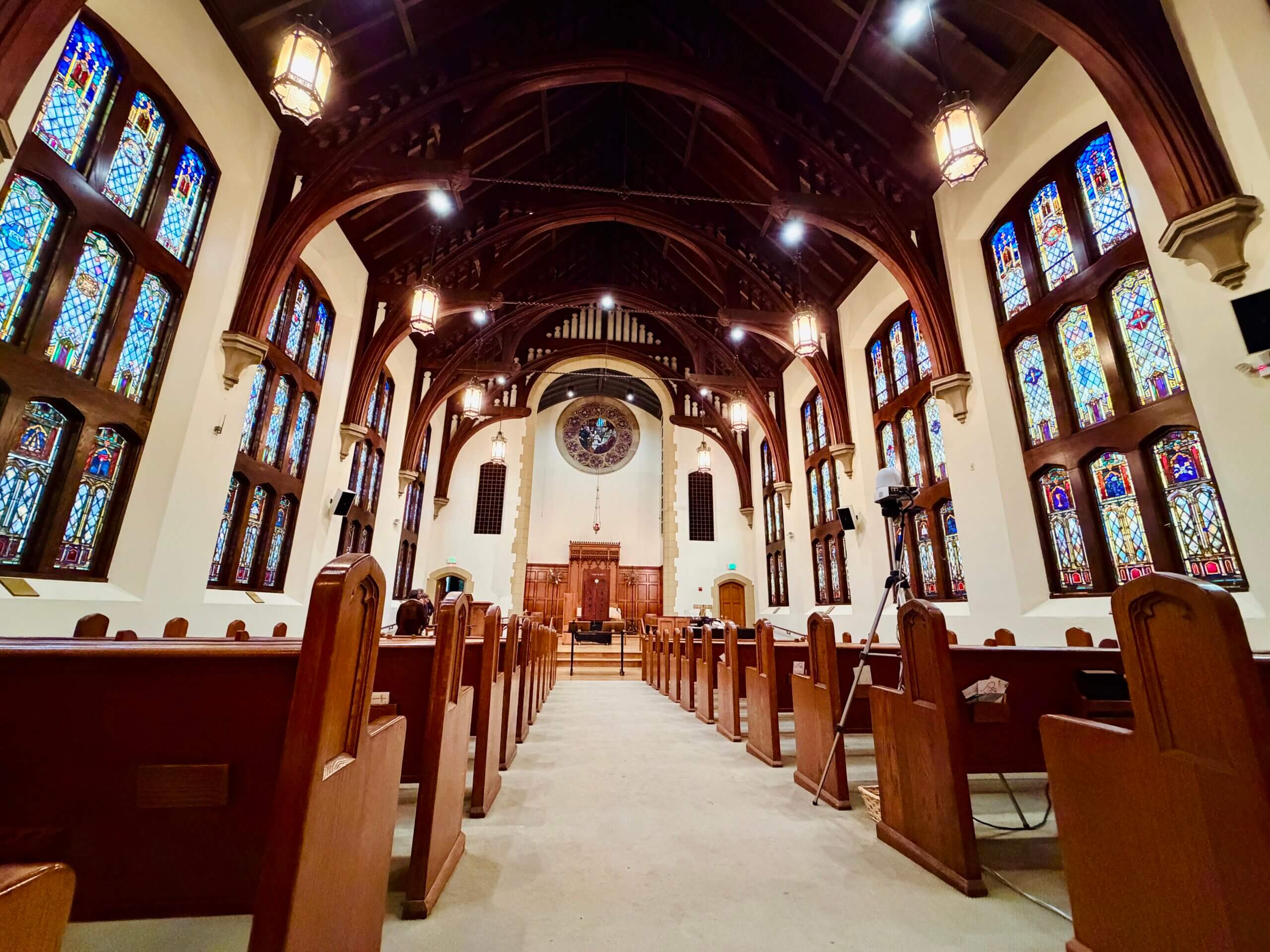
PASADENA — A year after fire reduced the Pasadena Jewish Temple and Center to ash, Cantor Ruth Berman Harris stands in the rain on the empty lot where it once stood. Beneath her boots, the ground is slick; above her, the San Gabriel Mountains fade into fog — the inverse of the dry, wind-driven night when flames tore through this block.
As smoke filled the building, and ash began falling in the parking lot one year ago, Berman searched for her husband through the darkness, calling out to make sure the Torahs were being carried out. Joined by the synagogue’s president and custodian, they worked quickly, loading the 13 scrolls into two cars as the fire, a beast consuming Los Angeles, roared closer. By night’s end, the building was destroyed, the flames claiming it all.
Over the past year, the synagogue has been doing the work of recovery in plain sight and in borrowed space. It has not seen a collapse in membership; as many families have joined since the fire as in the year before it. The calendar has remained full. In 2025, the shul celebrated 25 bar and bat mitzvahs — one nearly every other week — even as services moved to a church chapel across town. And as the community continues to grieve what was lost, leaders are already imagining a rebuilt synagogue designed to better reflect how the congregation lives and gathers now.
For Berman, 55, that rhythm felt familiar.
She grew up in Buenos Aires and lived through two acts of mass violence that targeted the Jewish community there — the 1992 bombing of the Israeli embassy and the 1994 bombing of a Jewish community center, which killed 85 people, including friends of hers. In those moments, she was the one making sandwiches for rescue workers, helping others absorb shock.
The Eaton Fire that razed Pasadena was different.
“What surprised me,” she said, “was how loving and caring and strong and vibrant a community can be in the midst of tragedy. There was no doubt that we were going to be OK.”
Over the past year, she has watched people return to Jewish life who had once drifted away from it — not out of fear, but out of need.
“It surprised me how relevant a Jewish community can be in times of crisis,” she said. “I knew it from books. I had never experienced it.”
Some losses, she knows, cannot be replaced. On her office walls hung artwork painted by her mother. On her desk, a constant presence was a prayer book she had studied from since cantorial school, filled with notes, highlights, and the handwriting of her teachers.
“I can buy another siddur,” she said. “But I can’t replicate their writing.”
She speaks plainly about the trauma. Nightmares. Compartmentalization. What she calls a lockbox she has learned to keep sealed so she can continue doing her job. Only recently, she said, has she begun to feel steady enough to open it — helped by the arrival of a permanent rabbi, and by the knowledge that the community is no longer just surviving.
A temporary sanctuary
Shabbat arrives inside a side chapel at the First United Methodist Church, where the Pasadena Jewish Temple and Center has been gathering since the fire.
During Sukkot, the church opened its courtyard for a sukkah. Shul congregants found themselves explaining the holiday — its temporary walls, its invitation to dwell with uncertainty — to church members who stopped to ask questions. What might once have been an accommodation became, instead, a point of exchange: Jewish ritual practiced openly, and neighbors eager to understand it.
The chapel feels like a sanctuary in its own right. There are no crosses on the walls. The space is rectangular and airy, with wood arches vaulting toward the ceiling like the hull of an inverted ship. Gold-rimmed stained-glass windows run the length of the room on both sides. One of them, inexplicably, bears a purple menorah.
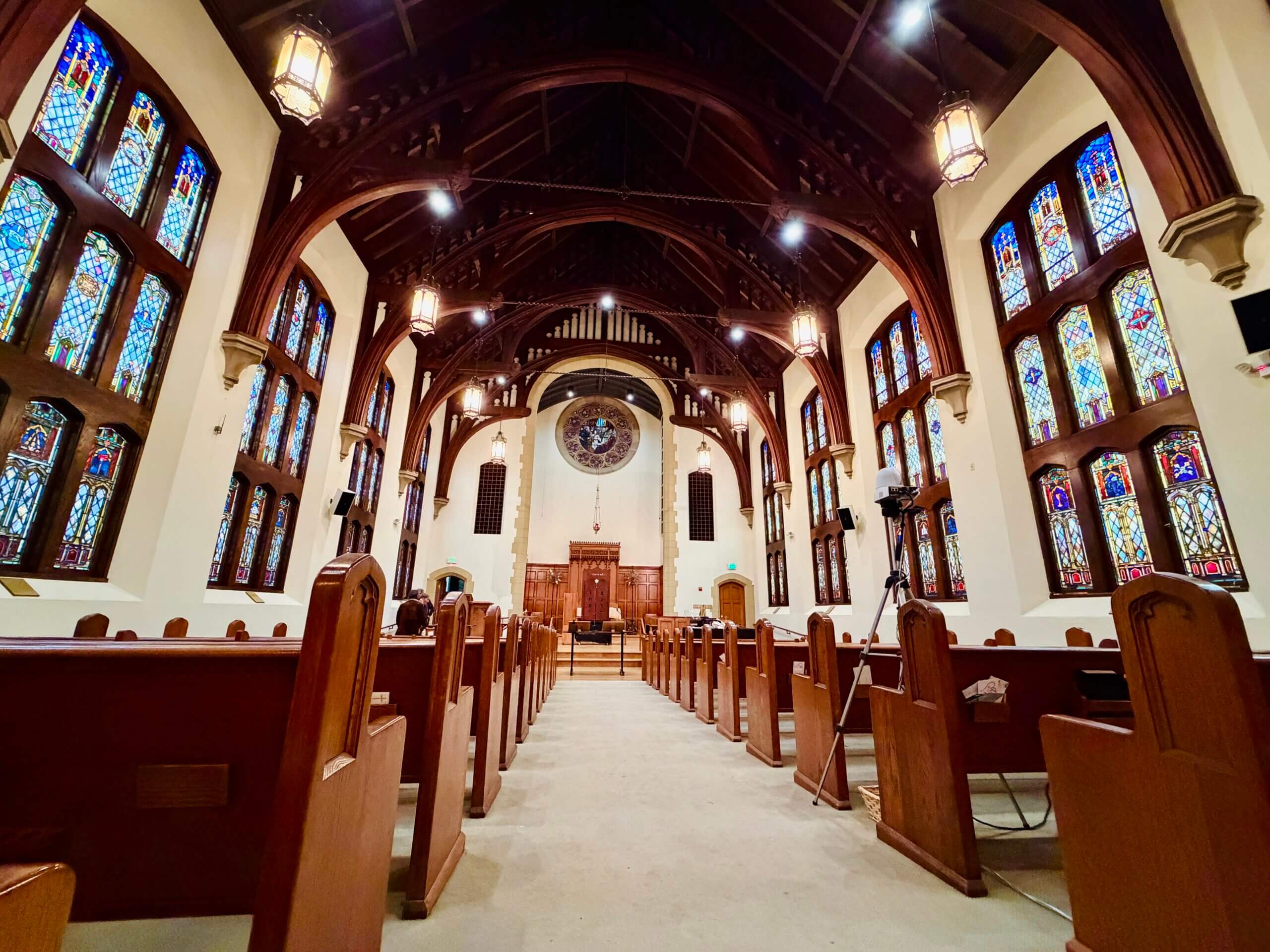
Only small details reveal the building’s Christian life: a New Century Hymnal tucked into the back of each pew, a Bible containing both the Old and New Testaments, a small tithing envelope resting beside it.
About 100 people fill the pews on Saturday morning. At the front of the chapel, Berman and Rabbi Joshua Ratner lead services alongside a bat mitzvah girl, while a guitarist and mandolin player keep the room humming.
The portable ark behind them has an unlikely backstory. It was crafted decades ago by a Los Angeles pediatrician (and father of Forward reporter Louis Keene) who had built it for his own shul which, at the time, was temporarily meeting at a Baptist church.
In recent years, the ark sat unused in the doctor’s garage. After the January 2025 wildfires, the family donated it to Pasadena — carried in and out of the church chapel each week, suddenly suited to a congregation without a permanent home.
For a year now, the Pasadena Jewish Temple and Center has lived this way. “It’s a mishkan,” Ratner said. “A traveling tabernacle.”
As the service continues, Ratner delivers the sermon. He began the job in August, months after the fire, at a moment when the synagogue no longer had a building to offer him — only a congregation in flux.
Ratner, 50, spent his early career as a lawyer before pivoting to the pulpit. He applied for the Pasadena job before the fire, drawn by what he had heard about the community. When the building was destroyed, he thought the search would be called off.
“I assumed that would be the end of it,” he said.
Instead, synagogue leaders doubled down. They wanted a rabbi not after recovery, but in the middle of it.
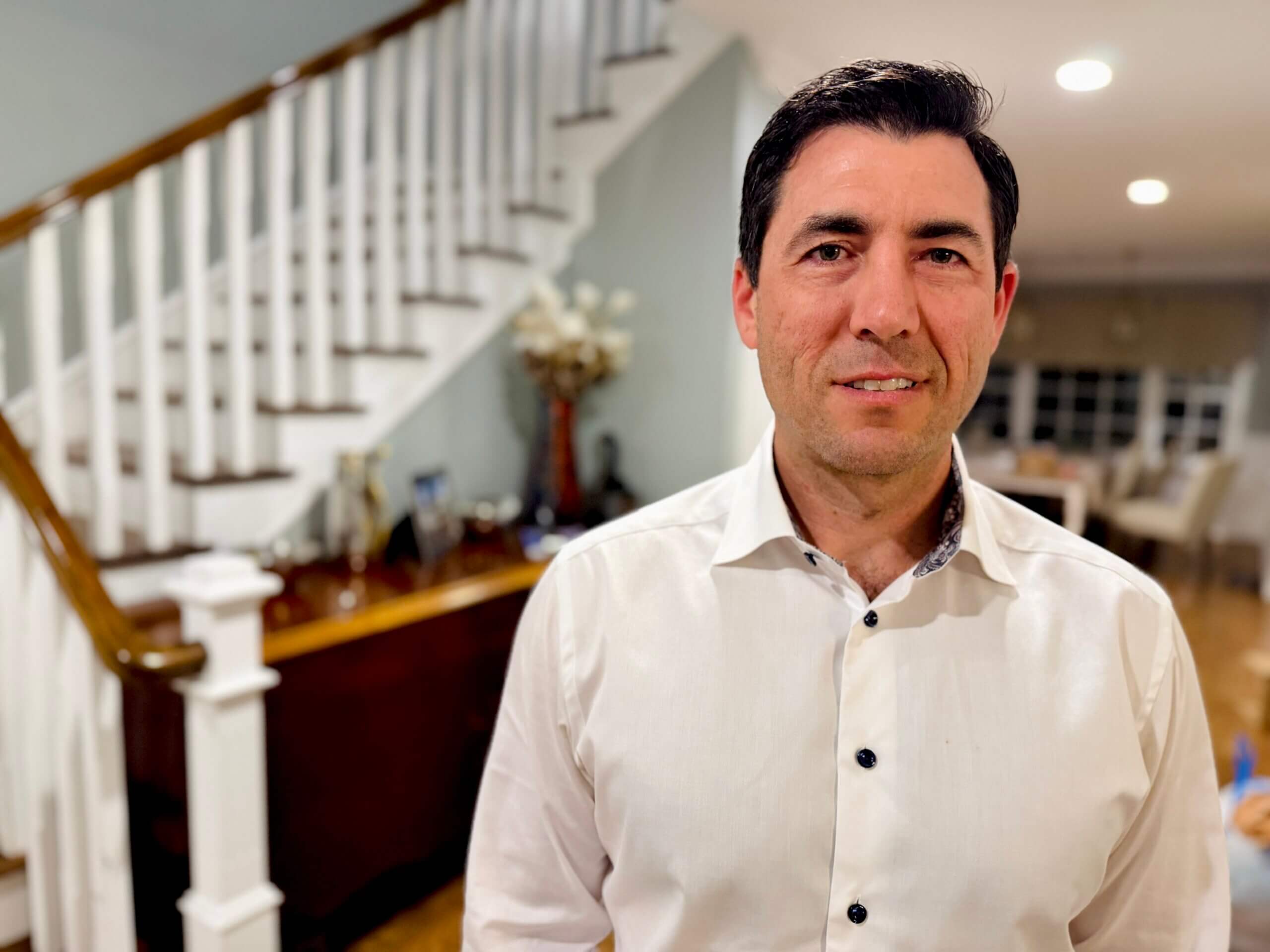
When Ratner visited Pasadena after the fire, he was struck by what he found. Hundreds of people filled Friday night and Shabbat morning services — not out of obligation, but solidarity.
The community, Ratner sensed, was grieving, but not frozen. “There’s no doubt or existential fear,” he said. “While we’re still mourning what we lost, we’re already morphing into the future.”
Since his arrival, the momentum has held. “Every week almost feels new,” Ratner said. “Like a simcha.”
A family without a home
For some of the shul families, the losses were not only communal.
In neighboring Altadena, Heather Sandoval Feng and her husband, Oscar, stand on the front steps of what used to be their home. The fire left behind a pile of rubble and a concrete staircase leading nowhere.
Three weeks after the fire destroyed their house, their daughter Hannah became a bat mitzvah.
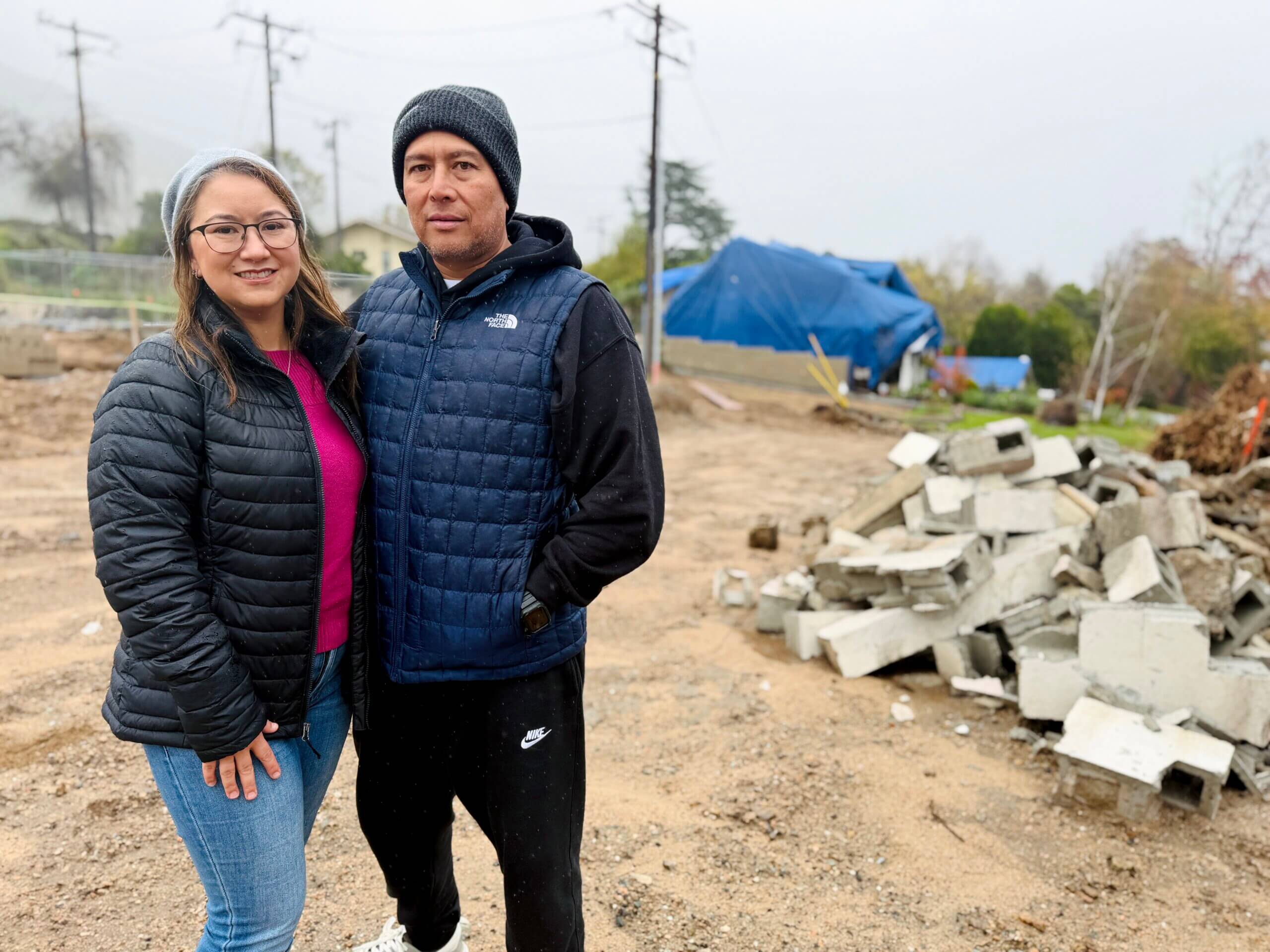
Like the congregation itself, the family was displaced. They moved in with Heather’s parents nearby. Life became provisional — borrowed bedrooms, borrowed routines, borrowed time. And yet Hannah’s bat mitzvah went ahead as planned, held in the church chapel where the Pasadena Jewish Temple and Center now gathers each Shabbat.
“There was something strangely comforting about that,” Heather said. “The synagogue had lost its home. We had lost ours. We were going through it together.”
Oscar described the year as one long exercise in adjustment — learning how to live without the assumption of permanence. “We’ve had to be a little nomadic,” he said, looking over as their son, Noah, 10, played in the dirt where his bedroom once stood.
The bat mitzvah ceremony became a life lesson — not just about Torah, but about continuity without certainty. “It turned into a teachable moment,” Oscar said.
What sustained them, both parents said, was the congregation’s steadiness. Tutors kept showing up. Shabbat kept coming. People checked in — not performatively, but persistently. The synagogue did not treat their family as a separate tragedy. It folded them into its own.
“There was never a question of whether things would still happen,” Heather said. “The answer was always: Of course they will.”
Holding steady and looking ahead
In the months after the fire, synagogue leaders worried about what displacement might do to membership. Instead of a drop-off, the numbers told a different story. Since the fire, the Pasadena Jewish Temple and Center has welcomed 49 new families — roughly the same number it added the year before. A handful of families have moved away, some because of the fire itself, but overall membership has remained remarkably consistent, hovering around 430 families.
An added bonus: Some relatives who flew in from out of town for bar and bat mitzvahs found themselves so moved by the congregation that they later joined it themselves.
What surprised Melissa Levy, the synagogue’s executive director, was not just the endurance, but the momentum behind it. Families kept calling. Local Jews who were not members wanted to now join the congregation.
“It’s amazing,” she said, “but it’s also a testament to how strong this community already was.”
That strength has been built over more than a century.
Founded in 1921 as Temple B’nai Israel, the congregation moved onto its current property in 1941, a campus of Mission Revival–style buildings arranged in a U-shape — a midcentury synagogue just beyond the urban sprawl of Los Angeles that had expanded over decades to include classrooms, playgrounds, and a social hall. At one point, it even had a swimming pool. During World War II, the synagogue hosted USO-style dances for servicemen stationed nearby.
Members have included NASA engineers, Caltech professors, and those who built their dreams among the stars. “I used to joke that growing up in Pasadena, our shul had doctors, lawyers and rocket scientists,” said Rabbi Alex Weisz, whose family has been members for generations.
As Jewish demographics shifted, the congregation absorbed others — merging with Shomrei Emunah and later Shaarei Torah — eventually becoming the singular Conservative synagogue serving the western San Gabriel Valley.
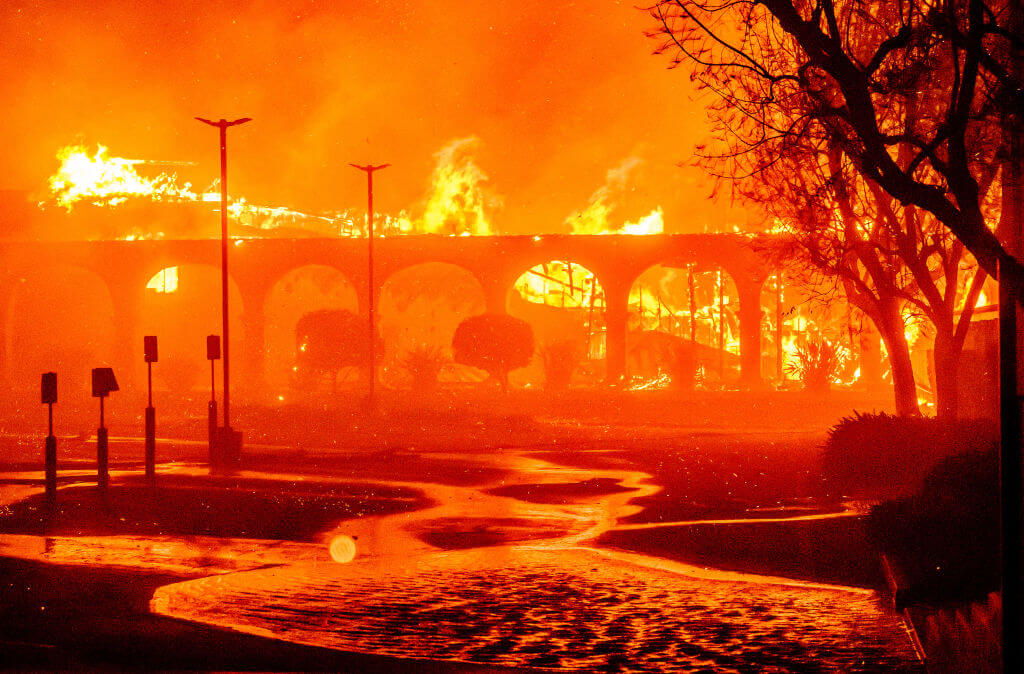
That history now informs the future, and what rises in its place will not be a replica of what was lost. The new building will be more intentional: fewer walls, more flexibility, and spaces designed around how congregants actually spend time together now.
Plans call for open gathering areas where parents can linger when their children are in classes — places to work, talk, or simply stay — rather than treating the synagogue as a drop-off point. There will be more glass and fewer corridors, designed to draw the San Gabriel Mountains into view. Outdoor areas are meant not just for overflow, but for prayer and meditation — quiet spaces that look outward, toward the hills that rise behind Pasadena.
“We were fitting a circle into a square,” Levy said. The new building is being imagined as a place where different generations can overlap rather than pass through on separate schedules.
The goal is not grandeur, but usability. A synagogue that can hold worship and study, celebration and stillness — and that reflects a community that has learned, over the past year, how to gather without relying on walls at all.
The scale of what lies ahead is substantial. Rebuilding is expected to cost tens of millions of dollars. Insurance will cover roughly half of that amount — money that was paid out quickly and is already in an account collecting interest — but the rest will need to be raised by the congregation itself. The cost is immense, especially for middle-class Pasadena, but leaders describe it as something to be faced, not feared.
They hope to open the new building by the High Holidays of 2028 — not as a return to what was lost, but as an expression of what the community has become. For now, those plans exist alongside grief. But Jewish life continues — weekly, seasonally, insistently.
Asked what it feels like to stand at the site of the fire a year later, Cantor Berman pauses.
“I don’t really have words for it,” she said.
Rain dots the cracked pavement beneath her feet, darkening the outline of the lot where the synagogue once stood.
After the fire — after the Torahs had been rescued and the building reduced to rubble — she returned to the site and took one small thing that was still standing. Not a ritual object. Not a book. It was the sign from her parking space — Reserved for the Cantor — something ordinary that had marked the rhythm of returning to the same place, day after day.
There were other losses, she said. Some she remembers clearly. Others she does not.
“The things I don’t remember having,” she said, “will haunt me forever.”
The post She helped rescue the Torahs from their burning synagogue. A year later, Pasadena’s mishkan is thriving. appeared first on The Forward.
Uncategorized
Portuguese artists pull out of Jerry Seinfeld-headlined festival
(JTA) — Several Portuguese artists have dropped out of a comedy festival in Lisbon headlined by Jerry Seinfeld, citing their support for Palestinians and implying opposition to Seinfeld’s support for Israel.
At least six acts over recent days have canceled their appearances at the MEO Commedia a La Carte Fest, a new international comedy festival in the Portuguese capital. The event from Oct. 29 to Nov. 1 has advertised that it will host Seinfeld’s first live appearance in Portugal.
Though none of the artists who withdrew mentioned Seinfeld by name, some hinted at a boycott against his pro-Israel views. The Jewish comedian has become one of Hollywood’s most prominent advocates for Israel since October 2023.
Actress and comedian Inês Aires Pereira announced on Instagram on Saturday that “one of the names” featured at the festival “persistently defends ideas and acts that I consider indefensible,” adding, “We cannot relativize or normalize a genocide.”
The comedy duo Cebola Mol posted a graphic of themselves with a watermelon, widely recognized as a symbol of solidarity with Palestinians. “We will celebrate justice, freedom and joy with you on another occasion,” they said on Instagram.
The festival announced on Friday that performances by the groups Tributo Pop and Conjunto Cuca Monga were also canceled, but did not provide reasons. Two other acts, comedian Pedro Tochas and visual artist Vhils, shared their cancellations on Instagram without further details.
Seinfeld has aligned himself with Israel during its current conflict in Gaza, following decades of largely avoiding commenting on political issues. He visited Israel in December 2023 to meet with the families of hostages seized by Hamas on Oct. 7 of that year. Since then, he has attracted attention for a series of dismissive remarks toward pro-Palestinian advocates.
During an appearance last year at Duke University, Seinfeld compared pro-Palestinian activists with the Ku Klux Klan, saying, “The Klan is actually a little better here because they can come right out and say, ‘We don’t like Blacks, we don’t like Jews.’ OK, that’s honest.”
Representatives of Seinfeld and producers of the MEO Commedia a La Carte Fest did not immediately respond to requests for comment.
The post Portuguese artists pull out of Jerry Seinfeld-headlined festival appeared first on The Forward.
Uncategorized
UK, France, Canada to ban goods from Israeli settlements
(JTA) —
The United Kingdom, France and Canada will ban goods produced in the West Bank settlements and Jewish neighborhoods of East Jerusalem, British Foreign Secretary Ed Miliband told Parliament on Tuesday, explaining that all such communities were deemed by his country to be illegal.
The declaration exacerbated the rising tensions riling the traditionally strong Israel-U.K. alliance. Israeli Foreign Minister Gideon Sa’ar warned that these steps stoked antisemitism against British Jews in an on-camera statement to reporters in Jerusalem.
Sa’ar charged that the measures were a politicized hostile action deliberately taken ahead of Friday’s Jewish New Year holiday, with an eye toward influencing the country’s Oct. 27 elections.
Israel, he said, is responding by closing the British Consulate in Jerusalem that services Palestinians. It will also remove British representatives from the International Gaza Support Center in Kiryat Gat and halt the British training of Palestinian Authority security forces. He added that Israel would bar the entry of 12 British politicians and other nationals involved in anti-Israel activity.
France and Canada have also announced a ban on the import of settlement goods, Miliband told parliament. He noted that the Netherlands, Ireland, Belgium, Spain and Norway have either banned goods or in the process of doing so.
In the same address, Miliband affirmed Israel’s right to exist, reflected on his own Jewish roots and rejected the notion that there was a connection between the policy steps against West Bank settlement activity and the safety of British Jews.
What is motivating the U.K., Miliband said, is “a deep sense of shame about what has unfolded in Palestine under the eyes of the international community” as well as Israel’s “clear intent to bury the Palestinian state.”
In response, he said, the U.K. “will introduce an import ban on goods from illegal settlements in the occupied [Palestinian] territory” as part of a “new comprehensive sanctions regime” that will be put in place within nine months.
This will include, he said, “action against specific companies and individuals who provide services, such as construction, infrastructure, financing or real estate for settlement expansion.”
To those who “finance or facilitate illegal settlements, let me say this, you will face the full force of U.K. sanctions,” Miliband warned.
Miliband clarified that the ban would not affect the export of religious items or life-saving Israeli medications. He explained that trade with the settlements was minimal and that the greater impact would be the sanctions on services.
As part of declaring the ban, Miliband said that the British government is also adopting the International Court of Justice’s 2024 advisory opinion that all Israeli settlement activity over the pre-1967 border was illegal.
But others in Parliament pushed back against Miliband’s declaration. MP Richard Tice of Britain’s right-wing Reform party said that the sanctions were a grave mistake that would “embolden the scourge of antisemitism against British Jews on British streets,” endanger ties with the United States and lead to “tit for tat” sanctions from Israel.
Miliband shot back that “no British Jew is responsible for the policies of the Israeli government and it behooves all of us to make sure that there can be no confusion about that,” saying that Tice’s statement “fell foul” of that goal.
The U.K. action is the latest escalation in tensions between Israel and the Labour-led British government headed by Prime Minister Andy Burnham, who took power in July.
The prior government, led by former Labour Premier Keir Starmer, had already angered Israel by recognizing Palestinian statehood in 2025, suspending licenses for the export of arms to Israel and freezing talks toward a free-trade agreement.
France and Canada are also announcing a ban on the import of settlement goods, Miliband told parliament. He explained that the Netherlands, Ireland, Belgium, Spain, and Norway have either banned goods or in the process of doing so.
In concert with Miliband’s appearance at Parliament, Britain and 11 other countries issued a joint statement pledging “their intention to introduce national and/or support European restrictions on trade in goods with settlements which are illegal under international law.”
Those other countries were Canada, Denmark, Finland, France, Iceland, Ireland, Norway, Poland, Portugal, Spain and Sweden.
The 12-country bloc said it was taking this step to maintain the viability of the two-state resolution to the Israeli-Palestinian conflict, describing the situation in the West Bank as “rapidly deteriorating.”
In its statement, the bloc stressed that it was taking this step amid an “unprecedented level of settler violence and settlement expansion, including the unacceptable decision to publish tenders for the E1 settlement project.” That project is seen as cutting through land that would render a Palestinian state unviable.
The post UK, France, Canada to ban goods from Israeli settlements appeared first on The Forward.
Uncategorized
California Gov. Newsom, a presidential hopeful, slams Netanyahu and AIPAC in PBS interview
(JTA) — California Gov. Gavin Newsom, a 2028 presidential hopeful, ventured farther than ever in his criticisms of Prime Minister Benjamin Netanyahu, in a weekend interview that delved into the Democratic Party’s relationship with Israel.
“I think it’s overwhelmingly opposed to the current regime in Israel,” Newsom said of the party, in a PBS News Hour interview with Amna Nawaz.
Pressed by Nawaz on divisions among his colleagues on Israel, Newsom denied that the subject is “even controversial anymore,” stressing that “the condemnation of what Bibi Netnayahu’s doing is almost universal.” The governor slammed the Israeli military’s conduct in Gaza and condemned the settler violence that has expanded in the West Bank.
“We want a democratic and secure Israel, and we want a secure and democratic Palestinian state as well right next door,” Newsom said, adding that Netanyahu has proved counterproductive to achieving a two-state solution.
Though he repeatedly maintained that Democrats are not divided on Israel, the governor acknowledged that “some of the language” by fellow Democrats “has been weaponized.” Certain “aspects of rhetoric” from individual candidates, he added, are on “the spectrum of concern,” Newsom said.
A number of candidates from the party’s far left place most if not all of the blame on Israel for a war in Gaza that has resulted in tens of thousands of Palestinian deaths. and downplay the role of Hamas in launching the war with the Oct. 7, 2023 raid inside Israel in which 1,200 people were killed and more than 250 were abducted. Newsom’s rhetoric is of a piece with party moderates who are critical of the Israeli government but who call for a secure Israel, reject Hamas and who resist pressure from the left to call Israel’s actions “genocide.”
Newsom nonetheless insisted that the party is unified on the issue. “But I think universally, everyone agrees, even if you don’t think it’s genocide, that it’s been a moral catastrophe,” he said of the war in Gaza. “The vast majority of us also agree about the atrocities on Oct. 7th and how horrific and unacceptable it was, and the terrorism that was perpetrated by Hamas.”
Newsom was among the many U.S. politicians to visit Israel in October 2023, meeting with survivors and families impacted by the attacks.
During a March book tour, Newsom sparked a backlash when he said that some people were referring to Israel “appropriately as sort of an apartheid state.” He quickly walked back these remarks, telling Politico that he had used the term “in the context of the direction that Bibi is going.”
“I revere the state of Israel,” he declared at the time.
The governor warned, however, that if Netanyahu proceeds in the direction of West Bank annexation, apartheid could become “a word you may hear others use.”
In addition to amplifying his condemnation of Netanyahu this weekend, Newsom also addressed the fact that fewer Democrats are accepting funds from political action committees affiliated with the American Israel Public Affairs Committee, the pro-Israel lobbying group.
As for Newsom himself, Track AIPAC, an organization that compiles Federal Election Commission data to flag pro-Israel campaign contributions, did not log any such donations to the likely presidential candidate. But the group did flag him as “pro-Israel.”
“It’s a minority of Democrats that are accepting AIPAC,” the governor said, noting a “dramatic change” over the last couple years.
“The vast majority of Democrats I talk to, even Democrats in the past that have in the past have taken AIPAC money, are pledging not to now,” Newsom added. “That’s more of a mainstream position, interestingly, within the Democratic Party.”
The post California Gov. Newsom, a presidential hopeful, slams Netanyahu and AIPAC in PBS interview appeared first on The Forward.
